Arkansas USDA Newsletter - August 2024
In This Issue:
As we embrace the month of August, I want to take a moment to highlight some important initiatives and programs that our agency has implemented to help support Arkansas’ agriculture community.
One of our primary goals is to reduce barriers for producers seeking financial assistance. We understand the loan application process can be daunting, which is why we are proud to announce the launch of our simplified loan process. These changes are designed to streamline the application process, making it easier for you to access the funding necessary to support your farming operations. Additionally, we encourage you to take advantage of our online loan application system, which allows you to complete your application from the comfort of your home or office.
In addition to our loan programs, I want to remind you about the Noninsured Crop Disaster Assistance Program (NAP). NAP provides vital assistance to producers of non-insurable crops when they experience losses due to natural disasters. This program serves as a safety net for producers, ensuring the ability to recover from unexpected challenges.
Furthermore, the Agriculture Risk Coverage (ARC) and Price Loss Coverage (PLC) programs are still available. These programs provide essential financial protection against market fluctuations, helping to safeguard your operations. If you have not yet enrolled or need assistance, please contact your local USDA service center.
Our goal is to serve all farmers, ranchers, and agricultural partners; equitably; through the delivery of effective and efficient agricultural programs.
 |
As we near the end of the fiscal year, I am proud to reflect on the ways in which our partners and conservation districts have worked diligently with NRCS to promote our programs and help our customers put conservation on the ground. This July, the Clay County Conservation District and NRCS were invited to the Piggott and Rector Public Libraries to provide information to the youth of Clay County at their summer reading programs. Thanks to the Arkansas Game and Fish Commission (AGFC) Conservation Education Grant, materials such as life cycle figurines of different pollinators, wildflower seed, live ladybug eggs, and informational publications could be purchased to help illustrate to the youth and their families the importance of pollinators. Between the two programs, there were nearly 200 attendees! It’s events like these that help generate a passion for conservation in communities so that our programs can make a greater impact statewide. You can learn more about NRCS’s and the Conservation District’s attendance and educational outreach on the libraries’ respective Facebook pages and in the local newspapers.
Regards,
Stephen Smedley
Farmers and ranchers rely on crop insurance to protect themselves from disasters and unforeseen events, but not all crops are insurable through the USDA’s Risk Management Agency. The Farm Service Agency’s (FSA) Noninsured Crop Disaster Assistance Program (NAP) provides producers another option to obtain coverage against disaster for these crops. NAP provides financial assistance to producers of non-insurable crops impacted by natural disasters that result in lower yields, crop losses, or prevents crop planting.
Commercially produced crops and agricultural commodities for which crop insurance is not available are generally eligible for NAP. Eligible crops include those grown specifically for food, fiber, livestock consumption, biofuel or biobased products, or value loss crops such as aquaculture, Christmas trees, ornamental nursery, and others. Contact your local FSA office to see which crops are eligible in your state and county.
Eligible causes of loss include drought, freeze, hail, excessive moisture, excessive wind or hurricanes, earthquake and flood. These events must occur during the NAP policy coverage period, before or during harvest, and the disaster must directly affect the eligible crop. For guidance on causes of loss not listed, contact your local FSA county office.
Interested producers apply for NAP coverage using FSA form CCC-471, “Application for Coverage,” and pay the applicable service fee at the FSA office where their farm records are maintained. These must be filed by the application closing date, which varies by crop. Contact your local FSA office to verify application closing dates and ensure coverage for eligible NAP crops.
At the time of application, each producer acknowledges they have received the NAP Basic Provisions, which describes NAP requirements for coverage. NAP participants must report crop acreage shortly after planting and provide verifiable or reliable crop production records when required by FSA.
Producers are required to pay service fees which vary depending on the number of crops and number of counties your operation is located in. The NAP service fee is the lesser of $325 per crop or $825 per producer per administrative county, not to exceed a total of $1,950 for a producer with farming interests in multiple counties. Premiums also apply when producers elect higher levels of coverage with a maximum premium of $15,750 per person or legal entity.
A producer’s certification on Form CCC-860 Socially Disadvantaged, Limited Resource, Beginning and Veteran Farmer or Rancher Certification may serve as an application for basic NAP coverage for all eligible crops beginning with crop year 2022. These producers will have all NAP-related service fees for basic coverage waived, in addition to a 50 percent premium reduction if higher levels of coverage are elected.
For more detailed information on NAP, download the NAP Fact Sheet. To get started with NAP, we recommend you contact your local USDA service center.
The U.S. Department of Agriculture’s Farm Service Agency (FSA) reminds agricultural producers that Farm Loan Programs can be used to support a variety of climate-smart agriculture practices, which build on many practices that farmers and ranchers already use, like cover cropping, nutrient management and conservation tillage.
Climate-smart agricultural practices generate significant environmental benefits by capturing and sequestering carbon, improving water management, restoring soil health and more. Farm loan funding complements other tools to help producers adopt climate-smart practices, such as FSA’s Conservation Reserve Program, crop insurance options that support conservation, and conservation programs offered by USDA’s Natural Resources Conservation Service (NRCS).
FSA offers multiple types of loans to help farmers and ranchers start, expand or maintain a family agricultural operation. These loans can provide the capital needed to invest in climate-smart practices and equipment including the establishment of rotational grazing systems, precision agriculture equipment or machinery for conversion to no-till residue management. Additionally, for programs like Conservation Reserve Program and NRCS conservation programs where USDA and the producer share the implementation cost, a farm loan could be used for the producer’s share, if consistent with the authorized loan purpose.
Some additional ways farm loans can be leveraged to invest in climate-smart agriculture practices or equipment include:
-
Precision Agriculture Equipment - Eligible producers could use a Term Operating Loan to purchase equipment like GPS globes, monitors, or strip till fertilizer equipment.
-
Cover Crops - Eligible producers could use an Annual Operating Loan for seed costs.
-
No/Reduced Till - Eligible producers could use a Term Operating Loan to purchase equipment.
-
Livestock Facility Air Scrubber or Waste Treatment - Eligible producers could use a Farm Ownership Loan for capital improvements to livestock facilities.
-
Cross Fencing - Eligible producers could use an Annual or Term Operating Loan to purchase fencing and installation equipment.
Visit the Climate-Smart Agriculture and Forestry webpage on farmers.gov to learn more and see detailed examples of how an FSA farm loan can support climate-smart agriculture practices.
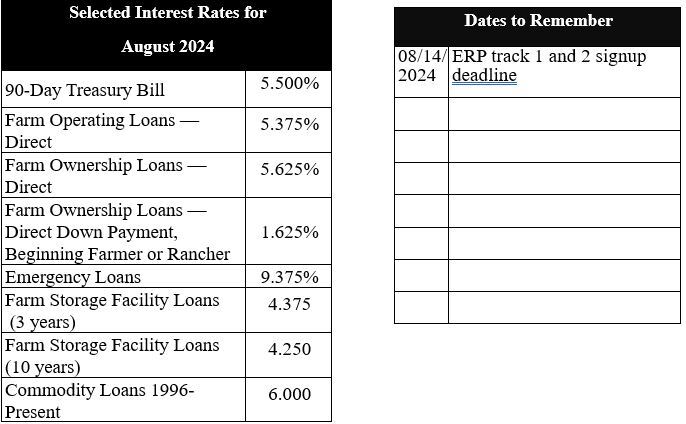
The U.S. Department of Agriculture (USDA) today announced the deadline for commodity and specialty crop producers to apply for the Emergency Relief Program (ERP) for 2022 natural disaster losses is Aug. 14, 2024. USDA’s Farm Service Agency (FSA) began accepting ERP 2022 applications in October 2023.
Background
Through the Disaster Relief Supplemental Appropriations Act, 2023 (P.L. 117-328) Congress allocated $3.2 billion in funding to cover an estimated $10 billion in uncovered crop losses.
ERP 2022 covers losses to crops, trees, bushes and vines due to qualifying calendar year 2022 natural disaster events including wildfires, hurricanes, floods, derechos, excessive heat, tornadoes, winter storms, freeze (including a polar vortex), smoke exposure, excessive moisture, qualifying drought and related conditions.
ERP 2022 Application Process – Track 1
ERP 2022 Track 1 leverages existing federal crop insurance or Noninsured Crop Disaster Assistance Program (NAP) data as the basis for calculating payments for eligible crop producers who received indemnities through these risk management programs.
In fall 2023, FSA began issuing pre-filled ERP 2022 Track 1 application forms to producers who had crop insurance and NAP data already on file with USDA. Receipt of a pre-filled application is not confirmation that a producer is eligible to receive an ERP 2022 Track 1 payment.
ERP 2022 Application Process – Track 2
Track 2 is a revenue-based certification program designed to assist producers who suffered an eligible decrease in revenue resulting from 2022 calendar year disaster events when compared with revenue in a benchmark year using revenue information that is readily available from most tax records.
In cases where revenue does not reasonably reflect a normal year’s revenue, Track 2 provides an alternative method for establishing revenue. Likewise, Track 2 affords producers of crops that are used within an operation and do not generate revenue from the sale of the crop a method for establishing revenue for the purpose of applying for ERP 2022 benefits. Producers are not required to submit tax records to FSA unless requested by the County Committee if required for an FSA compliance spot check.
Although not required when applying for ERP 2022 Track 2, applicants might find the following documents useful to the process:
- Schedule F (Form 1040)
- Profit or Loss from Farming or similar tax documents for tax years 2018, 2019, 2022 and 2023.
Track 2 targets gaps in emergency relief assistance for eligible producers whose eligible losses were not covered by crop insurance or NAP, including revenue losses too small (shallow loss) to be covered by crop insurance.
It’s important to note that disaster-impacted producers may be eligible for ERP 2022 assistance under one or both tracks (ERP 2022 Track 1 and Track 2). To avoid duplicative benefits, if a producer applies for both tracks, the Track 2 payment calculation will take into account any payments received through Track 1.
Additional Required Forms
For both ERP 2022 tracks, all producers must have certain required forms on file with FSA within 60 days of the Aug. 14 application deadline. If not already on file, producers can update, complete and submit required forms to FSA by Tuesday, Oct. 15, 2024.
Required forms:
- Form AD-2047, Customer Data Worksheet.
- Form CCC-902, Farm Operating Plan for an individual or legal entity.
- Form CCC-901, Member Information for Legal Entities (if applicable).
- Form FSA-510, Request for an Exception to the $125,000 Payment Limitation for Certain Programs (if applicable).
- Form CCC-860, Socially Disadvantaged, Limited Resource, Beginning and Veteran Farmer or Rancher Certification, if applicable, for the 2022 program year.
- Note: Currently, there is a Federal court injunction that prohibits USDA from “making or increasing payments, or providing any additional relief, based on its ‘socially disadvantaged farmer or rancher’ designation” under ERP 2022. This may impact certain payments.
- A highly erodible land conservation (sometimes referred to as HELC) and wetland conservation certification (Form AD-1026 Highly Erodible Land Conservation (HELC) and Wetland Conservation (WC) Certification) for the ERP producer and applicable affiliates.
Most producers, especially those who have previously participated in FSA programs, will likely have these required forms on file. However, those who are uncertain or want to confirm the status of their forms can contact their local FSA county office.
Future Insurance Coverage Requirements
All producers who receive ERP 2022 payments must purchase crop insurance, or NAP coverage where crop insurance is not available, in the next two available crop years as determined by the Secretary. Purchased coverage must be at the 60/100 coverage level or higher for insured crops or at the catastrophic coverage level or higher for NAP crops.
More Information
ERP 2022 eligibility details and payment calculation factor tables are available on FSA’s Emergency Relief webpage, in the ERP Track 1 and ERP Track 2 fact sheets and through the FSA at your local USDA Service Center.
There are options for Farm Service Agency (FSA) loan customers during financial stress. If you are a borrower who is unable to make payments on a loan, contact your local FSA Farm Loan Manager to learn about your options.
The Emergency Forest Restoration Program (EFRP) provides technical and financial assistance to owners of nonindustrial private forestland whose forestland was damaged by a qualifying natural disaster event.
EFRP can provide crucial assistance to producers after a natural disaster, but there are a few “myths” about the program that we want to dispel.
Myth: EFRP assists landowners with removal of a dead or damaged tree in their yard.
Fact: EFRP helps with the removal of dead or damaged trees as part of a reforestation project and must be on land that meets the definition of nonindustrial private forestland, is at least 120 feet wide, one acre in size, and at least 10% covered by live trees of any size. If the landowner’s yard does not meet these criteria, then the land is not eligible for EFRP. EFRP requires a landowner to incur at least $1,000 in forest restoration costs to be eligible for assistance. (Minimum restoration costs may be set at a higher level by the FSA State Committee). Finally, eligible forestland must have damage to natural resources caused by the natural disaster event that, if not treated, would impair natural resources on the land and materially affect the future use of the land. For example, damage to natural resources on nonindustrial private forestland could include trees that have died or were damaged by the natural disaster event and where it’s determined that removal and restoration is needed to restore forest health and future use of the land.
To read the full blog visit farmers.gov/blog/myth-busters-learn-facts-about-emergency-forest-restoration-program.
Marketing Assistance Loans (MALs) and Loan Deficiency Payments (LDPs) provide financing and marketing assistance for wheat, feed grains, soybeans, and other oilseeds, pulse crops, rice, peanuts, cotton, wool and honey. MALs provide you with interim financing after harvest to help you meet cash flow needs without having to sell your commodities when market prices are typically at harvest-time lows. A producer who is eligible to obtain a loan, but agrees to forgo the loan, may obtain an LDP if such a payment is available. Marketing loan provisions and LDPs are not available for sugar and extra-long staple cotton.
FSA is now accepting requests for 2024 MALs and LDPs for all eligible commodities after harvest. Requests for loans and LDPs shall be made on or before the final availability date for the respective commodities.
Commodity certificates are available to loan holders who have outstanding nonrecourse loans for wheat, upland cotton, rice, feed grains, pulse crops (dry peas, lentils, large and small chickpeas), peanuts, wool, soybeans and designated minor oilseeds. These certificates can be purchased at the posted county price (or adjusted world price or national posted price) for the quantity of commodity under loan, and must be immediately exchanged for the collateral, satisfying the loan. MALs redeemed with commodity certificates are not subject to Adjusted Gross Income provisions.
To be considered eligible for an LDP, you must have form CCC-633EZ, Page 1 on file at your local FSA Office before losing beneficial interest in the crop. Pages 2, 3 or 4 of the form must be submitted when payment is requested.
Marketing loan gains (MLGs) and loan deficiency payments (LDPs) are no longer subject to payment limitations, actively engaged in farming and cash-rent tenant rules.
Adjusted Gross Income (AGI) provisions state that if your total applicable three-year average AGI exceeds $900,000, then you’re not eligible to receive an MLG or LDP. You must have a valid CCC-941 on file to earn a market gain of LDP. The AGI does not apply to MALs redeemed with commodity certificate exchange.
For more information and additional eligibility requirements, contact your local County USDA Service Center at or visit fsa.usda.gov.
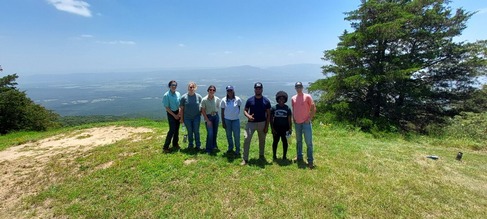 |
Nine interns from across Arkansas NRCS met at Mount Magazine State Park on
July 31st, 2024 for a soil field day. Northwest Area Resource Soil Scientist, Richard Vaught, conducted this training for the fourth year in a row, with last year’s event taking place at Petit Jean State Park. The morning started off with a discussion on core soil science principles that the interns can use throughout their prospective careers, including the five factors of soil formation: time, climate, parent material, topography, and organisms. Soil color and texture are both important properties for interpreting land use and management, and the group worked through exercises examining these characteristics. The day ended with a hike along the rim of Mount Magazine, which allowed for a discussion about how geology effects soil type and land use. Thank you to all everyone that helped organize the event, and to all those that attended.
By Terry J. Cosby, Chief, Natural Resources Conservation Service
All life depends on clean water, and how we manage our land affects surrounding waterbodies. With nearly 40% of U.S. land in farms, agriculture offers a major potential to support water quality improvements nationwide. USDA’s Natural Resources Conservation Service (NRCS) delivers science and data, one-on-one technical support, and cost share opportunities to ensure this potential is realized. Here’s how we support agricultural producers and conservation partners in achieving wins for water quality and working lands.
We provide strategies to improve cropland nutrient management on a field-by-field basis.
When farmers effectively manage nutrients from commercial fertilizer, manure, and other inputs, they minimize the losses of those nutrients from their fields into local waterbodies. While all crops need nutrients to grow and thrive, effective nutrient management is not one-size-fits-all. NRCS works with farmers to achieve SMART Nutrient Management.
A SMART Nutrient Management Plan includes the four Rs of nutrient stewardship we’ve used for years – the right Source, or type of nutrients; the right Method for applying them; the right Rate at which they’re applied; and the right Timing of application – while additionally emphasizing the need for a comprehensive Assessment of site-specific conditions. No two fields have identical histories or plans for production. When farmers work with NRCS to develop a SMART Nutrient Management Plan, our conservationists assess site-specific risks for nutrient and soil loss and offer opportunities to address those risks, all through voluntary measures.
This provides a way to boost crop yields, bottom lines, and water quality benefits all at once. In fact, farmers on average save $30 per acre on land currently receiving excess nutrients by implementing a SMART Nutrient Management Plan with NRCS. This Conservation Outcomes Webinar recording offers a detailed overview of SMART Nutrient Management and the science behind this approach.
We build the science base needed to effectively address nutrients across agricultural landscapes.
Managing nutrients as they’re applied is just one step in supporting water quality improvements. While this is vital, we must also understand and address nutrients that were previously not used by crops. These legacy nutrients may persist for decades in cropland soils and surrounding waterbodies.
Legacy nutrients present a major water quality challenge that can’t be fixed through SMART Nutrient Management alone. Improving conservation outcomes requires targeted, data-driven efforts at multiple scales – within fields, beyond the edges of fields, and across watersheds – to effectively address both current and legacy nutrient sources. Our Conservation Effects Assessment Project (CEAP) plays a key role here.
Through CEAP Watershed Assessments, NRCS works with producers and partners to quantify the outcomes of voluntary conservation in select watersheds nationwide. This blog explains how. CEAP provides data-driven insights to inform delivery of our conservation programs and initiatives and the systems of practices we plan with landowners to manage both current and legacy nutrients in-field and beyond.
Our new USDA Legacy Phosphorus Assessment Project webpage highlights a key example of CEAP efforts to advance the science behind legacy nutrient mitigation to support effective conservation strategies. Legacy phosphorus will be the focus of our next Conservation Outcomes Webinar, scheduled for 2:00 p.m. eastern on August 22. This free, one-hour webinar is open to all and will provide insights that producers and other landowners, conservationists, and researchers may use to more effectively manage for legacy phosphorus to improve water quality nationwide. Visit our Webinar Series webpage for additional details and instructions to join.
We work one-on-one with farmers, ranchers, and forest landowners.
As Chief of USDA’s primary private lands conservation agency, I’m regularly in awe of the power of voluntary conservation to deliver lasting results for our natural resources. Farmers, ranchers, and forest landowners are among the nation’s most dedicated stewards. At NRCS, we’re here to serve them.
The Conservation at Work Video Series features producers and NRCS staff talking about some of our voluntary conservation practices. This includes two-minute videos on conservation crop rotation, cover crop, field border, filter strip, grassed waterway, prescribed grazing, riparian forest buffer, and other practices that support water quality improvements. Systems of conservation practices used together often deliver the greatest benefit. How? This is not something producers have to figure out alone.
I encourage all producers to connect with the NRCS office at their local USDA Service Center. NRCS staff can visit your operation and share one-on-one technical expertise to meet your needs. They may also provide details on our programs, like the Conservation Stewardship Program and Environmental Quality Incentives Program, that deliver cost share to help eligible producers implement systems of NRCS conservation practices.
From small-scale farmers like Maigee Chang, who owns a 2.25-acre farm in Hawaii, to Walt Bones, a retired South Dakotan whose family manages multiple operations, producers nationwide are partnering with NRCS to strengthen their working lands and keep our waters clean. Join them, and us. Together, we will deliver wins for agriculture and water quality through data-driven, voluntary conservation.
The U.S. Department of Agriculture (USDA) has awarded $22 million for 29 selected projects in 36 states that expand access to conservation technical assistance for livestock producers and increases the use of conservation practices on grazing lands. USDA’s Natural Resources Conservation Service (NRCS) is funding the cooperative agreements through its Grazing Lands Conservation Initiative (GLCI), which empowers partners to increase availability of grazing land technical assistance for livestock producers, including historically underserved producers, as well as Native American tribal governments.
Selected projects focus on one or more of the following priorities:
- Addressing local natural resource concerns.
- Using climate-smart agriculture and forestry practices and principles.
- Encouraging existing and new partnerships to advance the resource needs of underserved communities.
- Identifying and implementing strategies to quantify, monitor, report on and verify conservation benefits associated with grazing management systems.
- Utilizing Indigenous Traditional Ecological Knowledge, where applicable.
Projects include:
-
The Wolfe’s Neck Farm Foundation, Inc. plans to expand managed grazing in New England and Eastern New York through partnerships, climate-smart technical assistance and education.
-
Virginia State University plans to provide outreach, training and technical assistance to underserved and veteran ranchers in Virginia on alternative grazing practices and herd management.
-
Rolling Hills Resource Conservation and Development Council, Inc. plans to improve grazing management in Georgia by educating producers in the art and science of grazing and introduce them to the latest technology within the grazing industry.
-
The Valley Stewardship Network plans to continuing momentum in Wisconsin for conservation grazing through farmer-led watershed management initiatives, technical assistance and ecological monitoring.
-
Chico State Enterprises plans to provide technical assistance and workforce development on grazing lands in Northern California. Project activities include working with underserved producers to increase their participation in new and existing grazing coalitions; create a new professional course in Indigenous Traditional Ecological Knowledge (ITEK).
-
National Grazing Lands Coalition plans to expand organizational capacity to support grazing coalitions that create local-grassroots-programs across the nation and on indigenous grazing lands to target local resource concerns.
The full list of projects is available on the GLCI webpage.
More on GLCI
Funded by the Farm Bill, GLCI was developed as a coordinated effort to identify priority issues, find solutions and effect change on private grazing land, enhancing existing conservation programs. NRCS is reviving and revitalizing GLCI to leverage partner capacity, expertise and technical assistance to expand the footprint of well-managed grazing systems across the country.
GLCI also supports the National Grazing Lands Coalition to help state grazing coalitions form and persist with participation from historically underserved producers and Native American tribal governments and organizations.
USDA touches the lives of all Americans each day in so many positive ways. In the Biden-Harris administration, USDA is transforming America’s food system with a greater focus on more resilient local and regional food production, fairer markets for all producers, ensuring access to safe, healthy and nutritious food in all communities, building new markets and streams of income for farmers and producers using climate smart food and forestry practices, making historic investments in infrastructure and clean energy capabilities in rural America, and committing to equity across the Department by removing systemic barriers and building a workforce more representative of America. To learn more, visit usda.gov.
Finding the right risk management fit for your farm can feel overwhelming, especially for specialty crop and small-scale farmers and ranchers. That’s why the USDA’s Risk Management Agency (RMA) created a new searchable directory of crop insurance agents who have experience selling Whole-Farm Revenue Protection (WFRP) and Micro Farm policies.
With 1,135 crop insurance agents listed, providing coverage in all 50 states, the process of finding the “right risk management fit” just got easier.
In addition to the new directory, there are other resources available for specialty crop producers including regional specialists located in each of the RMA regional offices. Feedback is crucial to continually improving risk management options, and specialty crop producers can reach out with suggestions or questions by e-mailing SpecialtyCrops@usda.gov.
Specialty crop and small-scale producers are encouraged to use the new searchable directory and visit the RMA Specialty Crops page.
Whole-Farm Revenue Protection
The first of its kind, WFRP recognizes diversification found on specialty and small-scale farms. With WFRP producers can insure their entire operation including crops, livestock, and nursery production, under one policy. Another advantage of WFRP coverage, is it bridges the insurance gap for several specialty crops that don’t currently have individual policies available.
Micro Farm
Also included in WFRP, the Micro Farm option gives smaller operations more streamlined insurance options. It provides a risk management safety net for all commodities on your farm under one insurance policy. This insurance plan is tailored for any farm with up to $350,000 in approved revenue, including farms with specialty or organic commodities (both crops and livestock), or those marketing to local, regional, farm-identity preserved, specialty, or direct markets.
Top of page
|