
Kiowa County Service Center Updates - August 8, 2024
In This Issue:
LFP (Livestock Forage Program)
Kiowa county is now accepting applications for LFP. We have a livestock inventory worksheet in the office that can be picked up or emailed.
ELAP (Emergency Assistance for Livestock Program)
If you are hauling water or feed to your animals, you may qualify for ELAP. The details are in the below article. Kiowa county triggered for drought according to the US Drought Monitor on August 5, 2024. This program will pay on hauling from August 5, 2024 to December 31, 2024.
Important Dates
August 23, 2024: Deadline to request assistance for ECP (Emergency Conservation Program)
September 2, 2024: Office closed in observance of Labor Day
September 3, 2024: Deadline to purchase NAP coverage for small grains for forage/grazing (wheat, barley, triticale, rye), alfalfa, cool season grasses for grazing
September 30, 2024: Deadline to change shares on ARC/PLC contracts
Sign up for text alerts!
Stay up to date on FSA programs and deadlines by signing up for text alerts.
In a new text message, enter 372669 as the phone number. In the message box, enter OKKIOWA, then press send!
You will receive a confirmation text if successful.
Things to Remember
- Keep your livestock records up to date. A good way to do this is to record your inventory by pastures on your calendar or in a notebook.
- Contact us regarding any records changes - changes to bank accounts, transfer of land to trusts, land ownership changes, new land acquired through lease or purchase, etc.
- If you plant something, report it!
A fire has caused severe damage in eastern areas of the County, starting on CR 2360 moving northwest to CR 2340 and CR 1420.
If you’ve suffered severe damage, you may be eligible for assistance under the Emergency Conservation Program (ECP) administered by the Kiowa County Farm Service Agency (FSA)
For land to be eligible, the natural disaster must create new conservation problems that, if untreated, would:
- be so costly to rehabilitate that Federal assistance is or will be needed to return the land to productive agricultural use
- is unusual and is not the type that would recur frequently in the same area
- affect the productive capacity of the farmland
- impair or endanger the land
If you qualify for ECP assistance, you may receive cost-share levels not to exceed 75 percent of the eligible cost of restoration measures. Eligible socially disadvantaged and beginning farmers and ranchers can receive up to 90 percent of the eligible cost of restoration. No one is eligible for more than $500,000 cost sharing per natural disaster occurrence.
If you’ve suffered a loss from a natural disaster may contact the local FSA County Office and request assistance from July 26 to August 23.
To be eligible for assistance, practices must not be started until all the following are met:
- an application for cost-share assistance has been filed
- the local FSA County Committee (COC) or its representative has conducted an onsite inspection of the damaged area
- the Agency responsible for technical assistance, such as the Natural Resource Conservation Service (NRCS), has made a needs determination, which may include cubic yards of earthmoving, etc., required for rehabilitation
In accordance with the National Environmental Policy Act (NEPA), FSA must complete an environmental compliance review prior to producers taking any actions.
For more information about ECP, contact your Kiowa County USDA Service Center at 580-726-3347 or visit fsa.usda.gov.
|
Top of page
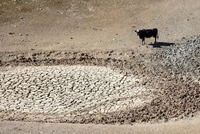
The U.S. Department of Agriculture (USDA) Farm Service Agency (FSA) Executive Director CED Amanda Montgomery in Kiowa County announced that FSA is now accepting applications for the Livestock Forage Disaster Program (LFP) for grazing losses due to drought. The deadline to apply for 2024 LFP assistance is January 30, 2025.
LFP provides compensation to eligible livestock producers who suffered grazing losses for covered livestock due to drought on privately owned or cash leased land or fire on federally managed land. For LFP, qualifying drought intensity levels are determined using the U.S. Drought Monitor. Producers in Kiowa County are eligible to apply for 2024 LFP benefits for grazing losses on native pasture, improved pasture, and crabgrass. Visit the FSA LFP webpage for a full list of eligible counties and pasture types.
Livestock eligible for LFP include alpacas, beef cattle, bison, buffalo, beefalo, dairy cattle, deer, elk, emus, equine, goats, llamas, ostriches, reindeer, or sheep that have been or would have been grazing the eligible grazing land or pastureland. Recently, FSA updated LFP policy to expand program eligibility to include additional income producing grazing animals, like horses and ostrich, that contribute to the commercial viability of an agricultural operation.
Livestock used for hunting and consumption by the owner and horses and other animals that are used or intended to be used for racing and wagering remain ineligible.
As a reminder, producers who want to participate in many USDA programs including disaster assistance programs like LFP, must file timely acreage reports by filling out the FSA-578 form to remain eligible for program benefits. Livestock producers interested in applying LFP should contact Kiowa County FSA at phone with any questions about the eligibility of specific livestock and forage crops.
More information in USDA disaster assistance is available at farmers.gov/recover.
|
USDA’s Farm Service Agency (FSA) reminds drought-impacted producers in State that they may be eligible for assistance through the Emergency Assistance for Livestock, Honey Bees, and Farm-Raised Fish Program (ELAP).
For eligible livestock in qualifying counties, starting August 5th, 2024, ELAP provides financial assistance for:
- the transportation of water to livestock;
- the above normal cost of mileage for transporting feed to livestock; and
- the above normal cost of transporting livestock to forage/grazing acres.* *Hauling livestock both ways starting in 2024, one haul per animal reimbursement and no payment for “empty miles.”
Eligible livestock include cattle, bison, goats and sheep, among others, that are maintained for commercial use and located in a county where qualifying drought conditions occur. A county must have had D2 severe drought intensity on the U.S. Drought Monitor for eight consecutive weeks during the normal grazing period, or D3 or D4 drought intensity at any time during the normal grazing period. Producers must have risk in both eligible livestock and eligible grazing land in an eligible county to qualify for ELAP assistance.
Transporting Water
Producers must be transporting water to eligible livestock on eligible grazing land where adequate livestock watering systems or facilities were in place before the drought occurred and where water transportation is not normally required. ELAP covers costs associated with personal labor, equipment, hired labor, and contracted water transportation fees. Cost of the water itself is not covered. ELAP covers $0.10 per gallon to transport water.
Transporting Feed
ELAP provides financial assistance to livestock producers who incur above normal expenses for transporting feed to livestock during drought. The payment formula excludes the first 25 miles and any mileage over 1,000 miles. The reimbursement rate is 60% of the cost above what would normally would have been incurred during the same time period in a normal (non-drought) year.
Livestock feed that is transported to livestock located on land enrolled in the Conservation Reserve Program (CRP) is eligible if the producer has an approved conservation plan with acceptable grazing practices developed in coordination with the Natural Resources Conservation Service
The payment rate to transport feed is $6.60/ loaded mile for expenses above what would have normally been incurred.
Transporting Livestock
ELAP provides financial assistance to livestock producers who are hauling livestock to a new location for feed resources due to insufficient feed or grazing in drought-impacted areas. As with transporting feed, the payment formula for transporting livestock excludes the first 25 miles and any mileage over 1,000 miles. The reimbursement rate is 60% of the costs above what would normally have been incurred during the same time period in a normal (non-drought) year.
The payment rate to transport livestock is $6.60/loaded mile for expenses above what would have normally been incurred and covers hauling livestock one-way, one haul per animal reimbursement and no payment for “empty miles.”
An online tool is now available to help ranchers document and estimate payments to cover feed and livestock transportation costs caused by drought.
Reporting Losses
Producers should contact FSA as soon as the loss of water or feed resources are known.
For ELAP eligibility, documentation of expenses is critical. Producers should maintain records and receipts associated with the costs of transporting water to eligible livestock, the costs of transporting feed to eligible livestock, the costs of additional feed purchases, and the costs of transporting eligible livestock to forage or other grazing acres.
More Information
Producers interested in ELAP assistance can contact their local USDA Service Center to learn more or to apply for programs.
Top of page
The Farm Service Agency’s (FSA) Farm Storage Facility Loan (FSFL) program provides low-interest financing to help you build or upgrade storage facilities and to purchase portable (new or used) structures, equipment and storage and handling trucks.
Eligible commodities include corn, grain sorghum, rice, soybeans, oats, peanuts, wheat, barley, minor oilseeds harvested as whole grain, pulse crops (lentils, chickpeas and dry peas), hay, honey, renewable biomass, fruits, nuts and vegetables for cold storage facilities, floriculture, hops, maple sap, rye, milk, cheese, butter, yogurt, meat and poultry (unprocessed), eggs, and aquaculture (excluding systems that maintain live animals through uptake and discharge of water). Qualified facilities include grain bins, hay barns and cold storage facilities for eligible commodities.
Loans up to $50,000 can be secured by a promissory note/security agreement, loans between $50,000 and $100,000 may require additional security, and loans exceeding $100,000 require additional security.
You do not need to demonstrate the lack of commercial credit availability to apply. The loans are designed to assist a diverse range of farming operations, including small and mid-sized businesses, new farmers, operations supplying local food and farmers markets, non-traditional farm products, and underserved producers.
For more information, contact your Washita County USDA Service Center at 580-832-3275 or visit fsa.usda.gov/pricesupport.
Top of page
Kiowa County USDA Service Center
800 W 11th St
Hobart, OK 73651
Phone: 580-726-3347
Fax: 855-407-0364
|
| |
|
County Executive Director
Amanda Montgomery
580-726-3347 Ext 2
amanda.montgomery@usda.gov
Farm Loan Manager
Vernon Whitney
580-832-3275
vernon.whitney@usda.gov
|
District Conservationist
Will Brock
580-726-3347 Ext 3
will.brock@usda.gov
District Secretary
edith.brown@usda.gov
kiowaaccd@conservation.ok.gov
|
|
Kiowa County FSA Committee: Kiowa County Conservation District Board:
Dallon Heller, Chairman Mat Braun
Chris Miller, Vice-Chairman Don Payne
Jana Morris, Member Nancy Perrin
FSA Program Analysts: Randy Squires
Zoe Heath Kevin Hart
Deanna Kimble
Chyanne Eastwood
Caitlyn Burnett
|
|
|
|






