
Upcoming Farm Service Agency Program Deadlines:
Ongoing FSA Programs:
County Committee Elections
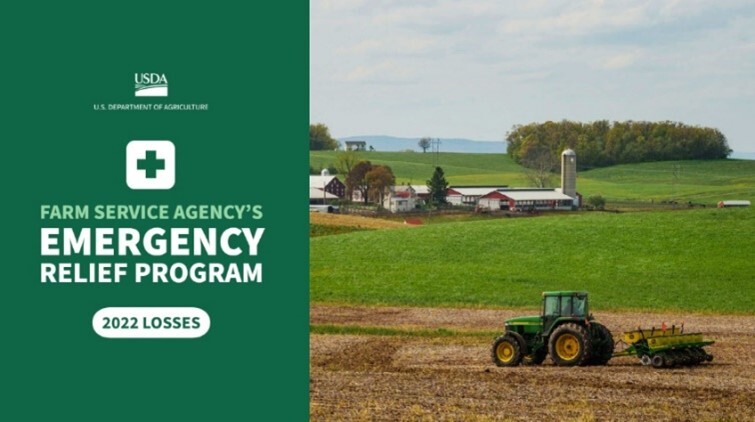
- If natural disasters impacted your farm or ranch in 2022, there’s still time to submit your application for Emergency Relief Program assistance before the Aug. 14 deadline.
- Don’t delay. Gather up your documents and contact your Santa Barbara/Ventura County FSA office at (805) 928-9269 Ext. 2 to complete the application process.
Background
The U.S. Department of Agriculture (USDA) announced the deadline for commodity and specialty crop producers to apply for the Emergency Relief Program (ERP) for 2022 natural disaster losses is Aug. 14, 2024. USDA’s Farm Service Agency (FSA) began accepting ERP 2022 applications in October 2023.
Through the Disaster Relief Supplemental Appropriations Act, 2023 (P.L. 117-328) Congress allocated $3.2 billion in funding to cover an estimated $10 billion in uncovered crop losses.
What losses may be eligible?
ERP 2022 covers losses to crops, trees, bushes and vines due to qualifying calendar year 2022 natural disaster events including wildfires, hurricanes, floods, derechos, excessive heat, tornadoes, winter storms, freeze (including a polar vortex), smoke exposure, excessive moisture, qualifying drought and related conditions.
ERP 2022 Application Process – Track 1
ERP 2022 Track 1 leverages existing federal crop insurance or Noninsured Crop Disaster Assistance Program (NAP) data as the basis for calculating payments for eligible crop producers who received indemnities through these risk management programs.
In fall 2023, FSA began issuing pre-filled ERP 2022 Track 1 application forms to producers who had crop insurance and NAP data already on file with USDA. Receipt of a pre-filled application is not confirmation that a producer is eligible to receive an ERP 2022 Track 1 payment.
ERP 2022 Application Process – Track 2
Track 2 is a revenue-based certification program designed to assist producers who suffered an eligible decrease in revenue resulting from 2022 calendar year disaster events when compared with revenue in a benchmark year using revenue information that is readily available from most tax records.
In cases where revenue does not reasonably reflect a normal year’s revenue, Track 2 provides an alternative method for establishing revenue. Likewise, Track 2 affords producers of crops that are used within an operation and do not generate revenue from the sale of the crop a method for establishing revenue for the purpose of applying for ERP 2022 benefits. Producers are not required to submit tax records to FSA unless requested by the County Committee if required for an FSA compliance spot check.
Although not required when applying for ERP 2022 Track 2, applicants might find the following documents useful to the process:
- Schedule F (Form 1040)
- Profit or Loss from Farming or similar tax documents for tax years 2018, 2019, 2022 and 2023.
Track 2 targets gaps in emergency relief assistance for eligible producers whose eligible losses were not covered by crop insurance or NAP, including revenue losses too small (shallow loss) to be covered by crop insurance.
It’s important to note that disaster-impacted producers may be eligible for ERP 2022 assistance under one or both tracks (ERP 2022 Track 1 and Track 2). To avoid duplicative benefits, if a producer applies for both tracks, the Track 2 payment calculation will take into account any payments received through Track 1.
Additional Required Forms
For both ERP 2022 tracks, all producers must have certain required forms on file with FSA within 60 days of the Aug. 14 application deadline. If not already on file, producers can update, complete and submit required forms to FSA by Tuesday, Oct. 15, 2024.
Required forms:
- Form AD-2047, Customer Data Worksheet.
- Form CCC-902, Farm Operating Plan for an individual or legal entity.
- Form CCC-901, Member Information for Legal Entities (if applicable).
- Form FSA-510, Request for an Exception to the $125,000 Payment Limitation for Certain Programs (if applicable).
- Form CCC-860, Socially Disadvantaged, Limited Resource, Beginning and Veteran Farmer or Rancher Certification, if applicable, for the 2022 program year.
-
Note: Currently, there is a Federal court injunction that prohibits USDA from “making or increasing payments, or providing any additional relief, based on its ‘socially disadvantaged farmer or rancher’ designation” under ERP 2022. This may impact certain payments.
- A highly erodible land conservation (sometimes referred to as HELC) and wetland conservation certification (Form AD-1026 Highly Erodible Land Conservation (HELC) and Wetland Conservation (WC) Certification) for the ERP producer and applicable affiliates.
Most producers, especially those who have previously participated in FSA programs, will likely have these required forms on file. However, those who are uncertain or want to confirm the status of their forms can contact their local FSA county office.
Future Insurance Coverage Requirements
All producers who receive ERP 2022 payments must purchase crop insurance, or NAP coverage where crop insurance is not available, in the next two available crop years as determined by the Secretary. Purchased coverage must be at the 60/100 coverage level or higher for insured crops or at the catastrophic coverage level or higher for NAP crops.
More Information
ERP 2022 eligibility details and payment calculation factor tables are available on FSA’s Emergency Relief webpage, in the ERP Track 1 and ERP Track 2 fact sheets and through the FSA at your local USDA Service Center. Contact the office at (805) 928-9269 Ext. 2 with any questions, or to check if you may be eligible for one or both Tracks.
The Santa Barbara and Ventura County Farm Service Agency is looking for farmers and ranchers to join our County Committee!
Farm Service Agency County committees (COCs) are a critical component of the day-to-day operations of FSA and allow grassroots input and location administration of federal farm programs. Nationwide, more than 7,700 dedicated members of the agricultural community serve on FSA county committees. The committees are made up of three to 11 members who serve three-year terms.
Join us for a webinar to learn all about County Committees. We will be presenting:
- A General Overview of County Committees (COC)
- The Roles of the County Committees
- How to Nominate and Vote.
When is the webinar?
Date: July 31st, 2024
Time: 9:00 AM
Signup at the following link: https://events.gcc.teams.microsoft.com/event/14f1f572-42c9-4366-ba34-71e7f3a171c5@ed5b36e7-01ee-4ebc-867e-e03cfa0d4697
When is the deadline to nominate someone?
County Committee members can nominate themselves or may be nominated by other agricultural producers by August 1, 2024.
To request a nomination form, visit the link Nomination Form FSA-669A (usda.gov) or reach out to the office at (805) 928-9269 Ext. 2.

Use the QR code or the link below to report your damage due to the 2024 Lake Fire. THIS FORM IS NOT AN APPLICATION. This form will be used to collect all necessary information for any future USDA FSA programs that may assist with the wildfires that occurred in year 2024.
Link: https://forms.office.com/g/fcd5yLzzSR
FSA will use the information collected to measure the extent of the damage in the County. Please note that if the extent of the damage is severe enough to necessitate Federal assistance, programs like the Emergency Conservation Program(ECP) could be authorized.
This form is designed to gather essential information related to the 2024 FIRE Damage. Producers are required to document the damage by submitting dated photographs, videos, and third-party verification. Please keep your property tax statement and/or copies of your land lease ready for submission.
It is crucial that you DO NOT commence any work to restore the farmland until the FSA approves a cost-share request.
The Santa Barbara/Ventura County FSA office will provide guidance on the application process and next steps. If you have questions, contact your Santa Barbara and Ventura County USDA Service Center at (805)928-9269 Ext. 2
|
Borrower training is available for all Farm Service Agency (FSA) customers. This training is required for all direct loan applicants, unless the applicant has a waiver issued by the agency.
Borrower training includes instruction in production and financial management. The purpose is to help the applicants develop and improve skills that are necessary to successfully operate a farm and build equity in the operation. It aims to help the producer become financially successful. Borrower training is provided, for a fee, by agency approved vendors. Contact your local FSA Farm Loan Manager for a list of approved vendors.

It’s 1899, and as the world prepares for a new century, railroad tycoon Edward Henry Harriman, along with a large crew, embarks on a two-month expedition to catalog the flora and fauna of the Alaskan coast; Joshua Lionel Cowen invents and patents the electric flash-lamp; and aviation pioneer Wilbur Wright discovers wing warping for aircraft wings.
With the spirit of exploration and invention in the air, Congress recognized the vital role soil surveys play in guiding agricultural development and supporting community planning and resource development. On May 3, 1899, Congress authorized funds for the U.S. Department of Agriculture (USDA) to investigate the soil resources of the United States in the field and laboratory, and the first soil surveys began. By the end of 1899, USDA mapped 720,000 acres and published four separate soil surveys in parts of Maryland, Connecticut, Massachusetts, Utah, and New Mexico.
After 125 years, USDA soil surveyors and partners continue to map soils in new areas, collecting data on what are called static soil properties, or those that change over thousands of years. They also revisit mapped soils to explore dynamic soil properties, such as soil organic carbon and structure, which change within the human timescale. These changes can be from natural factors, like soils eroding during a severe rain event, and human-caused factors, like soils building carbon as a result of good conservation practices.
Our knowledge of soils increases each year as we evolve with new technology, types of field and laboratory equipment, and ideas. Our experience observing, investigating, and researching in the field leads to new standards, methodology, and new and improved products for public use. Traditionally, we have conducted soil surveys on land to determine the best soils for growing corn, building a pond, maintaining wetlands, or supporting roads; however, today, we even conduct soil surveys from specialized boats in coastal zones!
The USDA’s Natural Resources Conservation Service (NRCS) is founded on the need to understand the soil resources of our nation. Data-driven and science-based, we fulfill a legislative mandate to inventory the soil resources and keep the soil survey relevant to ever-changing needs through the National Cooperative Soil Survey (NCSS).
We set standards in classification, mapping, and laboratory procedures with the largest and highest resolution inventory of natural resource data in the world used by our staff for conservation planning, application ranking criteria, and Highly Erodible Land determinations, among other services. The USDA NRCS’ world-renowned Kellogg Soil Survey Laboratory (KSSL) provides data and standards to the international community, as well as for our state conservation staff, supporting conservation activities involving soil health, wetlands, and ecological sites.
How Can Soil Surveys Help You?
Soil data assist farmers, ranchers, foresters, land managers, and conservation planners in effectively managing, conserving, and appraising their most valuable investment—the soil. The data can help determine soil-related hazards or limitations that affect home sites. It can help estimate the potential crop or forage production of a farmer’s land. Soil data can also help determine the suitability of soil for housing areas, onsite sewage disposal systems, pipelines, buildings, landfills, and recreation areas.
The fruits of our labor with soil surveys are visible in the productive soils we walk on, the food we eat, and the air we breathe. We will continue to build upon our 125-year legacy by providing soil data to inform, protect, and sustain future generations.
Visit the NRCS website for more information about soil surveys in your area or to locate your State Soil Scientist. Web Soil Survey is a one-stop shop for free soil information and soil maps, properties, and interpretations. Learn more about NRCS’ Soil Science.
Upcoming Meeting
Santa Barbara/Ventura County FSA Committee Meeting: September 4, 2024, at 8:30 AM.
Questions? Contact Daisy Banda at daisy.banda@usda.gov
If you need to request an accommodation, please contact Daisy Banda at (805) 928-9269 Ext. 2 or daisy.banda@usda.gov, to request accommodations (e.g., an interpreter, translator, seating arrangements, etc.) or materials in an alternative format (e.g., Braille, large print, audiotape – captioning, etc.)
|








