In This Issue:
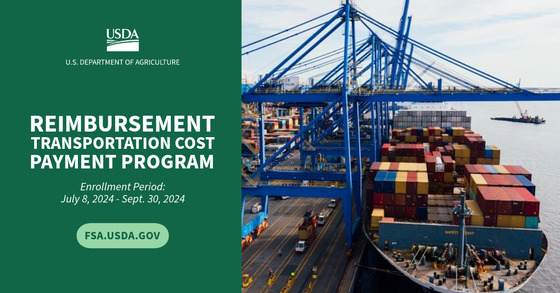
Program Helps Offset Transporting Costs for Farmers and Livestock Producers Outside the Contiguous U.S.
The U.S. Department of Agriculture (USDA) in State opened enrollment for the Reimbursement Transportation Cost Payment Program (RTCP) for fiscal year 2024. The enrollment period began on July 8 and will run through Sept. 30. The deadline for producers to provide supporting documentation is Nov. 1, 2024.
RTCP helps U.S. farmers and ranchers offset a portion of the cost of transporting agricultural products over long distances.
The Consolidated Appropriations Act, 2024 authorized $3.5 million for RTCP and allows farmers and livestock producers in Alaska, Hawaii and insular areas including the Commonwealth of Puerto Rico, Guam, American Samoa, Commonwealth of Northern Mariana Islands, Virgin Islands of the United States, Federated States of Micronesia, Republic of the Marshall Islands and Republic of Palau, to recover costs to transport agricultural commodities or inputs used to produce an agricultural commodity.
Nearly $4 million was issued to more than 1,100 producers, in all eligible areas combined, through the 2023 RTCP.
RTCP payments are calculated based on the costs incurred for transportation of agricultural commodities or inputs during a 12-month period, subject to an $8,000 per producer cap per fiscal year. A higher payment cap may be determined if claims for payments do not exceed available funding. Therefore, applicants are encouraged to submit all eligible receipts. If claims for payments exceed the funds available from the program for a fiscal year, payments will be reduced on a pro-rata basis.
Farmers and livestock producers interested in participating in RTCP can obtain applications and other documents by calling your local USDA FSA Service Center.
To learn more about FSA programs, producers can contact their local USDA Service Center. Producers can also prepare maps for acreage reporting as well as manage farm loans and view other farm records data and customer information by logging into their farmers.gov account. If you don’t have an account, sign up today.
Nominations are now being accepted for farmers and ranchers to serve on local U.S. Department of Agriculture (USDA) Farm Service Agency (FSA) county committees. These committees make important decisions about how federal farm programs are administered locally. All nomination forms for the 2024 election must be postmarked or received in the local FSA office by Aug. 1, 2024.
Elections for committee members will occur in certain Local Administrative Areas (LAA). LAAs are elective areas for FSA committees in a single county or multi-county jurisdiction and may include LAAs that are focused on an urban or suburban area.
Customers can locate their LAA through a geographic information system locator tool available at fsa.usda.gov/elections and determine if their LAA is up for election by contacting their local FSA office.
Agricultural producers may be nominated for candidacy for the county committee if they:
- Participate or cooperate in a USDA program.
- Reside in the LAA that is up for election this year.
A cooperating producer is someone who has provided information about their farming or ranching operation to FSA, even if they have not applied or received program benefits.
Individuals may nominate themselves or others and qualifying organizations may also nominate candidates. USDA encourages minority, women, urban and beginning farmers or ranchers to nominate, vote and hold office.
Nationwide, more than 7,700 dedicated members of the agricultural community serve on FSA county committees. The committees are made up of three to 11 members who serve three-year terms.
Committee members are vital to how FSA carries out disaster recovery, conservation, commodity and price support programs, as well as making decisions on county office employment and other agricultural issues.
You should contact your local FSA office today to register and find out how to get involved in your county’s election, including if their LAA is up for election this year. To be considered, you must be registered and sign an FSA-669A nomination form. This form and other information about FSA county committee elections are available at fsa.usda.gov/elections.
All nomination forms for the 2024 election must be postmarked or received in the local USDA Service Center by the Aug.1, 2024, deadline. Election ballots will be mailed to eligible voters in November 2024.
 Island Harvest's Pūehuehu Farm in Kohala. (Photo courtesy of Hawai‘i Land Trust)
Hawai‘i Land Trust (HILT) and Island Harvest Inc. (Island Harvest) announce the permanent protection of regenerative food producing lands in the Kohala community through the U.S. Department of Agriculture’s Natural Resources Conservation Service (NRCS) Agricultural Conservation Easement Program (ACEP).
The agricultural conservation easement ensures that 28 acres of land will continue to grow healthy food for Hawai‘i’s people and remain available for future generations of farmers. The Island Harvest agricultural easement is the second ACEP project completed under HILT’s partnership with NRCS since November 2020. The partnership provides HILT access to millions of dollars in federal matching funds to protect agricultural lands throughout Hawai‘i. Moreover, it provides opportunities for farmers, ranchers, and potentially in the future, it will allow fishpond stewards to preserve their lands in perpetuity to support food sustainability, community resilience and ecological health.
“NRCS conservation easements have a tremendous footprint in the U.S. at over 5 million acres, or 58,000 square miles enrolled,” said J.B. Martin, director of NRCS in the Pacific Islands Area. “NRCS is the largest easement holder and steward in the nation. We are excited to partner with HILT and Island Harvest in conserving, restoring and protecting Hawaiʻi’s vital wetlands, productive agricultural lands and grasslands.”
ACEP protects the agricultural viability and related conservation values of eligible land by preventing conversion of productive working lands to non-agricultural uses. The program helps restore, conserve or enhance eligible grazing land and wetlands through Agricultural Land Easements (ALE) and Wetland Reserve Easements (WRE). For more, visit ACEP in PIA.
"We are thrilled to finalize the protection of these farmlands with values aligned landowner stewards like Island Harvest," said Lu‘ukia Nakanelua, Manager of ʻĀina Protection of Hawaiʻi Land Trust. "An 1881 Hawaiian language newspaper article published in Ko Hawaii Pae Aina highlighted the rich agricultural history of the lands of Pūehuehu, referencing the traditional lands of ‘keiki mahi ‘uala’ — the lands of the sweet potato farmers where today we hear from generational families of it having been a famed Kohala profession. And as the holder of the agricultural conservation easement, HILT is humbled by Island Harvest’s commitment to forever protect and secure the true value in which the land holds—the ability to grow healthy food and respectable jobs for Kohala’s families.”
Founded by Jim Trump, a long-time Kohala resident, Island Harvest transitioned old sugar cane plantation lands into organic and regenerative macadamia nut farming, enabling generations of local Kohala families to maintain respectable agricultural jobs. After operating on year-to-year leases for over 30 years, in 2020, Island Harvest purchased the subject 28-acre parcel to expand into diversified agriculture, all while maintaining a team where 80% of its crew is born and raised in Kohala.
Today, Island Harvest grows approximately 5 acres of ‘ulu and 11 acres of citrus and macadamia nuts on the parcel, with farm activity structures limited to less than half an acre. Island Harvest reinvests 100% of the profits of its value-added products with 50% reinvested back into regenerative farming practices, 25% reinvested back into the Kohala community and organizations, and 25% shared with its employees.
It’s no secret that Hawaiʻi has some of the highest agricultural land costs in the nation, facing direct and continuous threats of land use conversion and fragmentation of agricultural lands. At the root of high land costs is partly the way it's valued by the maximum and best use of land, steering us away from a reality where land is truly valued for its ability to grow healthy food for people in a manner that is also healthy for the ecosystem.
Since 2007, conservation easements have been explored as a solution in Hawaiʻi to aid the preservation of land in perpetuity, in this case, for its agricultural use and value. Held by a land trust or sometimes a government agency like NRCS, conservation easements are voluntary commitments by landowners to permanently remove or limit development rights, subdivision rights, and commercial use of their private property. And this commitment is compensated via a cash purchase of the value of the rights removed from the land forever, a value donation of such, or a mix of a cash and value donation. The removal of such rights via a conservation easement effectively resets the maximum and best use of the property, putting money back into the landowner’s pocket helping to offset the cost of the land, farm expenses, a mechanism to hopefully make the realities of farming in Hawaiʻi just a little easier. And in the case of the Pūehuehu lands of Kohala, this conservation easement is another step to also help ensure the integrity and rural character of the Kohala community remains intact.
Being a faithful steward of the land and Kohala’s way of life is a core part of Island Harvest’s business values and practices. "Island Harvest is excited to collaborate with HILT and NRCS. This farming parcel, located at the makai end of Union Mill Road, has high quality soil and receives sunlight and rainfall sufficient to successfully grow a variety of orchard crops. Orchard establishment takes time and funding to do it right. We look forward to sharing our success and learning from our challenges as we farm this potentially productive land," said Jim Trump, President of Island Harvest.
In addition to NRCS, the Freeman Foundation, Ulupono Initiative, and other individual donors generously provided funding to purchase the agricultural conservation easement.
About Hawai‘i Land Trust Hawai‘i Land Trust (HILT) is Hawaiʻi’s local statewide nonprofit land trust that protects and stewards the lands that sustain Hawaiʻi, and connects people to the land through education, public access, and cultural practice. Over the past decade, the nationally accredited land trust has protected over 22,500 acres across the islands through land purchases and conservation easements, protecting Hawaiʻi’s coastlines, cultural landscapes, and lands that grow food. For more, visit HILT.org.
About Island Harvest Founded in 1991 as a response to helping to manage Kohala’s agricultural lands into the post-sugar era, Island Harvest is a steward of the lands it cultivates, building healthy soils and reinvesting 100% of profits from its products into regenerative agriculture, programs and organizations supporting the people of Kohala, and giving back to its employees and farmers, those who call Kohala home. For more, visit https://islandharvesthawaii.com/.
The U.S. Department of Agriculture (USDA) today announced the deadline for commodity and specialty crop producers to apply for the Emergency Relief Program (ERP) for 2022 natural disaster losses is Aug. 14, 2024. USDA’s Farm Service Agency (FSA) began accepting ERP 2022 applications in October 2023.
Through the Disaster Relief Supplemental Appropriations Act, 2023 (P.L. 117-328) Congress allocated $3.2 billion in funding to cover an estimated $10 billion in uncovered crop losses.
ERP 2022 covers losses to crops, trees, bushes and vines due to qualifying calendar year 2022 natural disaster events including wildfires, hurricanes, floods, derechos, excessive heat, tornadoes, winter storms, freeze (including a polar vortex), smoke exposure, excessive moisture, qualifying drought and related conditions.
ERP 2022 Application Process – Track 1
ERP 2022 Track 1 leverages existing federal crop insurance or Noninsured Crop Disaster Assistance Program (NAP) data as the basis for calculating payments for eligible crop producers who received indemnities through these risk management programs.
In fall 2023, FSA began issuing pre-filled ERP 2022 Track 1 application forms to producers who had crop insurance and NAP data already on file with USDA. Receipt of a pre-filled application is not confirmation that a producer is eligible to receive an ERP 2022 Track 1 payment.
ERP 2022 Application Process – Track 2
Track 2 is a revenue-based certification program designed to assist producers who suffered an eligible decrease in revenue resulting from 2022 calendar year disaster events when compared with revenue in a benchmark year using revenue information that is readily available from most tax records.
In cases where revenue does not reasonably reflect a normal year’s revenue, Track 2 provides an alternative method for establishing revenue. Likewise, Track 2 affords producers of crops that are used within an operation and do not generate revenue from the sale of the crop a method for establishing revenue for the purpose of applying for ERP 2022 benefits. Producers are not required to submit tax records to FSA unless requested by the County Committee if required for an FSA compliance spot check.
Although not required when applying for ERP 2022 Track 2, applicants might find the following documents useful to the process:
- Schedule F (Form 1040)
- Profit or Loss from Farming or similar tax documents for tax years 2018, 2019, 2022 and 2023.
Track 2 targets gaps in emergency relief assistance for eligible producers whose eligible losses were not covered by crop insurance or NAP, including revenue losses too small (shallow loss) to be covered by crop insurance.
It’s important to note that disaster-impacted producers may be eligible for ERP 2022 assistance under one or both tracks (ERP 2022 Track 1 and Track 2). To avoid duplicative benefits, if a producer applies for both tracks, the Track 2 payment calculation will take into account any payments received through Track 1.
Additional Required Forms
For both ERP 2022 tracks, all producers must have certain required forms on file with FSA within 60 days of the Aug. 14 application deadline. If not already on file, producers can update, complete and submit required forms to FSA by Tuesday, Oct. 15, 2024.
Required forms:
- Form AD-2047, Customer Data Worksheet.
- Form CCC-902, Farm Operating Plan for an individual or legal entity.
- Form CCC-901, Member Information for Legal Entities (if applicable).
- Form FSA-510, Request for an Exception to the $125,000 Payment Limitation for Certain Programs (if applicable).
- Form CCC-860, Socially Disadvantaged, Limited Resource, Beginning and Veteran Farmer or Rancher Certification, if applicable, for the 2022 program year.
-
Note: Currently, there is a Federal court injunction that prohibits USDA from “making or increasing payments, or providing any additional relief, based on its ‘socially disadvantaged farmer or rancher’ designation” under ERP 2022. This may impact certain payments.
- A highly erodible land conservation (sometimes referred to as HELC) and wetland conservation certification (Form AD-1026 Highly Erodible Land Conservation (HELC) and Wetland Conservation (WC) Certification) for the ERP producer and applicable affiliates.
Most producers, especially those who have previously participated in FSA programs, will likely have these required forms on file. However, those who are uncertain or want to confirm the status of their forms can contact their local FSA county office.
Future Insurance Coverage Requirements
All producers who receive ERP 2022 payments must purchase crop insurance, or NAP coverage where crop insurance is not available, in the next two available crop years as determined by the Secretary. Purchased coverage must be at the 60/100 coverage level or higher for insured crops or at the catastrophic coverage level or higher for NAP crops.
More Information
ERP 2022 eligibility details and payment calculation factor tables are available on FSA’s Emergency Relief webpage, in the ERP Track 1 and ERP Track 2 fact sheets and through the FSA at your local USDA Service Center.
 If you are a grazing or forest landowner or manager, you may be asked this summer to participate in a survey designed to help the Natural Resources Conservation Service (NRCS) improve the financial and technical services it offers grazing and forest landowners.
A joint project between NRCS and the National Agricultural Statistics Service (NASS), the Conservation Practice Adoption Motivations Survey (CPAMS) is aimed at understanding why people choose to use or not use different conservation practices.
“By responding to this survey, you also help document the ongoing stewardship of America’s agricultural producers and forest land managers,” said NRCS Chief Terry Cosby.
NASS began surveying more than 40,000 grazing and forest operations in June 2024. Respondents are encouraged to participate online but may also respond through the mail or by sending a fax. You can learn more about CPAMS by watching this short video.
Learn More about CPAMS
The U.S. Department of Agriculture (USDA) is expanding the Food Safety Certification for Specialty Crops (FSCSC) program to now include medium-sized businesses in addition to small businesses. Eligible specialty crop growers can apply for assistance for expenses related to obtaining or renewing a food safety certification. The program has also been expanded to include assistance for 2024 and 2025 expenses. Producers can apply for assistance on their calendar year 2024 expenses beginning July 1, 2024, through Jan. 31, 2025. For program year 2025, the application period will be Jan. 1, 2025, through Jan. 31, 2026.
Program Details
FSCSC assists specialty crop operations that incurred eligible on-farm food safety certification and expenses related to obtaining or renewing a food safety. FSCSC covers a percentage of the specialty crop operation’s cost of obtaining or renewing its certification, as well as a portion of related expenses.
Eligible FSCSC applicants must be a specialty crop operation; meet the definition of a small or medium-size business and have paid eligible expenses related to certification.
- A small business has an average annual monetary value of specialty crops sold by the applicant during the three-year period preceding the program year of no more than $500,000.
- A medium size business has an average annual monetary value of specialty crops the applicant sold during the three-year period preceding the program year of at least $500,001 but no more than $1,000,000.
Specialty crop operations can receive the following cost assistance:
- Developing a food safety plan for first-time food safety certification.
- Maintaining or updating an existing food safety plan.
- Food safety certification.
- Certification upload fees.
- Microbiological testing for products, soil amendments and water.
FSCSC payments are calculated separately for each eligible cost category. Details about payment rates and limitations are available at farmers.gov/food-safety.
Applying for Assistance
Interested applicants have until Jan. 31, 2025, to apply for assistance for 2024 eligible expenses. FSA will issue payments as applications are processed and approved. For program year 2025, the application period will be January 1, 2025, through January 31, 2026. FSA will issue 50% of the calculated payment for program year 2025 following application approval, with the remaining amount to be paid after the application deadline. If calculated payments exceed the amount of available funding, payments will be prorated.
Specialty crop producers can apply by completing the FSA-888-1, Food Safety Certification for Specialty Crops Program (FSCSC) for Program Years 2024 and 2025 application. The application, along with the AD-2047, Customer Data Worksheet and SF-3881, ACH Vendor/Miscellaneous Payment Enrollment Form, if not already on file with FSA, can be submitted to the FSA office at any USDA Service Center nationwide by mail, fax, hand delivery or via electronic means. Alternatively, producers with an eAuthentication account can apply for FSCSC online. Producers interested in creating an eAuthentication account should visit farmers.gov/sign-in.
Specialty crop producers can also call your FSA County office to to speak directly with a FSA employee ready to assist. Visit farmers.gov/food-safety for additional program details, eligibility information and forms needed to apply.
More Information
To learn more about FSA programs, producers can contact their local USDA Service Center. Producers can also prepare maps for acreage reporting as well as manage farm loans and view other farm records data and customer information by logging into their farmers.gov account. Producers without an account can sign up today.
Farm Operating - Direct 5.500%
Farm Operating - Microloan 5.500%
Farm Ownership - Direct 5.750%
Farm Ownership - Microloan 5.750%
Farm Ownership - Direct, Joint Financing 3.750%
Farm Ownership - Down Payment 1.750%
Emergency Loan - Amount of Actual Loss 3.750%
Effective as of July 1, 2024
July 22, 2024 - Kauai County deadline to sign up for Emergency Conservation Program to address damages from April 2024 Kona storm
August 1, 2024 - Deadline to submit nomination packets for the County Committee Election for applicable LAA's
August 14, 2024 - Deadline to apply for 2022 Emergency Relief Program (ERP)
September 30, 2024 - Deadline to apply for the Reimbursement Transportation Cost Payment Program for fiscal year 2024
October 31, 2024 - Deadline to apply for the Organic Certification Cost Share Program
November 1, 2024 - Deadline to submit documentation for the Reimbursement Transportation Cost Payment Program for fiscal year 2024.
January 30, 2025 - Deadline to apply for 2024 Livestock Forage Disaster Program for Guam, Rota, Saipan, Tinian, Maui and Hawaii County
|








