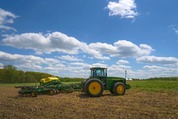
Agricultural producers who have not yet completed their crop acreage reports after spring planting should make an appointment with the Taylor / Green County Farm Service Agency (FSA) before the applicable deadline.
An acreage report documents a crop grown on a farm or ranch, its intended use and location. Filing an accurate and timely acreage report for all crops and land uses, including failed acreage and prevented planted acreage, can prevent the loss of benefits.
How to File a Report
The following acreage reporting dates are applicable in Taylor and Green County:
July 15, 2024 Perennial Forage, All Other Crops, and CRP
To file a crop acreage report, producers need to provide:
- Crop and crop type or variety
- Intended crop use
- Number of crop acres
- Map with approximate crop boundaries
- Planting date(s)
- Planting pattern, when applicable
- Producer shares
- Irrigation practice(s)
- Acreage prevented from planting, when applicable
- Other required information
Acreage Reporting Details
The following exceptions apply to acreage reporting dates:
- If the crop has not been planted by the acreage reporting date, then the acreage must be reported no later than 15 calendar days after planting is completed.
- If a producer acquires additional acreage after the reporting date, then the acreage must be reported no later than 30 calendar days after purchase or acquiring the lease. Appropriate documentation must be provided to the county office.
Noninsured Crop Disaster Assistance Program (NAP) policy holders should note that the acreage reporting date for NAP-covered crops is the earlier of the dates listed above or 15 calendar days before grazing or crop harvesting begins.
Prevented Planted Acreage
Producers should also report crop acreage they intended to plant but were unable to because of a natural disaster, including drought. Prevented planted acreage must be reported on form CCC-576, Notice of Loss, no later than 15 calendar days after the final planting date as established by FSA and USDA’s Risk Management Agency (RMA).
FSA recently updated policy that applies to prevented planted acreage due to drought. To certify prevented planted acreage due to drought, all of the following must apply:
- The area that is prevented from being planted has insufficient soil moisture for seed germination on the final planting date for non-irrigated acreage.
- Prolonged precipitation deficiencies that meet the D3 or D4 drought intensity level as determined by the U.S. Drought Monitor.
- Verifiable information must be collected from sources whose business or purpose is recording weather conditions as determined by FSA.
Continuous Certification Option for Perennial Forage
Agricultural producers with perennial forage crops have the option to report their acreage once, without having to report that acreage in subsequent years, as long as there are no applicable changes on the farm. Interested producers can select the continuous certification option after FSA certifies their acreage report. Examples of perennial forage include mixed forage, birdsfoot trefoil, chicory/radicchio, kochia (prostrata), lespedeza, perennial peanuts and perennial grass varieties.
Once the continuous certification option is selected, the certified acreage will roll forward annually with no additional action required by the producer in subsequent years unless the acreage report changes.
Farmers.gov Portal
Producers can access their FSA farm records, maps, and common land units through the farmers.gov customer portal. The portal allows producers to export field boundaries as shapefiles and import and view other shapefiles, such as precision agriculture boundaries within farm records mapping. Producers can view, print and label their maps for acreage reporting purposes. Level 2 eAuthentication or login.gov access that is linked to a USDA Business Partner customer record is required to use the portal.
Producers can visit farmers.gov/account to learn more about creating an account. Producers who have authority to act on behalf of another customer as a grantee via an FSA-211 Power of Attorney form, Business Partner Signature Authority or as a member of a business can now access information for the business in the farmers.gov portal.
More Information
For questions, please contact the Taylor / Green County FSA office at 270-465-4651.
|
Nominations are now being accepted for farmers and ranchers to serve on local U.S. Department of Agriculture (USDA) Farm Service Agency (FSA) county committees. These committees make important decisions about how federal farm programs are administered locally. All nomination forms for the 2024 election must be postmarked or received in the local FSA office by Aug. 1, 2024.
Elections for committee members will occur in certain Local Administrative Areas (LAA). LAAs are elective areas for FSA committees in a single county or multi-county jurisdiction and may include LAAs that are focused on an urban or suburban area.
Customers can locate their LAA through a geographic information system locator tool available at fsa.usda.gov/elections and determine if their LAA is up for election by contacting their local FSA office.
Agricultural producers may be nominated for candidacy for the county committee if they:
• Participate or cooperate in a USDA program.
• Reside in the LAA that is up for election this year.
A cooperating producer is someone who has provided information about their farming or ranching operation to FSA, even if they have not applied or received program benefits.
Individuals may nominate themselves or others and qualifying organizations may also nominate candidates. USDA encourages minority, women, urban and beginning farmers or ranchers to nominate, vote and hold office.
Nationwide, more than 7,700 dedicated members of the agricultural community serve on FSA county committees. The committees are made up of three to 11 members who serve three-year terms.
Committee members are vital to how FSA carries out disaster recovery, conservation, commodity and price support programs, as well as making decisions on county office employment and other agricultural issues.
Urban and Suburban County Committees
The 2018 Farm Bill directed USDA to form urban county committees and make other advancements related to urban agriculture, including the establishment of the Office of Urban Agriculture and Innovative Production. FSA established county committees specifically focused on urban agriculture that work to encourage and promote urban, indoor and other emerging agricultural production practices.
Additionally, the county committees may address food access, community engagement, support of local activities to promote and encourage community compost and food waste reduction.
Urban committee members are nominated and elected to serve by local urban producers in the same jurisdiction. Urban county committee members provide outreach to ensure urban producers understand USDA programs, serve as the voice of other urban producers and assist in program implementation that support the needs of the growing urban community.
The 27 cities with urban county committees are listed at fsa.usda.gov/elections and farmers.gov/urban. Of these, ten urban county committees will hold an inaugural election this cycle.
You should contact your local FSA office today to register and find out how to get involved in your county’s election, including if their LAA is up for election this year. To be considered, you must be registered and sign an FSA-669A nomination form. This form and other information about FSA county committee elections are available at fsa.usda.gov/elections.
All nomination forms for the 2024 election must be postmarked or received in the local USDA Service Center by the Aug.1, 2024, deadline. Election ballots will be mailed to eligible voters in November 2024.
Landowners and operators are reminded that in order to receive payments from USDA, compliance with Highly Erodible Land (HEL) and Wetland Conservation (WC) provisions are required. Farmers with HEL determined soils are reminded of tillage, crop residue, and rotation requirements as specified per their conservation plan. Producers are to notify the USDA Farm Service Agency prior to breaking sod, clearing land (tree removal), and of any drainage projects (tiling, ditching, etc.) to ensure compliance. Failure to update certification of compliance, with form AD-1026, triggering applicable HEL and/or wetland determinations, for any of these situations, can result in the loss of FSA farm program payments, FSA farm loans, NRCS program payments, and premium subsidy to Federal Crop Insurance administered by RMA.
Summer is the season for freshwater harmful algal blooms, which can produce toxins that are harmful to humans, livestock, working animals, and pets. The U.S. Department of Agriculture’s (USDA) Natural Resources Conservation Service (NRCS) has several conservation practices that may help farmers and ranchers protect animals and people by restricting access to contaminated water or providing alternate water sources.
The ABCs of HABs
Freshwater harmful algal blooms (HABs) are usually caused by rapid of blue-green algae (known as cyanobacteria) in water bodies such as lakes, ponds, and streams. These organisms can produce toxins (known as cyanotoxins) that are harmful to humans, livestock, working animals, and pets. Contacting or ingesting contaminated water (including water spray or mist) can result in irritation, illness, or even death.
Cyanobacteria are naturally found in water bodies, so they cannot be eradicated. Instead, it’s important to understand how and why blooms occur. Cyanobacterial blooms and their potential toxicity often are a result of excess nutrients, such as phosphorus and nitrogen, in water bodies. Excess nutrients can come from adjacent agricultural lands, livestock waste, and leaky septic systems, among other sources. HABs typically form in summer, when warm, nutrient-rich, stagnant waters and more frequent sunlight increase the opportunity for their growth.
Treatment of current HABs involves chemical, biological, or mechanical treatment targeted directly at the contaminated waters. Prevention of future HABs involves changing the conditions that favor cyanobacteria, including nutrient management of the surrounding land and trapping or treating nutrient losses to waterbodies.
Risks HABs pose to livestock, working animals, and pets
Symptoms* of cyanotoxin exposure in animals include:
- vomiting
- excessive salivation
- fatigue
- staggered walking
- difficulty breathing
- weakness
- convulsions
- liver failure
In severe cases, HAB poisoning can lead to death. Therefore, any potential intoxication needs to be immediately addressed by qualified professionals.
NRCS is not the authority on HAB symptoms in animals and humans. Please refer to the Centers for Disease Control (CDC) website for further information on HAB symptoms or contact your state or county health department.
Steps you can take if a potential exposure to cyanotoxins has occurred:
- Eliminate animal access to the suspected contaminated water source.
- Wash animals with clean water and monitor for symptoms of exposure to cyanotoxins. Isolate any animals exhibiting symptoms and seek veterinary care as soon as possible.
- An alternative source of livestock drinking water might be needed.
- Contact the appropriate state agency for sampling and testing guidance to test the water source for HABs and cyanotoxins. It is not safe for landowners to sample the water themselves without proper personal protective equipment and procedures.
- If a HAB occurs, there is potential for recurrence. Therefore, the waterbody should be monitored.
- Adopt conservation practices that reduce the risk of livestock exposure to HABs and prevent and reduce nutrient loading to waters to minimize the risk of future HABs occurrences.
Reduce livestock exposure to HABs
If HABs or cyanotoxins have been detected in a water body, preventing exposure by restricting access is key to ensuring the health and well-being of people, livestock, working animals and pets on the farm.
NRCS has several conservation practices that may be useful to exclude livestock from contaminated waters or provide alternative water sources. Some examples are:
- Fencing
- Pond
- Access control
- Water well
- Watering facility
For more information or assistance:
To learn more about how NRCS can help address HAB concerns or other natural resource concerns, visit the NRCS website or contact NRCS at your local USDA Service Center.
|








