
|
|
May 15, 2024
|
|
|
|
Farm Service Agency | Natural Resources Conservation Service | Risk Management Agency
|
|
May 31, 2024 - Acreage Reporting Deadline for Nursery
July 15, 2024 - Acreage Reporting Deadline for Corn, Cotton, Soybeans, Mixed Hay & Pasture, Spring/Summer Vegetables
July 31, 2024 - Acreage Reporting Deadline for Hemp
-
Franklin County Soil and Water Conservation District Meeting: May 23, 2024, 8:30 am at the Franklin County USDA Service Center.
- Questions? Contact Carolyn Wiseman at Carolyn.Montoye@tn.nacdnet.net
- If you would need to request an accommodation, please contact Carolyn Wiseman at (931) 967-3504 or Carolyn.Montoye@tn.nacdnet.net by May 17, 2024, to request accommodations (e.g., an interpreter, translator, seating arrangements, etc.) or materials in an alternative format (e.g., Braille, large print, audiotape – captioning, etc.).
Franklin County FSA Committee Meeting: July 29, 2024, 8:30 am at the Franklin County USDA Service Center.
- Questions? Contact Laura Henley at Laura.Henley@usda.gov.
- If you need to request an accommodation, please contact Laura Henley at (931) 967-2521 or Laura.Henley@usda.gov by July 22, 2024, to request accommodations (e.g., an interpreter, translator, seating arrangements, etc.) or materials in an alternative format (e.g., Braille, large print, audiotape – captioning, etc.).

A tract of forestland has great potential, but it must be managed well to harness its full benefits. If your woodlands have grown unproductive or overcrowded, consider some simple management techniques like an occasional cutting or thinning to improve them. Improvements to forests are easy – and the best part is, trees typically respond quickly to management techniques.
Thinning is often performed when a forest is overstocked with trees. Cutting the excess trees allows the remaining trees and understory plants to prosper from more sun, water and space. Depending on local markets and the size of the trees, it may be possible to remove and sell the thinned trees to offset the cost of the operation.
Harvest cuttings are used to remove and market logs for profit. Depending on the type of forest you own and your objectives for it, you may want to consider periodic intermediate cuttings to remove some trees of marketable size. Final harvest cutting occurs when the bulk of trees in a stand are removed and sold. After cutting, make sure the land is replanted or has existing younger trees to continue the regeneration of the forest.
USDA’s Natural Resources Conservation Service helps private landowners make their forests healthier through conservation activities, often called small woodlot improvement. In addition to these management techniques, NRCS helps landowners with other forest-related practices, such as using prescribed burning, installing fire lanes and establishing native grasses.
When land is managed well, it not only helps you, the landowner, but spurs other environmental benefits as well. For more information, contact your Franklin County USDA Service Center at (931) 967-2521 or visit nrcs.usda.gov.
|
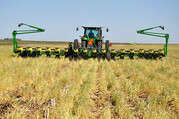
Maps are now available at the Franklin County FSA Office for acreage reporting purposes. If you wish to receive your maps by e-mail, please call our office at (931) 967-2521. Please see the following acreage reporting deadlines for Franklin County:
- May 31, 2024 – Nursery (Crop Year 2025)
- July 15, 2024 – Corn, Soybeans, Cotton, Perennial Forage (Hay & Pasture), Spring/Summer Vegetables
- July 31, 2024 – Hemp
In order to maintain program eligibility and benefits, you must file timely acreage reports. Failure to file an acreage report by the crop acreage reporting deadline may cause ineligibility for future program benefits. FSA will not accept acreage reports provided more than a year after the acreage reporting deadline.
Producers are encouraged to file their acreage reports as soon as planting is completed.
|

Landowners and operators are reminded that in order to receive payments from USDA, compliance with Highly Erodible Land (HEL) and Wetland Conservation (WC) provisions are required. Farmers with HEL determined soils are reminded of tillage, crop residue, and rotation requirements as specified per their conservation plan. Producers are to notify the USDA Farm Service Agency prior to breaking sod, clearing land (tree removal), and of any drainage projects (tiling, ditching, etc.) to ensure compliance. Failure to update certification of compliance, with form AD-1026, triggering applicable HEL and/or wetland determinations, for any of these situations, can result in the loss of FSA farm program payments, FSA farm loans, NRCS program payments, and premium subsidy to Federal Crop Insurance administered by RMA.
|

The U.S. Department of Agriculture (USDA) announced today that most farm loan borrowers will soon be able to make payments to their direct loans online through the Pay My Loan feature on farmers.gov in early February. Pay My Loan is part of a broader effort by USDA’s Farm Service Agency (FSA) to streamline its processes, especially for producers who may have limited time during the planting or harvest seasons to visit a local FSA office; modernize and improve customer service; provide additional customer self-service tools; and expand credit access to assist more producers.
On average, local USDA Service Centers process more than 225,000 farm loan payments each year. Pay My Loan gives most borrowers an online repayment option and relieves them from needing to call, mail, or visit a Service Center to pay their loan installment. Farm loan payments can now be made at the borrower’s convenience, on their schedule and outside of FSA office hours.
Pay My Loan also provides time savings for FSA’s farm loan employees by minimizing manual payment processing activities. This new service for producers means that farm loan employees will have more time to focus on reviewing and processing new loans or servicing requests.
The Pay My Loan feature can be accessed at farmers.gov/loans. To use the payment feature, producers must establish a USDA customer account and a USDA Level 2 eAuthentication (“eAuth”) account or a Login.gov account. This initial release only allows individuals with loans to make online payments. For now, borrowers with jointly payable checks will need to continue to make loan payments through their local office.
FSA has a significant initiative underway to streamline and automate the Farm Loan Program customer-facing business process. For the over 26,000 producers who submit a direct loan application annually, FSA has made various improvements including:
- The Online Loan Application, an interactive, guided application that is paperless and provides helpful features including an electronic signature option, the ability to attach supporting documents such as tax returns, complete a balance sheet, and build a farm operating plan.
- The Loan Assistance Tool that provides customers with an interactive online, step-by-step guide to identifying the direct loan products that may be a fit for their business needs and to understanding the application process.
- A simplified direct loan paper application, which reduced loan applications by more than half, from 29 pages to 13 pages.
|
|
|
|
|
Franklin County
USDA Service Center
200 S. Jefferson St.
Federal Building
Winchester, TN 37398
Phone: (931) 967-2521
Fax: (855) 539-6305
|
Farm Service Agency
Laura Henley, CED
(931) 967-2521
Laura.Henley@usda.gov
|
Farm Loans
Jan York, Farm Loan Officer
(931) 967-2521
Jan.York@usda.gov
|
|
Natural Resources Conservation Service
Josh Turner, District Conservationist
(931) 967-3504
Joshua.W.Turner@usda.gov
|
|
Franklin County Committee, FSA
Kurt Johnson, Chairperson
Dusty Matlock, Vice-Chairperson
Justin Woodall, Member
Nancy Hale, Advisor
|
Franklin County Soil and Water Conservation District
Dusty Matlock, Chairman
Holly Berke, Secretary/Treasurer
Jared Hill
Zachary Hopkins
Samuel Jones
|
|
|







