Montgomery County USDA Service Center Updates for April 2024

View as a webpage / Share

US Department of Agriculture

Montgomery County USDA Service Center Updates for April 2024

USDA Approves Emergency Forest Restoration Assistance for All Counties in Mississippi 

usda fsa logo

USDA Approves Emergency Forest Restoration Assistance for All Counties in Mississippi 

Additional conservation, farm loan and disaster recovery options available for drought-related tree loss   

Jackson, Miss., April 15, 2024 — U.S. Department of Agriculture (USDA) Farm Service Agency (FSA) today announced that all 82 Mississippi counties have been approved to accept applications for the Emergency Forest Restoration Program (EFRP) to address extensive private lands forest losses and damage due to severe drought and related insect infestation. The EFRP signup period runs from April 15, 2024, to Aug. 15, 2024.  

EFRP is a cost-share program that provides financial and technical assistance to owners of nonindustrial private forestland (NIPF) to restore NIPF damaged by a qualifying natural disaster event.     

“It’s important that producers apply for the Emergency Forest Restoration Program assistance promptly. Program funds will be allocated based on the number of applications received, as well as by on-site inspections that will determine the extent of the damage,” said Thaddeus Fairley, FSA State Executive Director in Mississippi. “I encourage eligible landowners who haven’t participated in FSA programs to contact their local FSA county office as soon as possible to establish farm records.”   

After applications are received, local FSA county committees determine land eligibility using on-site damage inspections that assess the type and extent of damage and approve applications.   

Financial assistance is not provided upfront but is reimbursed, at no more than 75% of the lesser of the actual costs incurred or allowable cost, after a restoration activity is complete. If an EFRP application is approved, the participant is expected to perform restoration and conservation practices based on the FSA-848A Cost-Share Agreement and restoration plan provided.    

The following requirements for participation in EFRP include:   

  • Restoration must be completed to meet the Natural Resources Conservation Service (NRCS) and/or state forestry agency technical standards.  
  • Participants must document and keep records of all costs incurred, including costs associated with personal labor, to complete the restoration activities.   
  • The minimum qualifying cost of restoration is $1,000.  
  • The program’s payment limitation is $500,000.   

In order to meet eligibility requirements, NIPF land must have existing tree cover or had tree cover immediately before the natural disaster occurred and be sustainable for growing trees. 

The land must also be owned or leased by any nonindustrial private individual, group, association, corporation, or other private legal entity that has definitive decision-making authority over the land.    

The natural disaster event must have resulted in damage that, if untreated, would impair or endanger the natural resources on the land and/or materially affect future use of the land.   

Additional Assistance Available   

Landowners experiencing drought related losses, including pine decline, of eligible trees planted on Conservation Reserve Program (CRP) acres may be eligible for up to 50% cost-share, not to exceed the Mississippi state average cost, to rehabilitate and replant the trees. CRP program participants should contact the Mississippi Forestry Commission to request a site visit to assess losses and determine next steps.   

Additionally, eligible orchardists and nursery tree growers may be eligible for cost-share assistance through the Tree Assistance Program (TAP) to replant or rehabilitate eligible trees, bushes or vines. TAP complements the Noninsured Crop Disaster Assistance Program or crop insurance coverage, which covers the crop but not the plants or trees in all cases. For TAP, a program application must be filed within 90 days of the disaster event or the date when the loss of the trees, bushes or vines is apparent.    

FSA also offers a variety of direct and guaranteed farm loans, including operating and emergency farm loans, to producers unable to secure commercial financing. Producers in counties with a primary or contiguous disaster designation may be eligible for low interest emergency loans to help them recover from production and physical losses. Loans can help producers replace essential property, purchase inputs like livestock, equipment, feed and seed, cover family living expenses or refinance farm-related debts and other needs. Additionally, FSA offers several loan servicing options available for borrowers who are unable to make scheduled payments on their farm loan programs debt to the agency because of reasons beyond their control.     

More Information  

 Additional USDA disaster assistance information can be found on farmers.gov, including USDA resources specifically for producers impacted by drought. Those resources include the Disaster Assistance Discovery Tool, Disaster-at-a-Glance fact sheet and Loan Assistance Tool.    

For more information please contact your local FSA county office or visit farmers.gov/recover.   

USDA is an equal opportunity provider, employer and lender.  


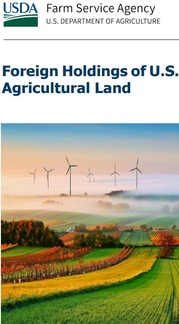
Foreign Investors Must Report U.S. Agricultural Land Holdings

AFIDA

File with your county office within 90 days of land transactions

U.S. Department of Agriculture (USDA) Farm Service Agency (FSA) Executive Director Jim Locke in Montgomery County reminds foreign investors with an interest in agricultural land in the United States that they are required to report their land holdings and transactions to USDA.

The Agricultural Foreign Investment Disclosure Act (AFIDA) requires foreign investors who buy, sell or hold an interest in U.S. agricultural land to report their holdings and transactions to the USDA. Foreign investors must file AFIDA Report Form FSA-153 with the FSA county office in the county where the land is located.  Large or complex filings may be handled by AFIDA headquarters staff in Washington, D.C.

According to CFR Title 7 Part 781, any foreign person who holds an interest in U.S. agricultural land is required to report their holdings no later than 90 days after the date of the transaction.

Foreign investors should report holdings of agricultural land totaling 10 acres or more used for farming, ranching or timber production, and leaseholds on agricultural land of 10 or more years.  Tracts totaling 10 acres or less in the aggregate, and which produce annual gross receipts in excess of $1,000 from the sale of farm, ranch, forestry or timber products, must also be reported.  AFIDA reports are also required when there are changes in land use, such as from agricultural to nonagricultural use. Foreign investors must also file a report when there is a change in the status of ownership.

The information from AFIDA reports is used to prepare an annual report to Congress.  These annual reports to Congress, as well as more information, are available on the FSA AFIDA webpage. .

Assistance in completing the FSA-153 report may be obtained from the local FSA office. For more information regarding AFIDA or FSA programs, contact the Montgomery County FSA office at 662-283-2443 or visit farmers.gov.


Payment Limitation 

FSA Logo

Program payments may be limited by direct attribution to individuals or entities. A legal entity is defined as an entity created under Federal or State law that owns land or an agricultural commodity, product or livestock. Through direct attribution, payment limitation is based on the total payments received by a person or legal entity, both and indirectly. Qualifying spouses are eligible for a separate payment limitation. 

Payments and benefits under certain FSA programs are subject to some or all of the following:  

  • payment limitation by direct attribution (including common attribution)  
  • payment limitation amounts for the applicable programs  
  • substantive change requirements when a farming operation adds persons, resulting in an increase in persons to which payment limitation applies  
  • actively engaged in farming requirements  
  • cash-rent tenant rule  
  • foreign person rule  
  • average AGI limitations  
  • programs subject to AGI limitation  

No program benefits subject to payment eligibility and limitation will be provided until all required forms for the specific situation are provided and necessary payment eligibility and payment limitation determinations are made.  Payment eligibility and payment limitation determinations may be initiated by the County Committee or requested by the producer. 

Statutory and Regulatory rules require persons and legal entities, provide the names and Tax Identification Numbers (TINs) for all persons and legal entities with an ownership interest in the farming operation to be eligible for payment.  

Payment eligibility and payment limitation forms submitted by persons and legal entities are subject to spot check through FSA’s end-of-year review process. 

Persons or legal entities selected for end-of-year review must provide the County Committee with operating loan documents, income and expense ledgers, canceled checks for all expenditures, lease and purchase agreements, sales contracts, property tax statements, equipment listings, lease agreements, purchase contracts, documentation of who provided actual labor and management, employee time sheets or books, crop sales documents, warehouse ledgers, gin ledgers, corporate or entity papers, etc.  

A finding that a person or legal entity is not actively engaged in farming results in the person or legal entity being ineligible for any payment or benefit subject to the actively engaged in farming rules.  Noncompliance with AGI provisions, either by exceeding the applicable limitation or failure to submit a certification and consent for disclosure statement, will result in payment ineligibility for all program benefits subject to AGI provisions. Program payments are reduced in an amount that is commensurate with the direct and indirect interest held by an ineligible person or legal entity in any legal entity, general partnership, or joint operation that receives benefits subject to the average AGI limitations.  

If any changes occur that could affect an actively engaged in farming, cash-rent tenant, foreign person, or average Adjusted Gross Income (AGI) determination, producers must timely notify the County FSA Office by filing revised farm operating plans and/or supporting documentation, as applicable. Failure to timely notify the County Office may adversely affect payment eligibility. 

Montgomery County FSA
11 West Courthouse Drive
Montgomery, MS 38967

Phone: 662-283-2443  
Fax: 844-325-7032

County Executive Director
Jim Locke
jim.locke@usda.gov

Acting District Conservationist
Brent Long
brent.long@usda.gov

Program Technician
Laurie Bright
laurie.bright@usda.gov

Soil Conservationist 
Scott Norwood
janthony.norwood1@usda.gov

Program Technician
Andrea Upchurch
andrea.upchurch@usda.gov

Soil & Water District Technician
Ron Walls
ronald.walls@ms.nacdnet.net

Program Technician
Rebekkah Bingham
rebekkah.bingham2@usda.gov

Montgomery County Soil & Water District Clerk
Carla Walls
carline.walls@ms.nacdnet.net