
Dairy producers are now able to enroll for 2024 Dairy Margin Coverage (DMC), an important safety net program offered through the U.S. Department of Agriculture (USDA) that provides producers with price support to help offset milk and feed price differences. This year’s DMC signup began Feb. 28, 2024, and ends April 29, 2024. For those who sign up for 2024 DMC coverage, payments may have begun as soon as March 4, 2024, for any payments that triggered in January 2024.
USDA’s Farm Service Agency (FSA) has revised the regulations for DMC to allow eligible dairy operations to make a one-time adjustment to established production history. This adjustment will be accomplished by combining previously established supplemental production history with DMC production history for those dairy operations that participated in Supplemental Dairy Margin Coverage during a prior coverage year. DMC has also been authorized through calendar year 2024. Congress passed a 2018 Farm Bill extension requiring these regulatory changes to the program.
DMC is a voluntary risk management program that offers protection to dairy producers when the difference between the all-milk price and the average feed price (the margin) falls below a certain dollar amount selected by the producer. In 2023, Dairy Margin Coverage payments triggered in 11 months including two months, June and July, where the margin fell below the catastrophic level of $4.00 per hundredweight, a first for Dairy Margin Coverage or its predecessor Margin Protection Program.
2024 DMC Coverage and Premium Fees FSA has revised DMC regulations to extend coverage for calendar year 2024, which is retroactive to Jan. 1, 2024, and to provide an adjustment to the production history for dairy operations with less than 5 million pounds of production. In previous years, smaller dairy operations could establish a supplemental production history and receive Supplemental Dairy Margin Coverage. For 2024, dairy producers can establish one adjusted base production history through DMC for each participating dairy operation to better reflect the operation’s current production.
For 2024 DMC enrollment, dairy operations that established supplemental production history through Supplemental Dairy Margin Coverage for coverage years 2021 through 2023, will combine the supplemental production history with established production history for one adjusted base production history.
For dairy operations enrolled in 2023 DMC under a multi-year lock-in contract, lock-in eligibility will be extended until Dec. 31, 2024. In addition, dairy operations enrolled in multi-year lock-in contracts are eligible for the discounted DMC premium rate during the 2024 coverage year. To confirm 2024 DMC lock-in coverage or opt out in favor of an annual contract for 2024, dairy operations having lock-in contracts must enroll during the 2024 DMC enrollment period.
DMC offers different levels of coverage, even an option that is free to producers, minus a $100 administrative fee. The administrative fee is waived for dairy producers who are considered limited resource, beginning, socially disadvantaged or a military veteran. To determine the appropriate level of DMC coverage for a specific dairy operation, producers can use the online dairy decision tool.
DMC Payments DMC payments are calculated using updated feed and premium hay costs, making the program more reflective of actual dairy producer expenses. These updated feed calculations use 100% premium alfalfa hay.
More Information USDA also offers other risk management tools for dairy producers, including the Dairy Revenue Protection (DRP) plan that protects against a decline in milk revenue (yield and price) and the Livestock Gross Margin (LGM) plan, which provides protection against the loss of the market value of milk minus the feed costs. Both DRP and LGM livestock insurance policies are offered through the Risk Management Agency. Producers should contact their local crop insurance agent for more information.
For more information on DMC, visit the DMC webpage or contact your local USDA Service Center.
|
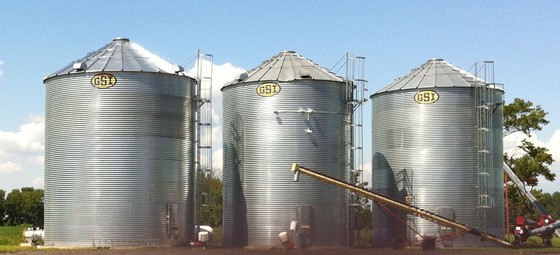
The Farm Service Agency’s (FSA) Farm Storage Facility Loan (FSFL) program provides low-interest financing to help you build or upgrade storage facilities and to purchase portable (new or used) structures, equipment and storage and handling trucks.
Eligible commodities include corn, grain sorghum, rice, soybeans, oats, peanuts, wheat, barley, minor oilseeds harvested as whole grain, pulse crops (lentils, chickpeas and dry peas), hay, honey, renewable biomass, fruits, nuts and vegetables for cold storage facilities, floriculture, hops, maple sap, rye, milk, cheese, butter, yogurt, meat and poultry (unprocessed), eggs, and aquaculture (excluding systems that maintain live animals through uptake and discharge of water). Qualified facilities include grain bins, hay barns and cold storage facilities for eligible commodities.
Loans up to $50,000 can be secured by a promissory note/security agreement, loans between $50,000 and $100,000 may require additional security, and loans exceeding $100,000 require additional security.
You do not need to demonstrate the lack of commercial credit availability to apply. The loans are designed to assist a diverse range of farming operations, including small and mid-sized businesses, new farmers, operations supplying local food and farmers markets, non-traditional farm products, and underserved producers.
For more information, contact your local county USDA Service Center or visit fsa.usda.gov/pricesupport.
The Farm Service Agency (FSA) makes loans to youth to establish and operate agricultural income-producing projects in connection with 4-H clubs, FFA and other agricultural groups. Projects must be planned and operated with the help of the organization advisor, produce sufficient income to repay the loan and provide the youth with practical business and educational experience. The maximum loan amount is $5,000.
Youth Loan Eligibility Requirements:
- Be a citizen of the United States (which includes Puerto Rico, the Virgin Islands, Guam, American Samoa, the Commonwealth of the Northern Mariana Islands) or a legal resident alien
- Be 10 years to 20 years of age
- Comply with FSA’s general eligibility requirements
- Conduct a modest income-producing project in a supervised program of work as outlined above
- Demonstrate capability of planning, managing and operating the project under guidance and assistance from a project advisor. The project supervisor must recommend the youth loan applicant, along with providing adequate supervision.
For help preparing the application forms, contact your local USDA Service Center or visit fsa.usda.gov.
U.S. Department of Agriculture (USDA) Farm Service Agency (FSA) reminds foreign investors with an interest in agricultural land in the United States that they are required to report their land holdings and transactions to USDA.
The Agricultural Foreign Investment Disclosure Act (AFIDA) requires foreign investors who buy, sell or hold an interest in U.S. agricultural land to report their holdings and transactions to the USDA. Foreign investors must file AFIDA Report Form FSA-153 with the FSA county office in the county where the land is located. Large or complex filings may be handled by AFIDA headquarters staff in Washington, D.C.
According to CFR Title 7 Part 781, any foreign person who holds an interest in U.S. agricultural land is required to report their holdings no later than 90 days after the date of the transaction.
Foreign investors should report holdings of agricultural land totaling 10 acres or more used for farming, ranching or timber production, and leaseholds on agricultural land of 10 or more years. Tracts totaling 10 acres or less in the aggregate, and which produce annual gross receipts in excess of $1,000 from the sale of farm, ranch, forestry or timber products, must also be reported. AFIDA reports are also required when there are changes in land use, such as from agricultural to nonagricultural use. Foreign investors must also file a report when there is a change in the status of ownership.
The information from AFIDA reports is used to prepare an annual report to Congress. These annual reports to Congress, as well as more information, are available on the FSA AFIDA webpage.
Assistance in completing the FSA-153 report may be obtained from the local FSA office. For more information regarding AFIDA or FSA programs, contact your local FSA office or visit farmers.gov.
Finding the right risk management fit for your farm can feel overwhelming, especially for specialty crop and small-scale farmers and ranchers. That’s why the USDA’s Risk Management Agency (RMA) created a new searchable directory of crop insurance agents who have experience selling Whole-Farm Revenue Protection (WFRP) and Micro Farm policies.
With 1,135 crop insurance agents listed, providing coverage in all 50 states, the process of finding the “right risk management fit” just got easier.
In addition to the new directory, there are other resources available for specialty crop producers including regional specialists located in each of the RMA regional offices. Feedback is crucial to continually improving risk management options, and specialty crop producers can reach out with suggestions or questions by e-mailing SpecialtyCrops@usda.gov.
Specialty crop and small-scale producers are encouraged to use the new searchable directory and visit the RMA Specialty Crops page.
Whole-Farm Revenue Protection
The first of its kind, WFRP recognizes diversification found on specialty and small-scale farms. With WFRP producers can insure their entire operation including crops, livestock, and nursery production, under one policy. Another advantage of WFRP coverage, is it bridges the insurance gap for several specialty crops that don’t currently have individual policies available.
Micro Farm
Also included in WFRP, the Micro Farm option gives smaller operations more streamlined insurance options. It provides a risk management safety net for all commodities on your farm under one insurance policy. This insurance plan is tailored for any farm with up to $350,000 in approved revenue, including farms with specialty or organic commodities (both crops and livestock), or those marketing to local, regional, farm-identity preserved, specialty, or direct markets.
Click here for April 2024 Lending Rates for Agricultural Producers.
April 29, 2024- Dairy Margin Coverage Enrollment Deadline
May 15, 2024 - Acreage reporting deadline for peas (green only) and potatoes
June 15, 2024 - Acreage reporting deadline for tomatoes
July 15, 2024 - Acreage reporting deadline for beans (limas only), cucumbers (planted 4/20-6/25 in Caroline, Dorchester, Kent and Talbot counties), ALL OTHER CROPS, perennial forage, CRP
July 31, 2024 - Acreage reporting deadline for hemp
August 15, 2024- Primary Nesting Season Ends
August 15, 2024 - Acreage reporting deadline for beans (all types except limas), cucumbers (planted 6/26-8/10 in Caroline, Dorchester, Kent, and Talbot Counties)
September 1, 2024 - NAP Coverage Application Closing date (Noninsured Crop Disaster Assistance Program (NAP) (usda.gov)) – Value-loss crops or controlled environment crops, ornamental nursery, aquaculture, Christmas trees, ginseng, floriculture, mushrooms, and turf grass sod
September 30, 2024 - NAP Coverage Application Closing date (Noninsured Crop Disaster Assistance Program (NAP) (usda.gov)) – Biennial and perennial forage crops, alfalfa, grass forages, mixed forages and other forages
September 30, 2024 - Acreage reporting deadline - Value-loss (ex-oysters) and controlled environment crops (except Nursery)
|








