In This Issue:
This week we are celebrating National Agriculture Week … Growing a Climate For Tomorrow. Investments in climate smart agriculture have been made by the Biden-Harris administration and we continue to implement these initiatives and programs throughout Maine.
I had the opportunity to participate in the Communities In Action – Building a Better Maine, New Hampshire, and Vermont event at the White House earlier this month. I was joined by Rural Development State Director Rhiannon Hampson and other community leaders from the tri-state region. Participants were encouraged to share the impact of the Biden-Harris Administration investments on their communities. These investments have had a tremendous impact across many sectors of our state:
- The Administration’s economic plan includes $1.1 billion in federal funds for 102 infrastructure projects in Maine (transportation, roads, bridges, access to clean water).
- The Investing in America agenda supports rural communities by investing in climate-smart agricultural practices which includes the creation of the Partnerships for Climate Smart Commodities. Local partners in Maine, include but are not limited to, MOFGA, MFT, UMaine Cooperative Extension, and Wolfe’s Neck Farm. The total investment for climate smart projects in Maine is $437 million. Additional information can be found here: Partnerships for Climate Smart Commodities
- Section 22006 for the Inflation Reduction Act allocated $3.1 billion to USDA to provide relief to distressed FSA borrowers. This assistance came at a critical time when many small family farms were having to make decisions on how, or if, to move forward. This financial assistance had a tremendous impact on our Maine agricultural community and contributed to our mission to keep farmers farming.
- Additional information on investments in rural America can be found here: Investing in America
For those affected by the severe weather events this winter, please note that sign up for the Emergency Forest Restoration Assistance Program will begin on Monday, March 25, 2024, and run through May 24, 2024. Please contact your local FSA office for more information.
 Sherry Hamel, SED
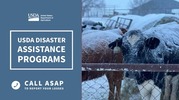
Farmers and ranchers know all too well that natural disasters can be a common, and likely a costly, variable to their operation. The Farm Service Agency (FSA) has emergency assistance programs to provide assistance when disasters strike, and for some of those programs, a disaster designation may be the eligibility trigger.
FSA administers four types of disaster designations.
USDA Secretarial Disaster Designation
- The designation process can be initiated by individual farmers, local government officials, State governors, State agriculture commissions, tribal councils or the FSA State Executive Director
- This designation is triggered by a 30-percent or greater production loss to at least one crop because of a natural disaster, or at least one producer who sustained individual losses because of a natural disaster and is unable to obtain commercial financing to cover those losses
- In 2012, USDA developed a fast-track process for disaster declarations for severe drought. This provides for a nearly automatic designation when, during the growing season, any portion of a county meets the D2 (Severe Drought) drought intensity value for eight consecutive weeks or a higher drought intensity value for any length of time as reported by the U.S. Drought Monitor (http://droughtmonitor.unl.edu)
Administrator’s Physical Loss Notification
- This designation is initiated by the FSA State Executive Director.
- The designation is triggered by physical damage and losses because of a natural disaster, including but not limited to dead livestock, collapsed buildings, and destroyed farm structures.
Presidential Designation
- A Presidential major disaster designation and emergency declaration is initiated by the Governor of the impacted state through the Federal Emergency Management Agency (FEMA).
- This designation is triggered by damage and losses caused by a disaster of such severity and magnitude that effective response is beyond the capability of the State and local governments.
Quarantine Designation
- This designation is requested of the Secretary of Agriculture by the FSA State Executive Director.
- A quarantine designation is triggered by damage and losses caused by the effects of a plant or animal quarantine approved by the Secretary under the Plant Protection Act or animal quarantine laws.
All four types of designations immediately trigger the availability of low-interest Emergency loans to eligible producers in all primary and contiguous counties. FSA borrowers in these counties who are unable to make their scheduled payments on any debt may be authorized to have certain set asides. Additional disaster assistance requiring a designation may also be provided by new programs in the future.
For more information on FSA disaster programs and disaster designations, contact your localCounty USDA Service Center or visit fsa.usda.gov/disaster.
|
Farm Service Agency (FSA) borrowers with farms located in designated primary or contiguous disaster areas who are unable to make their scheduled FSA loan payments should consider the Disaster Set-Aside (DSA) program.
DSA is available to producers who suffered losses as a result of a natural disaster and relieves immediate and temporary financial stress. FSA is authorized to consider setting aside the portion of a payment/s needed for the operation to continue on a viable scale.
Borrowers must have at least two years left on the term of their loan in order to qualify.
Borrowers have eight months from the date of the disaster designation to submit a complete application. The application must include a written request for DSA signed by all parties liable for the debt along with production records and financial history for the operating year in which the disaster occurred. FSA may request additional information from the borrower in order to determine eligibility.
All farm loans must be current or less than 90 days past due at the time the DSA application is complete. Borrowers may not set aside more than one installment on each loan.
The amount set-aside, including interest accrued on the principal portion of the set-aside, is due on or before the final due date of the loan.
For more information, contact your local County USDA Service Center or visit fsa.usda.gov.
Producers who received an Emergency Relief Program (ERP) payment need to meet ERP insurance linkage requirements by purchasing crop insurance, or Noninsured Crop Disaster Assistance Program (NAP) coverage where crop insurance is not available.
Purchase coverage must be at the 60/100 coverage level or higher for insured crops or at the catastrophic coverage level or higher for NAP crops for the next two available crop years, which will be determined from the date you received an ERP payment and may vary depending on the timing and availability of coverage. The insurance coverage requirement applies to the physical location of the county where the crop was located and for which an ERP payment was issued.
Contact your crop insurance agent or local FSA county office as soon as possible to ask about coverage options. Producers who do not obtain the applicable coverage by the sales/application closing date will be required to refund the ERP benefits received on the applicable crop, plus interest. To determine which crops are eligible for federal crop insurance or NAP, visit the RMA website.
For more information, contact your local USDA Service Center or visit fsa.usda.gov.
In this Ask the Expert, Toni Williams answers questions about how Farm Storage Facility Loans (FSFLs) provide low-interest financing to help producers build or upgrade commodity storage facilities. Toni is the Agricultural Program Manager for FSFLs at the Farm Service Agency (FSA).
Toni has worked for FSA for more than 32 years and is responsible for providing national policy and guidance for Farm Storage Facility Loans.
What are Farm Storage Facility Loans?
Farm Storage Facility Loans provide low-interest financing for eligible producers to build or upgrade facilities to store commodities.
The FSFL program was created in May 2000 to address an existing grain shortage. Historically, FSFLs benefitted grain farmers, but a change in the 2008 Farm Bill extended the program to fruit and vegetable producers for cold storage. An additional change extended the program to washing and packing sheds, where fresh produce is washed, sorted, graded, labeled, boxed up, and stored before it heads to market. Since May 2000, FSA has made more than 40,000 loans for on-farm storage.
Eligible facility types include grain bins, hay barns, bulk tanks, and facilities for cold storage. Drying and handling and storage equipment including storage and handling trucks are also eligible. Eligible facilities and equipment may be new or used, permanently affixed or portable.
To read the full blog visit farmers.gov/blog/ask-the-expert-qa-on-farm-storage-facility-loans-with-toni-williams
The Farm Service Agency (FSA) assists beginning farmers to finance agricultural enterprises. Under these designated farm loan programs, FSA can provide financing to eligible applicants through either direct or guaranteed loans. FSA defines a beginning farmer as a person who:
- Has operated a farm for not more than 10 years
- Will materially and substantially participate in the operation of the farm
- Agrees to participate in a loan assessment, borrower training and financial management program sponsored by FSA
- Does not own a farm in excess of 30 percent of the county’s average size farm.
For more information contact, contact your local County USDA Service Center or visit fsa.usda.gov.
Meeting will take place April 10, 2-4 p.m. ET
We’re inviting urban producers, innovative producers, and other stakeholders to virtually attend a public meeting of the Federal Advisory Committee for Urban Agriculture and Innovative Production on April 10 from 2-4 p.m. Eastern.
Meeting details can be viewed in the Federal Register Notice. Written comments can be submitted via UrbanAgricultureFederalAdvisoryCommittee@usda.gov by April 24 at 11:59 p.m. The Committee will deliberate and vote on proposed recommendations and address public comments during the meeting. USDA will share the agenda between 24 to 48 hours prior to the meeting on the Committee’s webpage.
The Committee is managed by the Office of Urban Agriculture and Innovative Production and was established through the 2018 Farm Bill and is part of a broad USDA investment in urban agriculture.
Learn more or register.
Persons with disabilities who require accommodations to attend or participate in any meeting/event/function should contact Mary Anne Coffin at 207-990-9140 or Federal Relay Service at 1-800-877-8339.
|








