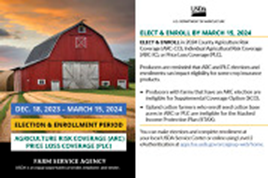
Agricultural producers who have not yet enrolled in the Agriculture Risk Coverage (ARC) or Price Loss Coverage (PLC) programs for the 2024 crop year have until March 15, 2024, to revise elections and sign contracts. Both safety net programs, delivered by USDA’s Farm Service Agency (FSA), provide vital income support to farmers who experience substantial declines in crop prices or revenues for the 2024 crop year. In Colorado, producers have completed 7,589 contracts to date, representing 41% of the more than 16,000 expected contracts.
Producers can elect coverage and enroll in ARC-County or PLC, which provide crop-by-crop protection, or ARC-Individual, which protects the entire farm. Although election changes for 2024 are optional, producers must enroll, with a signed contract, each year. If a producer has a multi-year contract on the farm, the contract will continue for 2024 unless an election change is made.
If producers do not submit their election revision by the March 15, 2024, deadline, the election remains the same as their 2023 election for eligible commodities on the farm. Also, producers who do not complete enrollment and sign their contract by the deadline will not be enrolled in ARC or PLC for the 2024 year and will not receive a payment if one is triggered. Farm owners can only enroll in these programs if they have a share interest in the commodity.
Producers are eligible to enroll farms with base acres for the following commodities: barley, canola, large and small chickpeas, corn, crambe, flaxseed, grain sorghum, lentils, mustard seed, oats, peanuts, dry peas, rapeseed, long grain rice, medium and short grain rice, safflower seed, seed cotton, sesame, soybeans, sunflower seed and wheat.
Web-Based Decision Tools
Many universities, including Texas A&M https://www.afpc.tamu.edu/tools/farm/farmbill/2018/ and University of Illinois https://fd-tools.ncsa.illinois.edu/#/, offer web-based decision tools to help producers make informed, educated decisions using crop data specific to their respective farming operations. Producers are encouraged to use the tool of their choice to support their ARC and PLC elections.
Crop Insurance Considerations
Producers are reminded that enrolling in ARC or PLC programs can impact eligibility for some crop insurance products offered by USDA’s Risk Management Agency (RMA). Producers who elect and enroll in PLC also have the option of purchasing Supplemental Coverage Option (SCO) through their Approved Insurance Provider, but producers of covered commodities who elect ARC are ineligible for SCO on their planted acres.
Unlike SCO, RMA’s Enhanced Coverage Option (ECO) is unaffected by participating in ARC for the same crop, on the same acres. You may elect ECO regardless of your farm program election.
Upland cotton farmers who choose to enroll seed cotton base acres in ARC or PLC are ineligible for the stacked income protection plan, or STAX, on their planted cotton acres.
More Information
For more information on ARC and PLC, producers can visit the ARC and PLC webpage or contact their local USDA Service Center. Producers can also prepare maps for acreage reporting as well as manage farm loans and view other farm records data and customer information by logging into their farmers.gov account. If you don’t have an account, sign up today.
|

U.S. Department of Agriculture (USDA) announced that agricultural producers and private landowners can begin signing up for the general Conservation Reserve Program (CRP) starting March 4 and running through March 29, 2024. This conservation opportunity gives producers tools to conserve wildlife habitat while achieving other conservation benefits, including sequestering carbon and improving water quality and soil health.
“The USDA has a long track record of fostering and supporting the vital relationship between agriculture and conservation, and the Conservation Reserve Program helps our producers be good stewards of their lands and boost wildlife populations at the same time,” said Kent Peppler, FSA State Executive Director in Colorado. “These efforts demonstrate the power of USDA’s Farm Bill conservation programs to conserve wildlife habitat, protect clean water and address climate change in partnership with farmers, ranchers, forest owners and conservation organizations across the country.”
On Nov. 16, 2023, President Biden signed into law H.R. 6363, the Further Continuing Appropriations and Other Extensions Act, 2024 (Pub. L. 118-22), which extended the Agriculture Improvement Act of 2018 (Pub. L. 115-334), more commonly known as the 2018 Farm Bill, through Sept. 30, 2024. This extension allows authorized programs, including CRP, to continue operating.
As one of the largest private lands conservation programs in the United States, CRP offers a range of conservation options to farmers, ranchers, and landowners. It has been an especially strong opportunity for farmers with less productive or marginal cropland, helping them re-establish valuable land cover to help improve water quality, prevent soil erosion, and support wildlife habitat.
Producers and landowners enrolled about 926,000 acres in General CRP in 2023, bringing the total of enrolled acres in General CRP to 7.78 million. This, combined with all other acres in CRP through other enrollment opportunities, such as Grassland and Continuous CRP, bring the current total of enrolled acres to 24.8 million.
General CRP
General CRP helps producers and landowners establish long-term, resource-conserving plant species, such as approved grasses or trees, to control soil erosion, improve water quality and enhance wildlife habitat on cropland. Additionally, General CRP includes a Climate-Smart Practice Incentive to help increase carbon sequestration and reduce greenhouse gas emissions by helping producers and landowners establish trees and permanent grasses, enhance wildlife habitat, and restore wetlands.
General CRP is one of several ways agricultural producers and private landowners can participate in the program.
Other CRP Options
This past January FSA began accepting applications for the Continuous CRP signup. Under this enrollment, producers and landowners can enroll in CRP throughout the year. Offers are automatically accepted provided the producer and land meet the eligibility requirements and the enrollment levels do not exceed the statutory cap.
The USDA also offers financial assistance to producers and landowners enrolled in CRP to improve the health of their forests through the Forest Management Incentive (FMI), which can help participants with forest management practices, such as brush management and prescribed burning.
FSA will announce the dates for Grassland CRP signup in the near future.
Producers with expiring CRP acres can use the Transition Incentives Program (TIP), which incentivizes producers who sell or enter a long-term lease with a beginning, veteran, or socially disadvantaged farmer or rancher who plans to sustainably farm or ranch the land.
How to Sign Up
Landowners and producers interested in CRP should contact their local USDA Service Center to learn more or to apply for the program before their deadlines.
More Information
Signed into law in 1985, CRP is one of the largest voluntary private-lands conservation programs in the United States. It was originally intended to primarily control soil erosion and potentially stabilize commodity prices by taking marginal lands out of production. The program has evolved over the years, providing many conservation and economic benefits.
USDA touches the lives of all Americans each day in so many positive ways. Under the Biden-Harris administration, USDA is transforming America’s food system with a greater focus on more resilient local and regional food production, fairer markets for all producers, ensuring access to safe, healthy and nutritious food in all communities, building new markets and streams of income for farmers and producers using climate smart food and forestry practices, making historic investments in infrastructure and clean energy capabilities in rural America, and committing to equity across the Department by removing systemic barriers and building a workforce more representative of America. To learn more, visit usda.gov.
|
The Natural Resources Conservation Service (NRCS) works to help farmers, ranchers and forest landowners invest in their operations and local communities to keep working lands working, boost rural economies, increase the competitiveness of American agriculture, and improve the quality of our air, water, soil, and wildlife habitat.
Simply put – NRCS helps America’s farmers, ranchers and forestland owners make conservation work for them.
Our Conservation Technical Assistance (CTA) program enables every acre of voluntary conservation applied through every program NRCS administers. It is the foundation of our financial and technical assistance delivery system.
Every farm and acre are unique and requires tailored management; and every decision maker has different management concerns and needs. Our technical assistance is one-on-one, personalized advice and support to help producers make the best decisions for their lands – and is offered free of charge.
This personalized assistance provides producers with the science-based data and tools to make informed decisions about where to target efforts to get the greatest return on their investment and ensure the long-term sustainability of American agriculture.
A comprehensive conservation plan is the first step to managing all the natural resources on a farm. NRCS walks the farm with the producer and develops options to address that producer’s needs. Our toolbox includes aerial photos, soil surveys, engineering solutions and individual science-based analysis customized for the producer’s property. The plan we develop with the producer combines existing production methods with recommended conservation practices to best manage that farm’s unique natural resources, while allowing the producer to grow sustainably and productively. Supported by our expert analysis and recommendations, the producer chooses which option best meets their needs. These decisions become the producer’s conservation plan, a step-by-step guide to reach their objectives.
This planning process also makes it easier to identify how and when the farmer, rancher or forest landowner could qualify for Farm Bill financial assistance to help them install conservation systems or receive incentives for trying new ones. We have the expertise to see our customers through this process. Because identifying when, where, and how to implement practices is not plug and play.
The final plan provides a roadmap for the producer to meet their natural resource conservation goals. It includes helpful information on each of the producer’s practices, such as how they benefit the farm, how to maintain them, and how they help the soil, water, and wildlife.
By developing a conservation plan and adding conservation to the land, farmers, ranchers, and forest landowners can protect the land’s ability to provide for their family and future generations.
With offices in communities nationwide, NRCS staff provide the information, tools, and delivery systems.
The U.S. Department of Agriculture (USDA) announced today that most farm loan borrowers will soon be able to make payments to their direct loans online through the Pay My Loan feature on farmers.gov in early February. Pay My Loan is part of a broader effort by USDA’s Farm Service Agency (FSA) to streamline its processes, especially for producers who may have limited time during the planting or harvest seasons to visit a local FSA office; modernize and improve customer service; provide additional customer self-service tools; and expand credit access to assist more producers.
On average, local USDA Service Centers process more than 225,000 farm loan payments each year. Pay My Loan gives most borrowers an online repayment option and relieves them from needing to call, mail, or visit a Service Center to pay their loan installment. Farm loan payments can now be made at the borrower’s convenience, on their schedule and outside of FSA office hours.
Pay My Loan also provides time savings for FSA’s farm loan employees by minimizing manual payment processing activities. This new service for producers means that farm loan employees will have more time to focus on reviewing and processing new loans or servicing requests.
The Pay My Loan feature can be accessed at farmers.gov/loans. To use the payment feature, producers must establish a USDA customer account and a USDA Level 2 eAuthentication (“eAuth”) account or a Login.gov account. This initial release only allows individuals with loans to make online payments. For now, borrowers with jointly payable checks will need to continue to make loan payments through their local office.
FSA has a significant initiative underway to streamline and automate the Farm Loan Program customer-facing business process. For the over 26,000 producers who submit a direct loan application annually, FSA has made various improvements including:
- The Online Loan Application, an interactive, guided application that is paperless and provides helpful features including an electronic signature option, the ability to attach supporting documents such as tax returns, complete a balance sheet, and build a farm operating plan.
- The Loan Assistance Tool that provides customers with an interactive online, step-by-step guide to identifying the direct loan products that may be a fit for their business needs and to understanding the application process.
- A simplified direct loan paper application, which reduced loan applications by more than half, from 29 pages to 13 pages.
|
|







