|
|
Ingham & Livingston County USDA Service Center - March 2024 Update
|
|
|
|
Farm Service Agency | Natural Resources Conservation Service | Risk Management Agency
|

Have you completed your 2024 Agriculture Risk Coverage (ARC) and Price Loss Coverage (PLC) program contracts?
The USDA Ingham/Livingston Farm Service Agency (FSA) encourages agricultural producers make sure they have signed and returned their 2024 Agriculture Risk Coverage (ARC) and Price Loss Coverage (PLC) contracts before the March 15, 2024 deadline.
Producers are reminded that ARC and PLC elections can impact eligibility for some crop insurance products.If you purchased the Supplemental Coverage Option (SCO) with your approved Insurance Provider, you will need to make certain that you have the PLC election in place with FSA.
Signed ARC/PLC contracts can be returned by email, fax, US mail, or dropped off in person during office hours, or 24/7 in the locked drop box just outside the office door. County Office Staff can also work with producers to securely sign their contracts electronically, using the document signing service OneSpan. If your records on file with FSA are correct and up to date, then signing electronically could be a great option for you. It’s convenient, painless, fast and easy. There is no login requirement and OneSpan is available anywhere you can access your email, even from the seat of your favorite tractor using your smart phone!
All signatures, including shares, must be returned by the deadline.
Don’t wait until the last minute...call the Ingham/Livingston Farm Service Agency today at 517-676-4644 Ext. 2 for an appointment to complete your 2024 contracts before the deadline of March 15, 2024!
|

The Farm Service Agency (FSA) is accepting applications in Ingham County for the Agency’s (FSA) Emergency Forest Restoration Program (EFRP) to address tornado damages.
EFRP provides payments to eligible owners of nonindustrial private forest (NIPF) land to enable them to carry out emergency measures to restore land damaged by a natural disaster. EFRP signup began on January 22, 2024 and will end on March 22, 2024.
After applications are received, local FSA county committees determine land eligibility using on-site damage inspections that assess the type and extent of damage and approve applications.
Eligible forest restoration practices include debris removal, such as down or damaged trees, in order to establish a new stand or provide natural regeneration; site preparation, planting materials and labor to replant forest land; restoration of forestland roads, fire lanes, fuel breaks or erosion control structures; fencing, tree shelters and tree tubes to protect trees from wildlife damage; and wildlife enhancement to provide cover openings and wildlife habitat.
In order to meet eligibility requirements, NIPF land must have existing tree cover or had tree cover immediately before the natural disaster occurred and be sustainable for growing trees. The land must also be owned by any nonindustrial private individual, group, association, corporation or other private legal entity that has definitive decision-making authority over the land. The natural disaster must have resulted in damage that if untreated would impair or endanger the natural resources on the land and/or materially affect future use of the land.
An environmental review must be completed before actions are approved, such as site preparation or ground disturbance.
For more information contact the Ingham and Livingston County USDA Service Center at 517-676-4644 Ext2 or visit farmers.gov/recover.
|
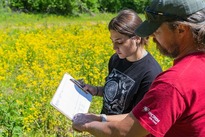
As the use of cover crops to improve soil health and reduce water quality concerns on working cropland has increased in recent years, questions have emerged regarding the value of cover crops to wildlife. For example, do cover crops provide needed habitat for grassland birds, a group that has experienced widespread population decline in recent decades? What is the value of cover crop fields to grassland birds during the winter, spring migration, and breeding periods compared to cropland fields without cover crops or areas of perennial cover?
On April 25 at 2:00 p.m. eastern, Dr. Adam Janke of Iowa State University and Dr. David Buehler of the University of Tennessee will provide answers to these questions and more during our free, one-hour Conservation Outcomes Webinar. This webinar will share findings from recent studies examining bird use of cover crops in Iowa and Tennessee conducted in partnership with USDA's Conservation Effects Assessment Project. Findings may be used to support on-the-ground cropland management decisions informed by a better understanding of the potential roll of cover crops in grassland bird conservation efforts.
Registration is not required. Access instructions are available on the Conservation Outcomes Webinar Series webpage along with a calendar of upcoming webinars through 2024.
|
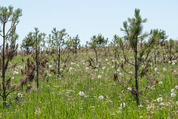
The U.S. Department of Agriculture (USDA) announced that agricultural producers and private landowners can begin signing up for the general Conservation Reserve Program (CRP) starting March 4 and running through March 29, 2024. The announcement was made earlier today by Zach Ducheneaux, Administrator of the USDA’s Farm Service Agency (FSA) at this year’s National Pheasant Fest, in Sioux Falls, SD.
On Nov. 16, 2023, President Biden signed into law H.R. 6363, the Further Continuing Appropriations and Other Extensions Act, 2024 (Pub. L. 118-22), which extended the Agriculture Improvement Act of 2018 (Pub. L. 115-334), more commonly known as the 2018 Farm Bill, through Sept. 30, 2024. This extension allows authorized programs, including CRP, to continue operating.
As one of the largest private lands conservation programs in the United States, CRP offers a range of conservation options to farmers, ranchers, and landowners. It has been an especially strong opportunity for farmers with less productive or marginal cropland, helping them re-establish valuable land cover to help improve water quality, prevent soil erosion, and support wildlife habitat.
Producers and landowners enrolled about 926,000 acres in General CRP in 2023, bringing the total of enrolled acres in General CRP to 7.78 million. This, combined with all other acres in CRP through other enrollment opportunities, such as Grassland and Continuous CRP, bring the current total of enrolled acres to 24.8 million.
General CRP
General CRP helps producers and landowners establish long-term, resource-conserving plant species, such as approved grasses or trees, to control soil erosion, improve water quality and enhance wildlife habitat on cropland. Additionally, General CRP includes a Climate-Smart Practice Incentive to help increase carbon sequestration and reduce greenhouse gas emissions by helping producers and landowners establish trees and permanent grasses, enhance wildlife habitat, and restore wetlands.
General CRP is one of several ways agricultural producers and private landowners can participate in the program.
Other CRP Options
This past January FSA began accepting applications for the Continuous CRP signup. Under this enrollment, producers and landowners can enroll in CRP throughout the year. Offers are automatically accepted provided the producer and land meet the eligibility requirements and the enrollment levels do not exceed the statutory cap.
The USDA also offers financial assistance to producers and landowners enrolled in CRP to improve the health of their forests through the Forest Management Incentive (FMI), which can help participants with forest management practices, such as brush management and prescribed burning.
FSA will announce the dates for Grassland CRP signup in the near future.
Producers with expiring CRP acres can use the Transition Incentives Program (TIP), which incentivizes producers who sell or enter a long-term lease with a beginning, veteran, or socially disadvantaged farmer or rancher who plans to sustainably farm or ranch the land.
How to Sign Up
Landowners and producers interested in CRP should contact their local USDA Service Center to learn more or to apply for the program before their deadlines.
|

Farmers can use USDA farm ownership microloans to buy and improve property. These microloans are especially helpful to beginning or underserved farmers, U.S. veterans looking for a career in farming, and those who have small and mid-sized farming operations. Microloans have helped farmers and ranchers with operating costs, such as feed, fertilizer, tools, fencing, equipment, and living expenses since 2013.
Microloans can also help with farmland and building purchases and soil and water conservation improvements. FSA designed the expanded program to simplify the application process, expand eligibility requirements and expedite smaller real estate loans to help farmers strengthen their operations. Microloans provide up to $50,000 to qualified producers and can be issued to the applicant directly from the USDA Farm Service Agency (FSA).
To learn more about the FSA microloan program, contact your Ingham/Livingston Farm Loan Officer at the Shiawassee USDA Service Center at 989-723-8263 ext. 2 or visit fsa.usda.gov/microloans.
|
-
Ongoing - Farm Records Updates - Report Changes (land picked up, ownership changes, deeds for newly purchased land, etc.)
-
March 15, 2024 - Last Day to Timely Enroll in the ARC/PLC Program (usda.gov)
-
March 22, 2024 - EFRP Deadline
-
March 29, 2024 -General CRP Signup Deadline
-
April 29, 2024 - DMC Signup Ends
For more information on program deadlines, visit USDA's National Program Deadlines Webpage
|
|
|
USDA Service Center
Ingham and Livingston Counties
521 N Okemos St
Mason, MI 48854
Ph: 517-676-4644 (FSA-NRCS)
Ph: 989-723-8263 (Farm Loan)
FARM SERVICE AGENCY
County Executive Director - William Brandt
PROGRAM TECHNICIANS
JoAnna Rogers – Karen Vozarik – Gretchen Wasper
COUNTY COMMITTEE
Chairperson – Sam Hitchcock
Members – Sean Butler, Gordon Kingsley, Dan Minnis, Gerald Schwab
COC Advisor – Jeanine Igl
FARM LOAN STAFF ARE BASED IN THE OWOSSO SERVICE CENTER
Farm Loan Manager – {to be announced}
Farm Loan Officer - Mason McGrew
NATURAL RESOURCES CONSERVATION SERVICE
District Conservationist – Karry Trickey
Natural Resource Specialist - Maria Weston
|
|