In This Issue:
 |
The U.S. Department of Agriculture (USDA) announced today that most farm loan borrowers will be able to make payments to their direct loans online through the Pay My Loan feature on farmers.gov in early February. Pay My Loan is part of a broader effort by USDA’s Farm Service Agency (FSA) to streamline its processes, especially for producers who may have limited time during the planting or harvest seasons to visit a local FSA office; modernize and improve customer service; provide additional customer self-service tools; and expand credit access to assist more producers.
“Farmers and ranchers have responded to some difficult challenges over the last few years and their time is a precious commodity,” said Agriculture Deputy Secretary Xochitl Torres Small. "Having the option to conduct business online is essential, and the Pay My Loan feature allows customers to take care of business seamlessly. The online payment feature is just one of many ways the Farm Service Agency is modernizing its Farm Loan Programs and enhancing the customer experience for this incredibly hardworking group.”
On average, local USDA Service Centers process more than 225,000 farm loan payments each year. Pay My Loan gives most borrowers an online repayment option and relieves them from needing to call, mail, or visit a Service Center to pay their loan installment. Farm loan payments can now be made at the borrower’s convenience, on their schedule and outside of FSA office hours.
Pay My Loan also provides time savings for FSA’s farm loan employees by minimizing manual payment processing activities. This new service for producers means that farm loan employees will have more time to focus on reviewing and processing new loans or servicing requests.
The Pay My Loan feature can be accessed at farmers.gov/loans. To use the payment feature, producers must establish a USDA customer account and a USDA Level 2 eAuthentication (“eAuth”) account or a Login.gov account. This initial release only allows individuals with loans to make online payments. For now, borrowers with jointly payable checks will need to continue to make loan payments through their local office.
FSA has a significant initiative underway to streamline and automate the Farm Loan Program customer-facing business process. For the over 26,000 producers who submit a direct loan application annually, FSA has made various improvements including:
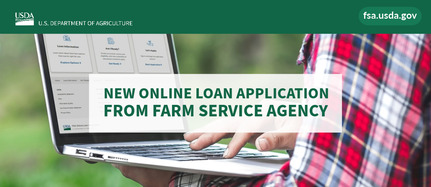
- The Online Loan Application, an interactive, guided application that is paperless and provides helpful features including an electronic signature option, the ability to attach supporting documents such as tax returns, complete a balance sheet, and build a farm operating plan.
- The Loan Assistance Tool that provides customers with an interactive online, step-by-step guide to identifying the direct loan products that may be a fit for their business needs and to understanding the application process.
- A simplified direct loan paper application, which reduced loan applications by more than half, from 29 pages to 13 pages.
More Information
USDA touches the lives of all Americans each day in so many positive ways. In the Biden-Harris administration, USDA is transforming America’s food system with a greater focus on more resilient local and regional food production, fairer markets for all producers, ensuring access to safe, healthy and nutritious food in all communities, building new markets and streams of income for farmers and producers using climate smart food and forestry practices, making historic investments in infrastructure and clean energy capabilities in rural America, and committing to equity across the Department by removing systemic barriers and building a workforce more representative of America. To learn more, visit www.usda.gov.
Looking for ways to do business with USDA that saves you time? Look no further than farmers.gov.
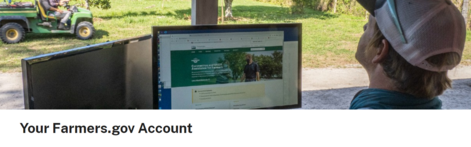
When you create a farmers.gov account for the farmers.gov authenticated site, you have access to self-service features through a secure login. Managing your business with the Farm Service Agency (FSA) and the National Resources Conservation Service (NRCS) is faster than ever. From e-signing documents, viewing, printing, and exporting maps and receiving notifications of payment disbursements, a farmers.gov authenticated account makes doing business with USDA easy and secure.
What can you do with your farmers.gov account?
- Submit a Direct Farm Loan application. This tool and other process improvements allow farmers and ranchers to submit complete loan applications. Helpful features include an electronic signature option, the ability to attach supporting documents such as tax returns, complete a balance sheet, and build a farm operating plan.
- View NRCS Disbursements and Farm Loans financial activity from the past 180 days.
- View, print and export detailed farm records and farm/tract maps.
- Export common land unit (field) boundaries as ESRI and GeoJSON file types.
- Import precision agriculture planting boundaries, create labels containing crop information, and print both on farm tract maps.
- Use the draw tools to determine acres in an area of interest that can be printed on a map and provided to a third party or exported as a feature file for use in other geospatial applications.
- View, upload, download and e-sign NRCS documents.
- Request conservation and financial assistance, including submitting a program application.
- Access information on current and past conservation practices, report practice completion and request practice certification
- View detailed information on previous and ongoing contracts, including the amount of cost- share assistance received and request contract modifications.
- View Farm Loan Program loans: View Farm Loan principal and interest balances, payment history, loan terms, and download interest statements.
How do you create a farmers.gov account?
To create a farmers.gov account you will need:
- A USDA individual customer record - A customer record contains information you have given to USDA to do business with them, like your name, address, phone number, and any legal representative authority relationships.
- A login.gov account – Login.gov is a sign-in service that gives people secure online access to participating government programs.
- Customers who are new to USDA should visit Get Started at Your USDA Service Center, then go to gov/account to create a farmers.gov account.
In addition to the self-service features, farmers.gov also has information on USDA programs, farm loans, disaster assistance, conservation programs and crop insurance.
Livestock inventory records are necessary in the event of a natural disaster, so remember to keep them updated.
When disasters strike, the USDA Farm Service Agency (FSA) can help you if you’ve suffered excessive livestock death losses and grazing or feed losses due to eligible natural disasters.
To participate in the Livestock Indemnity Program (LIP), you’ll be required to provide verifiable documentation of death losses resulting from an eligible adverse weather event and must submit a notice of loss to your local FSA office no later than 60 calendar days after the end of the calendar year in which the eligible loss condition occurred. For the Emergency Assistance for Livestock, Honeybees, and Farm-raised Fish Program (ELAP), you must submit a notice of loss to your local FSA office no later than the annual program application deadline of January 30 following the program year in which the loss occurred and should maintain documentation and receipts.
You should record all pertinent information regarding livestock inventory records including:
- Documentation of the number, kind, type, and weight range of livestock
- Beginning inventory supported by birth recordings or purchase receipts.
For more information on documentation requirements, contact your County USDA Service Center or visit fsa.usda.gov.
The Agricultural Foreign Investment Disclosure Act (AFIDA) requires all foreign owners of U.S. agricultural land to report their holdings to the Secretary of Agriculture. Foreign persons who have purchased or sold agricultural land in the county are required to report the transaction to FSA within 90 days of the closing. Failure to submit the AFIDA form could result in civil penalties of up to 25 percent of the fair market value of the property. County government offices, realtors, attorneys and others involved in real estate transactions are reminded to notify foreign investors of these reporting requirements. The data gained from these disclosures is used in the preparation of periodic reports to the President and Congress concerning the effect of such holdings upon family farms and rural communities. Click here for more information on AFIDA.
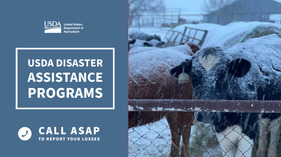 |
Winter storms create significant challenges and often result in catastrophic loss for agricultural producers, especially for those raising livestock, row crops and vulnerable crops like citrus. Despite every attempt to mitigate risk, your operation may suffer losses. As you prepare for the potential impacts of upcoming winter weather, know that USDA offers several programs to help with recovery.
Risk Management
For producers who have risk protection through Federal Crop Insurance or the Noninsured Crop Disaster Assistance Program (NAP), we want to remind you to report crop damage to your crop insurance agent or the local Farm Service Agency (FSA) office.
If you have crop insurance, contact your agency within 72 hours of discovering damage and be sure to follow up in writing within 15 days. If you have NAP coverage, file a Notice of Loss (also called Form CCC-576) within 15 days of loss becoming apparent, except for hand-harvested crops, which should be reported within 72 hours.
Disaster Assistance
USDA also offers disaster assistance programs, which are especially important to livestock, fruit and vegetable, specialty and perennial crop producers.
First, the Livestock Indemnity Program (LIP) and Emergency Assistance for Livestock, Honeybee and Farm-raised Fish Program (ELAP) reimburses producers for a portion of the value of livestock, poultry and other animals that died as a result of a qualifying natural disaster event– like these winter storms – or for loss of grazing acres, feed and forage. To participate in LIP and ELAP, you will need to file a Notice of Loss by the annual program payment application date. The LIP payment application and notice of loss deadline is Feb. 29, 2024, for the 2023 program year and March 3, 2025, for 2024 program year losses. For ELAP, producers are required to complete and a notice of loss to their local FSA office no later than the annual program application deadline of January 30 following the program year in which the loss occurred.
Next, the Tree Assistance Program (TAP) provides cost share assistance to rehabilitate and replant tree, vines or shrubs loss experienced by orchards and nurseries. This complements NAP or crop insurance coverage, which covers the crop but not the plants or trees in all cases.
For TAP, you will need to file a program application within 90 days of the disaster event or the date when the loss of the trees, bushes, or vines is apparent.
Documentation
It’s critical to keep accurate records to document all losses following this devastating cold weather event. Livestock producers are advised to document beginning livestock numbers by taking time and date-stamped video or pictures prior to and after the loss.
Other common documentation options include:
- Purchase records
- Production records
- Vaccination records
- Bank or other loan documents
- Third-party certification
Other Programs
The Emergency Conservation Program and Emergency Forest Restoration Program can assist landowners and forest stewards with financial and technical assistance to restore fencing, damaged farmland or forests, and remove snow from feed stocks, water supplies, and feeding areas.
Additionally, FSA offers a variety of loans available including emergency loans that are triggered by disaster declarations and operating loans that can assist producers with credit needs. You can use these loans to replace essential property, purchase inputs like livestock, equipment, feed and seed, or refinance farm-related debts, and other needs. Additionally, FSA offers several loan servicing options available for borrowers who are unable to make scheduled payments on their farm loan programs debt to the agency because of reasons beyond their control.
Meanwhile, USDA’s Natural Resources Conservation Service (NRCS) provides financial resources through its Environmental Quality Incentives Program to help with immediate needs and long-term support to help recover from natural disasters and conserve water resources. Assistance may also be available for emergency animal mortality disposal from natural disasters and other causes.
Additional Resources
Additional details – including payment calculations – can be found on our NAP, ELAP, LIP, and TAP fact sheets. On farmers.gov, the Disaster Assistance Discovery Tool, Disaster-at-a-Glance fact sheet, and Farm Loan Assistance Tool can help you determine program or loan options.
While we never want to have to implement disaster programs, we are here to help. To inquire about available programs, contact your local USDA Service Center.
Discuss USDA Rural Development's Rural Energy for America (REAP) program and the Value-Added Producer Program (VAPG) with State Coordinator Laura Chavez and Business Programs Loan Specialist Michelle Kelly.
The REAP program provides guaranteed loan financing and grant funding to agricultural producers and rural small businesses for renewable energy systems or to make energy efficiency improvements. Agricultural producers may also apply for new energy efficient equipment and new system loans for agricultural production and processing.
The Value-Added Producer Grant (VAPG) program helps agricultural producers enter value-added activities to generate new products, create and expand marketing opportunities, and increase producer income with priority given to beginning or disadvantaged farmers and ranchers.
For more information, please visit the links below:
http://tinyurl.com/5n9xxpus and https://tinyurl.com/yjytptsb
For more information or questions contact teja.dusanapudi@usda.gov.
Register here: Microsoft Virtual Events Powered by Teams
Who may apply: The Recent Graduate Program is for recently graduated or graduating individuals who are looking for developmental experiences in the Federal Government. Recent graduates are those who have completed an academic program from a qualifying educational institution within the preceding two years. Veterans who were precluded by their military service obligation from meeting this requirement will have up to six years to apply.
Civil Engineer/ Agriculture Engineer - (Recent Graduate)
- Locations: Elko, Fallon, and Yerington, NV (In addition to other states)
- Grade: GS 5-9
- Salary Range: $44,039 - $94,317 per year (Incentives may be authorized)
- Announcement: https://www.usajobs.gov/job/775725900
- Duties: Assists higher graded engineers or field personnel in the planning, design and construction of engineering practices such as water management, animal waste management, erosion control and flood control. (see full list in announcement)
- Closing Date: February 26, 2024
The USDA's Natural Resources Conservation Service (NRCS) in Nevada has announced an additional Fiscal Year (FY) 2024 Environmental Quality Incentives Program (EQIP) signup for the Organic Transition Initiative (OTI). Producers beginning or in the process of transitioning to organic certification are encouraged to apply at their NRCS Service Center.
Applications for EQIP-OTI must be received by the local field office before 4 p.m. on February 29, 2024. Any applications received after the deadline will be considered for funding during the next funding cycle.
NRCS introduced a new organic management conservation practice in fiscal year 2023 as part of the initiative. It allows flexibility for producers to get the assistance and education they need, such as attending workshops or requesting help from experts or mentors. It also supports organic conservation activities and practices required for organic certification and may provide foregone income reimbursement for dips in production during the transition period. Higher payment rates and other options are available for underserved producers including socially disadvantaged, beginning, veteran and limited resource farmers and ranchers.
To learn more about NRCS and its programs, contact your local NRCS office. Office locations can be found by going to https://www.nrcs.usda.gov/conservation-basics/conservation-by-state/nevada and selecting the Nevada Service Center Map
. - The USDA's Natural Resources Conservation Service (NRCS) in Nevada has announced an additional Fiscal Year (FY) 2024 Environmental Quality Incentives Program (EQIP) signup for the Organic Transition Initiative (OTI). Producers beginning or in the process of transitioning to organic certification are encouraged to apply at their NRCS Service Center.
Applications for EQIP-OTI must be received by the local field office before 4 p.m. on February 29, 2024. Any applications received after the deadline will be considered for funding during the next funding cycle.
NRCS introduced a new organic management conservation practice in fiscal year 2023 as part of the initiative. It allows flexibility for producers to get the assistance and education they need, such as attending workshops or requesting help from experts or mentors. It also supports organic conservation activities and practices required for organic certification and may provide foregone income reimbursement for dips in production during the transition period. Higher payment rates and other options are available for underserved producers including socially disadvantaged, beginning, veteran and limited resource farmers and ranchers.
To learn more about NRCS and its programs, contact your local NRCS office. Office locations can be found by going to https://www.nrcs.usda.gov/conservation-basics/conservation-by-state/nevada and selecting the Nevada Service Center Map
. - The USDA's Natural Resources Conservation Service (NRCS) in Nevada has announced an additional Fiscal Year (FY) 2024 Environmental Quality Incentives Program (EQIP) signup for the Organic Transition Initiative (OTI). Producers beginning or in the process of transitioning to organic certification are encouraged to apply at their NRCS Service Center.
Applications for EQIP-OTI must be received by the local field office before 4 p.m. on February 29, 2024. Any applications received after the deadline will be considered for funding during the next funding cycle.
NRCS introduced a new organic management conservation practice in fiscal year 2023 as part of the initiative. It allows flexibility for producers to get the assistance and education they need, such as attending workshops or requesting help from experts or mentors. It also supports organic conservation activities and practices required for organic certification and may provide foregone income reimbursement for dips in production during the transition period. Higher payment rates and other options are available for underserved producers including socially disadvantaged, beginning, veteran and limited resource farmers and ranchers.
To learn more about NRCS and its programs, contact your local NRCS office. Office locations can be found by going to https://www.nrcs.usda.gov/conservation-basics/conservation-by-state/nevada and selecting the Nevada Service Center
. - The USDA's Natural Resources Conservation Service (NRCS) in Nevada has announced an additional Fiscal Year (FY) 2024 Environmental Quality Incentives Program (EQIP) signup for the Organic Transition Initiative (OTI). Producers beginning or in the process of transitioning to organic certification are encouraged to apply at their NRCS Service Center.
Applications for EQIP-OTI must be received by the local field office before 4 p.m. on February 29, 2024. Any applications received after the deadline will be considered for funding during the next funding cycle.
NRCS introduced a new organic management conservation practice in fiscal year 2023 as part of the initiative. It allows flexibility for producers to get the assistance and education they need, such as attending workshops or requesting help from experts or mentors. It also supports organic conservation activities and practices required for organic certification and may provide foregone income reimbursement for dips in production during the transition period. Higher payment rates and other options are available for underserved producers including socially disadvantaged, beginning, veteran and limited resource farmers and ranchers.
To learn more about NRCS and its programs, contact your local NRCS office. Office locations can be found by going to https://www.nrcs.usda.gov/conservation-basics/conservation-by-state/nevada and selecting the Nevada Service Center Map.
The U.S. Department of Agriculture’s Natural Resources Conservation Service (NRCS) of Nevada is offering financial and technical assistance to help agricultural producers apply conservation
practices through the Environmental Quality Incentives Program - Conservation Incentive Contracts (EQIP-CIC).
Applications for EQIP-CIC must be received by the local field office before 4 p.m. on March 1, 2024Any applications received after the deadline will be considered for funding during the next funding cycle.
EQIP-CIC is designed to be a steppingstone between EQIP and the Conservation Stewardship Program (CSP), to help producers move from correcting resource issues on specific land unites through EQIP to achieving sustainable stewardship on their entire operation.
Historically underserved (HU) participants, including limited resource farmers and ranchers, beginning farmers and ranchers, socially disadvantaged farmers and ranchers, and veteran farmers and ranchers are eligible for advance payments to help offset costs related to purchasing materials or contracting services through EQIP. HU participants may elect to receive an advance of not less than 50 percent of the EQIP conservation practice payment amount. Participants who receive advance payment must expend the funds within 90 days of receiving the advance.
To learn more about EQI-CIC, or for general information about NRCS programs, contact your local NRCS office.
The U.S Department of Agriculture’s Natural Resources Conservation Service (NRCS) is offering financial and technical assistance to help agricultural producers apply conservation practices through the Environmental Quality Incentives Program (EQIP) and the Agricultural Management Assistance Program (AMA). Approximately $17 million is available to producers through EQIP and AMA.
Applications for EQIP and AMA must be received by the local field office before 4 p.m. on March 29, 2024. Any applications received after the March 29 deadline will be considered for funding during the next funding cycle. Eligibility for applications will be determined by April 26, 2024, and money will be obligated by June 14, 2024.
To learn more about EQIP and AMA, or for general information about NRCS programs, contact your local NRCS office. Office locations can be found by going to https://www.nrcs.usda.gov/conservation-basics/conservation-by-state/nevada and selecting the Nevada Service Center Map.
The Natural Resources Conservation Service (NRCS) accepting applications for the Conservation Stewardship Program (CSP). CSP helps agricultural producers maintain and improve their existing conservation systems and adopt additional conservation activities to address priority natural resource concerns.
Applications for the classic CSP and Inflation Reduction Act funded versions are due before 4 p.m. on April 5, 2024. Any applications received after the March 29 deadline will be considered for funding during the next funding cycle. For both the Classic and IRA CSP, eligibility will be determined by May 3, field verification will be done by May 17, and money will be obligated by July 12, 2024.
The following amounts are available under each program:
- CSP-IRA: $775,000.00
- CSP Classic: $1,162,000.00
CSP is for all private working lands and agricultural land under jurisdiction of a tribe. This program provides annual payments for meeting certain benchmarks in the management of the land. Additional payments are earned by agreeing to complete enhancements to the land. On-farm benefits include increased crop yields, decreased inputs, wildlife habitat improvements, and better resilience to weather variables.
To learn more about CSP, or for general information about NRCS programs contact your local NRCS office. Office locations can be found by going to https://www.nrcs.usda.gov/conservation-basics/conservation-by-state/nevada and selecting the Nevada Service Center Map.
USDA’s Natural Resources Conservation Service (NRCS) is seeking public comment on proposed revisions to eight national conservation practice standards. Comments are due March 4, 2024.
Proposed revisions to the national conservation practice standards include:
• Field Border (Code 386);
• Filter Strip (Code 393);
• Grazing Management (Code 528);
• Hedgerow Planting (Code 422);
• Mulching (Code 484);
• Seasonal Water Management for Wildlife (Code 646);
• Structure for Water Control (Code 587); and
• Wetland Restoration (Code 657).
Proposed text can be found on this NRCS webpage. Changes are included in this notice on the Federal Register. Comments should be submitted via regulations.gov or via mail by March 4, 2024.
NRCS regularly reviews all national conservation practices to seek opportunities to increase flexibility and incorporate new technologies to help the nation’s farmers, ranchers, and private forest landowners better protect natural resources on their working lands. NRCS’s conservation practices offer guidelines for planning, installing, operating and maintaining conservation practices nationwide.
|