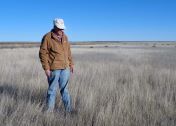
The U.S. Department of Agriculture (USDA) is now accepting applications for the Continuous Conservation Reserve Program (Continuous CRP). USDA’s Farm Service Agency (FSA) encourages agricultural producers and landowners in Minnesota who are interested in conservation opportunities for their land in exchange for yearly rental payments to consider the enrollment options available through Continuous CRP, which also includes the Conservation Reserve Enhancement Program (CREP) offered by FSA partners. Additionally, producers participating in CRP can now apply to re-enroll, if their contracts will expire this year.
To submit an offer, producers should contact the FSA at their local USDA Service Center by July 31, 2024, in order to have an offer effective by Oct. 1, 2024. To ensure enrollment acreages do not exceed the statutory cap, FSA will accept offers from producers on a first-come, first-served basis and will return offers for approval in batches throughout the year.
Additionally, producers with acres enrolled in Continuous CRP set to expire Sept. 30, 2024, can now offer acres for re-enrollment. A producer can both enroll new acres into Continuous CRP and re-enroll any acres expiring Sept. 30, 2024.
FSA water quality practices, such as riparian buffers, prairie strips, grassed waterways, and wetlands, will receive an additional 20% incentive. Buffer practices have a positive impact on water quality. Additionally, the Climate-Smart Practice Incentive launched in 2021 is also available in the Continuous signup.
|
 |
Technical and Financial Assistance is Available
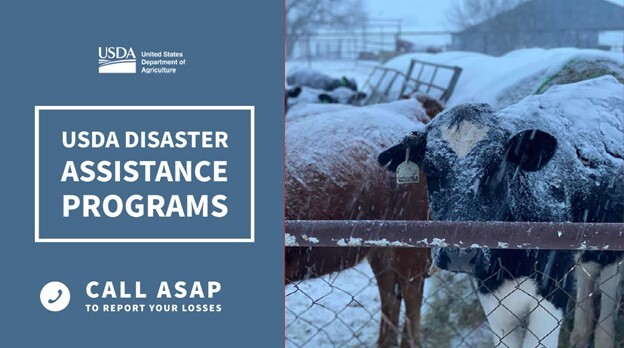
Winter storms create significant challenges and often result in catastrophic loss for agricultural producers, especially for those raising livestock, row crops and vulnerable crops like citrus. Despite every attempt to mitigate risk, your operation may suffer losses. As you prepare for the potential impacts of upcoming winter weather, know that USDA offers several programs to help with recovery.
Risk Management
For producers who have risk protection through Federal Crop Insurance or the Noninsured Crop Disaster Assistance Program (NAP), we want to remind you to report crop damage to your crop insurance agent or the local Farm Service Agency (FSA) office.
If you have crop insurance, contact your agency within 72 hours of discovering damage and be sure to follow up in writing within 15 days. If you have NAP coverage, file a Notice of Loss (also called Form CCC-576) within 15 days of loss becoming apparent, except for hand-harvested crops, which should be reported within 72 hours.
Disaster Assistance
USDA also offers disaster assistance programs, which are especially important to livestock, fruit and vegetable, specialty and perennial crop producers.
First, the Livestock Indemnity Program (LIP) and Emergency Assistance for Livestock, Honeybee and Farm-raised Fish Program (ELAP) reimburses producers for a portion of the value of livestock, poultry and other animals that died as a result of a qualifying natural disaster event– like these winter storms – or for loss of grazing acres, feed and forage. To participate in LIP and ELAP, you will need to file a Notice of Loss by the annual program payment application date. The LIP payment application and notice of loss deadline is Feb. 29, 2024, for the 2023 program year and March 3, 2025, for 2024 program year losses. For ELAP, producers are required to complete and a notice of loss to their local FSA office no later than the annual program application deadline of January 30 following the program year in which the loss occurred.
Next, the Tree Assistance Program (TAP) provides cost share assistance to rehabilitate and replant tree, vines or shrubs loss experienced by orchards and nurseries. This complements NAP or crop insurance coverage, which covers the crop but not the plants or trees in all cases.
For TAP, you will need to file a program application within 90 days of the disaster event or the date when the loss of the trees, bushes, or vines is apparent.
Documentation
It’s critical to keep accurate records to document all losses following this devastating cold weather event. Livestock producers are advised to document beginning livestock numbers by taking time and date-stamped video or pictures prior to and after the loss.
Other common documentation options include:
- Purchase records
- Production records
- Vaccination records
- Bank or other loan documents
- Third-party certification
Other Programs
The Emergency Conservation Program and Emergency Forest Restoration Program can assist landowners and forest stewards with financial and technical assistance to restore fencing, damaged farmland or forests, and remove snow from feed stocks, water supplies, and feeding areas.
Additionally, FSA offers a variety of loans available including emergency loans that are triggered by disaster declarations and operating loans that can assist producers with credit needs. You can use these loans to replace essential property, purchase inputs like livestock, equipment, feed and seed, or refinance farm-related debts, and other needs. Additionally, FSA offers several loan servicing options available for borrowers who are unable to make scheduled payments on their farm loan programs debt to the agency because of reasons beyond their control.
Meanwhile, USDA’s Natural Resources Conservation Service (NRCS) provides financial resources through its Environmental Quality Incentives Program to help with immediate needs and long-term support to help recover from natural disasters and conserve water resources. Assistance may also be available for emergency animal mortality disposal from natural disasters and other causes.
Additional Resources
Additional details – including payment calculations – can be found on our NAP, ELAP, LIP, and TAP fact sheets. On farmers.gov, the Disaster Assistance Discovery Tool, Disaster-at-a-Glance fact sheet, and Farm Loan Assistance Tool can help you determine program or loan options.
While we never want to have to implement disaster programs, we are here to help. To inquire about available programs, contact your local USDA Service Center.

The U.S. Department of Agriculture (USDA) is offering financial assistance to agricultural producers and private landowners enrolled in its Conservation Reserve Program (CRP) to improve the health of their forests. The Forest Management Incentive, available through USDA’s Farm Service Agency (FSA), can help participants with forest management practices, such as brush management and prescribed burning.
The Forest Management Incentive is available to participants with active CRP contracts with forest cover that are not within two years of expiring. The incentive is a payment to eligible CRP participants who properly completed authorized forest management practice activities to improve the condition of resources, promote forest management and enhance wildlife habitat.
Forest management practices include brush management, herbaceous weed control, prescribed burning, firebreaks, development of early successional habitat and forest stand improvement. Additional information is available in our Forest Management Incentive fact sheet.
Participants can now submit offers for the Forest Management Incentive. Interested producers should contact the FSA at their local USDA Service Center.
The Inflation Reduction Act of 2022 (Pub. L. 117-169) and the Further Continuing Appropriations and Other Extensions Act, 2024 (Pub. L. 118-22), extended the authority and provided funding for the Forest Management Incentive until 2031.
The Forest Management Incentive was launched in 2020 and is one of the many natural resource conservation options available through CRP. Currently, the Forest Management Incentive has participants in 27 states.
Producers not currently participating in CRP can now submit offers for Continuous CRP. Learn more.
|
|