Happy New Year! While we are almost one month into the new year, we have experienced record-breaking cold and rain events across the state. I hope you and your families are safe after these disruptive weather events. If you experienced losses in your operation, USDA’s Disaster Assistance Discovery Tool is a good resource to determine assistance available to help you recover.
Right now, our offices are busy assisting producers to signup for the Livestock Forage Program (LFP) and the Emergency Assistance for Livestock, Honeybees, and Farm-Raised Fish Program (ELAP) for eligible 2023 calendar year losses. For 2023, more than 240 Texas counties are eligible for LFP due to qualifying drought conditions throughout the year. If you have not contacted your local FSA office to apply or schedule an appointment, you should do so by the Jan. 30, 2024 deadline.
In Nov. 2023, FSA announced a waiver of certain notice of loss requirements for ELAP and the Livestock Indemnity Program. If you experienced eligible losses for either of these programs during 2023, you should report these losses by the Jan. 30, 2024 deadline.
The election and enrollment period for the Agriculture Risk Coverage (ARC) and Price Loss Coverage Programs (PLC) for the 2024 crop year opened on Dec. 18, 2023. The extension of the 2018 Farm bill through Sept. 30, 2024, included an extension of the ARC and PLC programs with no changes. The deadline to make an election and enroll is March 15, 2024. If you are eligible for ARC or PLC, I highly encourage you to schedule an appointment with you local FSA office to complete the process ahead of time and avoid a last-minute rush.
FSA also has a fast-approaching deadline for the Food Safety Certification for Specialty Crops Program (FSCSC). Producers who incurred on-farm food safety program expenses related to obtaining or renewing a food safety certification in calendar year 2023 may be interested in FSCSC. Eligible expenses include developing a food safety plan, food safety certification, or training expenses. The deadline to apply for FSCSC is Jan. 31, 2024. Your local FSA staff can answer questions you have about this program.
The entire Texas FSA team looks forward to serving you in 2024. For more information on FSA programs, contact your local FSA office of visit fsa.usda.gov.
Sincerely,
Kelly Adkins
State Executive Director
Farm Service Agency - Texas
|
Greetings and Happy New Year! I am excited to head into 2024 with conservation in mind.
If you haven’t visited with staff in your local field office recently, I encourage you to reach out as soon as possible. We have a couple of program application batching timelines that are rapidly approaching.
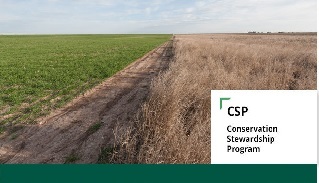
The first timeline to note is for the Conservation Stewardship Program (CSP) (both Classic and CSP-Inflation Reduction Act [IRA]). Although applications are accepted continuously, to take advantage of initial fiscal year (FY) 2024 funding, applications must be submitted to the local field office by Jan. 26, 2024.
USDA is increasing the minimum annual payment for agricultural producers participating in the Conservation Stewardship Program (CSP) from $1,500 to $4,000 starting in FY24. The increase addresses challenges faced by small scale, underserved, and urban producers and improves equity in the program by making participation more financially beneficial for smaller operations. The new minimum payment is available for new and renewed CSP contracts.
NRCS Texas is also currently accepting applications for the Environmental Quality Incentives Program (EQIP) Organic Transition Initiative (OTI). NRCS will help producers adopt the new organic management standard, which allows flexibility for producers to get the assistance and education they need such as attending workshops or requesting help from experts or mentors. It supports conservation practices required for organic certification and may provide foregone income reimbursement for dips in production during the transition period. Producers must submit their applications by Jan. 26, 2024, to be considered for FY24 funding. Reach out to your local office for more information.
Last month, the U.S. Department of Agriculture (USDA), Farm Service Agency (FSA), and Natural Resources Conservation Service (NRCS) held a Ribbon Cutting and Open House for the new USDA Urban Service Center in Dallas. Officially open since April 2023, the event provided an opportunity for urban and innovative producers, agency leadership and staff, congressional staff, partners, and the public to come together and celebrate. Read the full story on the NRCS Texas website.
The nation’s largest farmer-led, farmer focused convention, Commodity Classic, is being held in Houston, Texas, from Feb. 28 – Mar. 2, 2024. It is presented annually by the American Soybean Association, National Corn Growers Association, National Association of Wheat Growers, National Sorghum Producers, and the Association of Equipment Manufacturers. If you are attending this year, make sure to stop by the NRCS booth to learn more about our programs and services.
2024 is already shaping up to be an exciting year for agriculture in Texas. I encourage you to visit with staff at your local office to find out how NRCS can help you achieve your conservation goals.
Sincerely,
Kristy Oates
State Conservationist
Natural Resources Conservation Service - Texas
|
Severe weather events create significant challenges and often result in catastrophic loss for agricultural producers. Despite every attempt to mitigate risk, your operation may suffer losses. USDA offers several programs to help with recovery.
Risk Management
For producers who have risk protection through Federal Crop Insurance or the Noninsured Crop Disaster Assistance Program (NAP), we want to remind you to report crop damage to your crop insurance agent or the local Farm Service Agency (FSA) office.
If you have crop insurance, contact your agency within 72 hours of discovering damage and be sure to follow up in writing within 15 days. If you have NAP coverage, file a Notice of Loss (also called Form CCC-576) within 15 days of loss becoming apparent, except for hand-harvested crops, which should be reported within 72 hours.
Disaster Assistance
USDA also offers disaster assistance programs, which is especially important to livestock, fruit and vegetable, specialty and perennial crop producers who have fewer risk management options.
First, the Livestock Indemnity Program (LIP) and Emergency Assistance for Livestock, Honeybee and Farm-raised Fish Program (ELAP) reimburses producers for a portion of the value of livestock, poultry and other animals that died as a result of a qualifying natural disaster event or for loss of grazing acres, feed and forage. And, the Livestock Forage Disaster Program (LFP) provides assistance to producers of grazed forage crop acres that have suffered crop loss due to a qualifying drought. Livestock producers suffering the impacts of drought can also request Emergency Haying and Grazing on Conservation Reserve Program (CRP) acres.
Next, the Tree Assistance Program (TAP) provides cost share assistance to rehabilitate and replant tree, vines or shrubs loss experienced by orchards and nurseries. This complements NAP or crop insurance coverage, which cover the crop but not the plants or trees in all cases.
For LIP and ELAP, you will need to file a Notice of Loss for livestock and grazing or feed losses by the application deadline for each program. For TAP, you will need to file a program application within 90 days.
Documentation
It’s critical to keep accurate records to document all losses following this devastating cold weather event. Livestock producers are advised to document beginning livestock numbers by taking time and date-stamped video or pictures prior to after the loss.
Other common documentation options include:
- Purchase records
- Production records
- Vaccination records
- Bank or other loan documents
- Third-party certification
Other Programs
The Emergency Conservation Program and Emergency Forest Restoration Program can assist landowners and forest stewards with financial and technical assistance to restore damaged farmland or forests.
Additionally, FSA offers a variety of loans available including emergency loans that are triggered by disaster declarations and operating loans that can assist producers with credit needs. You can use these loans to replace essential property, purchase inputs like livestock, equipment, feed and seed, or refinance farm-related debts, and other needs.
Meanwhile, USDA’s Natural Resources Conservation Service (NRCS) provides financial resources through its Environmental Quality Incentives Program to help with immediate needs and long-term support to help recover from natural disasters and conserve water resources. Assistance may also be available for emergency animal mortality disposal from natural disasters and other causes.
Additional Resources
Additional details – including payment calculations – can be found on our NAP, ELAP, LIP, and TAP fact sheets. On farmers.gov, the Disaster Assistance Discovery Tool, Disaster-at-a-Glance fact sheet, and Farm Loan Discovery Tool can help you determine program or loan options.
While we never want to have to implement disaster programs, we are here to help. To file a Notice of Loss or to ask questions about available programs, contact your local USDA Service Center.
The U.S. Department of Agriculture (USDA) announced that agricultural producers can now enroll in the Farm Service Agency’s (FSA) Agriculture Risk Coverage (ARC) and Price Loss Coverage (PLC) programs for the 2024 crop year. Producers can enroll and make election changes for the 2024 crop year starting Dec. 18, 2023. The deadline to complete enrollment and any election change is March 15, 2024.
On Nov. 16, 2023, President Biden signed into law H.R. 6363, the Further Continuing Appropriations and Other Extensions Act, 2024 (Pub. L. 118-22), which extended the Agriculture Improvement Act of 2018 (Pub. L. 115-334), more commonly known as the 2018 Farm Bill, through September 30, 2024. This extension allows authorized programs, including ARC and PLC, to continue operating.
2024 Elections and Enrollment
Producers can elect coverage and enroll in ARC-County (ARC-CO) or PLC, which provide crop-by-crop protection, or ARC-Individual (ARC-IC), which protects the entire farm. Although election changes for 2024 are optional, producers must enroll through a signed contract each year. Also, if a producer has a multi-year contract on the farm it will continue for 2024 unless an election change is made.
If producers do not submit their election revision by the March 15, 2024, deadline, their election remains the same as their 2023 election for commodities on the farm. Farm owners cannot enroll in either program unless they have a share interest in the cropland.
Covered commodities include barley, canola, large and small chickpeas, corn, crambe, flaxseed, grain sorghum, lentils, mustard seed, oats, peanuts, dry peas, rapeseed, long grain rice, medium grain rice, safflower seed, seed cotton, sesame, soybeans, sunflower seed and wheat.
2022 Crop Year Payments
This fall, FSA issued payments totaling more than $267 million to agricultural producers who enrolled in the 2022 ARC-CO option and the ARC ARC-IC option for covered commodities that triggered a payment. Payments through the PLC option did not trigger for the 2022 crop year.
ARC and PLC payments for a given crop year are paid out the following fall to allow actual county yields and the Market Year Average prices to be finalized. These payments help mitigate fluctuations in either revenue or prices for certain crops. Payments for crops that may trigger for the 2023 crop year will be issued in the fall of 2024.
Crop Insurance Considerations
ARC and PLC are part of a broader USDA safety net that also includes crop insurance and marketing assistance loans.
Producers are reminded that ARC and PLC elections and enrollments can impact eligibility for some crop insurance products.
Producers on farms with a PLC election can purchase Supplemental Coverage Option (SCO) through their Approved Insurance Provider; however, producers on farms where ARC is the election are ineligible for SCO on their planted acres for that crop on that farm.
Unlike SCO, the Enhanced Coverage Option (ECO) is unaffected by an ARC election. Producers may add ECO regardless of the farm program election.
Upland cotton farmers who choose to enroll seed cotton base acres in ARC or PLC are ineligible for the stacked income protection plan (STAX) on their planted cotton acres for that farm.
Web-Based Decision Tools
Many universities offer web-based decision tools to help producers make informed, educated decisions using crop data specific to their respective farming operations. Producers are encouraged to use the tool of their choice to support their ARC and PLC elections.
More Information
For more information on ARC and PLC, producers can visit the ARC and PLC webpage or contact their local USDA Service Center. Producers can also make elections and complete enrollment online with level 2 eAuth.
While the NRCS continuously accepts applications for enrollment into the Conservation Stewardship Program (CSP) (both Classic and CSP-Inflation Reduction Act [IRA]) throughout the year, interested applicants must submit applications to the local U.S. Department of Agriculture (USDA) Natural Resources Conservation Service (NRCS) field office by Jan. 26, 2024, for the CSP Classic and the CSP-IRA sign up. Any applications received after Jan. 26, 2024, will be considered for future CSP application sign ups.
USDA is increasing the minimum annual payment for agricultural producers participating in the Conservation Stewardship Program (CSP) from $1,500 to $4,000 starting in fiscal year 2024. The increase addresses challenges faced by small scale, underserved, and urban producers and improves equity in the program by making participation more financially beneficial for smaller operations. The new minimum payment is available for new and renewed CSP contracts.
CSP helps farmers, ranchers, and forest landowners to build on their existing conservation efforts while strengthening their operation. CSP participants earn an annual payment for 5 years which enables them to achieve a greater level on conservation and stewardship. Whether you are looking to improve grazing conditions, increase crop resiliency, or develop wildlife habitat, NRCS can custom design a CSP plan to help you meet those goals. CSP-IRA provides an exciting opportunity for producers to install conservation activities promoting climate-smart agriculture and forestry greenhouse gas mitigation on their agricultural operation.
CSP offers technical and financial assistance to help agricultural and forest producers take their conservation efforts to the next level. The program is designed to compensate agricultural and forest producers who agree to increase their level of conservation by adopting additional conservation activities and maintaining their baseline level of conservation.
Examples of CSP enhancements that are suitable for being adopted by smaller scale and urban producers include:
- Planting multi-species cover crops
- Mulching with natural materials
- Establishing pollinator habitats
- Soil health crop rotation
Inflation Reduction Act and CSP
Currently, an unprecedented amount of funding is available for CSP through the Inflation Reduction Act and Farm Bill. The Inflation Reduction Act provided $19.5 billion in additional funding for NRCS’ oversubscribed programs like CSP for five years. Inflation Reduction Act funds are available to help producers adopt climate-smart practices.
NRCS recently announced it increased the number of Climate-Smart Agricultural and Forestry Mitigation Activities eligible for Inflation Reduction Act funding for fiscal year 2024 through CSP, the Environmental Quality Incentives Program (EQIP), and the Regional Conservation Partnership Program (RCPP). To learn more, download the list of practices and a fact sheet.
How to Apply
NRCS accepts producer applications for its conservation programs year-round, but producers interested in CSP should apply by Jan. 26, 2024, for consideration. Funding is provided through a competitive process and will include an opportunity to address the unmet demand from producers who have previously sought funding.
For more information about assistance available, contact your local USDA Service Center.
Agricultural producers who farm or ranch in coastal states are recommended to consider Hurricane Insurance Protection – Wind Index (HIP-WI), which covers a portion of the deductible of the underlying crop insurance policy when a county, or county adjacent, is within the area of sustained hurricane-force winds. HIP-WI also includes a Tropical Storm Option. To date, this coverage has provided $700 million to producers, which includes payments for both hurricanes and tropical storms.
Last fall, USDA’s Risk Management Agency (RMA) received valuable feedback from producers, agents, and Approved Insurance Providers on ways to improve education. In response, RMA developed new resources including a video, a podcast, and updated frequently asked questions. RMA will continue to collect feedback to strengthen this vital tool for producers in hurricane prone areas. Upcoming sales closing dates are January 31, February 28, and March 15. To purchase before your sales closing date, speak to a crop insurance agent as soon as possible.
Learn more about HIP-WI.
The U.S. Department of Agriculture (USDA) is now accepting applications for the Continuous Conservation Reserve Program (Continuous CRP). USDA’s Farm Service Agency (FSA) encourages agricultural producers and landowners in Texas who are interested in conservation opportunities for their land in exchange for yearly rental payments to consider the enrollment options available through Continuous CRP, which also includes the Conservation Reserve Enhancement Program (CREP) offered by FSA partners. Additionally, producers participating in CRP can now apply to re-enroll, if their contracts will expire this year.
To submit an offer, producers should contact the FSA at their local USDA Service Center by July 31, 2024, in order to have an offer effective by Oct. 1, 2024. To ensure enrollment acreages do not exceed the statutory cap, FSA will accept offers from producers on a first-come, first-served basis and will return offers for approval in batches throughout the year.
Additionally, producers with acres enrolled in Continuous CRP set to expire Sept. 30, 2024, can now offer acres for re-enrollment. A producer can both enroll new acres into Continuous CRP and re-enroll any acres expiring Sept.30, 2024.
FSA water quality practices, such as riparian buffers, prairie strips, grassed waterways, and wetlands, will receive an additional 20% incentive. Buffer practices have a positive impact on water quality. Additionally, the Climate-Smart Practice Incentive launched in 2021 is also available in the Continuous signup.
The U.S. Department of Agriculture (USDA) is offering financial assistance to agricultural producers and private landowners enrolled in its Conservation Reserve Program (CRP) to improve the health of their forests. The Forest Management Incentive, available through USDA’s Farm Service Agency (FSA), can help participants with forest management practices, such as brush management and prescribed burning.
The Forest Management Incentive is available to participants with active CRP contracts with forest cover that are not within two years of expiring. The incentive is a payment to eligible CRP participants who properly completed authorized forest management practice activities to improve the condition of resources, promote forest management and enhance wildlife habitat.
Forest management practices include brush management, herbaceous weed control, prescribed burning, firebreaks, development of early successional habitat and forest stand improvement. Additional information is available in our Forest Management Incentive fact sheet.
Participants can now submit offers for the Forest Management Incentive. Interested producers should contact the FSA at their local USDA Service Center.
The Inflation Reduction Act of 2022 (Pub. L. 117-169) and the Further Continuing Appropriations and Other Extensions Act, 2024 (Pub. L. 118-22), extended the authority and provided funding for the Forest Management Incentive until 2031.
The Forest Management Incentive was launched in 2020 and is one of the many natural resource conservation options available through CRP. Currently, the Forest Management Incentive has participants in 27 states.
Producers not currently participating in CRP can now submit offers for Continuous CRP. Learn more.
Navigating filing taxes can be challenging, especially if you are new to running a farm business, participating in disaster programs for first time, or trying to forecast the farm’s tax bill. Receiving funds from USDA through activities such as a conservation program payment or a disaster program is considered farm income that includes a tax liability for farm businesses. USDA technical assistance is free and creates no tax implications.
At the end of the tax year, USDA issues tax forms 1098 and 1099 forms for farm loans, conservation programs administered by the Farm Service Agency and Natural Resource Conservation Service including the Conservation Reserve Program and Environmental Quality Incentives Program, crop disaster payments, and the Market Facilitation Program. USDA also issues tax forms for recipients of assistance for distressed borrowers, including through Section 22006 of the Inflation Reduction Act.
If you have received tax forms related to your operation, USDA cannot and does not provide tax advice but wants you to be aware of options that may help manage your tax liability. USDA has partnered with experts to provide resources to help you make the right tax decisions for your operation. Monthly webinars are available for registration and to view on demand at https://www.farmers.gov/working-with-us/taxes.
The Tax Estimator Tool is an interactive spreadsheet that producers can download to estimate tax liability. It is for informational and educational purposes and should not considered tax or legal advice. Producers may need to work with a tax professional to determine the correct information to be entered in the Tax Estimator Tool.
We encourage you to visit https://www.farmers.gov/working-with-us/taxes for more information on how to find and work with a tax preparer as well as instructions on how to request copies of USDA documents and links to other helpful tax resources.
The U.S. Department of Agriculture (USDA) reminds specialty crop growers that assistance is available for producers who incur eligible on-farm food safety program expenses to obtain or renew a food safety certification through the Food Safety Certification for Specialty Crops (FSCSC) program. Producers can apply for assistance on their calendar year 2023 expenses through Jan. 31, 2024.
Program Details
FSCSC assists specialty crop operations that incurred eligible on-farm food safety certification and related expenses pertaining to obtaining or renewing a food safety certification in calendar year 2023. FSCSC covers a percentage of the specialty crop operation’s cost of obtaining or renewing its certification, as well as a portion of related expenses.
To be eligible for FSCSC, the applicant must be a specialty crop operation; meet the definition of a small business or very small business; and have paid eligible expenses related to the 2023 certification.
Specialty crop operations may receive assistance for the following costs:
- Developing a food safety plan for first-time food safety certification.
- Maintaining or updating an existing food safety plan.
- Food safety certification.
- Certification upload fees.
- Microbiological testing for products, soil amendments and water.
FSCSC payments are calculated separately for each category of eligible costs. A higher payment rate has been set for socially disadvantaged, limited resource, beginning and veteran farmers and ranchers. Details about the payment rates and limitations can be found at farmers.gov/food-safety.
Applying for Assistance
The FSCSC application period for 2023 closes Jan. 31, 2024. FSA will issue payments after the application period closes. If calculated payments exceed the amount of available funding, payments will be prorated.
Interested specialty crop producers can apply by completing the FSA-888, Food Safety Certification for Specialty Crops Program (FSCSC) application. The application, along with other required documents, can be submitted to the FSA office at any USDA Service Center nationwide by mail, fax, hand delivery or via electronic means.
Specialty crop producers can also call 877-508-8364 to speak directly with a USDA employee ready to assist. Visit farmers.gov/food-safety for additional program details, eligibility information and forms needed to apply.
The Farm Service Agency (FSA) has several loan programs to help you start or continue an agriculture production. Farm ownership and operating loans are available.
While all qualified producers are eligible to apply for these loan programs, FSA has provided priority funding for members of targeted underserved applicants.
A targeted underserved applicant is one of a group whose members have been subjected to racial, ethnic or gender prejudice because of his or her identity as members of the group without regard to his or her individual qualities.
For purposes of this program, targeted underserved groups are women, African Americans, American Indians, Alaskan Natives, Hispanics, Asian Americans and Pacific Islanders.
FSA loans are only available to applicants who meet all the eligibility requirements and are unable to obtain the needed credit elsewhere.
Farm Service Agency (FSA) farm loans are considered progression lending. Unlike loans from a commercial lender, FSA loans are intended to be temporary in nature. Our goal is to help you graduate to commercial credit, and our farm loan staff is available to help borrowers through training and credit counseling.
The FSA team will help borrowers identify their goals to ensure financial success. FSA staff will advise borrowers on developing strategies and a plan to meet your goals and graduate to commercial credit. FSA borrowers are responsible for the success of their farming operation, but FSA staff will help in an advisory role, providing the tools necessary to help you achieve your operational goals and manage your finances.
For more information on FSA farm loan programs, contact your local USDA Service Center or visit fsa.usda.gov.
|