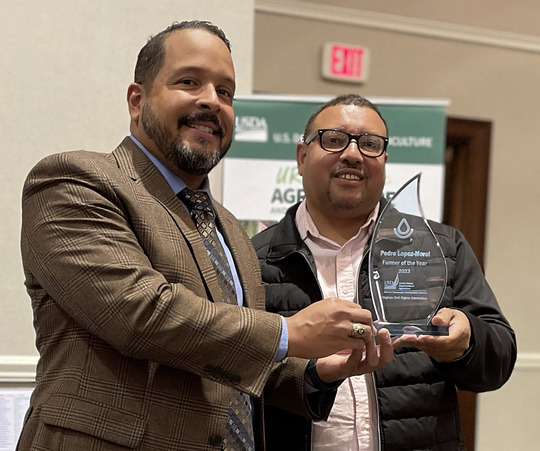
 Pedro Lopez Morel (right) receives his Farmer of the Year award from NRCS State Conservationist Dr. Edwin Martinez Martinez (Photo: Tatiana Gil, NRCS).
NRCS Selects Pedro Lopez Morel of Lawrenceville as Minority Farmer of the Year for 2023
RICHMOND, Va. – Pedro Lopez Morel of Lawrenceville, whose one-acre home lot may be the most intensively farmed property in Virginia, has been honored by the USDA's Natural Resources Conservation Service (NRCS) as the state's Minority Farmer of the Year for 2023.
Lopez, who was born in the Dominican Republic and has since become a naturalized American citizen, received his award from Dr. Edwin Martinez Martinez, NRCS' state conservationist for Virginia, on Jan. 20 at the Virginia Association for Biological Farming's Small Farm Outreach Summit in Roanoke.
Lopez came to the U.S. at age 21 in 1985 without farming skills or experience. He first landed a job as kitchen help in an Italian restaurant in New Jersey, eventually learning the chef's duties by watching the cook at work. After relocating in Brunswick County to cook at another restaurant, he realized he could generate more income by growing and selling food items than by preparing them for diners.
By 2017, he was ready to farm full-time and looking for help in making the transition. He affiliated with Virginia State University's Small Farm Outreach program, which led him to his regional NRCS field office. He remains active in the VSU program, although now it's as a mentor as he conducts clinics on how to grow some of his tropical plants in a non-tropical environment.
Lopez's business plan is to sell to both restaurants and at farmers markets. His goal is to not only sell food items popular with average Virginians, but also to provide "taste of home" produce for Hispanic buyers seeking authentic fruits and vegetables normally grown in Central America and the Caribbean islands.
The tropical plants require extensive use of high tunnels, enclosures that allow Lopez to extend his growing seasons and to shelter plants during Virginia's cold winters. Lopez now has nine of these structures in his crowded back yard with four of them partially funded by NRCS' Environmental Quality Incentives Program (EQIP), which is geared to assist beginning farmers.
He's currently producing between 35 and 40 different fruit and vegetable varieties. He and a partner share the expense of renting some nearby acreage to expand their growing capacities in the summer months, but the heart of Lopez's operation remains his residence, which sits on .97 acres and includes not only his house and driveway, but outdoor quarters for goats, chickens and other species of poultry.
"I want to do more expansion," he said. "At first, I concentrated on the tropical plants, but my American customers wanted more traditional American food items. I find room for them somewhere."
Tropical plants he raises include bananas, plantains, limes, tomatillos, habanero peppers and other species seldom grown in or even associated with Virginia. His current project involves permanently enclosing one of his home-made high tunnels to allow it to house freezers and serve as a cold storage room.
"At NRCS, we're committed to working effectively with agricultural producers in every county of the state, regardless of the size of their operations. We do so in collaboration with all our valuable partners," Martinez said. "VSU's Small Farm Outreach is a program we support and one that can make a difference by allowing new growers like Pedro to see all the opportunities they have."
"If I have a message for other people like me," Lopez said, "it's that there's no such thing as a space too small for farming. Don't wait until you can have a full-size farm. The best time to start is always now."
###
|