|
|
Benton County Farm Service Agency - December 29, 2023
|
|
|
|
Farm Service Agency | Natural Resources Conservation Service | Risk Management Agency
|
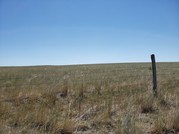
The U.S. Department of Agriculture (USDA) Farm Service Agency (FSA) Executive Director Acting CED, Teresa D. Collins, in Benton County today announced that FSA is now accepting applications for the Livestock Forage Disaster Program (LFP) for grazing losses due to drought. The deadline to apply for 2023 LFP assistance is Jan. 30, 2024.
LFP provides compensation to eligible livestock producers who suffered grazing losses for covered livestock due to drought on privately owned or cash leased land or fire on federally managed land. For LFP, qualifying drought intensity levels are determined using the U.S. Drought Monitor. Producers in Benton County are eligible to apply for 2023 LFP benefits for grazing losses on improved pasture mixed forage. Visit the FSA LFP webpage for a full list of eligible counties and pasture types.
Livestock eligible for LFP include alpacas, beef cattle, bison, buffalo, beefalo, dairy cattle, deer, elk, emus, equine, goats, llamas, ostriches, reindeer, or sheep that have been or would have been grazing the eligible grazing land or pastureland. Recently, FSA updated LFP policy to expand program eligibility to include additional income producing grazing animals, like horses and ostrich, that contribute to the commercial viability of an agricultural operation.
Livestock used for hunting and consumption by the owner and horses and other animals that are used or intended to be used for racing and wagering remain ineligible.
As a reminder, producers who want to participate in many USDA programs including disaster assistance programs like LFP, must file timely acreage reports by filling out the FSA-578 form to remain eligible for program benefits. Livestock producers interested in applying LFP should contact Benton County FSA at phone with any questions about the eligibility of specific livestock and forage crops.
More information in USDA disaster assistance is available at farmers.gov/recover.
|
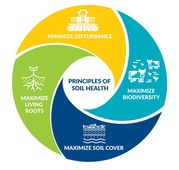
USDA’s Natural Resources Conservation Service can help you conserve water and build resilience to drought, through conservation practices that improve irrigation efficiency, boost soil health, and manage grazing lands.
Irrigation Efficiency
USDA helps you improve your irrigation efficiency to ensure each drop of water is used wisely. Saving water on your farm can help during drought and can offset rising water costs; reduce expenditures for energy, chemicals, and labor; and enhance revenues through higher crop yields and improved crop quality. Funded conservation practices include conversion to more efficient irrigation systems, such as micro-irrigation or subsurface drip irrigation, installation of irrigation pipeline, irrigation water management, structures for water control, and flow meters. Tools like drip irrigation, which provides water precisely where and when it’s needed, can achieve greater precision with flow meters and soil moisture sensors.
Soil Health
In addition, soil health conservation practices, such as reduced- or no-till, cover crops, mulching and residue management can help to make your soil, and the plants you grow or animals you raise, healthier. Healthier soil can absorb and retain more water for longer periods of time, making your farm or ranch more resilient to drought. Using soil health practices, you can conserve water by increasing your soil’s water-holding capacity and use conservation tillage to keep the ground covered, reducing water loss through transpiration and evaporation.
And soil health practices increase organic matter, and each pound of organic matter can hold up to 20 pounds of water. Every 1% increase in organic matter results in as much as 25,000 gallons of soil water per acre. Each 1% increase in organic matter can also provide up to 30 pounds of more available nitrogen per acre. That means less money and time spent on inputs like water and fertilizer, which make your operation more profitable.
Rotational/Prescribed Grazing, Water Sources for Livestock
Drought also impacts grazing lands, and NRCS works with you to increase the resilience of your livestock operation. Ranchers can adapt to dry conditions in two main ways: increasing the availability and suitability of forage and ensuring that cattle have an adequate and reliable source of water. For forage, rotational or prescribed grazing (rotating cattle among pastures) can relieve pressure on stressed vegetation and ensure a more consistent supply of forage for animals. NRCS conservationists can also work with you to plant more drought-tolerant forage species, plants best suited to local soils and conditions. For reliable sources of water, NRCS can help you with installing watering facilities, water wells, or water pipeline for livestock. Having available forage and water for livestock can make a big difference in difficult drought conditions.
USDA and NRCS are here for you, helping you recover from drought and prepare for the next one. For more information on drought recovery assistance at farmers.gov/protection-recovery/drought#recovery. For more information on conservation practices to make your operation more resilient to drought in future years, go to www.nrcs.usda.gov.
|
The USDA Farm Service Agency’s (FSA) Direct Farm Ownership loans can help farmers and ranchers become owner-operators of family farms, improve and expand current operations, increase agricultural productivity, and assist with land tenure to save farmland for future generations.
There are three types of Direct Farm Ownership Loans: regular, down payment and joint financing. FSA also offers a Direct Farm Ownership Microloan option for smaller financial needs up to $50,000.
Joint financing allows FSA to provide more farmers and ranchers with access to capital. FSA lends up to 50 percent of the total amount financed. A commercial lender, a State program or the seller of the property being purchased, provides the balance of loan funds, with or without an FSA guarantee. The maximum loan amount for a joint financing loan is $600,000, and the repayment period for the loan is up to 40 years.
The operation must be an eligible farm enterprise. Farm Ownership loan funds cannot be used to finance nonfarm enterprises and all applicants must be able to meet general eligibility requirements. Loan applicants are also required to have participated in the business operations of a farm or ranch for at least three years out of the 10 years prior to the date the application is submitted. The applicant must show documentation that their participation in the business operation of the farm or ranch was not solely as a laborer.
For more information about farm loans, contact your Bethanie Burton at 731-540-3142 or visit fsa.usda.gov.
|
|
|
|
USDA Service Center
205 Highway 641 N.
Camden, TN 38320
Phone: 731-584-8186
Fax: 855-490-5044
|
|