In This Issue:

Message from the SED:
Happy New Year 2024! As we embark upon a brand new year in FSA, it brings me great joy to emphasize the impact that FSA has on the lives producers and ranchers across Alabama. Alabama FSA is continually disbursing LFP (Livestock Forage Program) payments to many cattle producers who have been directly impacted by the 2023 drought. At present, Alabama FSA has distributed over 18 million in these payments and continuing the work of tirelessly making these payments on a daily basis. Cold and frigid temperatures have been the norm here in the great state of Alabama recently and definitely looking for some brighter and sunny days ahead. I am quite certain we all are looking forward to that. With that however, brings about a certain trepidation as we enter tornado season in the deep south. All producers are encouraged to contact and consult with their local FSA office in the event of any natural disaster that affects crops, land, etc. FSA has a myriad of disaster assistance programs that can assist when these uncertain times prevail (ECP, EFRP, NAP) just to mention a few. Additionally, please be reminded that NAP signup has begun and the deadline to enroll in NAP is February 28, 2024.
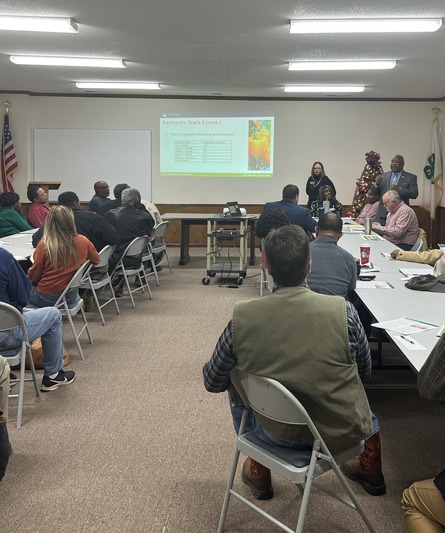
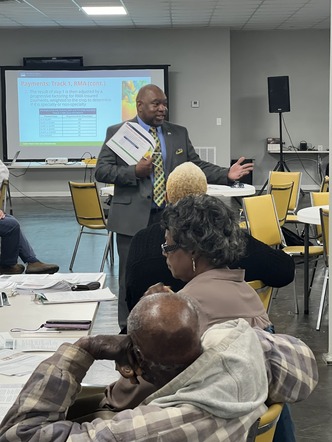
SED Warren has ambitiously scheduled trips to local FSA offices across the state for this 2024 year and very much looking forward to hearing from you, your concerns, and address the issue of how FSA can impact the lives of farmers and ranchers across this great state. Recently, SED Warren visited the Hale and Greene County areas and listened to producers concerns regarding the ERP program.
FYI: Click here for Current FSA Loan Interest Rates
|
 |
 |

Navigating filing taxes can be challenging, especially if you are new to running a farm business, participating in disaster programs for first time, or trying to forecast the farm’s tax bill. Receiving funds from USDA through activities such as a conservation program payment or a disaster program is considered farm income that includes a tax liability for farm businesses. USDA technical assistance is free and creates no tax implications.
At the end of the tax year, USDA issues tax forms 1098 and 1099 forms for farm loans, conservation programs administered by the Farm Service Agency and Natural Resource Conservation Service including the Conservation Reserve Program and Environmental Quality Incentives Program, crop disaster payments, and the Market Facilitation Program. USDA also issues tax forms for recipients of assistance for distressed borrowers, including through Section 22006 of the Inflation Reduction Act.
If you have received tax forms related to your operation, USDA cannot and does not provide tax advice but wants you to be aware of options that may help manage your tax liability. USDA has partnered with experts to provide resources to help you make the right tax decisions for your operation. Monthly webinars are available for registration and to view on demand at https://www.farmers.gov/working-with-us/taxes.
The Tax Estimator Tool is an interactive spreadsheet that producers can download to estimate tax liability. It is for informational and educational purposes and should not considered tax or legal advice. Producers may need to work with a tax professional to determine the correct information to be entered in the Tax Estimator Tool.
We encourage you to visit https://www.farmers.gov/working-with-us/taxes for more information on how to find and work with a tax preparer as well as instructions on how to request copies of USDA documents and links to other helpful tax resources.
|

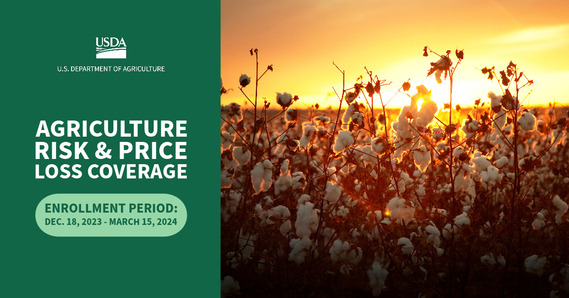 |
The U.S. Department of Agriculture (USDA) today announced that agricultural producers can now enroll in the Farm Service Agency’s (FSA) Agriculture Risk Coverage (ARC) and Price Loss Coverage (PLC) programs for the 2024 crop year. Producers can enroll and make election changes for the 2024 crop year starting Dec. 18, 2023. The deadline to complete enrollment and any election change is March 15, 2024.
On Nov. 16, 2023, President Biden signed into law H.R. 6363, the Further Continuing Appropriations and Other Extensions Act, 2024 (Pub. L. 118-22), which extended the Agriculture Improvement Act of 2018 (Pub. L. 115-334), more commonly known as the 2018 Farm Bill, through September 30, 2024. This extension allows authorized programs, including ARC and PLC, to continue operating.
2024 Elections and Enrollment
Producers can elect coverage and enroll in ARC-County (ARC-CO) or PLC, which provide crop-by-crop protection, or ARC-Individual (ARC-IC), which protects the entire farm. Although election changes for 2024 are optional, producers must enroll through a signed contract each year. Also, if a producer has a multi-year contract on the farm it will continue for 2024 unless an election change is made.
If producers do not submit their election revision by the March 15, 2024, deadline, their election remains the same as their 2023 election for commodities on the farm. Farm owners cannot enroll in either program unless they have a share interest in the cropland.
Covered commodities include barley, canola, large and small chickpeas, corn, crambe, flaxseed, grain sorghum, lentils, mustard seed, oats, peanuts, dry peas, rapeseed, long grain rice, medium grain rice, safflower seed, seed cotton, sesame, soybeans, sunflower seed and wheat.
2022 Crop Year Payments
This fall, FSA issued payments totaling more than $267 million to agricultural producers who enrolled in the 2022 ARC-CO option and the ARC ARC-IC option for covered commodities that triggered a payment. Payments through the PLC option did not trigger for the 2022 crop year.
ARC and PLC payments for a given crop year are paid out the following fall to allow actual county yields and the Market Year Average prices to be finalized. These payments help mitigate fluctuations in either revenue or prices for certain crops. Payments for crops that may trigger for the 2023 crop year will be issued in the fall of 2024.
Crop Insurance Considerations
ARC and PLC are part of a broader USDA safety net that also includes crop insurance and marketing assistance loans.
Producers are reminded that ARC and PLC elections and enrollments can impact eligibility for some crop insurance products.
Producers on farms with a PLC election can purchase Supplemental Coverage Option (SCO) through their Approved Insurance Provider; however, producers on farms where ARC is the election are ineligible for SCO on their planted acres for that crop on that farm.
Unlike SCO, the Enhanced Coverage Option (ECO) is unaffected by an ARC election. Producers may add ECO regardless of the farm program election.
Upland cotton farmers who choose to enroll seed cotton base acres in ARC or PLC are ineligible for the stacked income protection plan (STAX) on their planted cotton acres for that farm.
Web-Based Decision Tools
Many universities offer web-based decision tools to help producers make informed, educated decisions using crop data specific to their respective farming operations. Producers are encouraged to use the tool of their choice to support their ARC and PLC elections.
More Information
For more information on ARC and PLC, producers can visit the ARC and PLC webpage or contact their local USDA Service Center. Producers can also make elections and complete enrollment online with level 2 eAuth.
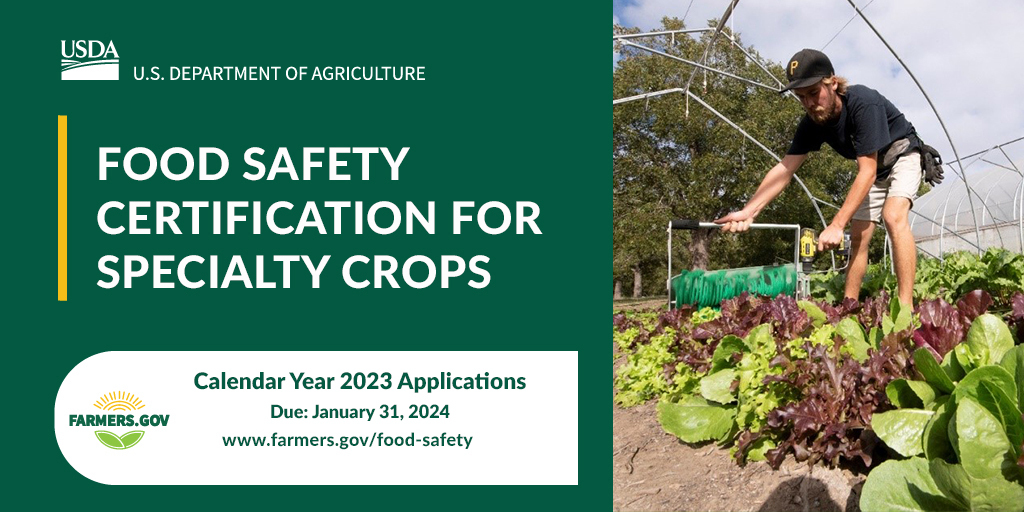
The U.S. Department of Agriculture (USDA) reminds specialty crop growers that assistance is available for producers who incur eligible on-farm food safety program expenses to obtain or renew a food safety certification through the Food Safety Certification for Specialty Crops (FSCSC) program. Producers can apply for assistance on their calendar year 2023 expenses through Jan. 31, 2024.
Program Details
FSCSC assists specialty crop operations that incurred eligible on-farm food safety certification and related expenses pertaining to obtaining or renewing a food safety certification in calendar year 2023. FSCSC covers a percentage of the specialty crop operation’s cost of obtaining or renewing its certification, as well as a portion of related expenses.
To be eligible for FSCSC, the applicant must be a specialty crop operation; meet the definition of a small business or very small business; and have paid eligible expenses related to the 2023 certification.
Specialty crop operations may receive assistance for the following costs:
- Developing a food safety plan for first-time food safety certification.
- Maintaining or updating an existing food safety plan.
- Food safety certification.
- Certification upload fees.
- Microbiological testing for products, soil amendments and water.
FSCSC payments are calculated separately for each category of eligible costs. A higher payment rate has been set for socially disadvantaged, limited resource, beginning and veteran farmers and ranchers. Details about the payment rates and limitations can be found at farmers.gov/food-safety.
Applying for Assistance
The FSCSC application period for 2023 closes Jan. 31, 2024. FSA will issue payments after the application period closes. If calculated payments exceed the amount of available funding, payments will be prorated.
Interested specialty crop producers can apply by completing the FSA-888, Food Safety Certification for Specialty Crops Program (FSCSC) application. The application, along with other required documents, can be submitted to the FSA office at any USDA Service Center nationwide by mail, fax, hand delivery or via electronic means.
Specialty crop producers can also call 877-508-8364 to speak directly with a USDA employee ready to assist. Visit farmers.gov/food-safety for additional program details, eligibility information and forms needed to apply.
|
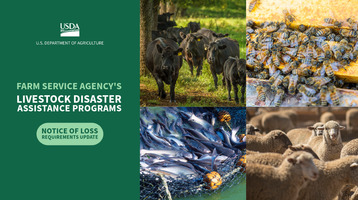
The U.S. Department of Agriculture (USDA) has waived certain notice of loss requirements for 2023 for the Emergency Assistance for Livestock, Honeybees, and Farm-raised Fish (ELAP) and Livestock Indemnity Program (LIP). In an effort to streamline assistance to support access to critical 2023 natural disaster recovery assistance, USDA’s Farm Service Agency (FSA) is waiving the requirement to submit ELAP or LIP notices of loss within a pre-determined number of days for 2023. Instead, producers have the flexibility to submit 2023 notices of loss as soon as possible, once losses are realized, following a natural disaster event or no later than the established annual program application for payment deadlines for each program. FSA county committees are also being asked to re-evaluate 2023 ELAP and LIP late-filed notices of loss to determine if the waiver applies.
Emergency Assistance for Livestock, Honeybees, and Farm-raised Fish
ELAP provides recovery assistance to eligible producers of livestock, honeybee, and farm-raised fish losses due to an eligible adverse weather or loss condition, including blizzards, disease, water shortages and wildfires. ELAP covers grazing and feed losses, transportation of water and feed to livestock and hauling livestock to grazing acres. ELAP also covers certain mortality losses for livestock including honeybees and farm-raised fish as well as honeybee hive losses. ELAP is designed to address losses not covered by other FSA disaster assistance programs.
For 2023, FSA is waiving the regulatory requirement for producers who are eligible for ELAP to file a notice of loss with FSA within 30 calendar days from when the loss first became apparent for livestock and farm-raised fish and 15 calendar days for honeybees. Under this waiver, notices of loss are to be completed by the eligible producer and submitted to FSA no later than the annual program application deadline of January 30 following the program year in which the loss occurred. Therefore, producers who incurred ELAP-eligible losses in 2023, will need to submit a notice of loss by Jan. 30, 2024.
Livestock Indemnity Program
LIP provides disaster recovery assistance to livestock owners and contract growers who experience livestock deaths, in excess of normal mortality caused by eligible loss conditions including adverse weather, disease and attacks by animals reintroduced into the wild by the federal government or protected by federal law, including wolves and avian predators. LIP also helps livestock owners who must sell livestock at a reduced price because of an injury from certain loss conditions.
For 2023, FSA is waiving the regulatory requirement for producers who are eligible for LIP to file a notice of loss within 30 calendar days from when the loss first became apparent. Under this waiver, producers are still required to complete and submit the notice of loss to FSA no later than the annual program payment application date, which is 60 calendar days following the program year in which the loss occurred. The LIP payment application and notice of loss deadline is Feb. 29, 2024, for the 2023 program year.
2023 Disapproved Applications
FSA county committees will review all notices of loss for both ELAP and LIP that were previously disapproved for the 2023 program year due to late filing and re-evaluate them to determine if the waiver applies. To receive ELAP and LIP benefits, producers will still need to file an application for payment by the established program deadline for the 2023 program year. Producers who are unsure about the status of their notice of loss or application for payment, should contact their local FSA county office as soon as possible.
Supporting Documentation
Accurate records and loss documentation are critical following disaster events and are required when filing notices of loss with FSA. Acceptable loss documentation includes:
- Documentation of the number, kind, type, and weight range of livestock that have died, supplemented, if possible, by photographs or video records of ownership and losses.
- Rendering truck receipts by kind, type, and weight - important to document prior to disposal.
- Beginning inventory supported by birth recordings or purchase receipts.
- Documentation from Animal Plant Health Inspection Service, Department of Natural Resources, or other sources to substantiate eligible death losses due to an eligible loss condition.
- Documentation that livestock were removed from grazing pastures due to an eligible adverse weather or loss condition.
- Costs of transporting livestock feed to eligible livestock, such as receipts for equipment rental fees for hay lifts and snow removal.
- Feed purchase receipts if feed supplies or grazing pastures are destroyed.
- Number of gallons of water transported to livestock due to water shortages.
More Information
The improvements to ELAP and LIP build on others made since 2021. This includes ELAP benefits for above normal costs for hauling feed and water to livestock and transporting livestock to other grazing acres during a qualifying drought. FSA also expanded eligible livestock under ELAP, LIP, and the Livestock Forage Disaster Assistance Program, and increased the LIP payment rate for beef, beefalo, bison, and dairy animals less than 250 pounds and most recently beef calves over 800 pounds. Learn about USDA disaster assistance programs on farmers.gov.
On farmers.gov, the Disaster Assistance Discovery Tool, Disaster-at-a-Glance fact sheet and Loan Assistance Tool can help producers and landowners determine disaster protection and recovery program or loan options. For more information about FSA programs, contact your local USDA Service Center.
|
Access local data to assist with your farming operation including weather forecasts and up-to-date commodity pricing
Farmers in ALABAMA can now access county specific farming data and USDA resources all in one place via the new farmers.gov local dashboard. Your new farmers.gov local dashboard includes farming data and USDA resources including USDA news, commodity pricing, weather forecasts, historical climate data, past storm events, USDA service center locator and additional state resources for ALABAMA and your county The dashboard transforms complex data sets into easy-to-read charts and graphs to help you quickly find information that matters to you. Find Your Local ALABAMA Dashboard
 Emergency Relief Program (ERP) 2022
The U. S Department of Agriculture (USDA) will provide more than $3 billion to commodity and specialty crop producers impacted by natural disaster events in 2022. Eligible impacted producers can apply for financial assistance through the Emergency Relief Program (ERP) 2022. The program will help offset the financial impacts of crop yield and value losses from qualifying disasters occurring in 2022.
Background
On Dec. 29, 2022, President Biden signed into law the Disaster Relief Supplemental Appropriations Act, 2023 (P.L. 117-328) that provides about $3.7 billion in financial assistance for agricultural producers impacted by eligible natural disasters that occurred in calendar year 2022.
ERP 2022 covers losses to crops, trees, bushes and vines due to qualifying, calendar year 2022 natural disaster events including wildfires, hurricanes, floods, derechos, excessive heat, tornadoes, winter storms, freeze (including a polar vortex), smoke exposure, excessive moisture, qualifying drought and related conditions.
ERP 2022 program benefits will be delivered to eligible producers through a two-track process. FSA intends to make both tracks available to producers at the same time. This two-track approach enables USDA to:
- Streamline the application process.
- Reduce the paperwork burden on producers.
- Proactively include provisions for underserved producers who have not been well served by past emergency relief efforts.
- Encourage producer participation in existing risk management programs to mitigate the impacts of future severe weather events.
It’s important to note that disaster-impacted producers may be eligible for ERP 2022 assistance under one or both tracks. To avoid duplicative benefits, if a producer applies for both tracks, the Track 2 payment calculation will take into account any payments received through Track 1.
ERP 2022 Application Process – Track 1
ERP 2022 Track 1 leverages existing federal crop insurance or Noninsured Crop Disaster Assistance Program (NAP) data as the basis for calculating payments for eligible crop producers who received indemnities through these risk management programs. Although FSA is sending pre-filled ERP 2022 Track 1 application forms to producers who have crop insurance and NAP data already on file with USDA, producers indemnified for losses resulting from 2022 natural disasters do not have to wait to receive the application before requesting ERP 2022 assistance. Effective Oct. 31, 2023, producers can apply for ERP 2022 benefits whether they have received the pre-filled application or not. Receipt of a pre-filled application is not confirmation that a producer is eligible to receive an ERP 2022 Track 1 payment.
USDA estimates that ERP Track 1 benefits will reach more than 206,000 producers who received indemnities for losses covered by federal crop insurance and more than 4,500 producers who obtained NAP coverage for the 2022 crop year.
ERP 2022 Application Process – Track 2
Track 2 is a revenue-based certification program designed to assist eligible producers who suffered an eligible decrease in revenue resulting from 2022 calendar year disaster events when compared with revenue in a benchmark year using revenue information that is readily available from most tax records. In cases where revenue does not reasonably reflect a normal year’s revenue, Track 2 provides an alternative method for establishing revenue. Likewise, Track 2 affords producers of crops that are used within an operation and do not generate revenue from the sale of the crop a method for establishing revenue for the purpose of applying for ERP 2022 benefits. Producers are not required to submit tax records to FSA unless requested by the County Committee if required for an FSA compliance spot check.
Although not required when applying for ERP 2022 Track 2, applicants might find the following documents useful to the process:
-
Profit or Loss from Farming or similar tax documents for tax years 2018, 2019, 2022 and 2023.
Track 2 targets gaps in emergency relief assistance for eligible producers whose eligible losses were not covered by crop insurance or NAP including revenue losses too small (shallow loss) to be covered by crop insurance.
Producers interested in applying for ERP 2022 Track 2, should contact their local FSA county office. Additional reference resources can be found on FSA’s emergency relief website.
Additional Required Forms
For both ERP 2022 tracks, all producers must have certain required forms on file with FSA within 60 days of the ERP 2022 deadline. Producers can apply for ERP 2022 starting Oct. 31, 2023. The application deadline has not yet been determined and will be announced at a later date. If not already on file, producers can update, complete and submit required forms to FSA at any time.
Required forms:
- Form AD-2047, Customer Data Worksheet.
- Form CCC-902, Farm Operating Plan for an individual or legal entity.
- Form CCC-901, Member Information for Legal Entities (if applicable).
- Form FSA-510, Request for an Exception to the $125,000 Payment Limitation for Certain Programs (if applicable).
- Form CCC-860, Socially Disadvantaged, Limited Resource, Beginning and Veteran Farmer or Rancher Certification, if applicable, for the 2022 program year.
- A highly erodible land conservation (sometimes referred to as HELC) and wetland conservation certification (Form AD-1026 Highly Erodible Land Conservation (HELC) and Wetland Conservation (WC) Certification) for the ERP producer and applicable affiliates.
Most producers, especially those who have previously participated in FSA programs, will likely have these required forms on file. However, those who are uncertain or want to confirm the status of their forms can contact their local FSA county office.
Future Insurance Coverage Requirements
All producers who receive ERP 2022 payments must purchase crop insurance, or NAP coverage where crop insurance is not available, in the next two available crop years as determined by the Secretary. Purchased coverage must be at the 60/100 coverage level or higher for insured crops or at the catastrophic coverage level or higher for NAP crops.
More Information
ERP 2022 eligibility details and payment calculation factor tables are available on the emergency relief website, in the ERP Track 1 and ERP Track 2 fact sheets and through your local FSA county office.
|