Tribal producers, leaders, and partners,
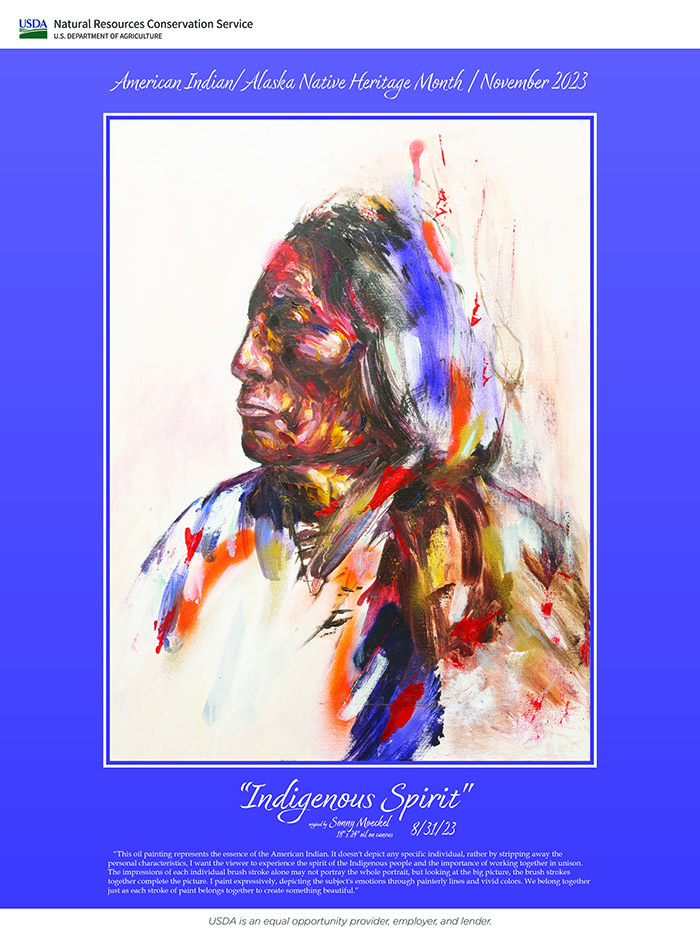
This year, Sonny Moeckel painted the NRCS American Indian/Alaska Native Heritage Month poster. Sonny is Jicarilla Apache and Navajo, living in Washington state. He writes the following:
“This oil painting represents the essence of the American Indian. It doesn’t depict any specific individual, rather by stripping away the personal characteristics, I want the viewer to experience the spirit of the Indigenous people and the importance of working together in unison. The impressions of each individual brush stroke alone may not portray the whole portrait, but looking at the big picture, the brush strokes together complete the picture. I paint expressively, depicting the subject’s emotions through painterly lines and vivid colors. We belong together just as each stroke of paint belongs together to create something beautiful.” Sonny Moeckel, painter of “Indigenous Spirit”
I can’t help but agree with Sonny’s ideas of individuals working together, seeing the big picture, and making good things happen. In that light, I’m very happy to say that because Tribal leaders and producers shared with us the difficulties of hiring for NRCS positions, we listened and updated our strategy. That interaction means we have hired four Tribal Conservationists over the past few months. Most recently, Latrice Tatsey reported to the NRCS office in Browning early in November and Michael Kinsey will service the Fort Belknap Indian Community starting in December. I want to welcome both Latrice and Michael to NRCS! See their introductions in this newsletter. Our Tribal Conservationist positions are now fully staffed.
That said, we are always hiring conservation planners across Montana. One way to get started with NRCS is to participate in opportunities for students. Currently, the 1994 Tribal Scholars Program is accepting applications. This scholarship provides full tuition, fees, books, a housing stipend, and paid workforce training with NRCS to students studying natural resources. After working with Tribal Nations to evaluate the program, a change was made this year to allow the scholarship to follow the student from a two-year associate program at a Tribal college to a four-year bachelor’s degree program. Get more details from the article in this newsletter. If you or a student have any questions about the program, contact Trisha Cracroft at trisha.cracroft@usda.gov or 406-596-0500.
Enjoy the fall weather we have had recently and all the best to you and your family through the holiday season.
Take care,
Tom Watson
NRCS State Conservationist for Montana
|