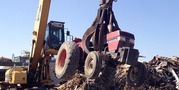
The U.S. Department of Agriculture (USDA) now provides financial assistance to help Connecticut agricultural producers replace older high-emitting diesel tractors and non-tractor on-farm agricultural equipment with new cleaner-burning or electric equipment.
USDA’s Natural Resources Conservation Service (NRCS) has expanded its combustion system improvement practice to provide financial assistance to producers to replace old high-emitting diesel engine tractors and other mobile on-farm equipment (loaders, forklifts, motor graders and backhoes) with either low-emitting diesel or electric equipment. Financial assistance is also available to help producers replace other higher-emitting combustion devices such as irrigation engines, boilers, heaters, and orchard/vineyard frost protection equipment with cleaner-burning or non-burning alternatives.
The combustion system improvement practice (Conservation Practice Standard 372) offered by NRCS is one of the many conservation practices available to producers through the Environmental Quality Incentives Program (EQIP).
“Replacing old high-emitting tractors and on-farm equipment with new low-emitting or electric equipment has tangible on- and off-farm impacts by improving air quality, reducing greenhouse gas emissions and improving the energy efficiency of on-farm equipment. It also benefits producers through energy savings,” Connecticut’s Acting State Conservationist Brunilda Velez-Diaz said. “Right now, we have significant funding available for our oversubscribed programs through the Inflation Reduction Act and the Farm Bill, and we encourage interested producers to apply today.”
The amount of financial assistance available to producers for the combustion system improvement practice is dependent upon the type of equipment being replaced and what it is being replaced with (i.e., new cleaner diesel or electric). Specific payment rates are reviewed, added and/or revised each year to incentivize the adoption of conservation technologies and approaches.
In order to receive assistance, producers using the practice are required to document the destruction and proper disposal of their existing equipment being replaced to prevent the old units from continued operation, reuse, or movement into another locale.
Electric on farm-equipment, including tractors, have zero on-farm emissions and would represent a significant reduction in air emissions from diesel-powered equipment and provides opportunities for producers to save energy. Replacing high-emitting diesel tractors or other on-farm equipment with electric options through the combustion system improvement practice is one of many climate-smart agriculture and forestry mitigation activities available for funding through the Inflation Reduction Act.
In 2024 alone, USDA is making more than $3 billion available nationally through the Inflation Reduction Act for climate-smart mitigation activities, in addition to the over $2 billion available through the Farm Bill. This extensive funding will be used to meet producer demand for oversubscribed conservation programs, maximize climate benefits and to help producers address their natural resource challenges.
While NRCS accepts applications for this program year-round, applicants interested in Fiscal Year 2024 funding need to apply no later than January 26, 2024.
To learn more about NRCS programs, producers can contact their local USDA Service Center. Producers can also apply for NRCS programs, manage conservation plans and contracts, and view and print conservation maps by logging into their farmers.gov account. Producers without an account can sign up today.
Under the Biden-Harris administration, USDA is engaged in a whole-of-government effort to combat the climate crisis and conserve and protect our nation’s lands, biodiversity and natural resources including our soil, air and water. Through conservation practices and partnerships, USDA aims to enhance economic growth and create new streams of income for farmers, ranchers, producers and private foresters. Successfully meeting these challenges will require USDA and our agencies to pursue a coordinated approach alongside USDA stakeholders, including State, local and Tribal governments.
|