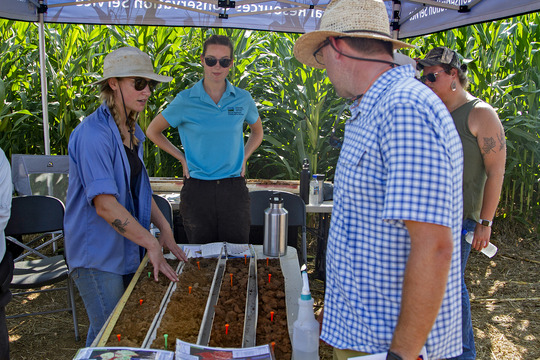
 Education is a component of many newly announced NRCS projects. Here, agency soil scientist Alexandra Schmidt (far left) conducts a soil health demonstration for farmers attending an ag expo. Photo: John Markon, Virginia NRCS.
NRCS Announces New Partners, Projects in Virginia
RICHMOND, Va. -- USDA’s Natural Resources Conservation Service (NRCS) is investing in partnerships in Virginia to assist the agency with delivery of its conservation programs, including the funding available through the Inflation Reduction Act of 2022. To strengthen implementation of the IRA, NRCS will be investing $2.93 million into seven Virginia partnerships during Fiscal Year 2024.
The IRA represents the single largest investment in climate and clean energy solutions in American history.
“These agreements already have been successfully executed,” said Dr. Edwin Martinez Martinez, NRCS’ state conservationist in Virginia, “and each of these projects has the potential to create, maintain and enhance what we’re doing now while giving us new avenues for targeted outreach and education that will help us add staff, raise our level of technical expertise and expand our current roster of partner groups and agencies.”
The new agreements will assist NRCS in addressing its priorities, including but not limited to equity, climate-smart agriculture and forestry, urban agriculture, staffing capacity and leveraging innovative partnerships.
The working relationship, trust and collaboration the USDA/NRCS Virginia team has developed with all these conservation partners is vital to our success as we expand our conservation efforts to every location in the commonwealth, support the state economy, provide job opportunities and works toward a comprehensive climate mitigation effort.
A brief summary of the new agreements:
-
Virginia Department of Forestry: $555,000. This agreement deals with the cost of technical assistance to forestland owners associated with the Farm Bill programs. These include the Environmental Quality Incentive Program (EQIP), the Conservation Stewardship Program (CSP) and any other future programs that include forestry components.
-
Virginia Tech – Integrated Conservation Agronomy: $1,130,866. The goal of this effort will be to improve the economic and environmental sustainability of agriculture across the state by emphasizing enhanced soil health and climate-smart agriculture along with outreach and technical assistance to producers and landowners. This three-year project also includes funding for a Mentor Farmer program.
-
American Farmland Trust: $300,000. This will feature targeted outreach to 250 state producers promoting adoption of climate-smart practices and NRCS conservation programs. Project rules have been written to assure access for Historically Underserved segments of the agricultural community. The program will also cover the cost of 12 “farmer-focused” events sponsored by the Farmland Trust and its partners.
-
Virginia Tech/Soil Health Coalition: $295,805. This will allow NRCS and Virginia Tech to work closely with the 2020 Farmers Cooperative to increase outreach and conservation delivery to the Co-op's more than 200 members in Virginia. Through an innovative partnership involving the Soil Health Coalition, the Co-op and NRCS, the project will fund 12 conservation-oriented webinars hosted by the Co-op, two on-farm presentations engaging more than 150 producers and 35 visits to individual farms. It will also subsidize 50 conservation plans NRCS will prepare for Historically Underserved farmers.
-
American Bird Conservancy: $58,072. NRCS will work with the Appalachian Mountains Joint Venture to build capacity to deliver Farm Bill and IRA conservation programs and provide technical conservation assistance for foresters. A key element will be a three-year series of in-person training sessions for foresters in addition to regular online educational presentations.
-
Virginia State University: $300,000. Will assist VSU in increasing the number of participants in its Small Farm Outreach program and program participants with implementing soil and water conservation practices. The project will also provide educational workshops to increase awareness of climate-smart practices.
-
Ducks Unlimited: $297,895. To raise the level of technical assistance to producers interested in addressing wildlife and/or water quality resource concerns through the delivery of climate-smart practices on the western shore of the Chesapeake Bay.
To learn more about these projects and/or partnership with NRCS, please contact John Womack, assistant state conservationist for partnerships and initiatives, at john.womack@usda.gov
###
|







