
Reminder: See the October 23, 2023 newsletter for details.
We’re Hiring: The Clark County Farm Service Agency (FSA) Office is seeking an individual who wants to serve those who supply the food and fiber that enrich our lives. The deadline to apply is October 30, 2023.
|
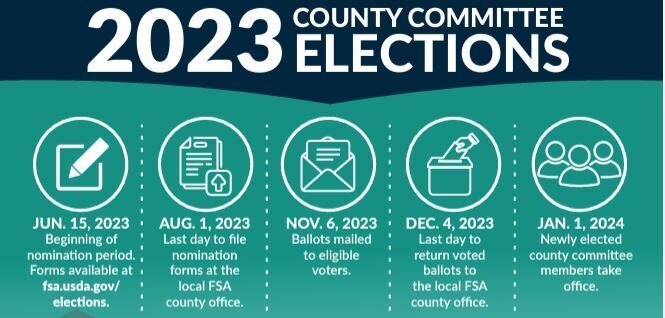
The 2023 Farm Service Agency County Committee Elections will begin on Nov. 6, 2023, when ballots are mailed to eligible voters. The deadline to return ballots to local FSA offices, or to be postmarked, is Dec. 4, 2023.
County committee members are an important component of the operations of FSA and provide a link between the agricultural community and USDA. Farmers and ranchers elected to county committees help deliver FSA programs at the local level, applying their knowledge and judgment to make decisions on commodity price support programs; conservation programs; incentive, indemnity and disaster programs for some commodities; emergency programs and eligibility. FSA committees operate within official regulations designed to carry out federal laws.
To be an eligible voter, farmers and ranchers must:
- Be of legal voting age or, if not of legal voting age, supervise and conduct the farming operation of an entire farm.
- Have an interest in a farm or ranch as either:
- An individual who meets one or more of the following:
- Is eligible and capable to vote in one’s own right.
- Is a partner of a general partnership.
- Is a member of a joint venture.
- Participates or cooperates in any FSA program that is provided by law. A cooperating producer is someone who has provided information to FSA about their farming or ranching operation(s) but may not have applied or received program benefits.
Eligible voters in Local Administrative Area 2, who do not receive a ballot can obtain one from their local FSA county office. Customers can identify which LAA they or their farming operation is in by using our new GIS locator tool available at fsa.usda.gov/elections.
Newly elected committee members will take office Jan. 1, 2024.
The candidate in this year’s election for Clark County is:
Matt Vandersnick is nominated in LAA 2, Clark County, to serve as a committee member for a 3-year term. Vandersnick resides on a farm in the Willow Lake-Vienna area and has produced corn, soybeans, oats for 15 years. Vandersnick is the Chairperson of the Willow Lake Area Community Foundation, the Secretary/Treasurer and volunteer of the Vienna Fire Department and a member of the Lions Club.
The candidate in this year’s election for Codington County is:
Kevin Bach is nominated in LAA 2, Codington County, to serve as a committee member for a 3-year term. Bach resides on a farm near Watertown and has produced corn, wheat, and soybeans for nearly 40 years. Kevin is also a Supervisor on the Fuller township board.
More information on county committees can be found at fsa.usda.gov/elections or by contacting the Clark (605-532-3686) or Codington (605-886-8202) County FSA office.
USDA announced loan interest rates for October 2023, which are effective Oct. 2, 2023. USDA’s Farm Service Agency (FSA) loans provide important access to capital to help agricultural producers start or expand their farming operation, purchase equipment and storage structures or meet cash flow needs.
Operating, Ownership and Emergency Loans
FSA offers farm ownership and operating loans with favorable interest rates and terms to help eligible agricultural producers, whether multi-generational, long-time, or new to the industry, obtain financing needed to start, expand or maintain a family agricultural operation. FSA also offers emergency loans to help producers recover from production and physical losses due to drought, flooding, other natural disasters or quarantine. For many loan options, FSA sets aside funding for underserved producers, including, beginning, women, American Indian or Alaskan Native, Asian, Black or African American, Native Hawaiian or Pacific Islander, and Hispanic farmers and ranchers.
Interest rates for Operating and Ownership loans for October 2023 are as follows:
FSA also offers guaranteed loans through commercial lenders at rates set by those lenders.
To access an interactive online, step-by-step guide through the farm loan process, visit the Loan Assistance Tool on farmers.gov.
Commodity and Storage Facility Loans
Additionally, FSA provides low-interest financing to producers to build or upgrade on-farm storage facilities and purchase handling equipment and loans that provide interim financing to help producers meet cash flow needs without having to sell their commodities when market prices are low. Funds for these loans are provided through the Commodity Credit Corporation (CCC) and are administered by FSA.
Simplified Direct Loan Application
FSA developed a new, simplified direct loan application for producers seeking a direct farm loan. The new application, reduced from 29 to 13 pages, provides improved customer experience for producers applying for loans and enables them to complete a more streamlined application. Producers now also have the option to complete an electronic fillable form or a traditional paper application for submission to their local FSA service center.
Marketing Assistance Loans (MALs) and Loan Deficiency Payments (LDPs) provide financing and marketing assistance for wheat, feed grains, soybeans, and other oilseeds, pulse crops, rice, peanuts, cotton, wool and honey. MALs provide you with interim financing after harvest to help you meet cash flow needs without having to sell your commodities when market prices are typically at harvest-time lows. A producer who is eligible to obtain a loan, but agrees to forgo the loan, may obtain an LDP if such a payment is available. Marketing loan provisions and LDPs are not available for sugar and extra-long staple cotton.
FSA is now accepting requests for 2023 MALs and LDPs for all eligible commodities after harvest. Requests for loans and LDPs shall be made on or before the final availability date for the respective commodities.
Commodity certificates are available to loan holders who have outstanding nonrecourse loans for wheat, upland cotton, rice, feed grains, pulse crops (dry peas, lentils, large and small chickpeas), peanuts, wool, soybeans and designated minor oilseeds. These certificates can be purchased at the posted county price (or adjusted world price or national posted price) for the quantity of commodity under loan, and must be immediately exchanged for the collateral, satisfying the loan. MALs redeemed with commodity certificates are not subject to Adjusted Gross Income provisions.
To be considered eligible for an LDP, you must have form CCC-633EZ, Page 1 on file at your local FSA Office before losing beneficial interest in the crop. Pages 2, 3 or 4 of the form must be submitted when payment is requested.
Marketing loan gains (MLGs) and loan deficiency payments (LDPs) are no longer subject to payment limitations, actively engaged in farming and cash-rent tenant rules.
Adjusted Gross Income (AGI) provisions state that if your total applicable three-year average AGI exceeds $900,000, then you’re not eligible to receive an MLG or LDP. You must have a valid CCC-941 on file to earn a market gain of LDP. The AGI does not apply to MALs redeemed with commodity certificate exchange.
For more information and additional eligibility requirements, contact the Clark County USDA Service Center at 605-532-3686 or the Codington County USDA Service Center at 605-886-8202, or visit fsa.usda.gov.
|
Codington County was declared a CONTIGUOUS disaster county due drought and heat using the Secretarial Disaster Designation process. Under this designation, if you have operations in any primary or contiguous county, you are eligible to apply for low interest emergency loans.
Emergency loans help you recover from production and physical losses due to drought, flooding and other natural disasters or quarantine.
You have eight months from the date of the declaration to apply for emergency loan assistance. FSA will consider each loan application on its own merits, taking into account the extent of losses, security available and repayment ability. You can borrow up to 100 percent of actual production or physical losses, to a maximum amount of $500,000.
For more information about emergency loans, contact your Codington County USDA Service Center at 605-886-8202 or visit fsa.usda.gov.
|
USDA is making more than $3 billion in funding available for agricultural producers and forest landowners nationwide to participate in voluntary conservation programs and adopt climate-smart practices in fiscal year 2024 as part of President Biden’s Investing in America agenda.
These funds are provided by President Biden’s Inflation Reduction Act – the largest climate and conservation investment in history. This law invests an additional $19.5 billion for USDA’s popular conservation programs. These programs also advance the President’s Justice40 Initiative, which aims to ensure 40 percent of the overall benefits of certain climate, clean energy, and other federal investments reach disadvantaged communities that have been marginalized by underinvestment and overburdened by pollution. On the heels of last week’s announcement that USDA’s Natural Resources Conservation Service (NRCS) saw record producer interest in these resources in fiscal year 2023, the agency is now accepting applications from producers interested in this additional conservation assistance for fiscal year 2024.
These additional investments are estimated to help hundreds of thousands of farmers and ranchers apply conservation to millions of acres of land. These funds provide direct climate mitigation benefits, advance a host of other environmental co-benefits, and expand access to financial and technical assistance for producers to advance conservation on their farm, ranch or forest land through practices like cover cropping, conservation tillage, wetland restoration, prescribed grazing, nutrient management, tree planting and more.
USDA is opening up the application period for fiscal year 2024 conservation assistance giving producers the opportunity to apply for this historic funding. However, in the event of a lapse in government funding, technical assistance, one-on-one help in answering questions, and other support for producers in navigating the application process would not be immediately available until the funding lapse ends. In the event of a funding lapse, NRCS would notify producers when staff are available to assist.
What’s New
Expansion of Climate-Smart Agriculture and Forestry Activities supported by the Inflation Reduction Act
NRCS is increasing Climate-Smart Agricultural and Forestry Mitigation Activities eligible for Inflation Reduction Act funding for fiscal year 2024 through the Environmental Quality Incentives Program (EQIP) and Conservation Stewardship Program (CSP). These in-demand activities are expected to deliver reductions in greenhouse gas emissions or increases in carbon sequestration as well as significant other benefits to natural resources like soil health, water quality, pollinator and wildlife habitat and air quality.
In response to feedback received from conservation partners, producers and NRCS staff across the country, NRCS considered and evaluated activities based on scientific literature demonstrating expected climate change mitigation benefits. To learn more, download the list of practices and a fact sheet.
When applied through this framework, these activities are expected to deliver reductions in greenhouse gas emissions or increases in carbon sequestration. NRCS will continue to evaluate additional practices as science progresses and will evaluate and identify quantification methodologies during the fiscal year.
Expansion of priorities for the ACEP investments through the Inflation Reduction Act
Additionally, NRCS is expanding the national priority areas eligible for Inflation Reduction Act funding for Agricultural Conservation Easements Program (ACEP) easements in fiscal year 2024.
For ACEP Agricultural Land Easements (ALE), NRCS is prioritizing securing:
- Grasslands in areas of highest risk for conversion to non-grassland uses to prevent the release of soil carbon stores.
- Agricultural lands under threat of conversion to non-agricultural uses.
- State-specific priorities including rice cultivation on subsiding highly organic soils.
For ACEP Wetland Reserve Easements (WRE), NRCS is prioritizing:
- Land with soils high in organic carbon.
- Eligible lands that will be restored to and managed as forests like bottomland hardwood forests.
- Eligible lands in existing forest cover that will be managed as forests.
- Several geographically specific priorities (i.e., former cranberry bogs, wet meadows, and ephemeral wetlands in grassland ecosystems).
Background
The Inflation Reduction Act provides funds to the EQIP, CSP, ACEP and Regional Conservation Partnership Program (RCPP). For fiscal year 2024, which begins Oct. 1, 2023, the Inflation Reduction Act provides an additional $1.65 billion for EQIP, $472 million for CSP, and $189 million for ACEP, and $754 million for RCPP.
How to Apply
NRCS accepts producer applications for its conservation programs year-round, but producers interested in this cycle of Inflation Reduction Act funding should apply as soon as possible. Producers interested in EQIP or CSP should apply by their state’s ranking dates for consideration this year. Funding is provided through a competitive process and will include an opportunity to address the unmet demand from producers who have previously sought funding for climate-smart conservation activities.
Similarly, NRCS accepts applications year-round for ACEP Agricultural Land Easements (ACEP-ALE) and Wetland Reserve Easements (ACEP-WRE), producers interested in this funding cycle must apply by Nov. 13, 2023. NRCS will also consider previously unfunded applications in this round.
NRCS plans to roll out the next RCPP funding opportunity in late January 2024.
NRCS will announce other opportunities for agreements and partnerships at the state level for fiscal year 2024 in the coming months. The Inflation Reduction Act provides funding to support those strategic partnerships with local, regional and national organizations. This will include outreach to underserved producers to ensure Inflation Reduction Act climate funding is reaching those who have been previously unable to access conservation assistance.
Interested producers should contact the NRCS at their local USDA Service Center.
|








