In This Issue:
Message from the SED:
Greetings:
The fall season is upon us, which reminds us here at FSA the Fiscal Year (FY) 2023 is coming to an end. Service Center technicians are submitting reports and some software may go offline until the completion of the runover. Don't be alarmed, customer service will still be stellar. However, there maybe instances where your paperwork will be delayed until we move into FY24.
I also want to encourage all of Alabama producers including beginners, Veterans, Crop, Livestock, even Landowners to subscribe to your local service center news bulletin. These bulletins often list application deadlines, final planting dates, program updates, and meeting and training opportunities. Subscribe on the Farmers.gov Stay-Connected page.
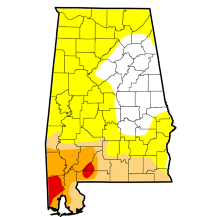
Producers in BALDWIN, CONECUH, ESCAMBIA, MOBILE, and MONROE Counties are eligible to apply for 2023 Livestock Forage Disaster Program (LFP) benefits.
LFP provides compensation if you suffer grazing losses for covered livestock due to drought on privately owned or cash leased land or fire on federally managed land.
County committees can only accept LFP applications after notification is received by the National Office of qualifying drought or if a federal agency prohibits producers from grazing normal permitted livestock on federally managed lands due to qualifying fire.
You must complete a CCC-853 and the required supporting documentation no later than Jan. 30, 2024, for 2023 losses.
For additional information about LFP, including eligible livestock and fire criteria, contact your County USDA Service Center by visiting fsa.usda.gov.
The application period is now open for a new financial assistance program under Section 22007 of the Inflation Reduction Act (IRA), for farmers, ranchers, and forest landowners who experienced discrimination in USDA farm lending programs prior to January 2021. The application process will close on October 31. Borrowers will have the option to apply for assistance online via 22007apply.gov or through a paper-based form.
Details about the program, including an application and e-filing portal, are available at 22007apply.gov. The website includes an English and Spanish language application that applicants can download or submit via an e-filing portal, information on how to obtain technical assistance in-person or virtually, and additional resources and details about the program. Applicants can also call the free call center at 1-800-721-0970, or visit one of several dozen brick-and-mortar offices the program has set up around the country. Locations are provided on the program website and vendors will update the local events schedule with more information as it becomes available. It is important to note that filing an application is FREE and does not require a lawyer.
If you want to get weekly updates on the program’s events and progress, you can go to https://22007apply.gov, and subscribe to a weekly newsletter.
|
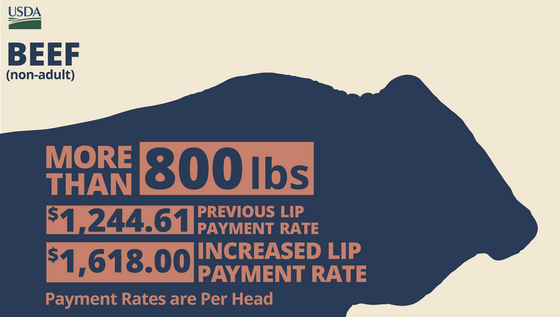 |
The USDA’s Farm Service Agency (FSA) announced today it is updating the Livestock Indemnity Program (LIP) payment rate to support livestock producers in the Midwest who have lost cattle to the extreme heat and humidity experienced this summer. To help indemnify ranchers to reflect a trend towards higher cattle weights in feedlots, the 2023 LIP payment rate for beef calves over 800 pounds will increase from $1244 per head to $1618, an increase of $374.
LIP provides benefits to livestock owners and some contract growers for livestock deaths exceeding normal mortality from eligible adverse weather events, certain predation losses and reduced sales prices due to injury from an eligible loss. Indemnity payments are made at a rate of 75% of the prior year’s average fair market value of the livestock.
The updated LIP payment rate is effective immediately and will be applied retroactively starting Jan.1, 2023, for all eligible causes of loss including excessive heat, tornado, winter storms, and other qualifying adverse weather. Producers who have already received LIP payments for 2023 losses will receive an additional payment, if applicable, commensurate with this updated rate. For details on eligibility and payment rates, review the LIP fact sheet.
FSA recognizes that an annual update of LIP payment rates does not account for the volatile nature of livestock markets and is further exploring flexibilities to establish more current payment rates.
More Information
On farmers.gov, Disaster Assistance Discovery Tool, Disaster Assistance-at-a-Glance fact sheet, and Loan Assistance Tool can help producers and landowners determine program or loan options. For FSA and NRCS programs, they should contact their local USDA Service Center.
The USDA Climate Hubs translate climate science into action, putting USDA research and resources into practice. The Hubs develop and deliver science-based, region-specific information and technology to natural resource and agricultural managers to help you make climate-informed decisions that reduce agricultural risk and build resilience to climate change. Our useful tools can help you plan for and manage weather- and climate-related risks.
The Climate Hubs offer a variety of resources to help you manage weather and climate-risks, including tools and technology, outreach and education, and risk assessments:
-
Tools and technology to help you respond effectively to climate change impacts including drought, extreme weather events, and changing growing seasons. We provide coordinated technical support to enhance USDA program delivery, especially to underserved and vulnerable communities.
The following tools can help you make informed management decisions on your operation:
-
Adaptation Workbook: A flexible process to consider the potential effects of climate change and design land management and conservation actions to prepare for changing conditions.
-
Grass-Cast: A grassland and forage productivity forecast for ranchers and rangeland managers.
-
AgRisk Viewer: A new platform to access, analyze, and visualize historical crop insurance loss data to inform risk management efforts.
-
Seedlot Selection Tool: A web-based mapping application that uses current or future climates to match seedlots and planting sites.
-
Outreach, education, and technical support on innovative ways to help lower barriers to adaptation, mitigation, and resilience-building:
The Climate Hubs are a unique collaboration that connects USDA research and program agencies like the Natural Resources Conservation Service (NRCS), Farm Service Agency (FSA), Risk Management Agency (RMA), Economic Research Service, and Foreign Agricultural Service, among others.
We support USDA stakeholders by providing vulnerability assessments, curating decision-making tools, and facilitating stakeholder outreach on climate change and its impacts on working lands.
The Climate Hubs also amplify the work of other USDA agencies to ensure USDA is meeting the needs of customers like you.
-
For example, the Southwest Climate Hub worked with RMA to provide more accessible, discoverable, and usable crop insurance data through the AgRisk Viewer.
-
Our Northern Plains Climate Hub developed a grassland and forage productivity model and rangeland drought dashboard working closely with agencies and partners.
-
At our Northeast Climate Hub, the NRCS liaison developed a webinar training titled “Helping farmers help the land through climate-smart farming” highlighting NRCS resource concerns and practices.
There are 10 regional Climate Hubs across the nation co-located at Agricultural Research Service (ARS) and U.S. Forest Service (USFS) research units. For more information on the Climate Hubs, visit climatehubs.usda.gov/. We are happy to help connect producers, USDA staff, and stakeholders to each other and to the best resources USDA has to offer.
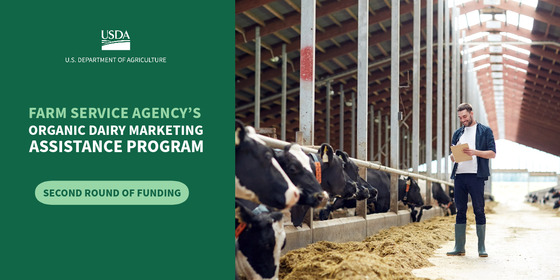 The U.S. Department of Agriculture (USDA) is announcing a second round of payments for dairy producers through the Organic Dairy Marketing Assistance Program (ODMAP), providing an additional $5 million to help dairy producers mitigate market volatility, higher input and transportation costs, and unstable feed supply and prices that have created unique hardships in the organic dairy industry. USDA’s Farm Service Agency (FSA) has already paid out $15 million in the first round of payments for eligible producers, bringing total ODMAP payments to $20 million. Producers paid during the first round will automatically receive payment in the second round and no action is needed.
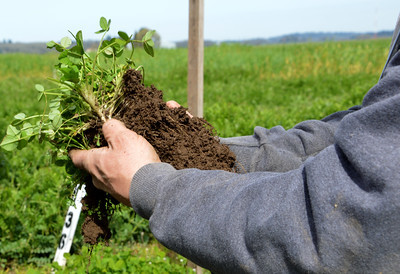 |
Cover crops are planted because of their excellent benefits, including improving the health and function of soil. This leads to better nutrient cycling, improved water infiltration and more consistent yields over time. Cover crops also suppress weeds, prevent erosion, control diseases and pests as well as help pollinators.
Farmers not familiar with how mixtures of cover crops work together might ask, “Why would I want to plant a cover crop that uses up all my water?” But using diverse annual cropping rotations and cover crop combinations increases soil organic matter. And for each 1 percent in organic matter, there is a 25 percent increase in water holding capacity and up to 30 pounds an acre more of available nitrogen.
While cover crops use some water in the soil profile to grow, they simultaneously improve the soil structure by building soil aggregates, providing armor for the soil surface, and recharging the water in the soil profile though increased infiltration.
Common cover crops in Alabama include Winter Pea, Crimson Clover, Hairy Vetch, Cowpea, Oat, Cereal Rye, Sorghum-Sudangrass, Winter Wheat, Rapeseed, Radish.
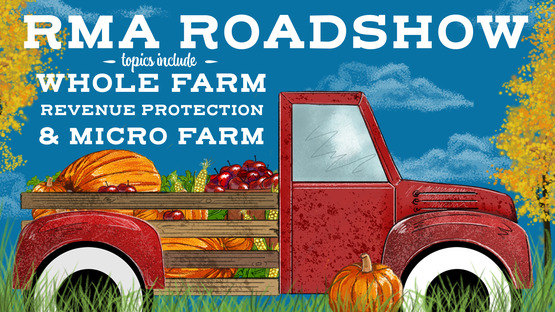
USDA announced that it is improving crop insurance options for small and diversified farmers through improvements to the Whole-Farm Revenue Protection (WRFP) and Micro Farm insurance plans. These updates are part of USDA’s Risk Management Agency (RMA) efforts to increase participation and access to crop insurance.
Improvements to WFRP for the 2024 policy year include:
-
Allowing all eligible producers to qualify for 80% and 85% coverage levels.
-
Allowing producers to purchase catastrophic coverage level policies for individual crops with WFRP.
-
Expanding yield history to a 10-year maximum (from 4 years) for all crops not covered by another federal crop insurance policy.
-
Making the policy more affordable for single commodity producers.
-
Allowing producers to customize their coverage by choosing whether WFRP will consider other federal crop insurance policies as primary insurance when calculating premium and revenue to count during claim time.
Improvements to Micro Farm for the 2024 policy year include:
-
Moving the sales closing date to a less busy time of year to help agents dedicate time to marketing the program. This is important specifically for producers that are purchasing Micro Farm for the first time as it provides additional time for agents to assist growers with important risk management decisions.
-
Allowing producers to purchase other Federal crop insurance with Micro Farm.
-
Allowing vertically integrated entities to be eligible for Micro Farm.
-
Making the Expanding Operations feature available with Micro Farm.
About WFRP and Micro Farm:
WFRP and Micro Farm policies provide a risk management safety net for all commodities grown on a farm under one policy. Both policy options were designed to meet the needs of specialty, organic (both crops and livestock), or those marketing to local, regional, farm-identity preserved, specialty, or direct markets. The Micro Farm insurance plan is tailored for any farm with up to $350,000 in approved revenue, and WFRP covers any farm with up to $17 million in insured revenue. RMA introduced Micro Farm in 2021.
Currently, producers hold 1,784 WFRP policies covering $2.17 billion in liabilities, and they hold 93 Micro Farm policies covering $6.15 million in liabilities.
Crop insurance is sold and delivered solely through private crop insurance agents. A list of crop insurance agents is available at all USDA Service Centers and online at the RMA Agent Locator. Learn more about crop insurance and the modern farm safety net at rma.usda.gov or by contacting your RMA Regional Office.
|
|
Alabama USDA
|
Farm Service Agency (FSA)
4121 Carmichael Road, Ste 600
Montgomery, AL 36106
Phone: (334) 279-3500
Fax: (855) 747-0599
FSA State Director
Clifton Warren, Jr
|
Natural Resource Conservation Service (NRCS)
3381 Skyway Dr.
Auburn, AL 36830
Phone: (334) 887-4500
Fax: (855)292-1671
NRCS State Conservationist
Ben Malone
|
|
FSA State Committee
Donald Means, Chairperson
Marvin Datcher
Gary Terry
William Townsend Kyser III
Danny Ellison
|
Risk Management
106 S. Patterson Street, Suite 250
Valdosta, GA 31601-5673
Phone: 229-242-7235
Fax: (229) 242-3566
RMA Regional Director
Davina Lee
|
|
|
|
|
|
USDA is an equal opportunity provider, employer and lender. To file a complaint of discrimination, write: USDA, Office of the Assistant Secretary for Civil Rights, Office of Adjudication, 1400 Independence Ave., SW, Washington, DC 20250-9410 or call (866) 632-9992 (Toll-free Customer Service), (800) 877-8339 (Local or Federal relay), (866) 377-8642 (Relay voice users).
|