|
Greetings, hope all is well!
This month I wanted to share a few photos with you. The first photo is of me and fellow SED from Arizona, Ginger Torres, participating in the 75th Annual Navajo Nation Fair & Parade. The second photo is from a series of stops that New Mexico FSA planned during a recent RMA visit to Dona Ana County. Thank you to Dosi Alvarez for hosting us on your farm and a big thank you to all those involved in coordinating the RMA visit to Las Cruces.
 FSA New Mexico SED Jonas Moya and Arizona SED Ginger Torres at the 75th Navajo Nation Fair & Parade in Window Rock, AZ
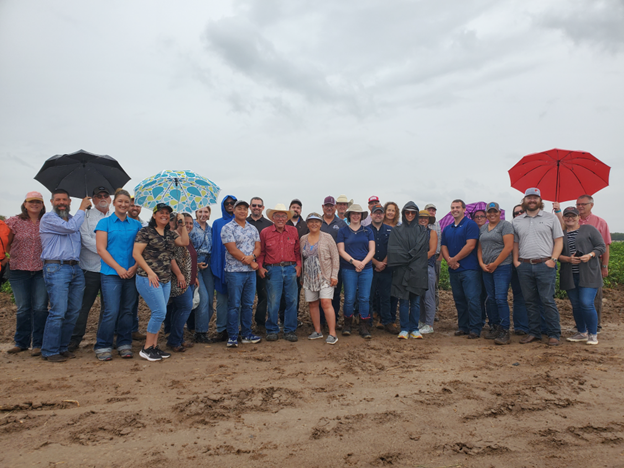 RMA Administrator Marcia Bunger and staff, FSA STO and Dona Ana COF staff with Dona Ana Co. Farmer Dosi Alvarez
The work continues in New Mexico. Just this past month three disaster designations have occurred, and New Mexico FSA is here to help you through these difficult times. On farmers.gov, the Disaster Assistance Discovery Tool, Disaster Assistance-at-a-Glance fact sheet, and Loan Assistance Tool can help you determine program or loan options. To file a Notice of Loss or to ask questions about available programs, contact your local USDA Service Center. FEMA offers different assistance programs for individual citizens, public groups including government agencies and private nonprofit organizations. To find the FEMA help you need following a disaster event, visit fema.gov/assistance. Please visit New Mexico News Releases (usda.gov) for information on the designations.
It was announced the Milk Loss Program (MLP) assistance for eligible dairy operations for milk that was dumped or removed, without compensation, from the commercial milk market due to qualifying weather events and the consequences of those weather events that inhibited delivery or storage of milk (e.g., power outages, impassable roads, infrastructure losses, etc.) during calendar years 2020, 2021 and 2022. Administered by the Farm Service Agency (FSA), signup for MLP begins Sept. 11 and runs through Oct. 16, 2023. On farmers.gov, the Disaster Assistance Discovery Tool, Disaster Assistance-at-a-Glance fact sheet and Loan Assistance Tool can help producers and landowners determine program or loan options. For assistance with a crop insurance claim, producers and landowners should contact their crop insurance agent. For FSA and NRCS programs, they should contact their local USDA Service Center.
Jonas Moya
State Executive Director
OFFICE CLOSURE
- Columbus Day– October 9
- Veterans Day (observed) – November 10
- Thanksgiving – November 23
- Christmas Day – December 25
IMPORTANT DATES (Please check with your local office for other deadlines that may apply to your particular situation) Service Center Locator
- Conservation Programs
- Conservation Reserve Program (Continuous) Signup 59 Ongoing
- Acreage Certification Reporting
-
Noninsured Crop Assistance Program (NAP)
- 2024 Crop Coverage Purchase Deadlines:
- September 30 Deadline for Barley, Oats, Rye, Triticale, Wheat
-
Organic Certification Cost Share Program (OCCSP)
- September 30 Sign up Ends
The U.S. Department of Agriculture (USDA) launched a new online tool to help farmers and ranchers better navigate the farm loan application process. This uniform application process will help to ensure all farm loan applicants receive equal support and have a consistent customer experience with USDA’s Farm Service Agency (FSA) regardless of their individual circumstances.
USDA experiences a high rate of incomplete or withdrawn applications, particularly among underserved customers, due in part to a challenging and lengthy paper-based application process. The Loan Assistance Tool is available 24/7 and gives customers an online step-by-step guide that supplements the support they receive when working in person with a USDA employee, providing materials that may help an applicant prepare their loan application in one tool.
Farmers can access the Loan Assistance Tool by visiting farmers.gov/farm-loan-assistance-tool and clicking the ‘Get Started’ button. From here they can follow the prompts to complete the Eligibility Self-Assessment and start the farm loan journey. The tool is built to run on any modern browser like Chrome, Edge, Firefox, or the Safari browser, and is fully functional on mobile devices. It does not work in Internet Explorer.
The Loan Assistance Tool is the first of multiple farm loan process improvements that will be available to USDA customers on farmers.gov in the future. Other improvements and tools that are anticipated to launch in 2023 include:
- A streamlined and simplified direct loan application, reduced from 29 pages to 13 pages.
- An interactive online direct loan application that gives customers a paperless and electronic signature option, along with the ability to attach supporting documents such as tax returns.
- An online direct loan repayment feature that relieves borrowers from the necessity of calling, mailing, or visiting a local Service Center to pay a loan installment.
The U.S. Department of Agriculture (USDA) has developed a simplified direct loan application to provide improved customer experience for producers applying for loans from the Farm Service Agency (FSA). The simplified direct loan application enables producers to complete a more streamlined application, reduced from 29 to 13 pages. Producers will also have the option to complete an electronic fillable form or prepare a traditional, paper application for submission to their local FSA farm loan office. The paper and electronic versions of the form are now available.
Approximately 26,000 producers submit a direct loan application to the FSA annually, but there is a high rate of incomplete or withdrawn applications, due in part to a challenging and lengthy paper-based application process. Coupled with the Loan Assistance Tool released in October 2022, the simplified application will provide all loan applicants access to information regarding the application process and assist them with gathering the correct documents before they begin the process. This new application will help farmers and ranchers submit complete loan applications and reduce the number of incomplete, rejected, or withdrawn applications.
In October 2022, USDA launched the Loan Assistance Tool, an online step-by-step guide that provides materials to help an applicant prepare their farm loan application in one tool. Farmers can access the Loan Assistance Tool by visiting farmers.gov/farm-loan-assistance-tool and clicking the ‘Get Started’ button. The tool is built to run on any modern browser like Chrome, Edge, Firefox, or the Safari browser. A version compatible with mobile devices is expected to be available by the summer. It does not work in Internet Explorer.
The simplified direct loan application and Loan Assistance Tool are the first of multiple farm loan process improvements that will be available to USDA customers on farmers.gov in the future. Other improvements that are anticipated to launch in 2023 include:
- An interactive online direct loan application that gives customers a paperless and electronic signature option, along with the ability to attach supporting documents such as tax returns.
- An online direct loan repayment feature that relieves borrowers from the necessity of calling, mailing, or visiting a local Service Center to pay a loan installment.
USDA provides access to credit to approximately 115,000 producers who cannot obtain sufficient commercial credit through direct and guaranteed farm loans. With the funds and direction Congress provided in Section 22006 of the Inflation Reduction Act, USDA took action in October 2022 to provide relief to qualifying distressed borrowers while working on making transformational changes to loan servicing so that borrowers are provided the flexibility and opportunities needed to address the inherent risks and unpredictability associated with agricultural operations.
Soon, all direct loan borrowers will receive a letter from USDA describing the circumstances under which additional payments will be made to distressed borrowers and how they can work with their FSA local office to discuss these options. Producers can explore all available options on all FSA loan options at fsa.usda.gov or by contacting their local USDA Service Center.
FSA is updating the Livestock Indemnity Program (LIP) payment rate to support livestock producers in the Midwest who have lost cattle to the extreme heat and humidity experienced this summer. To help indemnify ranchers to reflect a trend towards higher cattle weights in feedlots, the 2023 LIP payment rate for beef calves over 800 pounds will increase from $1244 per head to $1618, an increase of $374.
LIP provides benefits to livestock owners and some contract growers for livestock deaths exceeding normal mortality from eligible adverse weather events, certain predation losses and reduced sales prices due to injury from an eligible loss. Indemnity payments are made at a rate of 75% of the prior year’s average fair market value of the livestock.
The updated LIP payment rate is effective immediately and will be applied retroactively starting Jan.1, 2023, for all eligible causes of loss including excessive heat, tornado, winter storms, and other qualifying adverse weather. Producers who have already received LIP payments for 2023 losses will receive an additional payment, if applicable, commensurate with this updated rate. For details on eligibility and payment rates, review the LIP fact sheet.
FSA recognizes that an annual update of LIP payment rates does not account for the volatile nature of livestock markets and is further exploring flexibilities to establish more current payment rates.
More Information
On farmers.gov, the Disaster Assistance Discovery Tool, Disaster Assistance-at-a-Glance fact sheet, and Loan Assistance Tool can help producers and landowners determine program or loan options. For assistance with a crop insurance claim, producers and landowners should contact their crop insurance agent. For FSA and NRCS programs, they should contact their local USDA Service Center.
Agriculture brings so much value to our communities, including food production, open space, and economic prosperity. This is true no matter where an agricultural operation is located – whether rural or urban. USDA is committed to working with farms of all sizes and in all locations, including those in urban areas.
Our commitment includes opening new offices and providing staff expertise in urban communities to increase access to services designed to meet the unique operational needs of urban producers. Last month, Agriculture Secretary Tom Vilsack announced a series of investments in urban agriculture and food and market access, including $40 million for initiatives supporting urban and suburban producers. As part of that announcement, we are proud to highlight several new services and opportunities that our urban agricultural customers can look forward to and access in 2023 and beyond.
Visiting a New Urban Service Center
USDA works with agricultural producers through a network of more than 2,300 Service Centers nationwide. These Service Centers are where producers can meet face-to-face with Farm Service Agency (FSA) and Natural Resources Conservation Service (NRCS) employees to discuss their vision, goals, and ways USDA can help.
We’re excited to announce that FSA and NRCS collaborated to open 17 new Urban Service Centers, which will offer personalized assistance with farm loans, conservation, disaster assistance, and risk management programs to producers in and near urban areas and communities. These new Urban Service Centers are located in: Albuquerque, NM; Atlanta, GA; Chicago, IL; Cleveland, OH; Dallas, TX; Detroit, MI; Grand Rapids, MI; Los Angeles, CA; Oakland, CA; Minneapolis-St. Paul, MN; New Orleans, LA; New York, NY; Philadelphia, PA; Phoenix, AZ; Portland, OR; Richmond, VA; and St. Louis, MO.
If you farm in one of these locations, we encourage you to reach out to your local Urban Service Center staff. If not, you can find the Service Center nearest you on our Service Center Locator.
If you’re new to working with us, don’t worry, we have a checklist on how to prepare for your visit and what to expect.
Serving on an Urban County Committee
Serving on an urban county committee is an important opportunity for urban producers to affect USDA priorities and funding. Urban county committee members make decisions that impact local urban growers, and share information with USDA staff to provide urban producers better and more efficient access to USDA programs and services. Urban county committee members serve as spokespeople on USDA’s available resources and encourage and promote urban, indoor, innovative and other emerging agricultural production practices.
This year, USDA is adding 10 new urban county committees to the 17 that currently exist nationwide. The cities with new urban county committees will be Boston, MA; Columbia, SC; Denver, CO; Houston, TX; Jackson, MS; Kansas City, MO; Las Vegas, NV; Little Rock, AR; Memphis, TN; and Pittsburgh, PA.
To learn more about county committees, including urban county committees, visit the county committees webpage.
Taking Advantage of Training and Professional Development Opportunities
To make sure that the Urban Service Centers and urban county committees will be as effective as they can be, USDA is partnering with local and national organizations to train USDA staff about how best to serve urban producers. These organizations will also provide outreach, training, and technical assistance for producers and interested community members in urban areas. More information about professional development opportunities from our partners will be coming shortly.
Currently, USDA offers live and on-demand webinars on topics that are of interest to urban producers, including the People’s Garden webinar series, farm record tutorials, and tax assistance videos.
Learning More about Future Funding and Other Opportunities
USDA’s Office of Urban Agriculture and Innovative Production publishes a monthly newsletter with resources for urban and innovative producers, including lists of grant and technical assistance programs that are accepting applications. To receive the newsletter, subscribe to USDA emails on farmers.gov by selecting “Urban Agriculture and Innovative Production” from the list of topics.
The zip code or size of a community should not determine whether families can purchase healthy, locally grown food. Through programs like these, USDA is investing in America’s urban and suburban communities and strengthening local food systems. We look forward to building on this great work with future expansions to support our urban customer base.
Using the correct signature when doing business with FSA can save time and prevent a delay in program benefits.
The following are FSA signature guidelines:
- A married woman must sign her given name: Mrs. Mary Doe, not Mrs. John Doe
- For a minor, FSA requires the minor's signature and one from the minor’s parent
Note, by signing a document with a minor, the parent is liable for actions of the minor and may be liable for refunds, liquidated damages, etc.
When signing on one’s behalf the signature must agree with the name typed or printed on the form or be a variation that does not cause the name and signature to be in disagreement. Example - John W. Smith is on the form. The signature may be John W. Smith or J.W. Smith or J. Smith. Or Mary J. Smith may be signed as Mrs. Mary Joe Smith, M.J. Smith, Mary Smith, etc.
FAXED signatures will be accepted for certain forms and other documents provided the acceptable program forms are approved for FAXED signatures. Producers are responsible for the successful transmission and receipt of FAXED information.
Spouses may sign documents on behalf of each other for FSA and CCC programs in which either has an interest, unless written notification denying a spouse this authority has been provided to the county office.
Spouses cannot sign on behalf of each other as an authorized signatory for partnerships, joint ventures, corporations or other similar entities. Likewise, a spouse cannot sign a document on behalf of the other in order to affirm the eligibility of oneself.
Any member of a general partnership can sign on behalf of the general partnership and bind all members unless the Articles of Partnership are more restrictive. Spouses may sign on behalf of each other’s individual interest in a partnership, unless notification denying a spouse that authority is provided to the county office. Acceptable signatures for general partnerships, joint ventures, corporations, estates, and trusts must consist of an indicator “by” or “for” the individual’s name, individual’s name and capacity, or individual’s name, capacity, and name of entity.
For additional clarification on proper signatures contact your local FSA office.
In order to claim a Farm Service Agency (FSA) payment on behalf of a deceased producer, all program conditions for the payment must have been met before the applicable producer’s date of death.
If a producer earned a FSA payment prior to his or her death, the following is the order of precedence for the representatives of the producer:
- administrator or executor of the estate
- the surviving spouse
- surviving sons and daughters, including adopted children
- surviving father and mother
- surviving brothers and sisters
- heirs of the deceased person who would be entitled to payment according to the State law
For FSA to release the payment, the legal representative of the deceased producer must file a form FSA-325 to claim the payment for themselves or an estate. The county office will verify that the application, contract, loan agreement, or other similar form requesting payment issuance, was signed by the applicable deadline by the deceased or a person legally authorized to act on their behalf at that time of application.
If the application, contract or loan agreement form was signed by someone other than the deceased participant, FSA will determine whether the person submitting the form has the legal authority to submit the form.
Payments will be issued to the respective representative’s name using the deceased program participant’s tax identification number. Payments made to representatives are subject to offset regulations for debts owed by the deceased.
FSA is not responsible for advising persons in obtaining legal advice on how to obtain program benefits that may be due to a participant who has died, disappeared or who has been declared incompetent.
|