In This Issue:
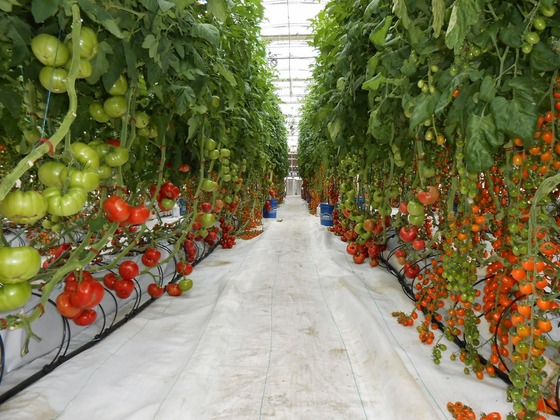 Is the new Controlled Environment crop insurance right for you? Find out with USDA’s Risk Management Agency.
The USDA is introducing a new Federal Crop Insurance program designed to provide greenhouse growers an opportunity to insure against losses due to destruction orders based on detection of plant disease vectors. USDA is hosting an in-person public session on SEPT. 19 in APOPKA, FL, to introduce the program and answer any questions you may have. Learn more and see the schedule of the session’s exact time and location. Learn More
The USDA’s Risk Management Agency (RMA) reminds Florida oats, potato, sugarcane, and wheat growers that the final date to apply for crop insurance coverage for the 2024 crop year is September 30. Current policyholders who wish to make changes to their existing coverage also have until the September 30 sales closing date to do so.
Federal crop insurance is critical to the farm safety net. It helps producers and owners manage revenue risks and strengthens the rural economy. Coverage is available for oats in Alachua, Calhoun, Escambia, Gadsden, Holmes, Jackson, Jefferson, Levy, Okaloosa, Walton, and Washington counties. Coverage is also available for potatoes in Charlotte, Collier, Highlands, Indian River, Lee, Manatee, and Okeechobee counties. Coverage is available for sugarcane in Glades, Hendry, Martin, and Palm Beach counties. Coverage is also available for wheat in Alachua, Calhoun, Columbia, Escambia, Gadsden, Gilchrist, Gulf, Hamilton, Holmes, Jackson, Jefferson, Leon, Levy, Liberty, Madison, Okaloosa, Santa Rosa, Suwannee, Walton, and Washington counties.
Growers are encouraged to visit their crop insurance agent soon to learn specific details for the 2024 crop year.
Crop insurance is sold and delivered solely through private crop insurance agents. A list of crop insurance agents is available at all USDA Service Centers and online at the RMA Agent Locator. Learn more about crop insurance and the modern farm safety net at www.rma.usda.gov.
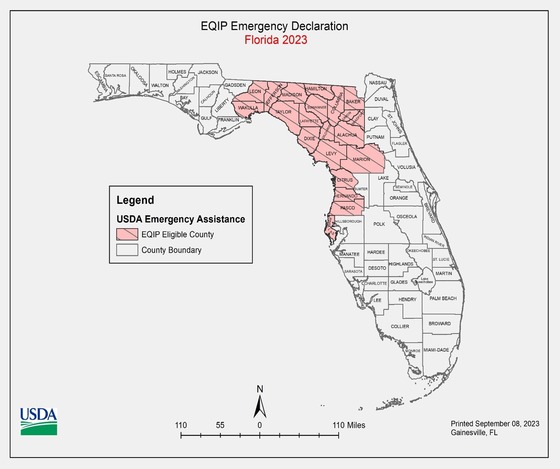 Map of USDA Emergency Assistance declaration counties for Hurricane Idalia in 2023 for the purposes of EQIP emergency sign-up eligibility.
U.S. Department of Agriculture (USDA) Natural Resources Conservation Service (NRCS) can provide assistance, through conservation program contracts, for Environmental Quality Incentives Program (EQIP) conservation practices to help agricultural landowners and producers address disaster related resource concerns on their land.
“The Natural Resources Conservation Service remains committed to helping the people of Florida agriculture with every means at our disposal. We can assist local farmers in repairing damages to their land and existing conservation practices caused by Hurricane Idalia,” said Walter Albarran, Acting State Conservationist. “Through EQIP, we can help farmers repair and prevent soil erosion, as well as address water quality issues or other resource concerns resulting from high rainfall events and flooding.”
Florida EQIP Emergency Declaration Counties: Alachua, Baker, Bradford, Citrus, Columbia, Dixie, Gilchrist, Hamilton, Hernando, Jefferson, Lafayette, Leon, Levy, Madison, Marion, Pasco, Pinellas, Suwannee, Taylor, Union, and Wakulla.
NRCS EQIP conservation practices eligible for financial assistance in the Hurricane Idalia emergency declaration counties:
Practice Name (Practice Code & Units):
Clearing and Snagging (326 - ac)
Conservation Cover (327 - ac)
Cover Crop (340 - ac)
Critical Area Planting (342 - ac)
Emergency Animal Mortality Management (368 - amu)
Fence (382 - ft)
Mulching (484 - ac)
Obstruction Removal (500 - no)
Woody Residue Treatment (384 - ac)
Read more here: https://www.nrcs.usda.gov/programs-initiatives/eqip-environmental-quality-incentives/florida/hurricane-emergency-assistance
Sponsors Encouraged to Apply by October 29
The U.S. Department of Agriculture, Natural Resources Conservation Service (USDA NRCS) encourages local and state governments to serve as sponsors and request Emergency Watershed Protection (EWP) assistance to relieve imminent hazards to life and property caused by Hurricane Idalia. The deadline for sponsors to request EWP assistance is October 29, 2023.
NRCS has set up an e-mail inbox; so that potential sponsors may submit requests for EWP assistance. For efficiency, NRCS encourages sponsors to submit by email to: SM.FPAC.NRCS.FLEWP@USDA.GOV. A sample letter of request for EWP assistance is available for sponsors on the NRCS Florida EWP webpage.
“EWP provides immediate assistance to communities to mitigate potential hazards to life and property resulting from disasters and particularly the severe erosion and flooding that can occur following hurricanes,” said Walter Albarran, Acting State Conservationist for NRCS in Florida. “We can work with a local sponsor to help a damaged watershed so that lives and property are protected while preventing further devastation in the community.”
Through EWP, NRCS provides assistance to local and state governments, for the cost of addressing watershed impairments or hazards such as debris removal and streambank stabilization. Eligible sponsors include state governments, cities, counties, towns, or any federally recognized Native American Tribe or Tribal organization.
Read more here:
https://www.nrcs.usda.gov/conservation-basics/conservation-by-state/florida/news/emergency-watershed-protection-assistance
|
Program Signup Begins Sept. 11, 2023
USDA announced Milk Loss Program (MLP) assistance for eligible dairy operations for milk that was dumped or removed, without compensation, from the commercial milk market due to qualifying weather events and the consequences of those weather events that inhibited delivery or storage of milk (e.g., power outages, impassable roads, infrastructure losses, etc.) during calendar years 2020, 2021 and 2022. Administered by the Farm Service Agency (FSA), signup for MLP begins Sept. 11 and runs through Oct. 16, 2023.
Background
On Dec. 29, 2022, President Biden signed into law the Extending Government Funding and Delivering Emergency Assistance Act (P.L. 117-43), providing $10 billion for crop losses, including milk losses due to qualifying disaster events that occurred in calendar years 2020 and 2021. Additionally, the Disaster Relief Supplemental Appropriations Act, 2023 (Pub. L. 117-328) provides approximately $3 billion for disaster assistance for similar losses that occurred in calendar year 2022.
Eligibility
MLP compensates dairy operations for milk dumped or removed without compensation from the commercial milk market due to qualifying disaster events, including droughts, wildfires, hurricanes, floods, derechos, excessive heat, winter storms, freeze (including a polar vortex), and smoke exposure that occurred in the 2020, 2021 and 2022 calendar years. Tornadoes are considered a qualifying disaster event for calendar year 2022 only.
The milk loss claim period is each calendar month that milk was dumped or removed from the commercial market. Each MLP application covers the loss in a single calendar month. Milk loss that occurs in more than one calendar month due to the same qualifying weather event requires a separate application for each month.
The days that are eligible for assistance begin on the date the milk was removed or dumped and for concurrent days milk was removed or dumped. Once the dairy operation restarts milk marketing, the dairy operation is ineligible for assistance unless after restarting commercial milk marketing, additional milk is dumped due to the same qualifying disaster event. The duration of yearly claims is limited to 30 days per year for 2020, 2021 and 2022.
How to Apply
To apply for MLP, producers must submit:
- FSA-376, Milk Loss Program Application
- Milk marketing statement from the:
- Month prior to the month milk was removed or dumped.
- Affected month.
- Detailed written statement of milk removal circumstances, including the weather event type and geographic scope, what transportation limitations occurred and any information on what was done with the removed milk.
- Any other information required by the regulation.
If not previously filed with FSA, applicants must also submit all the following items within 60 days of the MLP application deadline:
- Form AD-2047, Customer Data Worksheet.
- Form CCC-902, Farm Operating Plan for an individual or legal entity.
- Form CCC-901, Member Information for Legal Entities (if applicable).
- Form FSA-510, Request for an Exception to the $125,000 Payment Limitation for Certain Programs (if applicable).
- Form CCC-860, Socially Disadvantaged, Limited Resource, Beginning and Veteran Farmer or Rancher Certification, (if applicable).
- A highly erodible land conservation (sometimes referred to as HELC) and wetland conservation certification (Form AD-1026 Highly Erodible Land Conservation (HELC) and Wetland Conservation (WC) Certification) for the MLP producer and applicable affiliates.
Most producers, especially those who have previously participated in FSA programs, will likely have these required forms already on file. However, those who are uncertain or want to confirm the status of their forms can contact their local FSA county office.
MLP Payment Calculation
The final MLP payment is determined by factoring the MLP payment calculation by the applicable MLP payment percentage.
The calculation for determining MLP payment is:
- ((Base period per cow average daily milk production x the number of milking cows in a claim period x the number of days milk was removed or dumped in a claim period) ÷ 100) x pay price per hundredweight (cwt.).
For MLP payment calculations, the milk loss base period is the first full month of production before the dumping or removal occurred.
The MLP payment percentage will be 90% for underserved producers, including socially disadvantaged, beginning, limited resource, and veteran farmers and ranchers and 75% for all other producers.
To qualify for the higher payment percentage, eligible producers must have a CCC-860, Socially Disadvantaged, Limited Resource, Beginning and Veteran Farmer or Rancher Certification, form on file with FSA for the 2022 program year.
Adjusted Gross Income (AGI) limitations do not apply to MLP, however the payment limitation for MLP is determined by the person’s or legal entity’s average adjusted gross farm income (income derived from farming, ranching and forestry operations). Specifically, a person or legal entity, other than a joint venture or general partnership, cannot receive, directly or indirectly, more than $125,000 in payments under MLP if their average adjusted gross farm income is less than 75% of their average AGI or more than $250,000 if their adjusted gross farm income is at least 75% of their average AGI.
More Information
In other FSA dairy safety-net support, Dairy Margin Coverage (DMC) program payments have triggered every month, January through July, for producers who obtained coverage for the 2023 program year. July 2023’s income over feed margin of $3.52 per hundredweight (cwt.) is the lowest margin since DMC program benefits to dairy producers started in 2019. To date, FSA has paid more than $1 billion in DMC benefits to covered dairy producers for the 2023 program year.
Additionally, FSA closed the Organic Dairy Marketing Assistance Program (ODMAP) application period on Aug. 11.
On farmers.gov, the Disaster Assistance Discovery Tool, Disaster Assistance-at-a-Glance fact sheet and Loan Assistance Tool can help producers and landowners determine program or loan options. For assistance with a crop insurance claim, producers and landowners should contact their crop insurance agent. For FSA and NRCS programs, they should contact their local USDA Service Center.
Farmers and ranchers know all too well that natural disasters can be a common, and likely a costly, variable to their operation. The Farm Service Agency (FSA) has emergency assistance programs to provide assistance when disasters strike, and for some of those programs, a disaster designation may be the eligibility trigger.
FSA administers four types of disaster designations.
USDA Secretarial Disaster Designation
- The designation process can be initiated by individual farmers, local government officials, State governors, State agriculture commissions, tribal councils or the FSA State Executive Director
- This designation is triggered by a 30-percent or greater production loss to at least one crop because of a natural disaster, or at least one producer who sustained individual losses because of a natural disaster and is unable to obtain commercial financing to cover those losses
- In 2012, USDA developed a fast-track process for disaster declarations for severe drought. This provides for a nearly automatic designation when, during the growing season, any portion of a county meets the D2 (Severe Drought) drought intensity value for eight consecutive weeks or a higher drought intensity value for any length of time as reported by the U.S. Drought Monitor (http://droughtmonitor.unl.edu)
Administrator’s Physical Loss Notification
- This designation is initiated by the FSA State Executive Director.
- The designation is triggered by physical damage and losses because of a natural disaster, including but not limited to dead livestock, collapsed buildings, and destroyed farm structures.
Presidential Designation
- A Presidential major disaster designation and emergency declaration is initiated by the Governor of the impacted state through the Federal Emergency Management Agency (FEMA).
- This designation is triggered by damage and losses caused by a disaster of such severity and magnitude that effective response is beyond the capability of the State and local governments.
Quarantine Designation
- This designation is requested of the Secretary of Agriculture by the FSA State Executive Director.
- A quarantine designation is triggered by damage and losses caused by the effects of a plant or animal quarantine approved by the Secretary under the Plant Protection Act or animal quarantine laws.
All four types of designations immediately trigger the availability of low-interest Emergency loans to eligible producers in all primary and contiguous counties. FSA borrowers in these counties who are unable to make their scheduled payments on any debt may be authorized to have certain set asides. Additional disaster assistance requiring a designation may also be provided by new programs in the future.
For more information on FSA disaster programs and disaster designations, contact your local USDA Service Center or visit fsa.usda.gov/disaster.

In this Ask the Expert, urban conservationist Brooke Franklin explains the support available for urban producers through USDA and offers tips for urban gardening in the summer heat. Brooke is a Natural Resource Specialist working on urban conservation with USDA’s Natural Resources Conservation Service (NRCS) in Kansas.
How do you work with urban producers at NRCS?
In my current position I help specialty crop and small-scale farmers conserve natural resources so they can continue to have a profitable and sustainable business. I provide technical assistance to farmers to conserve soil, water, air, and other natural resources. At NRCS we have programs that can help all farmers achieve their conservation goals.
I help small and urban farms practice conservation using cover crops, pollinator/native plantings, composting, micro-irrigation, and rain catchment systems. I also work a lot with high tunnels due to the fact that many urban farms are growing what some call market gardens, which help feed the community. The high tunnels help these farmers extend the growing season by starting earlier and farming later into the year and they are even able to overwinter crops in some cases.
To read the full blog visit farmers.gov/blog/ask-the-expert-qa-on-urban-conservation-and-gardening-in-the-summer-with-brooke-franklin.
|
Sept 30 - RMA Margin Protection Insurance Plan
Nov 1 - FSA Organic Certification Cost Share Program (OCCSP)
| Farm Operating - Direct |
5.125% |
| Farm Operating - Microloan |
5.125% |
| Farm Ownership - Direct |
5.000% |
| Farm Ownership - Microloan |
5.000% |
| Farm Ownership - Direct, Joint Financing |
3.000% |
| Farm Ownership - Down Payment |
1.500% |
| Emergency Loan - Amount of Actual Loss |
3.750% |
|