|
|
Butler County USDA GovDelivery Updates - May 19, 2023
|
|
|
|
Farm Service Agency | Natural Resources Conservation Service | Risk Management Agency
|
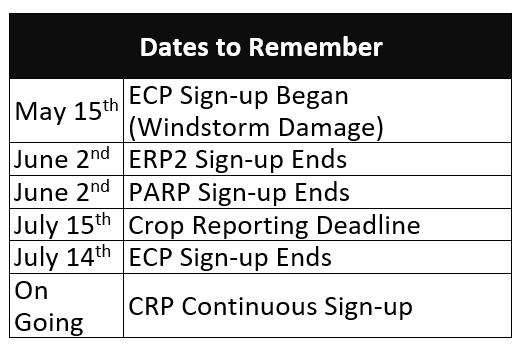 |

A Windstorm has caused severe damage in all of Butler County.
If you’ve suffered severe damage, you may be eligible for assistance under the Emergency Conservation Program (ECP) administered by the Butler County Farm Service Agency (FSA)
For land to be eligible, the natural disaster must create new conservation problems that, if untreated, would:
- be so costly to rehabilitate that Federal assistance is or will be needed to return the land to productive agricultural use
- is unusual and is not the type that would recur frequently in the same area
- affect the productive capacity of the farmland
- impair or endanger the land
If you qualify for ECP assistance, you may receive cost-share levels not to exceed 75 percent of the eligible cost of restoration measures. Eligible socially disadvantaged and beginning farmers and ranchers can receive up to 90 percent of the eligible cost of restoration. No one is eligible for more than $500,000 cost sharing per natural disaster occurrence.
If you’ve suffered a loss from a natural disaster may contact the local FSA County Office and request assistance from May 15, 2023 to July 14, 2023.
To be eligible for assistance, practices must not be started until all the following are met:
- an application for cost-share assistance has been filed
- the local FSA County Committee (COC) or its representative has conducted an onsite inspection of the damaged area
- the Agency responsible for technical assistance, such as the Natural Resource Conservation Service (NRCS), has made a needs determination, which may include cubic yards of earthmoving, etc., required for rehabilitation
In accordance with the National Environmental Policy Act (NEPA), FSA must complete an environmental compliance review prior to producers taking any actions.
For more information about ECP, contact your Butler County USDA Service Center at 270-526-3765 or visit fsa.usda.gov.
|
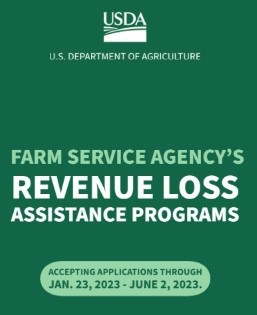
Beginning January 23, 2023, agricultural producers can begin to apply for two new important programs for revenue losses, from 2020 and 2021 natural disasters or the COVID-19 pandemic. Both programs equitably fill gaps in earlier assistance.
First, you may be eligible for assistance through the Emergency Relief Program (ERP) Phase Two if you experienced revenue losses from eligible natural disasters in 2020 and 2021.
You may also be eligible for the Pandemic Assistance Revenue Program (PARP) if you experienced revenue losses in calendar year 2020. PARP is addressing gaps in previous pandemic assistance, which was targeted at price loss or lack of market access, rather than overall revenue losses.
Applications for both new programs are due June 2, 2023, and you can apply for both programs during your same appointment with USDA’s Farm Service Agency (FSA).
Historically, FSA programs have been designed to make direct payments to producers based on a single disaster event or for a single commodity loss. For many of you, this may be the first revenue-based program that you’ve applied for with FSA.
Why revenue-based programs?
ERP Phase Two and PARP take a much more holistic approach to disaster assistance, ensuring that producers not just make it through a single growing season but have the financial stability to invest in the long-term well-being of their operations and employees.
In general, ERP Phase Two payments are based on the difference in allowable gross revenue between a benchmark year, representing a typical year of revenue for the producer and the disaster year – designed to target the remaining needs of producers impacted by qualifying natural disasters and avoid duplicative payments. ERP Phase Two revenue loss is based on tax years.
For PARP, an agricultural producer must have been in the business of farming during at least part of the 2020 calendar year and had a decrease in revenue for the 2020 calendar year, as compared to a typical year. PARP revenue loss is based on calendar years.
How to Apply
In preparation for enrollment, producers should gather supporting documentation including:
- Schedule F (Form 1040); and
-
Profit or Loss from Farming or similar tax documents for tax years 2018, 2019, 2020, 2021 and 2022 for ERP and for calendar years 2018, 2019 and 2020 for PARP.
Producers should also have, or be prepared to have, the following forms on file for both ERP and PARP program participation:
- Form AD-2047, Customer Data Worksheet (as applicable to the program participant);
- Form CCC-902, Farm Operating Plan for an individual or legal entity;
- Form CCC-901, Member Information for Legal Entities (if applicable); and
- Form AD-1026 Highly Erodible Land Conservation (HELC) and Wetland Conservation (WC) Certification.
- Form CCC-860, Socially Disadvantaged, Limited Resource, Beginning and Veteran Farmer or Rancher Certification, as certain existing permanent and ad-hoc disaster programs provide increased benefits or reduced fees and premiums.
Most producers, especially those who have previously participated in FSA programs, will likely have these required forms on file. However, those who are uncertain or want to confirm should contact FSA at their local USDA Service Center.
Yes, FSA is stepping outside of the box.
FSA is a big proponent of agricultural producers having a say in the design, implementation and delivery of the programs that directly impact their livelihoods. We also believe that some of the most creative and useful ideas for program and process improvements come from the FSA employees who administer this assistance through our network of more than 2,100 county offices. We want to thank producers across the country, along with the entire FSA workforce, for not just thinking outside of the box but also providing their input to make sure that we can improve and enhance our programs and our approach to assistance to better and more efficiently serve all producers who need our help.
Please visit your local USDA Service Center for more information on ERP Phase Two, PARP and our full portfolio of conservation, prices support, safety-net, credit and disaster assistance programs.
|
The U.S. Department of Agriculture (USDA) launched a new online tool to help farmers and ranchers better navigate the farm loan application process. This uniform application process will help to ensure all farm loan applicants receive equal support and have a consistent customer experience with USDA’s Farm Service Agency (FSA) regardless of their individual circumstances.
USDA experiences a high rate of incomplete or withdrawn applications, particularly among underserved customers, due in part to a challenging and lengthy paper-based application process. The Loan Assistance Tool is available 24/7 and gives customers an online step-by-step guide that supplements the support they receive when working in person with a USDA employee, providing materials that may help an applicant prepare their loan application in one tool.
Farmers can access the Loan Assistance Tool by visiting farmers.gov/farm-loan-assistance-tool and clicking the ‘Get Started’ button. From here they can follow the prompts to complete the Eligibility Self-Assessment and start the farm loan journey. The tool is built to run on any modern browser like Chrome, Edge, Firefox, or the Safari browser, and is fully functional on mobile devices. It does not work in Internet Explorer.
The Loan Assistance Tool is the first of multiple farm loan process improvements that will be available to USDA customers on farmers.gov in the future. Other improvements and tools that are anticipated to launch in 2023 include:
- A streamlined and simplified direct loan application, reduced from 29 pages to 13 pages.
- An interactive online direct loan application that gives customers a paperless and electronic signature option, along with the ability to attach supporting documents such as tax returns.
- An online direct loan repayment feature that relieves borrowers from the necessity of calling, mailing, or visiting a local Service Center to pay a loan installment.
Background
USDA provides access to credit to approximately 115,000 producers who cannot obtain sufficient commercial credit through direct and guaranteed farm loans. With the funds and direction Congress provided in Section 22006 of the Inflation Reduction Act, USDA is taking action to immediately provide relief to qualifying distressed borrowers whose operations are at financial risk while working on making transformational changes to loan servicing so that borrowers are provided the flexibility and opportunities needed to address the inherent risks and unpredictability associated with agricultural operations.
|

Understanding your specific soil and its dynamic properties, which can change over time due to human impacts, land management, and climate change, can be invaluable. The USDA’s Natural Resources Conservation Service (NRCS), through the National Cooperative Soil Survey (NCSS), has a team of soil and data scientists who are bringing customers the best soil information using the newest technology through the Lab Data Mart.
The newly updated Lab Data Mart website, also known as the National Cooperative Lab Characterization Database, brings valuable soil data to the public’s fingertips through a user-friendly, state-of-the-art interactive map. It includes data estimating soil properties such as organic carbon, clay content, calcium carbonate equivalent, and pH, which is beneficial in soil health assessments. Architects, educators, engineers, farmers, landowners, researchers, scientists, and anyone looking to learn more about their soil can access the latest data to make more informed decisions and reduce potential soil risks and hazards.
The Lab Data Mart includes mid-infrared (MIR) soil spectroscopy data gathered during soil analysis at the NRCS’ Kellogg Soil Survey Laboratory, one of the largest libraries of such data in the world. MIR soil spectroscopy uses the interactions between soil matter and infrared radiation to estimate soil properties.
The Lab Data Mart’s interactive map also links to a national database of soil characterization data, allowing users to locate soil samples and “pedons” analyzed in the lab. A pedon is the smallest unit of soil, containing all the soil horizons of a particular soil type. The customized data in the Lab Data Mart is downloadable to multiple applications and web services and is continuously updated as more sampled soil sites are added or re-visited.
How Can the Lab Data Mart Help You?
-
Determining carbon credits or improving carbon sequestration: The data can help you determine how much carbon is currently in the top 12 inches of soil and decide whether you want to sequester more carbon and consider methods and management practices to do so.
-
Leasing or buying land: The data may help determine if your planned management practices will work; and if not, what could be the added cost to do things differently. Understanding the mineralogy of your soil can help you determine if it requires soil amendments, a new tool or piece of equipment to accomplish your goals, or a change to what you farm or your tillage operation.
-
Taking a more systematic view of your land: Whether working with an NRCS conservation planner or on your own, the data helps you know more about your soil and ties into how you look at the whole ecological site.
Who Can Help You Use Lab Data Mart and Help You Understand Your Data?
NRCS State Soil Scientists and their staff, as well as technical service providers, can assist with obtaining the data in Lab Data Mart and understanding it. Contact NRCS at your local USDA Service Center for help and more information. Visit the Lab Data Mart website, or learn more about NRCS’ Soil Science.
|
|
|
|
Butler County USDA Service Center
216 W. Ohio Street
Morgantown, KY 42261
Phone: 270-526-3765
Fax: 855-770-7592
|
|