In This Issue:
“... I cannot conceive of the time when knowledge of soils will be complete. Our expectation is that our successors will build on what has been done, as we are building on the work of our predecessors.”
- R.S. Smith, Director of the Illinois Soil Survey, 1928
Rhode Island Agriculture is changing. If you read my last message, you will see it has grown, shrunk and is growing again. More farms, smaller, demographics changing, lots of interest in farming all through the state. As I travel around and see and talk with our producers and those individuals who support our farmers, I often get a question about the future of farming in the state.
We are seeing farming in a new way. I don’t have the references for this, but a while back (my time in RI ag started back in 1981 in Greenville office of SCS at the time), I was told it would take 40,000 acres of cropland to provide food needed in Rhode Island. An impossible number, never going to happen. And recently I have heard that we only produce 3-5% of the food we consume here in the state. Not a promising picture for food security in a changing global environment.
And, I have heard that there is a desire in the state to produce 50% of the food consumed in Rhode Island by 2050. When I mention that to anyone lately, the first thing I hear is a ‘scoff’. Well, agriculture is changing. We are seeing more interest in indoor agriculture (called ‘controlled environment agriculture’ or CEA for short). We have it already with Gotham Greens and some other ventures. We are seeing large scale greenhouses coming to Rhode Island, for year-round production. And USDA and the Farm Bill are focused more and more on urban agriculture.
Things are changing. If you have time, I would like you to read the following article and see what USDA is doing with Urban Agriculture and how we can help. And please pass this along to someone you know who may not know who to turn to for help.
Are You Gardening or Farming in an Urban Environment? | Morning Ag Clips
And, if you can, link the following site as a good place to check in on where the state is in helping to promote our farms.
RI Grown | Rhode Island Department of Environmental Management
|
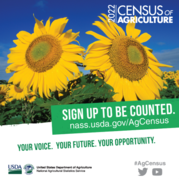
Time is running out to respond to the 2022 Census of Agriculture! Thank you to the producers who have already completed the ag census. If you have not responded, there is still time. By federal law, the ag census questionnaire needs to be completed by everyone who received it, including landowners who lease land to producers, those involved in conservation programs, even those who may have received the ag census and did not farm in 2022.
Strong response means strong data; these data will inform decisions that will help shape the future of American agriculture for the next five or six years. By not responding, you risk being unrepresented and therefore underserved in farm programs and funding, crop insurance rates, rural development, disaster assistance, and more. Return your ag census by mail or fill it out online at agcounts.usda.gov. Learn more at nass.usda.gov/AgCensus and respond today. Learn more at nass.usda.gov/AgCensus and respond today.
|
A message from FSA Administrator Zach Ducheneaux
Earlier this year, Farm Service Agency (FSA) made several updates to disaster assistance programs to give more farmers, ranchers, and Tribes equitable access to recovery programs. Specifically, we made changes to the Noninsured Crop Disaster Assistance Program (NAP) and simplified the application process for underserved producers.
This important policy change opens the door to risk management options for producers who may not have previously known about or been able to obtain coverage to protect their crops.
NAP provides financial assistance to producers of noninsurable crops when natural disaster events cause low yields, loss of inventory, or prevented planting.
Our policy improvements mean that, beginning with the 2022 crop year, having a CCC-860 form, Socially Disadvantaged, Limited Resource, Beginning and Veteran Farmer or Rancher Certification, on file with FSA will provide producers with basic NAP coverage for all eligible crops. Specifically, FSA is waiving all NAP-related service fees for basic coverage for producers with a CCC-860 on file prior to the application closing date for each crop. These producers are also eligible to receive a 50% premium reduction if they elect higher levels of coverage before the application closing date for each crop.
At the end of January, FSA notified producers who already have the CCC-860 certification form on file regarding their eligibility for NAP basic coverage for 2022. If you suffered losses from natural disasters in 2022, you will need to contact your local FSA county office to file an acreage report, as well as a notice of loss, and an application for a NAP payment.
If you are interested in NAP coverage for 2023 and future years, your local FSA county office staff will be more than happy to provide information on eligibility, coverage options, and how to apply for additional coverage.
While these recent policy changes are intended to remove barriers to available benefits and help underserved producers manage risk, any producer of noninsurable crops can apply for NAP coverage by completing FSA form CCC-471, Application for Coverage, and paying a service fee. Your local FSA office can verify application closing dates and ensure coverage for your crops is available.
FSA is committed to revisiting program policies and finding ways, within our authorities, to remove obstacles that prevent participation. Expanding NAP to ensure all producers of noninsured crops have access to risk coverage is the result of proactive input from producers and the willingness of FSA employees to think outside of the box for the benefit of the producers we serve.
Please contact the Rhode Island FSA County Office at 401-828-3120 Option 1 for more information on NAP coverage options.
|
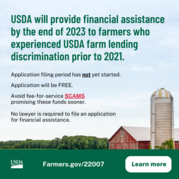
The Inflation Reduction Act provides $2.2 billion in financial assistance for farmers, ranchers, and forest landowners who experienced discrimination in USDA’s farm lending programs prior to January 1, 2021.
USDA has become aware of some lawyers and groups spreading misleading information about this process, pressuring people to sign retainer agreements, and asking people to fill out forms with private and sensitive information.
Application forms for this program are not yet available and the application filing period has not started. Before the application process opens, USDA will publish a list of trusted community organizations located across the country that will provide FREE help completing applications.
Please beware of organizations seeking to file your application for a fee. Filing an application for the program will be FREE. You will not need a lawyer to file an application for this program. If you feel the need for legal advice, seek the assistance of a trusted, licensed attorney.
Beware of solicitations by mail, email, or phone calls from individuals claiming to be connected to USDA. USDA will not solicit you for information.
The most up-to-date information on this program will be posted at www.farmers.gov/22007, a USDA website. Please check there for any concerns or reach out to the Rhode Island FSA County Office at 401-828-3120 option 1.
If you believe there is an organization conducting a scam related to this process, please contact the USDA Office of the Inspector General (OIG) or any other appropriate authorities. The USDA OIG hotline can be accessed online at https://usdaoig.oversight.gov/hotline and by phone at (800) 424-9121
|
NRCS State Conservationist for Rhode Island, R. Phou Vongkhamdy, announces the fiscal year 2023 signup to help Rhode Island farmers and forest landowners transition to organic production. This signup is part of USDA’s multi-agency Organic Transition Initiative (OTI) to provide technical and financial assistance to help farmers adopt a new organic management standard and support conservation practices required for organic certification.
“Producers transitioning to organic can count on NRCS for assistance through the process,” said Vongkhamdy. “By strengthening our technical proficiency and providing technical and financial assistance through new tools and practices, we can better support farmers through the challenges they may have transitioning to organic production.”
How to Apply
Eligible farmers, forest landowners, and other agricultural producers beginning or in the process of transitioning to organic certification should apply through NRCS at their local USDA Service Center by June 15, 2023, to be eligible for this year’s funding. Learn more...
^ back to top
|
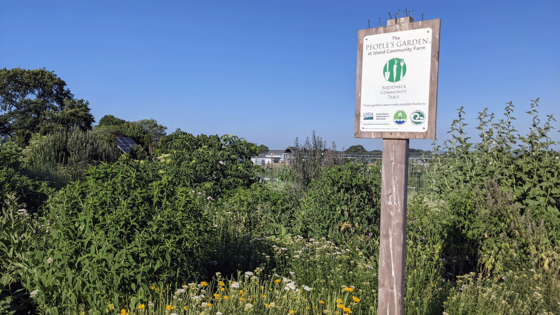 The People’s Garden community is growing! Last May, USDA renewed the People’s Garden initiative. On the anniversary of the reopening we invite you to join approximately 1,200 People’s Gardens that have signed up nationwide in the past year by registering on the USDA People’s Garden website. Community gardens, urban farms, school gardens, and small-scale agriculture projects in rural, suburban and urban areas can join the “People’s Garden” community.
We invite you to:
-
Join the People’s Garden community.
-
Grow using sustainable practices that benefit people and wildlife.
-
Teach about local, resilient food systems.
People’s Gardens are marked on a map on the USDA website and may be featured in USDA communications. You’ll receive a People’s Garden sign to display and learn about People’s Garden community information such as webinars.
NRCS in Rhode Island has been funding People's Gardens throughout the Ocean State in cooperation with our partners from the Rhode Island State Conservation Committee and our Eastern, Northern and Southern Rhode Island Conservation Districts. Find out how to develop your project and apply for funding or sign up your existing garden at www.usda.gov/peoples-garden.
May is American Wetlands Month. To celebrate, NRCS invites you to attend a one-hour webinar highlighting recent findings on the effects of forest management decisions on associated wetlands.
In May and all year long, NRCS supports landowners in making data-driven decisions to help wetlands thrive. Wetlands provide fish and wildlife habitat, microclimate regulation, nutrient and sediment capture and storage, water storage to reduce flooding, and carbon storage with resulting benefits for climate change mitigation. The scope of these benefits may be significantly affected by surrounding land cover, including variations in forest density and canopy leaf area.
On May 11 at 1:00 p.m. eastern, Dr. Katie Glodzik and Dr. Esther Lee from the University of Florida School of Forest, Fisheries, and Geomatic Sciences will discuss the influence of upland forest management on wetland and landscape-scale hydrologic functions. Findings from their analysis, supported by USDA’s Conservation Effects Assessment Project, can inform landowners’ management practices that increase water yield, improve wetland functions including carbon sequestration, and support targeted wetlands restoration efforts in the future. While the focus of this presentation is on geographically isolated wetlands in Coastal Plain pine forests of the southeastern United States, a diversity of wetlands landscapes can benefit from the findings.
No registration is required. Visit the Conservation Outcomes Webinar webpage below for additional information, including access instructions.
Access the Webinar
^ back to top
|
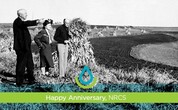
Originally known as the Soil Conservation Service NRCS was formed on Apr. 27, 1935. For 88 years we have been helping people help the land, and are proud to be part of such an amazing organization.
Today’s farmers, ranchers, and private forest landowners are better prepared to maintain healthy and resilient soil due to the tireless efforts of Dr. Hugh Hammond Bennett, the Soil Conservation Service’s (SCS) first Chief and the Father of Soil Conservation, who was born on April 15, 1881.
A maverick and visionary, Bennett knew that productive soils would help farmers, ranchers and forest landowners protect their livelihoods. Protecting soil and water resources served as the foundational mission of the agency he led for 16 years. Even then, Bennett, a scientist, knew good science must be the foundation for voluntary conservation on private lands.
Bennett’s mission was to reduce or prevent soil and water erosion on the nation’s agricultural land and grasslands. He was so driven by this purpose that he made conservation his life’s work. He saw the devastating impacts of soil and water erosion such as the huge gullies and loss of productive agricultural land. Learn more about our founder and the history of NRCS...
^ back to top
|
 Each May we celebrate the immeasurable contributions, vibrant cultures and achievements of Asian Americans, Native Hawaiians & Pacific Islanders and recommit ourselves to the ongoing work to ensure equity and opportunity for AA and NHPIs at USDA and throughout the United States.
^ back to top
|
Rhode Island USDA
60 Quaker Lane
Warwick, RI 02886
|
RI FSA County Office:
|
401-828-3120 Option 1
|
|
RI FSA Farm Loan Team:
|
401-828-3120 Option 2
|
|
RI FSA State Office:
|
401-828-3120 Option 3
|
|
RI NRCS Field Offices:
|
401-828-1300
|
|
RI NRCS State Office:
|
401-822-8813
|
|
Risk Management Agency:
|
919-875-4880
|
USDA is an equal opportunity provider, employer and lender. To file a complaint of discrimination, write: USDA, Office of the Assistant Secretary for Civil Rights, Office of Adjudication, 1400 Independence Ave., SW, Washington, DC 20250-9410 or call (866) 632-9992 (Toll-free Customer Service), (800) 877-8339 (Local or Federal relay), (866) 377-8642 (Relay voice users).
|