Manager's Messages
Timely Report Ownership and Operator Changes: Producers who are buying or selling agricultural land need to notify FSA as soon as possible following transaction for timely update of FSA farm records. To report an ownership change, provide either a copy of the recorded warranty deed or a contract for deed to FSA.
If you will be renting new land, the FSA County Office will need a copy of the lease before we can add you to the farm and/or give you any information about the farms such as maps, base acres, yields, and ARCPLC Election(s). If an operator is dropping rented land, we appreciate notification of those changes also for updating of records.
Producers who have transferred their land into a trust also need to timely report this "ownership" change to the FSA County Office. To record an ownership change to a trust, the trust, grantors, or trustee(s) need to provide a copy of the recorded deed to FSA.
Ownership changes involving land enrolled in the Conservation Reserve Program (CRP) need to be reported to the FSA County Office once the deed is recorded at the County Recorder’s office. Failure to timely report an ownership change (including land being transferred from an individual to a trust, etc.) for land enrolled in CRP could result in termination of the CRP contract and require a refund of all payments received under the applicable contract. Timely reporting of ownership changes is appreciated.
FSA is not notified by the County Recorder’s Office of these sales. In addition, notify FSA if your bank account has changed.
Swift County NRCS Office Is Hiring: The Benson Natural Resources Conservation Service (NRCS) office in Swift County is hiring a full time Soil Conservationist. The deadline to apply is March 23, 2023.
This position works with local producers on planning conservation on fields.
Benefits include:
-Monday-Friday flexible 8 or 9 hour days (40 hour work week) with possible limited telework options after being trained in.
-Excellent vacation and sick leave.
-11 Holidays off with possible.
-12 week paid maternity/paternity leave.
-Excellent Health, dental and vision insurance.
-Flex Spending options for day care and health.
-Large salary increases the first few years.
-Chances for spot award bonuses.
Basic Education Requirement:
Degree: soil conservation or related agricultural or natural resource discipline such as agronomy, soil science, forestry, agricultural education, or agricultural engineering. The study must have included 30 semester hours in a natural resource or agricultural field, including at least 12 semester hours in a combination of soils and crops or plant science. Of the 12 semester hours, a minimum of 3 semester hours must have been in soils and 3 semester hours in crops or plant science; OR
Combination of Education and Experience: At least 30 semester hours in one or more of the disciplines as shown above, including at least 12 semester hours in a combination of soils and crops or plant science, plus appropriate experience or additional education comparable to a four-year degree. Of the 12 semester hours, a minimum of 3 semester hours must have been in soils and 3 semester hours in crops or plant science.
If you are interested or know of someone who might be interested, please share this information with them. Here is the direct link to the position with information on how to apply: USAJOBS - Job Announcement
|
Sign Up for Text Alerts: In addition to email alerts, you can also subscribe to receive text messages on your cell phone from the Swift County USDA Service Center. To subscribe to text message alerts, text MNSwift to 372-669. Standard text messaging rates apply, and you can unsubscribe at any time.
|
~ Lindsay Christiansen, County Executive Director
March 31 - Deadline to apply for a commodity loan for 2022 crops: wheat, barley, oats, canola, honey, and flax
April 7 - Deadline to sign up for general CRP
May 31 - Deadline to apply for commodity loan for 2022 crops: corn, soybeans, sunflowers, and dry beans
June 2 - Deadline to apply for assistance through the Emergency Relief Program Phase 2 (ERP) and the Pandemic Assistance Revenue Program (PARP)
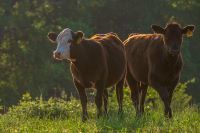
The Livestock Indemnity Program (LIP) provides assistance to you for livestock deaths in excess of normal mortality caused by adverse weather, disease and attacks by animals reintroduced into the wild by the federal government or protected by federal law.
For disease losses, FSA county committees can accept veterinarian certifications that livestock deaths were directly related to adverse weather and unpreventable through good animal husbandry and management.
For 2023 livestock losses, you must file a notice within 30 calendar days of when the loss is first apparent. You then must provide the following supporting documentation to your local FSA office no later than 60 calendar days after the end of the calendar year in which the eligible loss condition occurred.
-
Proof of death documentation
-
Copy of grower’s contracts
-
Proof of normal mortality documentation
USDA has established normal mortality rates for each type and weight range of eligible livestock, i.e. Adult Beef Cow = 1.5% and Non-Adult Beef Cattle (less than 250 pounds) = 5%. These established percentages reflect losses that are considered expected or typical under “normal” conditions.
|
Signup began January 23 for additional emergency relief from the U.S. Department of Agriculture (USDA) through the Emergency Relief Program (ERP) Phase Two.
To be eligible for Phase Two, producers must have suffered a decrease in allowable gross revenue in 2020 or 2021 due to necessary expenses related to losses of eligible crops from a qualifying natural disaster event. Eligible crops include both traditional insurable commodities and specialty crops that are produced in the United States as part of a farming operation and are intended to be commercially marketed. This also includes losses of eligible on-farm stored commodities. ERP Phase 2 applicants will use the following tax years when selecting allowable gross revenue:
-
Benchmark years: 2018 and/or 2019; estimated for new producers with no 2018 or 2019 revenue or adjusted if the benchmark years are not representative of the disaster year due to a change in operation size.
-
Disaster years: 2020 and/or 2021. The allowable gross revenue for the specific disaster year will be based on the tax year applicable to that revenue (2020, 2021 or 2022).
The ERP tool assists producers in calculating allowable gross revenue, as well as adjusted revenue for the benchmark years 2018 and 2019, and allowable gross revenue for representative tax years 2020-2022 which represent disaster years 2020 and 2021. Once producers complete the allowable gross revenue entries, they are able to print forms FSA-521 and FSA-521A through this tool.
The ERP Phase 2 and PARP application period is open from January 23 through June 2 2023.
For more information on payment calculations, payment limitations or how to determine allowable gross revenue, please reference the ERP Phase 2 fact sheet.
The Pandemic Assistance Revenue Program (PARP) will assist eligible producers of agricultural commodities who experienced revenue decreases in calendar year 2020 compared to 2018 or 2019 due to the COVID-19 pandemic. PARP will help address gaps in previous pandemic assistance, which was targeted at price loss or lack of market access, rather than overall revenue losses.
USDA's Farm Service Agency will accept PARP applications from January 23, 2023, through June 2, 2023.
Eligible and Ineligible Commodities
For PARP, eligible agricultural commodities include crops, aquaculture, livestock, livestock byproducts, or other animals or animal byproducts that are produced as part of a farming operation and are intended to be commercially marketed. This includes only commodities produced in the United States or those produced outside the United States by a producer located in the United States and marketed inside the United States.
The following commodities are not eligible for PARP:
-
Wild free-roaming animals.
-
Horses and other animals used or intended to be used for racing or wagering.
-
Aquatic species that do not meet the definition of aquaculture.
-
Cannabis sativa L. and any part of that plant that does not meet the definition of hemp.
-
Timber.
Program Eligibility
PARP payments will be made on a whole-farm basis, not commodity-by-commodity. To be eligible for PARP, an agricultural producer must have been in the business of farming during at least part of the 2020 calendar year and must have experienced a 15 percent decrease in allowable gross revenue in 2020, as compared to either:
-
The 2018 or 2019 calendar year, as elected by the producer, if they received allowable gross revenue during the 2018 or 2019 calendar years, or
-
The producer’s expected 2020 calendar year allowable gross revenue, if the producer had no allowable gross revenue in 2018 or 2019.
PARP payments will be issued after the application period ends on June 2, 2023.
The U.S. Department of Agriculture (USDA) has developed a simplified direct loan application to provide improved customer experience for producers applying for loans from the Farm Service Agency (FSA). The simplified direct loan application enables producers to complete a more streamlined application, reduced from 29 to 13 pages. Producers will also have the option to complete an electronic fillable form or prepare a traditional, paper application for submission to their local FSA farm loan office. The paper and electronic versions of the form will be available starting March 1, 2023.
Approximately 26,000 producers submit a direct loan application to the FSA annually, but there is a high rate of incomplete or withdrawn applications, due in part to a challenging and lengthy paper-based application process. Coupled with the Loan Assistance Tool released in October 2022, the simplified application will provide all loan applicants access to information regarding the application process and assist them with gathering the correct documents before they begin the process. This new application will help farmers and ranchers submit complete loan applications and reduce the number of incomplete, rejected, or withdrawn applications.
In October 2022, USDA launched the Loan Assistance Tool, an online step-by-step guide that provides materials to help an applicant prepare their farm loan application in one tool. Farmers can access the Loan Assistance Tool by visiting farmers.gov/farm-loan-assistance-tool and clicking the ‘Get Started’ button. The tool is built to run on any modern browser like Chrome, Edge, Firefox, or the Safari browser. A version compatible with mobile devices is expected to be available by the summer. It does not work in Internet Explorer.
The simplified direct loan application and Loan Assistance Tool are the first of multiple farm loan process improvements that will be available to USDA customers on farmers.gov in the future. Other improvements that are anticipated to launch in 2023 include:
-
An interactive online direct loan application that gives customers a paperless and electronic signature option, along with the ability to attach supporting documents such as tax returns.
-
An online direct loan repayment feature that relieves borrowers from the necessity of calling, mailing, or visiting a local Service Center to pay a loan installment.
USDA provides access to credit to approximately 115,000 producers who cannot obtain sufficient commercial credit through direct and guaranteed farm loans. With the funds and direction Congress provided in Section 22006 of the Inflation Reduction Act, USDA took action in October 2022 to provide relief to qualifying distressed borrowers while working on making transformational changes to loan servicing so that borrowers are provided the flexibility and opportunities needed to address the inherent risks and unpredictability associated with agricultural operations.
Soon, all direct loan borrowers will receive a letter from USDA describing the circumstances under which additional payments will be made to distressed borrowers and how they can work with their FSA local office to discuss these options. Producers can explore all available options on all FSA loan options at fsa.usda.gov or by contacting their local USDA Service Center.
USDA is making funding available for agricultural producers and forest landowners nationwide to participate in voluntary conservation programs and adopt climate-smart practices. The Inflation Reduction Act (IRA) provided an additional $19.5 billion over five years for climate smart agriculture through several of the conservation programs that USDA’s Natural Resources Conservation Service (NRCS) implements. NRCS is making available $850 million in fiscal year 2023 for its oversubscribed conservation programs: the Environmental Quality Incentives Program (EQIP), Conservation Stewardship Program (CSP), Agricultural Conservation Easement Program (ACEP) and Regional Conservation Partnership Program (RCPP).
The IRA funding includes an additional $8.45 billion for EQIP, $4.95 billion for RCPP, $3.25 billion for CSP, and $1.4 billion for ACEP. The increased funding levels begin in fiscal year 2023 and rapidly build over four years. These additional investments are estimated to help hundreds of thousands of farmers and ranchers apply conservation to millions of acres of land. Additionally, the IRA provides $300 million to quantify carbon sequestration and greenhouse gases (GHG) through the collection and use of field-based data to assess conservation outcomes. Information gained through this effort will be used to improve practices and technical assistance to customers. Further guidance on this important work will be provided as the implementation of this portion of the IRA continues.
These funds will provide direct climate mitigation benefits and will expand access to financial and technical assistance for producers to advance conservation on their farm, ranch or forest land through practices like cover cropping, conservation tillage, wetland restoration, prescribed grazing, nutrient management, tree planting and more. To ensure we can quantify the benefits of these IRA investments, NRCS is working to support Department-wide work on Measurement, Monitoring, Reporting and Verification (MMRV). The IRA provided targeted funding to support this effort. In administering the Inflation Reduction Act climate investments, USDA will also support other environmental co-benefits, including – among other things – water conservation, wildlife habitat improvements, and reducing runoff.
How to Apply
NRCS accepts producer applications for its conservation programs year-round, but producers interested in EQIP or CSP should apply by their state’s ranking dates to be considered for funding in the current cycle. Funding is provided through a competitive process and will include an opportunity to address the unmet demand from producers who have previously sought funding for climate-smart conservation activities.
For ACEP Agricultural Land Easements (ACEP-ALE) or Wetland Reserve Easements (ACEP-WRE), applications for the current IRA funding cycle must be submitted by March 17, 2023, for the first funding round. This year, NRCS will prioritize ACEP-ALE for grasslands in areas of highest risk for conversion to non-grassland uses to prevent the release of soil carbon stores. Meanwhile, NRCS will prioritize ACEP-WRE for eligible lands that contain soils high in organic carbon.
NRCS plans to roll out the next RCPP funding opportunity in early spring, which will include IRA funds from fiscal year 2023.
Other opportunities for agreements and partnerships at the state level will be announced for fiscal year 2023 in the coming months. The IRA provides funding to support those strategic partnerships with local, regional and national organizations. This will include outreach to underserved producers to ensure IRA climate funding is reaching those who have been previously unable to access conservation assistance.
Farm Storage Facility Loan Program Interest Rates
4.000% - Farm Storage Facility Loans, 3-Year
3.750% - Farm Storage Facility Loans, 5-Year
3.750% - Farm Storage Facility Loans, 7-Year
3.625% - Farm Storage Facility Loans, 10-Year
3.625% - Farm Storage Facility Loans, 12-Year
Farm Loan Program Interest Rates
4.75% - Farm Operating Loans, Direct
4.875% - Farm Ownership Loans, Direct
2.875% - Farm Ownership, Joint Financing
1.50% - Farm Ownership Loans, Beginning Farmer Down Payment
March 2023 Commodity Loan Interest Rates
5.75% - Commodity Loans
|








