In This Issue:
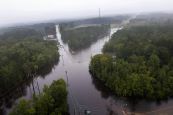
Signup begins January 23 for additional emergency relief from the U.S. Department of Agriculture (USDA) through the Emergency Relief Program (ERP) Phase Two.
To be eligible for Phase Two, producers must have suffered a decrease in allowable gross revenue in 2020 or 2021 due to necessary expenses related to losses of eligible crops from a qualifying natural disaster event. Eligible crops include both traditional insurable commodities and specialty crops that are produced in the United States as part of a farming operation and are intended to be commercially marketed. This also includes losses of eligible on-farm stored commodities. ERP Phase 2 applicants will use the following tax years when selecting allowable gross revenue:
- Benchmark years: 2018 and/or 2019; estimated for new producers with no 2018 or 2019 revenue or adjusted if the benchmark years are not representative of the disaster year due to a change in operation size.
- Disaster years: 2020 and/or 2021. The allowable gross revenue for the specific disaster year will be based on the tax year applicable to that revenue (2020, 2021 or 2022).
The ERP tool assists producers in calculating allowable gross revenue, as well as adjusted revenue for the benchmark years 2018 and 2019, and allowable gross revenue for representative tax years 2020-2022 which represent disaster years 2020 and 2021. Once producers complete the allowable gross revenue entries, they are able to print forms FSA-521 and FSA-521A through this tool.
The ERP Phase 2 and PARP application period is open from January 23 through June 2 2023.
For more information on payment calculations, payment limitations or how to determine allowable gross revenue, please reference the ERP Phase 2 fact sheet.
|
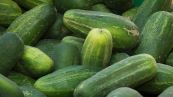
The USDA’s Risk Management Agency (RMA) reminds
Florida corn, cotton, cucumbers, flue-cured tobacco, grain sorghum, peanut, and soybean growers that the final date to apply for crop insurance coverage for the 2023 crop year is February 28.
Growers who are interested in the Whole-Farm Revenue Protection (WFRP) policy and are calendar year or early fiscal year filers, have until February 28 to apply for crop insurance. Current policyholders who wish to make changes to their existing coverage also have until the February 28 sales closing date to do so. Federal crop insurance is critical to the farm safety net. It helps producers and owners manage revenue risks and strengthens the rural economy. Coverage is available for corn, cotton, peanuts, soybeans, and WFRP in select Florida counties. Coverage is available for cucumbers in Jackson
County. Coverage is also available for flue-cured tobacco in Alachua, Columbia, Gadsden, Gilchrist, Hamilton, Lafayette, Madison, and Suwannee counties. Coverage is available for grain sorghum in Calhoun, Escambia, Jackson, Jefferson, and Levy counties. Please contact your insurance agent to see if your county is covered. Growers are encouraged to visit their crop insurance agent soon to learn specific details for the 2023 crop year.
Crop insurance is sold and delivered solely through private crop insurance agents. A list of crop insurance agents is available online using the RMA Agent Locator. Producers can use the RMA Cost Estimator to get a premium amount estimate of their insurance needs online. Learn more about crop insurance and the modern farm safety net at www.rma.usda.gov.
|
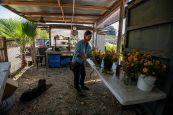
The Pandemic Assistance Revenue Program (PARP) will assist eligible producers of agricultural commodities who experienced revenue decreases in calendar year 2020 compared to 2018 or 2019 due to the COVID-19 pandemic. PARP will help address gaps in previous pandemic assistance, which was targeted at price loss or lack of market access, rather than overall revenue losses.
USDA's Farm Service Agency will accept PARP applications from January 23, 2023, through June 2, 2023.
Eligible and Ineligible Commodities
For PARP, eligible agricultural commodities include crops, aquaculture, livestock, livestock byproducts, or other animals or animal byproducts that are produced as part of a farming operation and are intended to be commercially marketed. This includes only commodities produced in the United States or those produced outside the United States by a producer located in the United States and marketed inside the United States.
The following commodities are not eligible for PARP:
- Wild free-roaming animals.
- Horses and other animals used or intended to be used for racing or wagering.
- Aquatic species that do not meet the definition of aquaculture.
-
Cannabis sativa L. and any part of that plant that does not meet the definition of hemp.
- Timber.
Program Eligibility
PARP payments will be made on a whole-farm basis, not commodity-by-commodity. To be eligible for PARP, an agricultural producer must have been in the business of farming during at least part of the 2020 calendar year and must have experienced a 15 percent decrease in allowable gross revenue in 2020, as compared to either:
- The 2018 or 2019 calendar year, as elected by the producer, if they received allowable gross revenue during the 2018 or 2019 calendar years, or
- The producer’s expected 2020 calendar year allowable gross revenue, if the producer had no allowable gross revenue in 2018 or 2019.
PARP payments will be issued after the application period ends on June 2, 2023.
For more information on determining allowable gross revenue visit farmers.gov/coronavirus/pandemic-assistance/parp or review the PARP fact sheet.
More Information
To apply for PARP, contact your local USDA Service Center.
|

The Farm Service Agency’s (FSA) Farm Storage Facility Loan (FSFL) program provides low-interest financing to help you build or upgrade storage facilities and to purchase portable (new or used) structures, equipment and storage and handling trucks.
Eligible commodities include corn, grain sorghum, rice, soybeans, oats, peanuts, wheat, barley, minor oilseeds harvested as whole grain, pulse crops (lentils, chickpeas and dry peas), hay, honey, renewable biomass, fruits, nuts and vegetables for cold storage facilities, floriculture, hops, maple sap, rye, milk, cheese, butter, yogurt, meat and poultry (unprocessed), eggs, and aquaculture (excluding systems that maintain live animals through uptake and discharge of water). Qualified facilities include grain bins, hay barns and cold storage facilities for eligible commodities.
Loans up to $50,000 can be secured by a promissory note/security agreement, loans between $50,000 and $100,000 may require additional security, and loans exceeding $100,000 require additional security.
You do not need to demonstrate the lack of commercial credit availability to apply. The loans are designed to assist a diverse range of farming operations, including small and mid-sized businesses, new farmers, operations supplying local food and farmers markets, non-traditional farm products, and underserved producers.
For more information, contact your local County USDA Service Center or visit fsa.usda.gov/pricesupport.
|
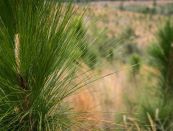
Thursday, February 23, 2023, 1:00-2:00 p.m. ET
Longleaf pine forests, which once encompassed more than 90 million acres across the southeastern United States, represent some of the world’s most biologically diverse ecosystems. Development, timbering, and fire suppression over the past two centuries have severely reduced the range of these forests, and with them, a suite of now threatened and endangered species. On February 23 at 1:00 p.m. eastern, Chambers English of the University of Georgia will present on both the barriers and impacts of longleaf pine restoration efforts compared to other common land uses in the Coastal Plains.
This presentation will focus on identifying economic barriers and water use impacts of multiple management regimes in southeastern forests, including native longleaf pine restoration compared to loblolly pine restoration. Findings may be leveraged by forest landowners in Florida to inform on-the-ground management decisions and by government agencies and conservation partners to guide targeted support for voluntary programs and initiatives related to longleaf pine restoration across private lands. No registration is required. Visit the Conservation Outcomes Webinar webpage below for additional information, including access instructions. Access the Webinar
|

New form will be available starting March 1, 2023
The U.S. Department of Agriculture (USDA) has developed a simplified direct loan application to provide improved customer experience for producers applying for loans from the Farm Service Agency (FSA). The simplified direct loan application enables producers to complete a more streamlined application, reduced from 29 to 13 pages. Producers will also have the option to complete an electronic fillable form or prepare a traditional, paper application for submission to their local FSA farm loan office. The paper and electronic versions of the form will be available starting March 1, 2023.
Approximately 26,000 producers submit a direct loan application to the FSA annually, but there is a high rate of incomplete or withdrawn applications, due in part to a challenging and lengthy paper-based application process. Coupled with the Loan Assistance Tool released in October 2022, the simplified application will provide all loan applicants access to information regarding the application process and assist them with gathering the correct documents before they begin the process. This new application will help farmers and ranchers submit complete loan applications and reduce the number of incomplete, rejected, or withdrawn applications.
In October 2022, USDA launched the Loan Assistance Tool, an online step-by-step guide that provides materials to help an applicant prepare their farm loan application in one tool. Farmers can access the Loan Assistance Tool by visiting farmers.gov/farm-loan-assistance-tool and clicking the ‘Get Started’ button. The tool is built to run on any modern browser like Chrome, Edge, Firefox, or the Safari browser. A version compatible with mobile devices is expected to be available by the summer. It does not work in Internet Explorer.
The simplified direct loan application and Loan Assistance Tool are the first of multiple farm loan process improvements that will be available to USDA customers on farmers.gov in the future. Other improvements that are anticipated to launch in 2023 include:
- An interactive online direct loan application that gives customers a paperless and electronic signature option, along with the ability to attach supporting documents such as tax returns.
- An online direct loan repayment feature that relieves borrowers from the necessity of calling, mailing, or visiting a local Service Center to pay a loan installment.
USDA provides access to credit to approximately 115,000 producers who cannot obtain sufficient commercial credit through direct and guaranteed farm loans. With the funds and direction Congress provided in Section 22006 of the Inflation Reduction Act, USDA took action in October 2022 to provide relief to qualifying distressed borrowers while working on making transformational changes to loan servicing so that borrowers are provided the flexibility and opportunities needed to address the inherent risks and unpredictability associated with agricultural operations.
Soon, all direct loan borrowers will receive a letter from USDA describing the circumstances under which additional payments will be made to distressed borrowers and how they can work with their FSA local office to discuss these options. Producers can explore all available options on all FSA loan options at fsa.usda.gov or by contacting their local USDA Service Center.
|
 |
|
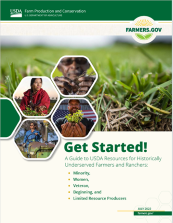
A multi-agency guide for USDA assistance for underserved farmers and ranchers is now available. If you are a farmer or rancher and are a minority, woman, veteran, beginning, or limited resource producer, you can use this booklet to learn about assistance and targeted opportunities available to you. This includes programs offered through the Farm Service Agency, Natural Resources Conservation Service, and Risk Management Agency. Download the guide here. The guide is also available in Spanish, Hmong, Korean, Vietnamese, Thai and Chinese on farmers.gov/translations. |
Friday, February 24, 2023
Florida A&M University/Research and Extension Center
4259 Bainbridge Highway, Quincy, FL 32352
Florida A&M University, in collaboration with the University of Georgia, is working together in conjunction with USDA Service Center Agencies such as the Farm Service Agency (FSA) and Natural Resources Conservation Service (NRCS) to increase participation of Underserved Landowners in the Conservation Reserve Program (CRP).
To increase the participation of underserved landowners in CRP. The project aims to improve understanding, identify challenges faced by underserved landowners, and formulate solutions for overcoming barriers to increase their participation in CRP. To this end, a series of workshops are being developed targeting Jefferson, Wakulla, Leon, Gadsden, Liberty, Calhoun, and Jackson Counties in the Florida Panhandle. Our first workshop will be on Friday, February 24, 2023, at the FAMU Research and Extension Center, 4259 Bainbridge Highway, Quincy, FL, from 8:30 AM to 4 PM. Lunch will be served.
The workshop activities include:
- An introduction to CRP
- Perspectives, processes, and challenges of getting into CRP
- Factors affecting CRP enrollment
- CRP practices & ecosystem benefits
- Heirs property and resolution
- Possible solutions for increasing underserved landowners’ participation in CRP
Underserved landowners are beginning farmers and ranchers, socially disadvantaged, limited resource, females, and military veterans.
No cost to register. To reserve a spot, please click HERE. For more information, please contact: Alex Bolques, alejandro.bolques@famu.edu, 850-421-6521

June 11-24, 2023
FAMU AgDiscovery is an opportunity for students to explore agricultural sciences and learn about careers in animal-related disciplines, including veterinary medicine.
Students will gain experiential learning through workshops, laboratory and field exercises, field trips, and various cultural and teambuilding activities.
The program helps students to understand better or refine their career paths and apply for early admission to FAMU.
Application Deadline: March 31, 2023
To apply or for more information, visit: www.aphis.usda.gov/agdiscovery.
Contact:
Carmen Lyttle-N’guessan, Ph.D.: 850-412-5363
Glen Wright, DVM: 850-599-8433
Cooperative Extension Program: 850-599-3546
https://cafs.famu.edu/outreach/AgDiscovery.php
|
Mar 2 - Deadline to file an ELAP application for payment for losses from Hurricane Ian
Mar 30 - EXTENDED Deadline to file a notice of loss for LIP
May 1 - EXTENDED deadline to file a LIP application for payment for losses from Hurricane Ian
June 2 - Pandemic Assistance Revenue Program (PARP)
June 2 - Emergency Relief Program (ERP) Phase Two
| Farm Operating - Direct |
4.750% |
| Farm Operating - Microloan |
4.750% |
| Farm Ownership - Direct |
4.750% |
| Farm Ownership - Microloan |
4.750% |
| Farm Ownership - Direct, Joint Financing |
2.750% |
| Farm Ownership - Down Payment |
1.500% |
| Emergency Loan - Amount of Actual Loss |
3.750% |
|