Ozark USDA Service Center GovDelivery Newletter

View as a webpage / Share

US Department of Agriculture

Franklin/Johnson/Logan County GovDelivery Newlsetter- January 27, 2023

MESSAGE FROM THE CED

FSA Logo

Disaster Assistance for 2022 Livestock Forage Losses

Producers in Franklin/Johnson/Logan County are eligible to apply for 2022 Livestock Forage Disaster Program (LFP) benefits on improved pasture.

LFP provides compensation if you suffer grazing losses for covered livestock due to drought on privately owned or cash leased land.  LFP sign up deadline is Monday January 30, 2023. If you have not scheduled an appointment with FSA, or received payment for you application, make sure to contact the County Office prior to Close of Business on Monday January 30, 2023, at 479-667-8600 Ext. 2

Additional CFAP2 Payment

FSA is issuing an additional Coronavirus Food Assistance Program 2 (CFAP 2) 2020 payment to underserved farmers and ranchers under the same authority as the producers’ previous CFAP 2 2020 payments using CCC funds. The additional CFAP 2 payment will be equal to 15% of the producer’s previous CFAP 2 payments, subject to CFAP 2 payment limitation provisions.

Underserved farmers and ranchers will be determined based on certification on form CCC-860.  This form declares you belong in a category of historically underserved producers whether it be by gender, race, or ethnicity. Some of our other programs offer producers that fall into these categories the same top up payment of 15%, such as the Emergency Relief Program (ERP), where others have fees waived, like our Non-Insured Crop Disaster Assistance Program often referred to as NAP. The NAP program is extremely beneficial to livestock producers as it covers pasture ground and is free once the service fee is waived. CCC-860 must be on file with FSA to receive the additional payment. The deadline to submit a CCC-860 for the additional CFAP2 payment is February 10, 2023. For additional information contact the Franklin/Johnson/Logan County FSA office at 479-667-8600                            


Farmers Can Now Make 2023 Crop Year Elections, Enroll in Agriculture Risk Coverage and Price Loss Coverage Programs

crops

Agricultural producers can now change election and enroll in the Agriculture Risk Coverage (ARC) and Price Loss Coverage programs for the 2023 crop year, two key safety net programs offered by the U.S. Department of Agriculture (USDA). Signup began Oct. 17, 2022, and producers have until March 15, 2023, to enroll in these two programs. Additionally, USDA’s Farm Service Agency (FSA) has started issuing payments totaling more than $255 million to producers with 2021 crops that have triggered payments through ARC or PLC.  

2023 Elections and Enrollment   

Producers can elect coverage and enroll in ARC-County (ARC-CO) or PLC, which provide crop-by-crop protection, or ARC-Individual (ARC-IC), which protects the entire farm. Although election changes for 2023 are optional, producers must enroll through a signed contract each year. Also, if a producer has a multi-year contract on the farm and makes an election change for 2023, they must sign a new contract.    

If producers do not submit their election by the March 15, 2023, deadline, their election remains the same as their 2022 election for crops on the farm.  Farm owners cannot enroll in either program unless they have a share interest in the farm.     

Covered commodities include barley, canola, large and small chickpeas, corn, crambe, flaxseed, grain sorghum, lentils, mustard seed, oats, peanuts, dry peas, rapeseed, long grain rice, medium and short grain rice, safflower seed, seed cotton, sesame, soybeans, sunflower seed and wheat.    

Web-Based Decision Tools   

In partnership with USDA, the University of Illinois and Texas A&M University offer web-based decision tools to assist producers in making informed, educated decisions using crop data specific to their respective farming operations. Tools include:   

  • Gardner-farmdoc Payment Calculator, a tool available through the University of Illinois allows producers to estimate payments for farms and counties for ARC-CO and PLC.  
  • ARC and PLC Decision Tool, a tool available through Texas A&M that allows producers to obtain basic information regarding the decision and factors that should be taken into consideration such as future commodity prices and historic yields to estimate payments for 2022.   

2021 Payments and Contracts  

ARC and PLC payments for a given crop year are paid out the following fall to allow actual county yields and the Market Year Average prices to be finalized. This month, FSA processed payments to producers enrolled in 2021 ARC-CO, ARC-IC and PLC for covered commodities that triggered for the crop year.   

For ARC-CO, producers can view the 2021 ARC-CO Benchmark Yields and Revenues online database, for payment rates applicable to their county and each covered commodity. For PLC, payments have triggered for rapeseed and peanuts. 

For ARC-IC, producers should contact their local FSA office for additional information pertaining to 2021 payment information, which relies on producer-specific yields for the crop and farm to determine benchmark yields and actual year yields when calculating revenues.  

By the Numbers  

In 2021, producers signed nearly 1.8 million ARC or PLC contracts, and 251 million out of 273 million base acres were enrolled in the programs.  For the 2022 crop year signed contracts surpassed 1.8 million, to be paid in the fall of 2023, if a payment triggers. 

Since ARC and PLC were first authorized by the 2014 Farm Bill and reauthorized by the 2018 Farm Bill, these safety-net programs have paid out more than $34.9 billion to producers of covered commodities.  

Crop Insurance Considerations   

ARC and PLC are part of a broader safety net provided by USDA, which also includes crop insurance and marketing assistance loans.   

Producers are reminded that ARC and PLC elections and enrollments can impact eligibility for some crop insurance products.   

Producers on farms with a PLC election have the option of purchasing Supplemental Coverage Option (SCO) through their Approved Insurance Provider; however, producers on farms where ARC is the election are ineligible for SCO on their planted acres for that crop on that farm.   

Unlike SCO, the Enhanced Coverage Option (ECO) is unaffected by an ARC election.  Producers may add ECO regardless of the farm program election.  

Upland cotton farmers who choose to enroll seed cotton base acres in ARC or PLC are ineligible for the stacked income protection plan (STAX) on their planted cotton acres for that farm.    

More Information    

For more information on ARC and PLC, visit the ARC and PLC webpage or contact your local 

.


The 2022 Census of Agriculture is Underway

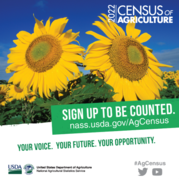
Census of Ag Signup 2022

America’s farmers and ranchers now have the opportunity to be represented in the nation’s only comprehensive and impartial agriculture data for every state, county and territory. USDA has mailed the 2022 Census of Agriculture to all known agriculture producers across the nation and Puerto Rico. Producers have the option to respond securely and conveniently online at agcounts.usda.gov or by mail. The deadline for response is Feb. 6, 2023.

Collected in service to American agriculture since 1840 and now conducted every five years by USDA’s National Agricultural Statistics Service (NASS), the Census of Agriculture tells the story and shows the value of U.S. agriculture. The data inform decisions about business, programs, rural development, research, and more. These are things that directly impact producers, and better data can lead to better decisions. That is why it is so important for every producer’s voice to be counted.

Responding to the Census of Agriculture is required by law under Title 7 USC 2204(g) Public Law 105-113. The same law requires NASS to keep personally-identifiable information confidential, to use the data only for statistical purposes, and only publish in aggregate form to prevent disclosing the identity of any individual producer or farm operation. NASS will release the results of the ag census in 2024.

To learn more about the Census of Agriculture, visit nass.usda.gov/AgCensus or call 800-727-9540. On the website, producers and other data users can access past ag census data, partner tools to help spread the word about the upcoming ag census, special study information, and more. For highlights of these and the latest information on the upcoming Census of Agriculture, follow USDA NASS on twitter @usda_nass.


Farmers.gov Feature Helps Producers Find Farm Loans that Fit Their Operation

USDA

Farmers and ranchers can use the Farm Loan Discovery Tool on farmers.gov to find information on USDA farm loans that may best fit their operations.

USDA’s Farm Service Agency (FSA) offers a variety of loan options to help farmers finance their operations. From buying land to financing the purchase of equipment, FSA loans can help.

USDA conducted field research in eight states, gathering input from farmers and FSA farm loan staff to better understand their needs and challenges.

How the Tool Works

Farmers who are looking for financing options to operate a farm or buy land can answer a few simple questions about what they are looking to fund and how much money they need to borrow. After submitting their answers, farmers will receive information on farm loans that best fit their specific needs. The loan application and additional resources also will be provided.

Farmers can download application quick guides that outline what to expect from preparing an application to receiving a loan decision. There are four guides that cover loans to individuals, entities, and youth, as well as information on microloans. The guides include general eligibility requirements and a list of required forms and documentation for each type of loan. These guides can help farmers prepare before their first USDA service center visit with a loan officer.

Farmers can access the Farm Loan Discovery Tool by visiting farmers.gov/fund and clicking the “Start” button. Follow the prompts and answer five simple questions to receive loan information that is applicable to your agricultural operation. The tool is built to run on any modern browser like Chrome, Edge, Firefox, or the Safari browser, and is fully functional on mobile devices. It does not work in Internet Explorer.

About Farmers.gov

In 2018, USDA unveiled farmers.gov, a dynamic, mobile-friendly public website combined with an authenticated portal where farmers will be able to apply for programs, process transactions, and manage accounts.

The Farm Loan Discovery Tool is one of many resources on farmers.gov to help connect farmers to information that can help their operations. Earlier this year, USDA launched the My Financial Information feature, which enables farmers to view their loan information, history, payments, and alerts by logging into the website.

USDA is building farmers.gov for farmers, by farmers. In addition to the interactive farm loan features, the site also offers a Disaster Assistance Discovery Tool. Farmers can visit farmers.gov/recover/disaster-assistance-tool#step-1 to find disaster assistance programs that can help their operation recover from natural disasters.

For more information, contact your Franklin/Johnson/Logan County USDA Service Center at 479-667-8600 or visit farmers.gov.


Change to Policy on Filing a Notice of Loss for Grazed Forage Producers with NAP Coverage

For the 2022 crop year, NAP forage producers with the intended use of grazing who elect to use independent assessments or other approved alternative loss percentage methods to establish their loss are no longer required to file a CCC-576 Notice of Loss with FSA.  However, a CCC-576 Application for Payment form must be submitted to FSA no later than 60 calendar days after the coverage period ends. If an independent assessment is used to determine the loss, producers have 180 days to file an application for payment.


Producers that elect to have the grazing loss determined using similar mechanically harvested units still must timely file a CCC-576 Notice of Loss within 15 days of the disaster event or damage to the crop first becomes apparent or within 15 days of harvest.


USDA Service Center

2720 W Commercial
Ozark, AR 72949

Phone: 479-667-8600
Fax: 855-623-0249

County Executive Director

Marshall Duffey Rye
marshall.rye@usda.gov

District Conservationist

Cody Carlile-Franklin Co
cody.carlile@usda.gov

Allison Fox-Johnson County
allison.fox@usda.gov

Travis Caudle-Logan County
travis.caudle@usda.gov

Program Technicians

Marcia Schluterman-Farm Programs
marcia.schluterman@usda.gov

Sarah Culver-Farm Programs
sarah.culver@usda.gov

Bille Hall-Farm Loan
billie.hall@usda.gov

Soil Conservationist

Holly Jones-Franklin County
holly.jones@usda.gov

County Committee:

Kelley Whitaker
Scott Childers
Bruce Staton
Chad Komp
Sarah Halmes
Christopher Heiser
Lawrence Plugge


Questions? Marshall Rye at email address:  marshall.rye@usda.gov

If you would need to request an accommodation, please contact Marshall Rye at 479-667-8600 Ext. 2 or email marshall.rye by 03/05/2023 to request accommodations (e.g., an interpreter, translator, seating arrangements, etc.) or materials in an alternative format (e.g., Braille, large print, audiotape – captioning, etc.).

Next County Committee Meeting:
March 9, 2023 at 9:00 a.m. 
Ozark USDA FSA office