Manager Comments

Steve Frericks - FSA County Executive Director
With a New Year we have two new programs, deadlines fast approaching, planning for 2023 crop year, and tons of resources to help educate you on our programs. Take some time to read this bulletin - and sign up for text messages - you don't want to be the one that missed that deadline.
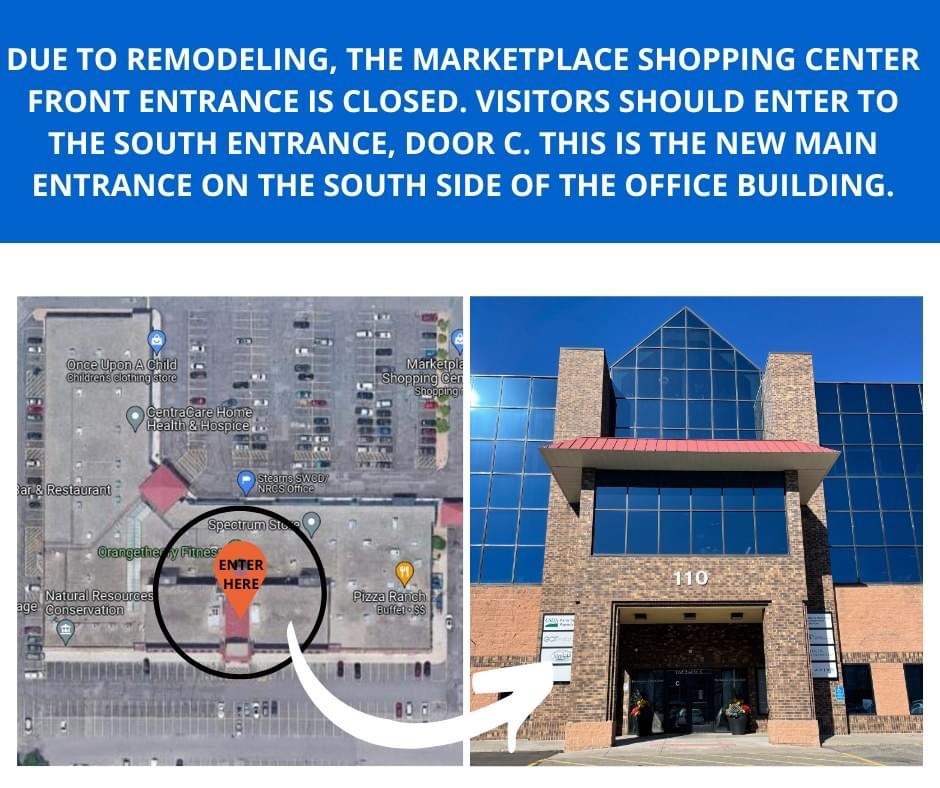
The USDA Service Center Building is under construction.
Producers will no longer be able to access the USDA Service Center from the North common entry through the atrium. Customers will need to access the suite from the south parking lot through door "C" as detailed above. The south parking lot is accessible via the passage east of Pizza Ranch. Please note that USDA also has a new conference room location adjacent to the FSA suite. We apologize for any inconvenience this might cause during the construction and relocation process.
Upcoming Revenue Loss Assistance Programs – Emergency Relief Program (ERP) Phase 2 is a tax year-based certification program that provides assistance for producers that suffered a loss in revenue due to necessary expenses associated with losses of eligible crops (excluding crops intended for grazing), due in whole or in part, to a qualifying disaster event that occurred in the 2020 or 2021 calendar year. Qualifying natural disaster events include wildfires, hurricanes, floods, derechos, excessive heat, winter storms, freeze (including a polar vortex), smoke exposure, excessive moisture, qualifying drought, and related conditions. In general, ERP phase two payments are to be based on the difference in certain farm revenue between a typical year of revenue (2018 or 2019) and the disaster year. Signup will be from January 23 to June 2, 2023.
Pandemic Assistance Revenue Program (PARP). USDA is providing critical support to producers impacted by the effects of the COVID-19 outbreak through the Pandemic Assistance Revenue Program (PARP). PARP provides direct financial assistance to producers of agricultural commodities who suffered at least a 15% loss in gross revenue in calendar year 2020 due to the COVID-19 pandemic. Payments to eligible producers will be based upon a comparison of the producer’s gross revenue from 2020 compared to either 2018 or 2019, as elected by the producer. The Farm Service Agency (FSA) is accepting applications for PARP from January 23 to June 2, 2023.
For additional information: Emergency Relief Program (ERP) and Pandemic Assistance Relief Program (PARP). Information on these programs may be found by clicking the links below or visiting farmers.gov. ERP Phase 2 Fact Sheet PARP Fact Sheet Comparison Fact Sheet
2022 Wool Loan Deficiency Payments (LDP) - Deadline is January 31 – Please remember to contact our office to ensure you have page 1 of form CCC-633EZ submitted before you lose interest in the wool. For wool, these forms are tied to the calendar year, so if you completed your shearing after the 1st of the year, make sure you have submitted a 2023 CCC-633EZ, Page 1 to avoid losing out on potential wool LDPs.
Organic Producers - Late-Filed Deadline February 3 – Producers that are certified organic, or are transitioning their operation to certified organic, may be eligible for financial assistance for expenses paid through USDA’s Organic and Transitional Education and Certification Program (OTECP). USDA is currently accepting program year 2022 late filed applications from organic producers to assist with the cost of receiving and maintaining organic certification through the Organic Certification Cost Share Program (OCCSP) and for OTECP.
Agricultural Risk Coverage/Price Loss Coverage (ARC/PLC) Program Election/Enrollment - Deadline March 15 – The ARC/PLC farm program election and enrollment for crop year 2023 runs through March 15, 2023. For more information on the programs, please go to ARC/PLC Program. OneSpan works very well and minimizes the amount of time needed to complete the process. Email mnwaitepar-fsa@usda.gov or call 320-251-7800 in Stearns County to request OneSpan for a "tap and sign" signature process.
2023 Continuous CRP Signup – Ongoing – Under the continuous CRP signup, environmentally sensitive land devoted to certain conservation practices can be enrolled in CRP at any time. Offers for continuous enrollment are not subject to competitive bidding during specific periods. Instead, they are automatically accepted provided the land and producer meet certain eligibility requirements and the enrollment levels do not exceed the statutory cap. A new practice established under the 2018 Farm Bill is CP43 Prairie Strips which could be used on perimeter of fields to replace conservation issues with headlands, irrigation corners, and salinity areas on cropland. Land that is not currently enrolled in CRP or expiring CRP may be offered for enrollment under Continuous CRP signup. For more information on Continuous CRP, click here.
Timely Report Ownership and Operator Changes – Producers who are buying or selling agricultural land need to notify FSA as soon as possible following the transaction for timely update of FSA farm records. To report an ownership change, provide either a copy of the recorded warranty deed or a contract for deed to FSA.
If you will be renting new land, the FSA County Office will need a copy of the lease before we can add you to the farm and/or give you any information about the farms such as maps, base acres, yields, and ARC/PLC Election(s). If an operator is dropping rented land, we appreciate notification of those changes also for updating of records.
Producers who have transferred their land into a trust also need to timely report this "ownership" change to the FSA County Office. To record an ownership change to a trust, the trust, grantors, or trustee(s) need to provide a copy of the recorded deed to FSA.
Ownership changes involving land enrolled in the Conservation Reserve Program (CRP) need to be reported to the FSA County Office once the deed is recorded at the County Recorder’s office. Failure to timely report an ownership change (including land being transferred from an individual to a trust, etc.) for land enrolled in CRP could result in termination of the CRP contract and require a refund of all payments received under the applicable contract. Timely reporting of ownership changes is appreciated.
FSA is not notified by the County Recorder’s Office of these sales. In addition, notify FSA if your bank account has changed.
Program Opportunities
Keep Connected with FSA: With all of the existing programs and new programs becoming available to assist you, I don’t want you to miss out on any of these deadlines. I highly encourage you to sign up for our text message alerts. FSA provides text message alerts (no more than 2 per month) for important reminders and deadlines. Don’t miss out on getting these reminders.
Let’s get you signed up right now! Take out your phone, send a message to 372-669 with MNStearns in the box of the text, and hit send. If you did these 3 easy steps you are signed up to receive text alerts. Thanks for doing this and you will receive quick reminders of important deadlines
|
A video series from NRCS and farmers.gov, Conservation at Work, presents short and easy to understand videos about popular conservation practices. These videos feature producers explaining how an individual practice helps their land and why they are using it. The videos shine the spotlight on farmers, ranchers, and forestland owners from across the U.S. who explain why they’ve implemented the conservation practices and how they work on their land. They also provide insight into how each practice is helping them protect and improve resources and save time and money. We’ve got videos showcasing high tunnels, no-till, cover crops, prescribed grazing, and many more. Check out the Conservation at Work video series at farmers.gov/conserve/conservationatwork.
|
Farmers and ranchers working with USDA’s Farm Service Agency or Natural Resources Conservation Service can now sign and share documents online in just a few clicks. By using Box or OneSpan, producers can digitally complete business transactions without leaving their homes or agricultural operations. Both services are free, secure, and available for multiple FSA and NRCS programs.
Box is a secure, cloud-based site where FSA or NRCS documents can be managed and shared. Producers who choose to use Box can create a username and password to access their secure Box account, where documents can be downloaded, printed, manually signed, scanned, uploaded, and shared digitally with Service Center staff. This service is available to any FSA or NRCS customer with access to a mobile device or computer with printer connectivity.
OneSpan is a secure eSignature solution for FSA and NRCS customers. Like Box, no software downloads or eAuthentication is required for OneSpan. Instead, producers interested in eSignature through OneSpan can confirm their identity through two-factor authentication using a verification code sent to their mobile device or a personalized question and answer. Once identity is confirmed, documents can be reviewed and e-signed through OneSpan via the producer’s personal email address. Signed documents immediately become available to the appropriate Service Center staff.
Box and OneSpan are both optional services for customers interested in improved efficiency in signing and sharing documents with USDA, and they do not replace existing systems using eAuthentication for digital signature. Instead, these tools provide additional digital options for producers to use when conducting business with FSA or NRCS.
USDA Service Center staff are available to help producers get started with Box and OneSpan through a few simple steps. Please visit farmers.gov/service-locator to find your local office and let Service Center staff know you’re interested in signing and sharing documents through these new features. In most cases, one quick phone call will be all that is needed to initiate the process.
Visit farmers.gov/mydocs to learn more about Box and OneSpan, steps for getting started, and additional resources for conducting business with USDA online
The Farm Loan team in Stearns County is already working on operating loans for spring 2023 and asks potential borrowers to submit their requests early so they can be timely processed. The farm loan team can help determine which loan programs would work best for applicants.
FSA offers a wide range of low-interest loans that can meet the financial needs of any farm operation for just about any purpose. The traditional farm operating and farm ownership loans can help large and small farm operations take advantage of early purchasing discounts for spring inputs as well expenses throughout the year.
Microloans are a simplified loan program that will provide up to $50,000 for both Farm Ownership and Operating Microloans to eligible applicants. These loans, targeted for smaller and non-traditional operations, can be used for operating expenses, starting a new operation, purchasing equipment, and other needs associated with a farming operation. Loans to beginning farmers and members of underserved groups are a priority.
Agricultural producers can now change election and enroll in the Agriculture Risk Coverage (ARC) and Price Loss Coverage programs for the 2023 crop year, two key safety net programs offered by the U.S. Department of Agriculture (USDA). Producers have until March 15, 2023, to enroll in these two programs.
2023 Elections and Enrollment Producers can elect coverage and enroll in ARC-County (ARC-CO) or PLC, which provide crop-by-crop protection, or ARC-Individual (ARC-IC), which protects the entire farm. Although election changes for 2023 are optional, producers must enroll through a signed contract each year. Also, if a producer has a multi-year contract on the farm and makes an election change for 2023, they must sign a new contract. If producers do not submit their election by the March 15, 2023 deadline, their election remains the same as their 2022 election for crops on the farm. Farm owners cannot enroll in either program unless they have a share interest in the farm. Covered commodities include barley, canola, large and small chickpeas, corn, crambe, flaxseed, grain sorghum, lentils, mustard seed, oats, peanuts, dry peas, rapeseed, long grain rice, medium and short grain rice, safflower seed, seed cotton, sesame, soybeans, sunflower seed and wheat.
Web-Based Decision Tools In partnership with USDA, the University of Illinois and Texas A&M University offer web-based decision tools to assist producers in making informed, educated decisions using crop data specific to their respective farming operations. Tools include: Gardner-farmdoc Payment Calculator, a tool available through the University of Illinois allows producers to estimate payments for farms and counties for ARC-CO and PLC.
ARC and PLC Decision Tool, a tool available through Texas A&M that allows producers to obtain basic information regarding the decision and factors that should be taken into consideration such as future commodity prices and historic yields to estimate payments for 2022. Crop Insurance Considerations ARC and PLC are part of a broader safety net provided by USDA, which also includes crop insurance and marketing assistance loans. Producers are reminded that ARC and PLC elections and enrollments can impact eligibility for some crop insurance products. Producers on farms with a PLC election have the option of purchasing Supplemental Coverage Option (SCO) through their Approved Insurance Provider; however, producers on farms where ARC is the election are ineligible for SCO on their planted acres for that crop on that farm. Unlike SCO, the Enhanced Coverage Option (ECO) is unaffected by an ARC election. Producers may add ECO regardless of the farm program election.
More Information For more information on ARC and PLC, visit the ARC and PLC webpage or contact your local USDA Service Center.
2023 is here, which means it’s time to start thinking about what you want to work on in the new year. Setting resolutions can be hard, but we’re here to help!
If you would like to make a Conservation Resolution for 2023, here are some options to consider:
- Incorporate cover crops into your operation.
- Extend your growing season by using a high tunnel.
- Improve your soil health by utilizing no-till practices.
- Provide recreational opportunities and wildlife habitat by restoring wetlands.
- Reduce input costs by focusing on nutrient management.
- Protect topsoil and groundwater quality by devoting environmentally sensitive agricultural land to conservation benefits instead of farming.
Resolutions can be daunting and hard to stick to, but here are some tips for how to make them successful.
-
Make a plan - To get started on your #ConservationResolutions, we recommend you stop by your local USDA service center, so we can discuss your vision for your land. The Natural Resources Conservation Service (NRCS) can provide you with free technical assistance and or advice.
-
Don’t do it alone – USDA’s conservation programs available through NRCS and the Farm Service Agency (FSA) give you the tools and resources to protect environmentally sensitive land and restore grasslands, wetlands, and forests, which leads to cleaner water and air, healthier soil, and enhanced wildlife habitat. We can also help with financial assistance to help you achieve your #ConservationResolutions
-
See what other landowners are doing - Learn about the benefits of conservation practices directly from the farmers, ranchers, and forest landowners applying them with our series of 90-second videos. Explore the different types of conservation practices by watching our Conservation at Work series. You can also read producer profiles on farmers.gov.
In future articles, we’ll be highlighting different #ConservationResolutions that can help protect our natural resources. Follow along to start yours!
The U.S. Department of Agriculture (USDA) Farm Service Agency (FSA) is currently making automatic Coronavirus Food Assistance Program 2 (CFAP 2) top-up payments to underserved farmers and ranchers. Payments will be based on the 2020 program certification on form CCC-860, Socially Disadvantaged, Limited Resource, Beginning and Veteran Farmer or Rancher Certification.
Producers who have not previously certified to their status for the 2020 program year have until Feb. 10, 2023, to submit form CCC-860 to be eligible for the additional payments. Contact your local USDA Service Center for more information.
|








