|
The U.S. Department of Agriculture (USDA) has technical and financial assistance available to help farmers and livestock producers recover. If your agricultural operation was impacted by recent rains and flooding, please contact your local USDA Service Center to report losses and learn more about program options available to assist in the recovery from crop, land, infrastructure and livestock losses and damages. To expedite FSA disaster assistance, you will likely need to provide documents, such as farm records, herd inventory, receipts and pictures of damages or losses.
On farmers.gov, the Disaster Assistance Discovery Tool, Disaster Assistance-at-a-Glance fact sheet, and Farm Loan Discovery Tool can help producers and landowners determine program or loan options. For assistance with a crop insurance claim, producers and landowners should contact their crop insurance agent. For FSA and NRCS programs, they should contact their local USDA Service Center.
If you’ve suffered excessive livestock death losses and grazing or feed losses due to recent floods, you may be eligible for disaster assistance programs through the USDA Farm Service Agency (FSA).
The Livestock Indemnity Program (LIP) offers payments to you for livestock death losses in excess of normal mortality due to adverse weather and the Emergency Assistance for Livestock, Honeybees, and Farm-Raised Fish Program (ELAP) provides emergency relief for losses due to feed or water shortages, disease, adverse weather, or other conditions, which are not adequately addressed by other disaster programs.
To participate in LIP, you will be required to provide verifiable documentation of death losses resulting from an eligible adverse weather event, and you must submit a notice of loss to your local FSA office within 30 calendar days of when the loss of livestock is apparent. To participate in ELAP, you must submit a notice of loss to your local FSA office within 30 calendar days of when the loss is apparent and should maintain documentation and receipts.
You should record all pertinent information regarding livestock losses due to the eligible adverse weather or loss condition, including:
- Documentation of the number, kind, type, and weight range of livestock that have died, supplemented if possible by photographs or video records of ownership and losses;
- Rendering truck receipts by kind, type and weight - important to document prior to disposal;
- Beginning inventory supported by birth recordings or purchase receipts;
- Documentation from Animal Plant Health Inspection Service, Department of Natural Resources, or other sources to substantiate eligible death losses due to an eligible loss condition;
- Documentation that livestock were removed from grazing pastures due to an eligible adverse weather or loss condition;
- Costs of transporting livestock feed to eligible livestock, such as receipts for equipment rental fees for hay lifts and snow removal;
- Feed purchase receipts if feed supplies or grazing pastures are destroyed;
For more information, contact your local FSA Office.
The U.S. Department of Agriculture (USDA) Farm Service Agency (FSA) is currently making automatic Coronavirus Food Assistance Program 2 (CFAP 2) top-up payments to underserved farmers and ranchers. Payments will be based on the 2020 program certification on form CCC-860, Socially Disadvantaged, Limited Resource, Beginning and Veteran Farmer or Rancher Certification.
Producers who have not previously certified to their status for the 2020 program year have until Feb. 10, 2023, to submit form CCC-860 to be eligible for the additional payments. Contact your local USDA Service Center for more information.
Payments Issuing to Producers of 2021 Crops Triggering Safety-Net Program Payments
Agricultural producers can now change election and enroll in the Agriculture Risk Coverage (ARC) and Price Loss Coverage programs for the 2023 crop year, two key safety net programs offered by the U.S. Department of Agriculture (USDA). Signup began Monday, and producers have until March 15, 2023, to enroll in these two programs. Additionally, USDA’s Farm Service Agency (FSA) has started issuing payments totaling more than $255 million to producers with 2021 crops that have triggered payments through ARC or PLC.
“It’s that time of year for produces to consider all of their risk management options, including safety-net coverage elections through Agriculture Risk Coverage and Price Loss Coverage,” said FSA Administrator Zach Ducheneaux. “We recognize that market prices have generally been very good, but if the ongoing COVID-19 pandemic, frequent catastrophic weather events and the Ukraine war have taught us anything, it’s that we must prepare for the unexpected. It’s through programs like ARC and PLC that FSA can provide producers the economic support and security they need to manage market volatility and disasters.”
2023 Elections and Enrollment
Producers can elect coverage and enroll in ARC-County (ARC-CO) or PLC, which provide crop-by-crop protection, or ARC-Individual (ARC-IC), which protects the entire farm. Although election changes for 2023 are optional, producers must enroll through a signed contract each year. Also, if a producer has a multi-year contract on the farm and makes an election change for 2023, they must sign a new contract.
If producers do not submit their election by the March 15, 2023 deadline, their election remains the same as their 2022 election for crops on the farm. Farm owners cannot enroll in either program unless they have a share interest in the farm.
Covered commodities include barley, canola, large and small chickpeas, corn, crambe, flaxseed, grain sorghum, lentils, mustard seed, oats, peanuts, dry peas, rapeseed, long grain rice, medium and short grain rice, safflower seed, seed cotton, sesame, soybeans, sunflower seed and wheat.
Web-Based Decision Tools
In partnership with USDA, the University of Illinois and Texas A&M University offer web-based decision tools to assist producers in making informed, educated decisions using crop data specific to their respective farming operations. Tools include:
-
Gardner-farmdoc Payment Calculator, a tool available through the University of Illinois allows producers to estimate payments for farms and counties for ARC-CO and PLC.
-
ARC and PLC Decision Tool, a tool available through Texas A&M that allows producers to obtain basic information regarding the decision and factors that should be taken into consideration such as future commodity prices and historic yields to estimate payments for 2022.
2021 Payments and Contracts
ARC and PLC payments for a given crop year are paid out the following fall to allow actual county yields and the Market Year Average prices to be finalized. This month, FSA processed payments to producers enrolled in 2021 ARC-CO, ARC-IC and PLC for covered commodities that triggered for the crop year.
For ARC-CO, producers can view the 2021 ARC-CO Benchmark Yields and Revenues online database, for payment rates applicable to their county and each covered commodity. For PLC, payments have triggered for rapeseed and peanuts.
For ARC-IC, producers should contact their local FSA office for additional information pertaining to 2021 payment information, which relies on producer-specific yields for the crop and farm to determine benchmark yields and actual year yields when calculating revenues.
By the Numbers
In 2021, producers signed nearly 1.8 million ARC or PLC contracts, and 251 million out of 273 million base acres were enrolled in the programs. For the 2022 crop year signed contracts surpassed 1.8 million, to be paid in the fall of 2023, if a payment triggers.
Since ARC and PLC were first authorized by the 2014 Farm Bill and reauthorized by the 2018 Farm Bill, these safety-net programs have paid out more than $34.9 billion to producers of covered commodities.
Crop Insurance Considerations
ARC and PLC are part of a broader safety net provided by USDA, which also includes crop insurance and marketing assistance loans.
Producers are reminded that ARC and PLC elections and enrollments can impact eligibility for some crop insurance products.
Producers on farms with a PLC election have the option of purchasing Supplemental Coverage Option (SCO) through their Approved Insurance Provider; however, producers on farms where ARC is the election are ineligible for SCO on their planted acres for that crop on that farm.
Unlike SCO, the Enhanced Coverage Option (ECO) is unaffected by an ARC election. Producers may add ECO regardless of the farm program election.
Upland cotton farmers who choose to enroll seed cotton base acres in ARC or PLC are ineligible for the stacked income protection plan (STAX) on their planted cotton acres for that farm.
More Information
For more information on ARC and PLC, visit the ARC and PLC webpage or contact your local USDA Service Center.
The U.S. Department of Agriculture (USDA) today announced the details of additional assistance for dairy producers, including a second round of payments through the Pandemic Market Volatility Assistance Program (PMVAP) and a new Organic Dairy Marketing Assistance Program (ODMAP). The update to PMVAP and the new ODMAP will enable USDA to better support small- and medium-sized dairy operations who weathered the pandemic and now face other challenges.
“The Biden-Harris administration continues to fulfill its commitments to fill gaps in pandemic assistance for producers. USDA is announcing a second set of payments of nearly $100 million to close-out the $350 million commitment under PMVAP through partnerships with dairy handlers and cooperatives to deliver the payments.,” said USDA Under Secretary for Marketing and Regulatory Programs Jenny Lester Moffitt. “USDA is also announcing new assistance targeted to small to medium size organic dairy farmers to help with anticipated marketing costs as they face a variety of challenges from weather to supply-chain challenges.”
Pandemic Market Volatility Assistance Program
PMVAP assists producers who received a lower value due to market abnormalities caused by the pandemic and ensuing Federal policies. As a result of the production cap increase, USDA’s Agricultural Marketing Service (AMS) will make PMVAP payments to eligible dairy farmers for fluid milk sales between 5 million and 9 million pounds from July through December 2020. This level of production was not eligible for payment under the first round of the PMVAP. Payment rates will be identical to the first round of payments, 80 percent of the revenue different per month, on fluid milk sales from 5 million to 9 million pounds from July through December 2020. USDA will again distribute monies through agreements with independent handlers and cooperatives, with reimbursement to handlers for allowed administrative costs. USDA will contact handlers with eligible producers to notify them of the opportunity to participate.
As part of the first round, PMVAP paid eligible dairy farmers on up to 5 million pounds of fluid milk sales from July through December 2020. The first round of payments distributed over $250 million in payments to over 25,000 eligible dairy farmers. These dairy farmers received the full allowable reimbursement on fluid milk sales up to 5 million pounds.
More information about the PMVAP production cap increase is available at www.ams.usda.gov/pmvap.
Organic Dairy Marketing Assistance Program
The new ODMAP, to be administered by USDA’s Farm Service Agency (FSA), is intended to help smaller organic dairy farms that have faced a unique set of challenges and higher costs over the past several years that have been compounded by the ongoing pandemic and drought conditions across the country. Many small organic dairy operations are now struggling to stay in business and FSA plans to provide payments to cover a portion of their estimated marketing costs for 2023. Final spending will depend on enrollment and each producers projected production, but ODMAP has been allocated up to $100 million.
The assistance provided by ODMAP will be provided through unused Commodity Credit Corporation funds remaining from earlier pandemic assistance programs. The assistance will help eligible organic dairy producers with up to 75 percent of their future projected marketing costs in 2023, based on national estimates of marketing costs. This assistance will be provided through a streamlined application process based on a national per hundredweight payment. The payments will be capped at the first five million pounds of anticipated production, in alignment with preexisting dairy programs that target assistance to those smaller dairies that are most vulnerable to marketing challenges. This program is still in development.
Details about the Organic Dairy Marketing Assistance Program will be available and updated at www.farmers.gov as more details are released in a Notice of Funds Availability later this year.
USDA is looking for exporters to apply for market development programs which provide funds to promote U.S. agricultural products overseas.
Programs like the Market Access Program (MAP), Foreign Market Development (FMD) program, Emerging Markets Program, Technical Assistance for Specialty Crops (TASC), and the Quality Samples Program (QSP) help U.S. producers, exporters, private companies, and trade organizations finance overseas marketing and promotional activities such as trade shows, market research, consumer promotions, technical assistance, trade servicing and educational seminars.
USDA programs also benefit small California producers and exporters through the Western United States Agricultural Trade Association (WUSATA), a MAP participant.
Each Spring, Foreign Agricultural Service (FAS) announces market development programs on Grants.gov and details about these programs can be found here: https://www.fas.usda.gov/programs.
Please reach out to Julie Scott at Julie.scott@usda.gov for more information.
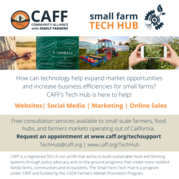
How can technology help expand market opportunities and increase business efficiencies for small farms?
Community Alliance with Family Farmers (CAFF) Tech Hub is here to Help!
Free Consultation services available to small scale farmers, food hubs and farmers markets operating out of California.
Request an appointment at www.caff.org/techsupport
For any questions email Techhub@caff.org or visit www.caff.org/techhub
|
Deadline for Calendar Year 2022 Applications is Jan. 31, 2023
The U.S. Department of Agriculture (USDA) reminds specialty crop producers of available assistance to help cover certain costs of complying with regulatory and market-driven food safety certification requirements. Applications for the Food Safety Certification for Specialty Crops (FSCSC) program for eligible 2022 costs are due by Jan. 31, 2023. USDA’s Farm Service Agency (FSA) will accept applications for 2023 costs from Feb. 1, 2023, to Jan. 31, 2024.
FSA is making available up to $200 million through the FSCSC program, which is part of USDA’s broader effort to transform the food system to create a more level playing field for small-scale agricultural operations and a more balanced, equitable economy for everyone working in food and agriculture.
USDA first announced and opened this program for signup in 2022, delivering critical assistance for specialty crop operations, with an emphasis on equity in program delivery while building on lessons learned from the COVID-19 pandemic and supply chain disruptions.
Program Details
FSCSC assists specialty crop operations that incurred eligible on-farm food safety certification and expenses related to obtaining or renewing a food safety certification in calendar years 2022 and 2023 for certifications issued on or after June 21, 2022. For each year, FSCSC covers a percentage of the specialty crop operation’s eligible costs of obtaining or renewing their certification, as well as a portion of their related expenses.
To be eligible for FSCSC, the applicant must:
- Be a specialty crop operation.
- Meet the definition of a small business or very small business.
- Have paid eligible expenses related to certification.
Specialty crop operations may receive assistance for the following costs:
- Developing a food safety plan for first-time food safety certification.
- Maintaining or updating an existing food safety plan.
- Food safety certification.
- Certification upload fees.
- Microbiological testing for products, soil amendments and water.
FSA calculates FSCSC payments for each category of eligible costs. FSA set a higher payment rate for underserved farmers and ranchers, which includes socially disadvantaged, limited resource, beginning and veteran producers who have a CCC-860 on file with FSA.
FSA will issue payments at the time of application approval for 2022 and after the application period ends for 2023. The 2023 application period opens Feb. 1, 2023, and closes Jan. 31, 2024. If calculated payments exceed the amount of available funding, payments will be prorated.
Applying for Assistance
Interested specialty crop producers can apply by completing the application, FSA-888. The application, along with other required documents, can be submitted to the FSA office at any USDA Service Center nationwide by mail, fax, hand delivery or via electronic means. Producers can visit farmers.gov/service-locator to find their local FSA office. Specialty crop producers can also call 877-508-8364 to speak directly with a USDA employee ready to assist.
Producers can visit farmers.gov/food-safety for additional program details, eligibility information and forms needed to apply.
Small nonfarm businesses in eight California counties are now eligible to apply for low‑interest federal disaster loans from the U.S. Small Business Administration, announced Director Tanya N. Garfield of SBA’s Disaster Field Operations Center-West. These loans offset economic losses because of reduced revenues caused by excessive high temperatures in the following primary county that occurred Sept. 1 – 9, 2022.
Primary county: Stanislaus;
Neighboring counties: Alameda, Calaveras, Mariposa, Merced, San Joaquin, Santa Clara and Tuolumne.
“SBA eligibility covers both the economic impacts on businesses dependent on farmers and ranchers that have suffered agricultural production losses caused by the disaster and businesses directly impacted by the disaster,” Garfield said.
Small nonfarm businesses, small agricultural cooperatives, small businesses engaged in aquaculture and most private nonprofit organizations of any size may qualify for Economic Injury Disaster Loans of up to $2 million to help meet financial obligations and operating expenses which could have been met had the disaster not occurred.
“Eligibility for these loans is based on the financial impact of the disaster only and not on any actual property damage. These loans have an interest rate of 3.04 percent for businesses and 1.875 percent for private nonprofit organizations, a maximum term of 30 years, and are available to small businesses and most private nonprofits without the financial ability to offset the adverse impact without hardship,” Garfield said.
By law, SBA makes Economic Injury Disaster Loans available when the U.S. Secretary of Agriculture designates an agricultural disaster. The Secretary declared this disaster on Jan. 13, 2023.
Businesses primarily engaged in farming or ranching are not eligible for SBA disaster assistance. Agricultural enterprises should contact the Farm Services Agency about the U.S. Department of Agriculture assistance made available by the Secretary’s declaration.
Applicants may apply online, receive additional disaster assistance information and download applications at https://disasterloanassistance.sba.gov/. Applicants may also call SBA’s Customer Service Center at (800) 659-2955 or email disastercustomerservice@sba.gov for more information on SBA disaster assistance. For people who are deaf, hard of hearing, or have a speech disability, please dial 7-1-1 to access telecommunications relay services. Completed applications should be mailed to U.S. Small Business Administration, Processing and Disbursement Center, 14925 Kingsport Road, Fort Worth, TX 76155.
The deadline to apply for economic injury is Sept. 13, 2023.
About the U.S. Small Business Administration
The U.S. Small Business Administration helps power the American dream of business ownership. As the only go-to resource and voice for small businesses backed by the strength of the federal government, the SBA empowers entrepreneurs and small business owners with the resources and support they need to start, grow, expand their businesses, or recover from a declared disaster. It delivers services through an extensive network of SBA field offices and partnerships with public and private organizations. To learn more, visit www.sba.gov.
The U.S. Department of Agriculture (USDA) made updates to several conservation, livestock and crop disaster assistance programs to give more farmers, ranchers, and tribes the opportunity to apply for and access programs that support recovery following natural disasters. Specifically, USDA’s Farm Service Agency (FSA) expanded eligibility and enhanced available benefits for a suite of its programs. These updates will provide critical assistance to producers who need to rebuild and recover after suffering catastrophic losses of production and infrastructure due to natural disasters.
FSA has updated the following programs: The Emergency Conservation Program (ECP), the Emergency Forest Restoration Program (EFRP), the Emergency Assistance for Livestock, Honeybees, and Farm-raised Fish (ELAP), the Livestock Forage Disaster Program (LFP), the Livestock Indemnity Program (LIP) and the Noninsured Crop Disaster Assistance Program (NAP).
Conservation Disaster Assistance Updates
FSA updated ECP to:
- Allow producers who lease Federally owned or managed lands, including tribal trust land, as well as State land the opportunity to participate.
- Provide advance payments, up to 25% of the cost, for all ECP practices before the restoration is carried out, an option that was previously only available for fence repair or replacement. The cost-share payment must be spent within 60 days.
Additionally, Congress also authorized the Federal government to pay 100% of the ECP and EFRP cost for damage associated with the Hermit’s Peak/Calf Canyon Fire in New Mexico. This fire burned over 340,000 acres from April 2022 to June 2022 and was the largest wildfire in recorded history in New Mexico. ECP and EFRP cost-share assistance is typically capped at 75%. This policy change for 100% cost-share applies only to those locations impacted by the Hermit’s Peak/Calf Canyon Fire.
ECP and EFRP provide financial and technical assistance to restore conservation practices like fencing, damaged farmland or forests.
Livestock Disaster Assistance Updates
FSA also expanded eligible livestock under ELAP, LFP and LIP. Specifically, horses maintained on eligible grazing land are eligible for ELAP, LFP and LIP. Many family farms and ranches use their forage to raise horses to augment their other agriculture endeavors. FSA recognizes that animals maintained in a commercial agriculture operation, add value to the operation and could be available for marketing from the farm. FSA regulations have been updated to include these animals as eligible livestock.
Horses and other animals that are used or intended to be used for racing and wagering remain ineligible.
Ostriches are also now eligible for LFP and ELAP. FSA is making this change because ostriches satisfy more than 50% of their net energy requirement through the consumption of growing forage grasses and legumes and are therefore considered “grazing animals”.
This change for ostriches is effective for the 2022 program year for both LFP and ELAP. ELAP requires a notice of loss to be filed with FSA within 30 days of when the loss is first apparent. Because this deadline may have passed for 2022, FSA is extending the deadline for filing notices of loss through March 31, 2023.
LIP and ELAP reimburses producers for a portion of the value of livestock, poultry and other animals that died as a result of a qualifying natural disaster event or for loss of grazing acres, feed and forage. LFP provides benefits for grazing losses due to drought and eligible wildfires on federally managed lands.
Noninsured Crop Disaster Assistance
NAP provides financial assistance to producers of non-insurable crops when low yields, loss of inventory or prevented planting occur due to natural disasters. Basic NAP coverage is equivalent to the catastrophic level risk protection plan of insurance coverage, which is based on the amount of loss that exceeds 50% of expected production at 55% of the average market price for the crop.
Previously, to be eligible for NAP coverage, a producer had to submit an application (Form CCC-471) for NAP coverage on or before the application closing date. For 2022, if a producer has a Socially Disadvantaged, Limited Resource, Beginning and Veteran Farmer or Rancher Certification (Form CCC-860) on file with FSA, it will serve as an application for basic coverage for all eligible crops having a 2022 application closing date and all NAP-related service fees for basic coverage will be waived for these producers.
FSA will notify all eligible producers who already have the CCC-860 certification form on file of their eligibility for NAP basic coverage for 2022. To potentially receive NAP assistance, producers who suffered losses due to natural disasters in 2022 should file an acreage report as well as a notice of loss with the FSA at their local Service Center.
Producers who are interested in obtaining NAP coverage for 2023 and subsequent years should also contact their local FSA county office for information on eligibility, coverage options and applying for coverage.
Farmers, are you searching for your future manager or supervisor? Whether you have a current employee who could use some additional training, or are seeking to hire a new team member, The Beginning Farm and Ranch Management Apprenticeship provides a structured pathway for aspiring farm managers to develop the knowledge and skills they need to be successful on your farm. The Center for Land-Based Learning covers all tuition for coursework and provides support for farmers and apprentices. To learn more about training an apprentice, visit https://landbasedlearning.org/apprentice-farmer-mentor
|







