|
|
Vermont USDA Newsletter - January 31, 2023
|
|
|
|
Farm Service Agency | Natural Resources Conservation Service | Risk Management Agency
|
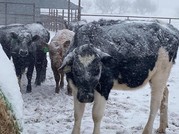
I hope that everyone has entered 2023 in great form and is looking forward to this New Year. As farmers we all know that it will be full of challenges, probably more than we wish, but hopefully you all remember that there is help out there. Whether talking to your neighbors, your friends, the staff at FSA or the Vermont Agency of Agriculture through Farm First.
2022 ended with Winter Storm Elliott. FSA staff is in the process of collecting damage reports caused by the storm, which especially impacted the maple industry, and are requesting authority to provide financial assistance for cleanup. Unfortunately, not all types of damage qualify for assistance through FSA programs, but I urge you to talk to your local county FSA office to see what help there is.
Vermont being a dairy state means anything that impacts the dairy industry is of importance to us. USDA has just announced two new dairy programs. The PMVAP Production Cap Increase will provide financial assistance to dairy farmers for fluid milk sales between 5 million and 9 million pounds from July through December 2020. This level of production was not eligible for payment under the first round of PMVAP. This program will be administered by AMS, the Agricultural Marketing Service.
The second program, the new Organic Dairy Marketing Assistance Program (ODMAP) will be administered by FSA. This program will provide relief to small organic dairy farms that have faced a unique set of challenges over the past several years that have been compounded by the ongoing pandemic and drought conditions across the country. Many small organic dairy operations are now struggling to stay in business in the face of substantially higher costs associated with hauling, storing, processing, and marketing certified organic milk. This has been highlighted in Vermont by the departure of Horizon and the dramatic rise in costs of organic livestock feed. The program will provide payments to cover a portion of organic dairy producers’ projected marketing costs in 2023. Final payment amounts will depend on enrollment and projected production; $100 Million has been set aside to cover these expected costs.
With both PMVAP and ODMAP the details have yet to be finalized but I want you all to be aware of this opportunity and as soon as we have the details, we will be letting you know.
The early part of the new year is often the time for meetings and there are a lot coming up in the next couple of months, so maybe I’ll see you there!
|

Agricultural producers who suffered economic harm and continue to experience working capital shortfalls due to the COVID 19 public health emergency may qualify for financial assistance from the VEDA Short-Term Forgivable Loan Program. For more information and eligibility requirements please visit VEDA Forgivable Loan Program.
If you already received financial assistance from this program, you may apply for loan forgiveness anytime, up to 12 months from the date you received the funds. Forgiveness applications are available at the link above.
|
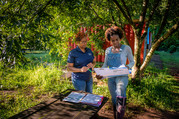
The Farm Service Agency (FSA) has several loan programs to help you start or continue an agriculture production. Farm ownership and operating loans are available.
While all qualified producers are eligible to apply for these loan programs, FSA has provided priority funding for members of targeted underserved applicants.
A targeted underserved applicant is one of a group whose members have been subjected to racial, ethnic or gender prejudice because of his or her identity as members of the group without regard to his or her individual qualities.
For purposes of this program, targeted underserved groups are women, African Americans, American Indians, Alaskan Natives, Hispanics, Asian Americans and Pacific Islanders.
FSA loans are only available to applicants who meet all the eligibility requirements and are unable to obtain the needed credit elsewhere.
|
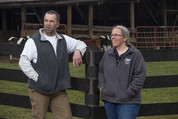
The Farm Service Agency (FSA) assists beginning farmers to finance agricultural enterprises. Under these designated farm loan programs, FSA can provide financing to eligible applicants through either direct or guaranteed loans. FSA defines a beginning farmer as a person who:
- Has operated a farm for not more than 10 years
- Will materially and substantially participate in the operation of the farm
- Agrees to participate in a loan assessment, borrower training and financial management program sponsored by FSA
- Does not own a farm in excess of 30 percent of the county’s average size farm.
For more information contact, contact your County USDA Service Center or visit fsa.usda.gov.
|

How much fuel can farmers save each year by transitioning from conventional tillage to continuous no-till? According to a new report from USDA’s Conservation Effects Assessment Project (CEAP), 3.6 gallons per acre is a reasonable estimate. With current off-road diesel fuel prices, this could translate into approximately $17 per acre saved annually.
Nearly 87 percent of all cropland acres nationwide are farmed using some form of conservation tillage, where tillage is reduced for at least one crop within a given field. Continuous no-till accounts for 33 percent of this total.
Improving soil health is one known benefit of limiting disturbance. Farmers who minimize tillage across their operation may reduce soil erosion, maximize water infiltration, improve nutrient cycling, build organic matter, and strengthen resilience to disaster events or challenging growing conditions. Based on the latest data, they may also use significantly less fuel than with conventional tillage and reduce their associated carbon dioxide emissions.
According to CEAP, farmers who implement conservation tillage practices instead of continuous conventional tillage:
- Reduce potential nationwide fuel use by 763 million gallons of diesel equivalents each year, roughly the amount of energy used by 2.8 million households.
- Reduce potential associated emissions by 8.5 million tons of carbon dioxide (CO2) equivalents each year, equivalent to removing nearly 1.7 million gasoline-powered passenger vehicles from the road.
How is this possible? Annually, farmers who practice continuous no-till use approximately 3.6 fewer gallons of fuel per acre than if they practiced continuous conventional tillage. Farmers who practice seasonal no-till – farming without tilling for at least one crop – use approximately 3 fewer gallons of fuel per acre than they would with conventional tillage year-round.
Acre by acre, fuel saved is money saved. Let’s assume an average off-road diesel fuel price of $4.75 per gallon*. By transitioning from continuous conventional tillage to continuous no-till, a farmer can save just over $17 per acre each year in fuel costs. A farmer who transitions from continuous conventional tillage to seasonal no-till can save more than $14 per acre on fuel annually. These potential savings are significantly larger than with CEAP’s first fuel savings report, primarily due to the current price of diesel fuel.
The bottom line for farmers: Reducing tillage leads to fuel savings that deliver significant financial benefits while building healthier soils for a more resilient operation.
USDA Can Help
If you’re a farmer interested in reducing tillage or pursuing other conservation efforts across your operation, USDA’s Natural Resources Conservation Service (NRCS) can help.
-
This blog offers five simple tips for farmers interested in trying no-till for the first time.
-
This 90-second video provides a description of no-till and associated benefits according to a Delaware farmer.
-
This 23-minute video follows five South Carolina farmers seeking to quantify the benefits of conservation practices that support soil health.
-
This webpage details principles to improve soil health, including reduced tillage and complimentary conservation practices such as cover crops, crop rotations, and rotational grazing.
NRCS has local USDA Service Centers in nearly every county across the United States. You may find contact information for your nearest Service Center here. NRCS staff are available to provide free, one-on-one assistance with a suite of practices to strengthen your operation, conserve natural resources, and boost your bottom line. SMART nutrient management, for example, is important to consider with no-till and may help you save money on fertilizer while improving water quality – another win-win.
Visit the new NRCS website to learn more about conservation basics, getting assistance from NRCS, programs and initiatives, and resources to inform management decisions. Visit the new CEAP webpage for additional information about USDA’s efforts to quantify the effects of conservation practices across croplands and other working lands.
|
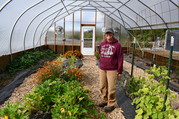
The first 10 years of a farming or ranching operation are tough. USDA recognizes you need dedicated support to help make sense of all the information coming your way. Now each state has a Beginning Farmer and Rancher team headed up by a state coordinator. The coordinator helps producers who have operated a farm or ranch for less than 10 years navigate USDA and partner resources.
To find your Vermont coordinator, visit farmers.gov/newfarmers/coordinators/. For more beginning farmer and rancher information, visit farmers.gov/newfarmers.
|
|
|
|
Vermont USDA
356 Mountain View Drive
Colchester, VT 05446
|
Farm Service Agency
John Roberts, State Executive Director
802-658-2803
john.roberts2@usda.gov
|
Natural Resources Conservation Service
Travis Thomason, State Conservationist 802-522-9943
travis.thomason@usda.gov
|
|
Addison County Office
Christine Lary, Acting County Executive Dir.
802-771-3027
christine.lary@usda.gov
Rebecca Davis, Farm Loan Manager
603-223-6003
rebecca.davis2@usda.gov
|
Central Zone
Marybeth Whitten, District Conservationist
802-771-3038
marybeth.whitten@usda.gov
|
|
Caledonia/Essex County Office
Patricia Matte, County Executive Director
802-424-3146
patricia.matte@usda.gov
|
Northeast Zone
Dave Blodgett, District Conservationist
802-624-7013
david.blodgett@usda.gov
|
|
Chittenden/Washington County Office
Lawrence Parker, County Executive Director
802-288-8155, ext. 102
lawrence.parker@usda.gov
|
Northwest Zone
Sarah Larose, District Conservationist
802-503-9202
sarah.larose@usda.gov
|
|
Lamoille/Orleans County Office
Heather Mateja, County Executive Director
Orleans: 802-334-6090, ext. 7016
Lamoille: 802-888-4935, ext. 3002 (Tues.)
heather.mateja@usda.gov
Angela Goodridge, Farm Loan Manager
802-334-6090, ext. 7003
angela.goodridge@usda.gov
|
South Zone
Phylicxia J. Moore, District Conservationist
802-774-8034
phylicxia.moore@usda.gov
|
|
Franklin/Grand Isle County Office
Laurie Locke, County Executive Director
802-528-4162
laurie.locke@usda.gov
Ryan Howrigan, District Director
802-528-4160
ryan.howrigan@usda.gov
|
|
|
Rutland/Bennington County Office
Christine Lary, Acting County Executive Dir.
802-775-8034, ext. 111
christine.lary@usda.gov
|
|
|
Windsor/Orange County Office
Christine Lary, County Executive Director
802-295-7942, ext. 3168
christine.lary@usda.gov
|
|
|
Windham County Office
Christine Lary, County Executive Director
802-254-9766, ext. 3032
christine.lary@usda.gov
|
|
|
|