The New Year is here, and in the spirit of a fresh start, I wish you all a great 2023!
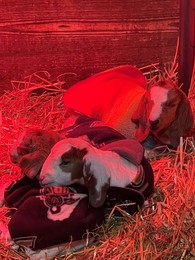
As barns across the Hoosier heartland are alive with the sounds of newly born livestock, it is the time to think about the year ahead of us and to make those ‘resolutions’ for the next 12 months. I certainly wish for continued good health for my family and friends (and goats and cows); for the markets to stabilize for planning purposes; and for you to embark upon a safe and productive planting and harvest seasons. These winter months provide time to think about your operation, and to focus on your goals and dreams. FSA stands ready to assist you with the multitude of programs offered from our 75 county offices across the state.
The winter season also is the time to attend annual meetings and conferences – take the time to attend these and obtain information and acquire resources you can use on the farm. It also is an opportunity to meet producers from across the state, and to contribute to the important agricultural dialogue. Your voice matters and makes a difference so find a way to get involved, at the county, state, and even national level!
The articles in this newsletter were hand-selected by our state office team to make certain you are aware of important programs and deadlines. We are planning to mail a newsletter to each of your homes in late February so look for that in your mailboxes soon.
I wish you a safe winter, and I know the eagerness of getting the equipment ready for planting season is just around the corner. Thank you for your commitment to production agriculture.
Yours in Agriculture,
|
 State Executive Director
Policy changes will help more producers recover from natural disasters.
The U.S. Department of Agriculture (USDA) made updates to several conservation, livestock and crop disaster assistance programs to give more farmers and tribes the opportunity to apply for and access programs that support recovery following natural disasters. Specifically, USDA’s Farm Service Agency (FSA) expanded eligibility and enhanced available benefits for a suite of its programs. These updates will provide critical assistance to producers who need to rebuild and recover after suffering catastrophic losses of production and infrastructure due to natural disasters.
FSA has updated the following programs: The Emergency Conservation Program (ECP), the Emergency Forest Restoration Program (EFRP), the Emergency Assistance for Livestock, Honeybees, and Farm-raised Fish (ELAP), the Livestock Forage Disaster Program (LFP), the Livestock Indemnity Program (LIP) and the Noninsured Crop Disaster Assistance Program (NAP).
Conservation Disaster Assistance Updates
FSA updated ECP to:
- Allow producers who lease Federally owned or managed lands, including tribal trust land, as well as State land the opportunity to participate.
- Provide advance payments, up to 25% of the cost, for all ECP practices before the restoration is carried out, an option that was previously only available for fence repair or replacement. The cost-share payment must be spent within 60 days.
ECP and EFRP provide financial and technical assistance to restore conservation practices like fencing, damaged farmland or forests.
Livestock Disaster Assistance Updates
FSA also expanded eligible livestock under ELAP, LFP and LIP. Specifically, horses maintained on eligible grazing land are eligible for ELAP, LFP and LIP. Many family farms use their forage to raise horses to augment their other agriculture endeavors. FSA recognizes that animals maintained in a commercial agriculture operation, add value to the operation and could be available for marketing from the farm. FSA regulations have been updated to include these animals as eligible livestock
Horses and other animals that are used or intended to be used for racing and wagering remain ineligible.
Ostriches are also now eligible for LFP and ELAP. FSA is making this change because ostriches satisfy more than 50% of their net energy requirement through the consumption of growing forage grasses and legumes and are therefore considered “grazing animals”.
This change for ostriches is effective for the 2022 program year for both LFP and ELAP. ELAP requires a notice of loss to be filed with FSA within 30 days of when the loss is first apparent. Because this deadline may have passed for 2022, FSA is extending the deadline for filing notices of loss through March 31, 2023.
LIP and ELAP reimburses producers for a portion of the value of livestock, poultry and other animals that died as a result of a qualifying natural disaster event or for loss of grazing acres, feed and forage. LFP provides benefits for grazing losses due to drought and eligible wildfires on federally managed lands.
Noninsured Crop Disaster Assistance
NAP provides financial assistance to producers of non-insurable crops when low yields, loss of inventory or prevented planting occur due to natural disasters. Basic NAP coverage is equivalent to the catastrophic level risk protection plan of insurance coverage, which is based on the amount of loss that exceeds 50% of expected production at 55% of the average market price for the crop.
Previously, to be eligible for NAP coverage, a producer had to submit an application (Form CCC-471) for NAP coverage on or before the application closing date. For 2022, if a producer has a Socially Disadvantaged, Limited Resource, Beginning and Veteran Farmer or Rancher Certification (Form CCC-860) on file with FSA, it will serve as an application for basic coverage for all eligible crops having a 2022 application closing date and all NAP-related service fees for basic coverage will be waived for these producers.
FSA will notify all eligible producers who already have the CCC-860 certification form on file of their eligibility for NAP basic coverage for 2022. To potentially receive NAP assistance, producers who suffered losses due to natural disasters in 2022 should file an acreage report as well as a notice of loss with the FSA at their local Service Center.
Producers who are interested in obtaining NAP coverage for 2023 and subsequent years should also contact their local FSA county office for information on eligibility, coverage options and applying for coverage.
Reporting Losses
Producers impacted by a natural disaster should report losses and damages and file an application with their FSA county office. Timelines for reporting losses and applying for payments differ by program.
For LIP and ELAP, producers will need to file a Notice of Loss for livestock and grazing or feed losses within 30 days and honeybee losses within 15 days. For LFP, producers must provide a completed application for payment and required supporting documentation to their FSA office within 30 calendar days after the end of the calendar year in which the grazing loss occurred.
For NAP, producers should contact their local FSA office for guidelines on submitting a notice of loss and filing an acreage certification.
More Information
The updates to these programs build on other Biden-Harris administration efforts to improve disaster assistance programs, including additional flexibility in obtaining Noninsured Crop Disaster Assistance Program (NAP) basic coverage for socially disadvantaged, beginning, limited resource and veteran farmers.
Previous enhancement to the ELAP provide program benefits to producers of fish raised for food and other aquaculture species as well as cover above normal expenses for transporting livestock to forage and grazing acres and transport feed to livestock impacted by qualifying drought. And earlier updates to the LIP payment rates better reflect the true market value of non-adult beef, beefalo, bison and dairy animals.
Additional Resources
On farmers.gov, the Disaster Assistance Discovery Tool, Disaster Assistance-at-a-Glance fact sheet, and Farm Loan Discovery Tool can help producers and landowners determine program or loan options. For assistance with a crop insurance claim, producers and landowners should contact their crop insurance agent. For FSA and Natural Resources Conservation Service programs, contact your local USDA Service Center.
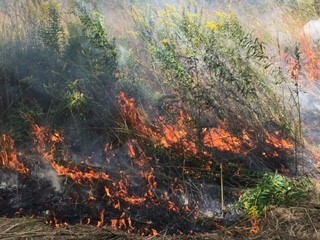
FSA encourages you to be proactive in preventing the spread of wildfire. If you participate in the Conservation Reserve Program (CRP), you are responsible for fire management on your CRP acreage. The goal is to suppress the amount of fuel in the event of a wildfire while still promoting the diversity of the conservation cover.
One fire management practice includes installing firebreaks, which should be included in the contract support document and installed according to NRCS firebreak standards. Barren firebreaks will only be allowed in high risk areas, such as transportation corridors, rural communities, and adjacent farmsteads. A conservationist must certify that there will not be an erosion hazard from the barren firebreak. If erosion becomes a problem, remedial action will be taken.
You must complete the necessary management activities outside of the Primary Nesting Season. In Indiana, the Primary Nesting Season is April 1 through August 1. Remember that fireguard technical practices should be outlined in your Conservation Plan of Operations (CPO).
|
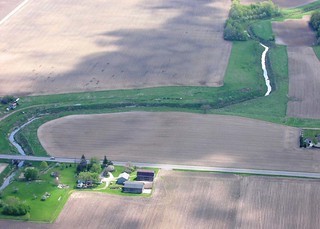
The Farm Service Agency (FSA) is accepting offers for specific conservation practices under the Conservation Reserve Program (CRP) Continuous Signup.
In exchange for a yearly rental payment, farmers enrolled in the program agree to remove environmentally sensitive land from agricultural production and to plant species that will improve environmental health and quality. The program’s long-term goal is to re-establish valuable land cover to improve water quality, prevent soil erosion, and reduce loss of wildlife habitat. Contracts for land enrolled in CRP are 10-15 years in length.
Under continuous CRP signup, environmentally sensitive land devoted to certain conservation practices can be enrolled in CRP at any time. Offers for continuous enrollment are not subject to competitive bidding during specific periods. Instead they are automatically accepted provided the land and producer meet certain eligibility requirements and the enrollment levels do not exceed the statutory cap.
For more information, including a list of acceptable practices, contact your local USDA Service Center or visit fsa.usda.gov/crp.
|
The term “sodbusting” is used to identify the conversion of land from native vegetation to commodity crop production after December 23, 1985. As part of the conservation provisions of the Food Security Act of 1985, if you’re proposing to produce agricultural commodities (crops that require annual tillage including one pass planting operations and sugar cane) on land that has been determined highly erodible and that has no crop history prior to December 23, 1985, that land must be farmed in accordance with a conservation plan or system that ensures no substantial increase in soil erosion.
Eligibility for many USDA programs requires compliance with a conservation plan or system on highly erodible land (HEL) used for the production of agricultural commodities. This includes Farm Service Agency (FSA) loan, disaster assistance, safety net, price support, and conservation programs; Natural Resources Conservation Service (NRCS) conservation programs; and Risk Management Agency (RMA) Federal crop insurance.
Before you clear or prepare areas not presently under production for crops that require annual tillage, you are required to file Form AD-1026 “Highly Erodible Land Conservation and Wetland Conservation Certification,” with FSA indicating the area to be brought into production. The notification will be referred to NRCS to determine if the field is considered highly erodible land. If the field is considered HEL, you are required to implement a conservation plan or system that limits the erosion to the tolerable soil loss (T) for the predominant HEL soil on those fields.
In addition, prior to removing trees or conducting any other land manipulations that may affect wetlands, remember to update form AD-1026, to ensure you remain in compliance with the wetland conservation provisions.
Prior to purchasing or renting new cropland acres, it is recommended that you check with your local USDA Service Center to ensure your activities will be in compliance with the highly erodible land and wetland conservation provisions.
For additional information on highly erodible land conservation and wetland conservation compliance, contact your local USDA Service Center.
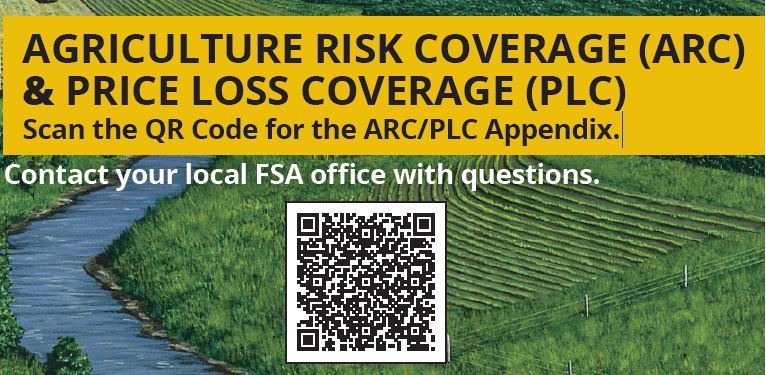
Agricultural producers can now change election and enroll in the Agriculture Risk Coverage (ARC) and Price Loss Coverage programs for the 2023 crop year, two key safety net programs offered by the U.S. Department of Agriculture (USDA). Signup began Oct. 17, 2022, and producers have until March 15, 2023, to enroll in these two programs. Additionally, USDA’s Farm Service Agency (FSA) has started issuing payments totaling more than $255 million to producers with 2021 crops that have triggered payments through ARC or PLC.
2023 Elections and Enrollment
Producers can elect coverage and enroll in ARC-County (ARC-CO) or PLC, which provide crop-by-crop protection, or ARC-Individual (ARC-IC), which protects the entire farm. Although election changes for 2023 are optional, producers must enroll through a signed contract each year. Also, if a producer has a multi-year contract on the farm and makes an election change for 2023, they must sign a new contract.
If producers do not submit their election by the March 15, 2023 deadline, their election remains the same as their 2022 election for crops on the farm. Farm owners cannot enroll in either program unless they have a share interest in the farm.
Covered commodities include barley, canola, large and small chickpeas, corn, crambe, flaxseed, grain sorghum, lentils, mustard seed, oats, peanuts, dry peas, rapeseed, long grain rice, medium and short grain rice, safflower seed, seed cotton, sesame, soybeans, sunflower seed and wheat.
Web-Based Decision Tools
In partnership with USDA, the University of Illinois and Texas A&M University offer web-based decision tools to assist producers in making informed, educated decisions using crop data specific to their respective farming operations. Tools include:
-
Gardner-farmdoc Payment Calculator, a tool available through the University of Illinois allows producers to estimate payments for farms and counties for ARC-CO and PLC.
-
ARC and PLC Decision Tool, a tool available through Texas A&M that allows producers to obtain basic information regarding the decision and factors that should be taken into consideration such as future commodity prices and historic yields to estimate payments for 2022.
2021 Payments and Contracts
ARC and PLC payments for a given crop year are paid out the following fall to allow actual county yields and the Market Year Average prices to be finalized. This month, FSA processed payments to producers enrolled in 2021 ARC-CO, ARC-IC and PLC for covered commodities that triggered for the crop year.
For ARC-CO, producers can view the 2021 ARC-CO Benchmark Yields and Revenues online database, for payment rates applicable to their county and each covered commodity. For PLC, payments have triggered for rapeseed and peanuts.
For ARC-IC, producers should contact their local FSA office for additional information pertaining to 2021 payment information, which relies on producer-specific yields for the crop and farm to determine benchmark yields and actual year yields when calculating revenues.
By the Numbers
In 2021, producers signed nearly 1.8 million ARC or PLC contracts, and 251 million out of 273 million base acres were enrolled in the programs. For the 2022 crop year signed contracts surpassed 1.8 million, to be paid in the fall of 2023, if a payment triggers.
Since ARC and PLC were first authorized by the 2014 Farm Bill and reauthorized by the 2018 Farm Bill, these safety-net programs have paid out more than $34.9 billion to producers of covered commodities.
Crop Insurance Considerations
ARC and PLC are part of a broader safety net provided by USDA, which also includes crop insurance and marketing assistance loans.
Producers are reminded that ARC and PLC elections and enrollments can impact eligibility for some crop insurance product
Producers on farms with a PLC election have the option of purchasing Supplemental Coverage Option (SCO) through their Approved Insurance Provider; however, producers on farms where ARC is the election are ineligible for SCO on their planted acres for that crop on that farm.
Unlike SCO, the Enhanced Coverage Option (ECO) is unaffected by an ARC election. Producers may add ECO regardless of the farm program election.
Maintaining ARC/PLC Acreage
If you’re enrolled in the Agriculture Risk Coverage (ARC) or Price Loss Coverage (PLC) programs, you must protect all cropland and noncropland acres on the farm from wind and water erosion and noxious weeds. By signing ARC county or individual contracts and PLC contracts, you agree to effectively control noxious weeds on the farm according to sound agricultural practices. If you fail to take necessary actions to correct a maintenance problem on your farm that is enrolled in ARC or PLC, the County Committee may elect to terminate your contract for the program year.
More Information
For more information on ARC and PLC, visit the ARC and PLC webpage or contact your local USDA Service Center.
Accessing capital to begin, extend or support an agriculture operation can be especially challenging to new producers. Farm Service Agency’s “Beginning Farmer” direct and guaranteed loan programs provide an opportunity for qualified applicants to secure loans from funding set aside for producers who meet the following conditions:
- Has operated a farm for not more than 10 years
- Will materially and substantially participate in the operation of the farm
- Agrees to participate in a loan assessment, borrower training and financial management program sponsored by FSA
- Does not own a farm in excess of 30 percent of the county’s average size farm.
For more information contact, contact your local USDA Service Center, your Indiana Regional Farm Loan Office or visit fsa.usda.gov.
|
Distressed borrowers with qualifying USDA farm loans have already received nearly $800 million in assistance, as part of the $3.1 billion in assistance for distressed farm loan borrowers provided through Section 22006 of the Inflation Reduction Act (IRA). The IRA directed USDA to expedite assistance to distressed borrowers of direct or guaranteed loans administered by USDA’s Farm Service Agency (FSA) whose operations face financial risk.
The October 2022 announcement kicked off a process to provide assistance to distressed farm loan borrowers using several complementary approaches, with the goal of keeping them farming, removing obstacles that currently prevent many of these borrowers from returning to farming, and improving the way that USDA approaches borrowing and servicing. Through this assistance, USDA is focused on generating long-term stability and success for distressed borrowers.
Work has already started to bring some relief to distressed farmers. As of Oct. 2022, over 13,000 borrowers have already benefited from the resources provided under the Inflation Reduction Act as follows:
- Approximately 11,000 delinquent direct and guaranteed borrowers had their accounts brought current. USDA also paid the next scheduled annual installment for these direct loan borrowers giving them peace of mind in the near term.
- Approximately 2,100 borrowers who had their farms foreclosed on and still had remaining debt have had this debt resolved in order to cease debt collections and garnishment relieving that burden that has made getting a fresh start more difficult.
In addition to the automatic assistance already provided, USDA has also outlined steps to administer up to an additional $500 million in payments to benefit the following distressed borrowers:
- USDA will administer $66 million in separate automatic payments, using COVID-19 pandemic relief funds, to support up to 7,000 direct loan borrowers who used FSA’s disaster-set-aside option during the pandemic to move their scheduled payments to the end of their loans.
- USDA is also initiating two case-by-case processes to provide additional assistance to farm loan borrowers. Under the first new process, FSA will review and assist with delinquencies from 1,600 complex cases, including cases in which borrowers are facing bankruptcy or foreclosure. The second new process will add a new option using existing direct loan servicing criteria to intervene more quickly and help an estimated 14,000 financially distressed borrowers who request assistance to avoid even becoming delinquent.
More details on each of the categories of assistance, including a downloadable fact sheet, are available on the Inflation Reduction Act webpage on farmers.gov.
Similar to other USDA assistance, these payments will be reported as income and borrowers are encouraged to consult their tax advisors. USDA also has resources and partnerships with cooperators who can provide additional assistance and help borrowers navigate the process.
This is only the first step in USDA’s efforts to provide assistance to distressed farm loan borrowers and respond to farmers and to improve the loan servicing efforts at USDA by adding more tools and relaxing unnecessary restrictions. Additional announcements and investments in assistance will be made as USDA institutes these additional changes and improvements.
This effort will ultimately also include adding more tools and relaxing unnecessary restrictions through assistance made possible by Congress through the IRA. Further assistance and changes to the approach will be made in subsequent phases.
Background
USDA provides access to credit to approximately 115,000 producers who cannot obtain sufficient commercial credit through direct and guaranteed farm loans, which do not include farm storage facility loans or marketing assistance loans. With the funds and direction Congress provided in Section 22006 of IRA, USDA is taking action to immediately provide relief to qualifying distressed borrowers whose operations are at financial risk while working on making transformational changes to how USDA goes about loan servicing in the long run so that borrowers are provided the flexibility and opportunities needed to address the inherent risks and unpredictability associated with agricultural operations and remain in good financial standing.
In January 2021, USDA suspended foreclosures and other adverse actions on direct farm loans due to the pandemic and encouraged guaranteed lenders to follow suit. Last week, USDA reiterated this request to guaranteed lenders to provide time for the full set of IRA distressed borrower assistance to be made available before lenders take irreparable actions.
Producers can explore available loan options using the Farm Loan Discovery Tool on farmers.gov (also available in Spanish) or by contacting their local USDA Service Center. Producers can also call the FSA call center at 877-508-8364 between 8 a.m. and 7 p.m. Eastern. USDA has tax-related resources available at farmers.gov/taxes.
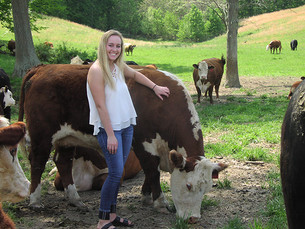
The Farm Service Agency (FSA) makes loans to youth to establish and operate agricultural income-producing projects in connection with 4-H clubs, FFA and other agricultural groups. Projects must be planned and operated with the help of the organization advisor, produce sufficient income to repay the loan and provide the youth with practical business and educational experience. The maximum loan amount is $5,000.
Youth Loan Eligibility Requirements:
- Be a citizen of the United States (which includes Puerto Rico, the Virgin Islands, Guam, American Samoa, the Commonwealth of the Northern Mariana Islands) or a legal resident alien
- Be 10 years to 20 years of age
- Comply with FSA’s general eligibility requirements
- Be unable to get a loan from other sources
- Conduct a modest income-producing project in a supervised program of work as outlined above
- Demonstrate capability of planning, managing and operating the project under guidance and assistance from a project advisor. The project supervisor must recommend the youth loan applicant, along with providing adequate supervision.
Read about one of Indiana's Youth Loan Success Stories
For help preparing the application forms, contact your local USDA Service Center, your Indiana Regional Farm Loan Office or visit fsa.usda.gov.
|
Many Farm Service Agency (FSA) programs require all program participants, either individuals or legal entities, to be “actively engaged in farming.” This means participants provide a significant contribution to the farming operation, whether it is capital, land, equipment, active personal labor and/or management. For entities, each partner, stockholder or member with an ownership interest, must contribute active personal labor and/or management to the operation on a regular basis that is identifiable and documentable as well as separate and distinct from contributions of any other member. Members of joint operations must have a share of the profits or losses from the farming operation commensurate with the member’s contributions to the operation and must make contributions to the farming operation that are at risk for a loss, with the level of risk being commensurate with the member’s claimed share on the farming operation.
Joint operations comprised of non-family members or partners, stockholders or persons with an ownership in the farming operation must meet additional payment eligibility provisions. Joint operations comprised of family members are exempt from these additional requirements. For 2016 and subsequent crop years, non-family joint operations can have one member that may use a significant contribution of active personal management exclusively to meet the requirements to be determined “actively engaged in farming.” The person or member will be defined as the farm manager for the purposes of administering these management provisions.
Non-family joint operations may request to add up to two additional managers for their farming operation based on the size and/or complexity of the operation. If additional farm managers are requested and approved, all members who contribute management are required to complete form CCC-902MR, Management Activity Record. The farm manager should use the form to record management activities including capital, labor and agronomics, which includes crop selection, planting decisions, acquisition of inputs, crop management and marketing decisions. One form should be used for each month and the farm manager should enter the number of hours of time spent for each activity under the date of the month the actions were completed. The farm manager must also document if each management activity was completed on the farm or remotely.
The records and supporting business documentation must be maintained and timely made available for review by the appropriate FSA reviewing authority, if requested.
If the farm manager fails to meet these requirements, their contribution of active personal management to the farming operation for payment eligibility purposes will be disregarded and their payment eligibility status will be re-determined for the applicable program year.
In some instances, additional persons or members of a non-family member joint operation who meet the definition of farm manager may also be allowed to use such a contribution of active personal management to meet the eligibility requirements. However, under no circumstances may the number of farm managers in a non-family joint operation exceed a total of three in any given crop and program year.
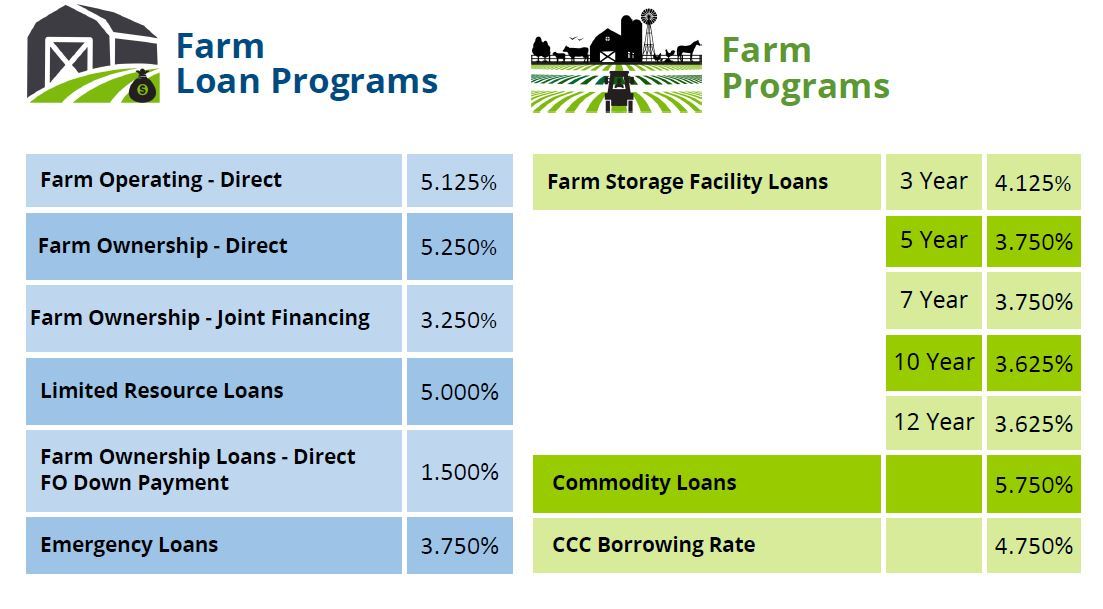
USDA announced loan interest rates for January 2023, which are effective January 1, 2023. USDA’s FSA loans provide important access to capital to help agricultural producers start or expand their farming operation, purchase equipment and storage structures, or meet cash flow needs.
FSA also offers guaranteed loans through commercial lenders at rates set by those lenders.
Check your eligibility for FSA loans by utilizing the Farm Loan Assistance Tool. Find out which of these loans may be right for you by using our Farm Loan Discovery Tool.
Producers can explore available options on all FSA loan options at fsa.usda.gov or by contacting your local USDA Service Center.
2023 Indiana FSA Important Deadline Dates
January 16 – Offices Closed in Observance of Martin Luther King, Jr’s Birthday
January 17 – Final Acreage Reporting Date for Apples
January 30 – Final Date to Submit Application for Payment for 2022 Losses under Emergency assistance for Livestock, Honeybees and Farm-Raised Fish Program (ELAP)
January 30 – Final Date to Submit Application for Payment for 2022 Losses under Livestock Forage Program (LFP)
January 31 – Deadline to Apply for Loan Deficiency Payments (LDP) for Unshorn Pelts Produced During the 2022 Crop Year
January 31 - Signup Deadline for 2023 Dairy Margin Coverage and Supplemental Dairy Margin Coverage
January 31 - Deadline to Submit an Application for the Food Safety Certification for Specialty Crops (FSCSC) Program for 2022
February 20 - Offices Closed in Observance of George Washington's Birthday
Ongoing - Signup for Continuous CRP
Ongoing – Submit an Application for a Farm Storage Facility Loan
Continuous - Submit an Application for FSA Farm Loans
Continuous - Signup for Local County Office FSA Text Alerts - Text Your Service Center Keyword to FSANOW (372-669)
Continuous – Sign up for GovDelivery Newsletters, Bulletins and Indiana Press Releases (Subscribe to USDA Emails for Farmers | Farmers.gov)
 2023 is an exciting year and the Purdue Women in Agriculture team invites you and your clients to attend the Ag Women Engage Conference (formerly the Women in Ag Conference) taking place in the new Terre Haute Convention Center, Terre Haute, IN from February 21-23, 2023!
February 21 features the pre-conference session “Becoming an Employer of Choice” (additional $50 registration fee).
February 22-23 is jam-packed with fantastic topics to help us re-engage our minds and bodies as we develop our new normal. Our keynote speaker features Dr. Brenda Mack, addressing stress, burnout, self-care, collaborative support, resiliency, wellness, and wellbeing for those in the health and agriculture fields.
Cost: $125 for February 22-23 (Additional $50 fee for February 21)
To register for the conference, visit: https://cvent.me/DDxyr2
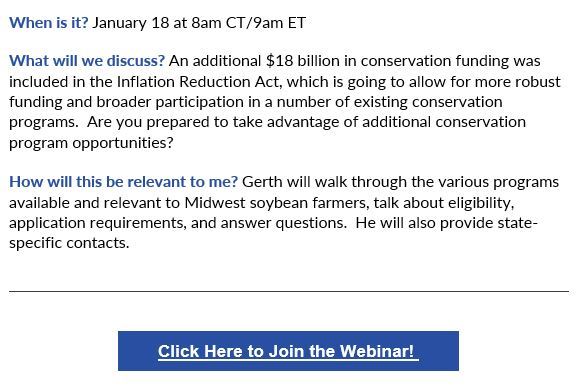
Join the Midwest Soybean Collaborative and Illinois State Conservationist Eric Gerth
to learn more about existing conservation funding opportunities.
For additional information concerning any FSA program, you may contact your local USDA Service Center or visit one of the following websites:
Unable to find the answer to your question. Ask.usda.gov offers the option to submit questions via email (askusda@usda.gov), online chat, or phone (1-833-ONE-USDA).
|