
Greetings Oklahoma! I hope each of you enjoyed a blessed holiday season and are off to a great new year. We are off to the races in 2023 and staff have been diligently working with applicants for our Environmental Quality Incentive Program (EQIP). Staff are making field visits to assess conservation needs, talk through alternative practices and will soon be ranking applications. We anticipate making initial EQIP funding decisions in early March.
NRCS was pleased to lead the Food and Agricultural Council Meeting on December 15th. Special thanks to our host, Langston University, for the wonderful tour of their world class goat research unit and new horticulture facilities. During the meeting Federal and State agencies provided updates on agriculture related issues including new programs available to producers, administrative and personnel updates, 2022 Census of Agriculture, and future field days and events.
January will mark my final month serving as Acting State Conservationist. We still await the naming of a permanent State Conservationist, but it has been my honor to serve Oklahoma these past few months. I feel blessed to have been able to work alongside amazing people, experience beautiful new cultures and learn more about the diversity of the agricultural landscape in this great State. Thank you for a wonderful experience and I wish you all the best and many future conservation successes!
Amanda Mathis, Acting State Conservationist
|
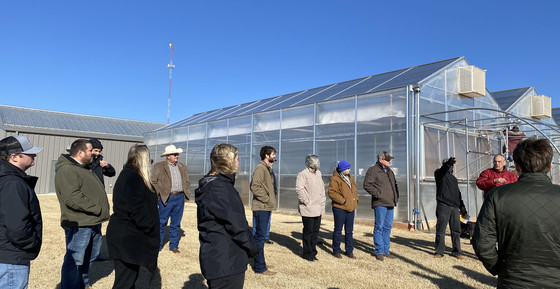 Langston, OK (Dec. 15, 2022) - The 2022 Food and Agricultural Council Meeting was hosted by Langston University. The event included a tour of the goat research unit and the university's new horticulture facilities.
EQIP Conservation Incentive Contracts
The Environmental Quality Incentives Program (EQIP) offers many services including the Conservation Incentive Contracts (CIC) program. CIC offers producers financial assistance to adopt conservation management practices on working landscapes and provides a steppingstone to the Conservation Stewardship Program (CSP).
Through these contracts, NRCS works with producers to strengthen the quality and condition of natural resources on their operations using management practices, such as prescribed grazing and residue and tillage management that target the priority resource concern(s).
A producer participating in CIC is not required to include their entire operation in the contract but can select which acres and land uses they wish to address. Under CIC, a producer must address at least one priority resource concern with a management practice within a high-priority area on an eligible land use.
Producers will receive an annual incentive payment to implement management practices and will have the opportunity to install conservation practices that support the management practice(s) in addressing the primary resource concern. Contracts under CIC last five years and a practice must be completed in the first 12 months following obligation.
The priority resource concern and land uses identified by the Oklahoma State Technical Committee in 2023 were Soil Quality Limitations on Cropland, Pastureland, and Rangeland. Eligible management practices to address the resource concern are:
- 328- Conservation Crop Rotation (Crop)
- 329- Residue and Tillage Management, No-Till (Crop)
- 340- Cover Crop (Crop)
- 345- Residue and Tillage Management, Reduced Till (Crop)
- 528- Prescribed Grazing (Pasture and Range)
How to Apply
NRCS accepts applications for EQIP Conservation Incentive Contracts year-round; however, producers and landowners should apply by February 24, 2023, to be considered for this year’s funding. To apply, producers should contact their local USDA Service Center.
Upcoming Vacancy Announcements:
- DHA Civil/Agricultural Engineer
- Soil Conservationist (District Conservationist), GS-0457-12
The best way to stay updated on job postings is to check USA Jobs often and sign up for notifications for job announcements.
All jobs with NRCS are listed and posted on USAJobs.
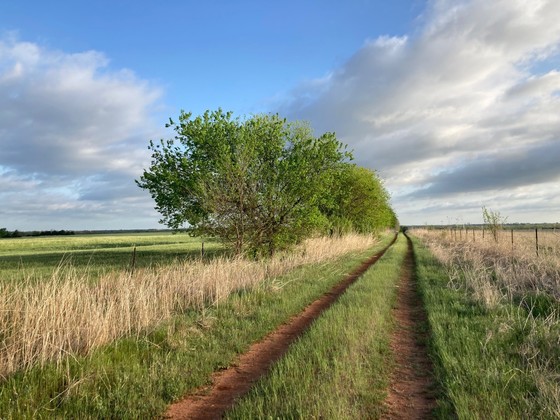 Photo by Raina Pelofsky from Logan County, OK. To enter a photo in this month's contest, email the full resolution photo to NRCSinfo-OK@usda.gov
NRCS and FSA will have representatives at the following events/meetings if you have questions or want to visit.
February
- Oklahoma Association Conservation District statewide meeting, Feb. 27-28, Oklahoma City, OK
Visit their state meeting page for more information
March
The USDA Farm Service Agency’s (FSA) Direct Farm Ownership loans can help farmers and ranchers become owner-operators of family farms, improve and expand current operations, increase agricultural productivity, and assist with land tenure to save farmland for future generations.
There are three types of Direct Farm Ownership Loans: regular, down payment and joint financing. FSA also offers a Direct Farm Ownership Microloan option for smaller financial needs up to $50,000.
Joint financing allows FSA to provide more farmers and ranchers with access to capital. FSA lends up to 50 percent of the total amount financed. A commercial lender, a State program or the seller of the property being purchased, provides the balance of loan funds, with or without an FSA guarantee. The maximum loan amount for a joint financing loan is $600,000, and the repayment period for the loan is up to 40 years.
The operation must be an eligible farm enterprise. Farm Ownership loan funds cannot be used to finance nonfarm enterprises and all applicants must be able to meet general eligibility requirements. Loan applicants are also required to have participated in the business operations of a farm or ranch for at least three years out of the 10 years prior to the date the application is submitted. The applicant must show documentation that their participation in the business operation of the farm or ranch was not solely as a laborer.
For more information about farm loans, contact your County USDA Service Center by visiting fsa.usda.gov.
WASHINGTON, Jan. 11, 2023 – The U.S. Department of Agriculture (USDA) reminds agricultural producers with perennial forage crops of an option to report their acreage once, without having to report that acreage in subsequent years, as long as there are no applicable changes on the farm. Interested producers can select the continuous certification option after USDA’s Farm Service Agency (FSA) certifies their acreage report.
“FSA’s continuous certification option simplifies future acreage reporting of perennial crops, and it can also help streamline the application process for many of our farm programs, including disaster assistance programs,” said FSA Administrator Zach Ducheneaux. “For example, when persistent drought conditions over the past year affected livestock producers in the West and Great Plains, producers who had previously filed a continuous acreage report were able to benefit from a streamlined application process for the Livestock Forage Disaster Program.”
An acreage report documents a crop grown on a farm or ranch and its intended uses, including perennial crops like mixed forage, birdsfoot trefoil, chicory/radicchio, kochia (prostrata), lespedeza, perennial peanuts and perennial grass varieties. To access many USDA programs, producers must file an accurate and timely acreage report for all crops and land uses, including failed acreage and prevented planting acreage.
The perennial crop continuous certification process requires a producer to initially complete an acreage report certifying the perennial crop acreage. The producer may select the continuous certification option any time after the crop is certified. Once the continuous certification option is selected, the certified acreage will roll forward annually and does not require additional action on the producer’s part in subsequent years unless the acreage report changes.
Once an producer selects continuous certification, then continuous certification is appliable to all fields on the farm for the specific crop, crop type and intended use. If continuous certification is selected by any producers sharing in the crop, then the continuous certification is appliable to fields in which the producer has a share for the specific crop, crop type and intended use.
“Currently less than half of the 336.5 million acres of perennial forage is being reported using the continuous certification process,” Ducheneaux said. “Producers can help streamline the reporting process by selecting continuous certification after filing their crop acreage report.”
Producers can opt out of continuous certification at any time. The continuous certification will terminate automatically if a change in the farming operation occurs.
How to File a Report
To file a crop acreage report, producers need to provide:
- Crop and crop type or variety.
- Intended use of the crop.
- Number of acres of the crop.
- Map with approximate boundaries for the crop.
- Planting date(s).
- Planting pattern, when applicable.
- Producer shares.
- Irrigation practice(s).
- Acreage prevented from planting, when applicable.
- Other information as required.
More Information
Producers can contact their local FSA office to see if their crops are eligible for continuous certification or to make an appointment. Producers can make an appointment to report acres by contacting their local USDA Service Center.
Policy changes will help more producers recover from natural disasters
The U.S. Department of Agriculture (USDA) made updates to several conservation, livestock and crop disaster assistance programs to give more farmers, ranchers, and tribes the opportunity to apply for and access programs that support recovery following natural disasters. Specifically, USDA’s Farm Service Agency (FSA) expanded eligibility and enhanced available benefits for a suite of its programs. These updates will provide critical assistance to producers who need to rebuild and recover after suffering catastrophic losses of production and infrastructure due to natural disasters.
FSA has updated the following programs: The Emergency Conservation Program (ECP), the Emergency Forest Restoration Program (EFRP), the Emergency Assistance for Livestock, Honeybees, and Farm-raised Fish (ELAP), the Livestock Forage Disaster Program (LFP), the Livestock Indemnity Program (LIP) and the Noninsured Crop Disaster Assistance Program (NAP).
Conservation Disaster Assistance Updates
FSA updated ECP to:
- Allow producers who lease Federally owned or managed lands, including tribal trust land, as well as State land the opportunity to participate.
- Provide advance payments, up to 25% of the cost, for all ECP practices before the restoration is carried out, an option that was previously only available for fence repair or replacement. The cost-share payment must be spent within 60 days.
Additionally, Congress also authorized the Federal government to pay 100% of the ECP and EFRP cost for damage associated with the Hermit’s Peak/Calf Canyon Fire in New Mexico. This fire burned over 340,000 acres from April 2022 to June 2022 and was the largest wildfire in recorded history in New Mexico. ECP and EFRP cost-share assistance is typically capped at 75%. This policy change for 100% cost-share applies only to those locations impacted by the Hermit’s Peak/Calf Canyon Fire.
ECP and EFRP provide financial and technical assistance to restore conservation practices like fencing, damaged farmland or forests.
Livestock Disaster Assistance Updates
FSA also expanded eligible livestock under ELAP, LFP and LIP. Specifically, horses maintained on eligible grazing land are eligible for ELAP, LFP and LIP. Many family farms and ranches use their forage to raise horses to augment their other agriculture endeavors. FSA recognizes that animals maintained in a commercial agriculture operation, add value to the operation and could be available for marketing from the farm. FSA regulations have been updated to include these animals as eligible livestock
Horses and other animals that are used or intended to be used for racing and wagering remain ineligible.
Ostriches are also now eligible for LFP and ELAP. FSA is making this change because ostriches satisfy more than 50% of their net energy requirement through the consumption of growing forage grasses and legumes and are therefore considered “grazing animals”.
This change for ostriches is effective for the 2022 program year for both LFP and ELAP. ELAP requires a notice of loss to be filed with FSA within 30 days of when the loss is first apparent. Because this deadline may have passed for 2022, FSA is extending the deadline for filing notices of loss through March 31, 2023.
LIP and ELAP reimburses producers for a portion of the value of livestock, poultry and other animals that died as a result of a qualifying natural disaster event or for loss of grazing acres, feed and forage. LFP provides benefits for grazing losses due to drought and eligible wildfires on federally managed lands.
Noninsured Crop Disaster Assistance
NAP provides financial assistance to producers of non-insurable crops when low yields, loss of inventory or prevented planting occur due to natural disasters. Basic NAP coverage is equivalent to the catastrophic level risk protection plan of insurance coverage, which is based on the amount of loss that exceeds 50% of expected production at 55% of the average market price for the crop.
Previously, to be eligible for NAP coverage, a producer had to submit an application (Form CCC-471) for NAP coverage on or before the application closing date. For 2022, if a producer has a Socially Disadvantaged, Limited Resource, Beginning and Veteran Farmer or Rancher Certification (Form CCC-860) on file with FSA, it will serve as an application for basic coverage for all eligible crops having a 2022 application closing date and all NAP-related service fees for basic coverage will be waived for these producers.
FSA will notify all eligible producers who already have the CCC-860 certification form on file of their eligibility for NAP basic coverage for 2022. To potentially receive NAP assistance, producers who suffered losses due to natural disasters in 2022 should file an acreage report as well as a notice of loss with the FSA at their local Service Center.
Producers who are interested in obtaining NAP coverage for 2023 and subsequent years should also contact their local FSA county office for information on eligibility, coverage options and applying for coverage.
Reporting Losses
Producers impacted by a natural disaster should report losses and damages and file an application with their FSA county office. Timelines for reporting losses and applying for payments differ by program.
For LIP and ELAP, producers will need to file a Notice of Loss for livestock and grazing or feed losses within 30 days and honeybee losses within 15 days. For LFP, producers must provide a completed application for payment and required supporting documentation to their FSA office within 30 calendar days after the end of the calendar year in which the grazing loss occurred.
For NAP, producers should contact their local FSA office for guidelines on submitting a notice of loss and filing an acreage certification.
More Information
The updates to these programs build on other Biden-Harris administration efforts to improve disaster assistance programs, including additional flexibility in obtaining Noninsured Crop Disaster Assistance Program (NAP) basic coverage for socially disadvantaged, beginning, limited resource and veteran farmers and ranchers.
Previous enhancement to the ELAP provide program benefits to producers of fish raised for food and other aquaculture species as well as cover above normal expenses for transporting livestock to forage and grazing acres and transport feed to livestock impacted by qualifying drought. And earlier updates to the LIP payment rates better reflect the true market value of non-adult beef, beefalo, bison and dairy animals.
Yesterday, FSA announced it would begin accepting applications for the Emergency Relief Program (ERP) Phase Two and the new Pandemic Assistance Revenue Program (PARP) on Jan. 23, 2023, through June 2, 2023. ERP Phase Two is designed to fill gaps in the delivery of program benefits not covered in ERP Phase One and improves equity in program delivery to underserved producers. PARP will help address gaps in previous pandemic assistance, which was targeted at price loss or lack of market access, rather than overall revenue losses. Learn more in the Jan. 9, 2023 news release.
Additional Resources
On farmers.gov, the Disaster Assistance Discovery Tool, Disaster Assistance-at-a-Glance fact sheet, and Farm Loan Discovery Tool can help producers and landowners determine program or loan options. For assistance with a crop insurance claim, producers and landowners should contact their crop insurance agent. For FSA and Natural Resources Conservation Service programs, contact the local USDA Service Center.
|