|
Before the end of the year, I will have visited over 50 county offices since starting in this position a year ago yesterday. Hands down my favorite part of the job is visiting with the field staff at Iowa FSA. The foundation of delivering our mission to serve Iowa farmers happens in our county offices.
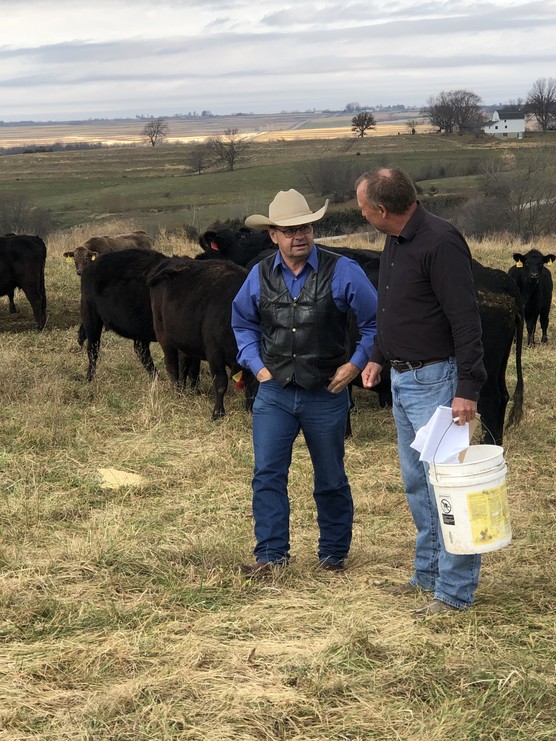
That’s why I was so excited we were able to host our FSA Administrator Zach Ducheneaux in Page County earlier this month. Our goal was to give our administrator an experience of how important USDA is to our local communities. It was also a great opportunity for our local community leaders to see how the combined programs from USDA work together to support their rural community. I offer a huge thanks to Seth Watkins who farms near Clarinda and serves on our FSA State Committee for helping to organize a full day of how USDA invests in the people of Page County.
I’m grateful that I’m getting the opportunity to better understand the skills and dedication of our field staff as they serve farming families like mine. I’m thankful that Iowa FSA has a deep culture of collaboration and leadership development. As we work together to solve problems, this culture is vital in delivering the resources American taxpayers are investing in Iowa farmers.
We are also hiring new staff at a rate that most of our 600 employees have never experienced before. What an amazing time to be part of Iowa FSA. We are building a generation of future leaders. The Biden-Harris Administration, under the leadership of Secretary Tom Vilsack, is investing in county offices to build renewed capacity to deliver an expanding set of programs.
It’s the honor of my career to be starting my second year serving alongside the amazing men and women at Iowa FSA and to be in leadership with fellow appointees like Administrator Ducheneaux, Iowa Rural Development State Director Theresa Greenfield, and our five State Committee members: Wendy Johnson, Seth Watkins, Kayla Koether, Ryan Marquardt, and Mark Recker. I also work closely with NRCS State Conservationist Jon Hubbert and shared a cup of coffee with him yesterday morning as we brainstormed how to leverage emerging investments in Iowa agriculture. Together, we are all responding to historic challenges with historic efforts to re-imagine how USDA serves rural America.
Administrator Ducheneaux (left) speaking with Seth Watkins on Watkins' farm outside of Clarinda.
Earlier this month, Iowa FSA hosted a visit from Administrator Zach Ducheneaux. During the visit to Iowa, Administrator Ducheneaux toured the Clarinda sale barn; visited the farm of Iowa State Committee member, Seth Watkins; met with USDA staff; and participated in a roundtable discussion with community leaders. Ducheneaux's visit to Iowa builds on USDA's commitment in being a trusted partner to rural America.
In his role as Administrator, Ducheneaux provides leadership and direction on agricultural policy, administering loan programs, and managing conservation, commodity, disaster, and farm marketing programs through USDA service centers nationwide.
Read more on the Administrator's visit with coverage from Progressive Farmer, the Clarinda Herald, and KMA Radio.
 |
The 2022 Farm Service Agency County Committee Elections began on Nov. 7, 2022, when ballots were mailed to eligible voters. The deadline to return ballots to local FSA offices, or to be postmarked, is Dec. 5, 2022.
County committee members are an important component of the operations of FSA and provide a link between the agricultural community and USDA. Farmers and ranchers elected to county committees help deliver FSA programs at the local level, applying their knowledge and judgment to make decisions on commodity price support programs; conservation programs; incentive indemnity and disaster programs for some commodities; emergency programs and eligibility. FSA committees operate within official regulations designed to carry out federal laws.
To be an eligible voter, farmers and ranchers must participate or cooperate in an FSA program. A person who is not of legal voting age but supervises and conducts the farming operations of an entire farm, may also be eligible to vote. A cooperating producer is someone who has provided information about their farming or ranching operation(s) but may not have applied or received FSA program benefits.
Newly elected committee members will take office Jan. 1, 2023.
More information on county committees, such as the new 2022 fact sheet, can be found on the FSA website at fsa.usda.gov/elections or at a local USDA Service Center.
Agriculture Secretary Tom Vilsack announced plans for additional emergency relief and pandemic assistance from the U.S. Department of Agriculture (USDA). USDA is preparing to roll out the Emergency Relief Program (ERP) Phase Two, as well as the new Pandemic Assistance Revenue Program (PARP), which are two programs to help offset crop and revenue losses for producers. USDA is sharing early information to help producers gather documents and train front-line staff on the new approach.
ERP Phase Two will assist eligible agricultural producers who suffered eligible crop losses, measured through decreases in revenue, due to wildfires, hurricanes, floods, derechos, excessive heat, winter storms, freeze (including a polar vortex), smoke exposure, excessive moisture and qualifying droughts occurring in calendar years 2020 and 2021.
PARP will assist eligible producers of agricultural commodities who experienced revenue decreases in calendar year 2020 compared to 2018 or 2019 due to the COVID-19 pandemic. PARP will help address gaps in previous pandemic assistance, which was targeted at price loss or lack of market access, rather than overall revenue losses.
Emergency Relief Program Phase Two
ERP is authorized under the Extending Government Funding and Delivering Emergency Assistance Act, which includes $10 billion in assistance to agricultural producers impacted by wildfires, droughts, hurricanes, winter storms and other eligible disasters experienced during calendar years 2020 and 2021.
Phase Two builds on ERP Phase One, which was rolled out in May 2022 and has since paid more than $7.1 billion to producers who incurred eligible crop losses that were covered by federal crop insurance or Non-insured Crop Disaster Assistance Program.
ERP Phase Two includes producers who suffered eligible losses but may not have received program benefits in Phase One. To be eligible for Phase Two, producers must have suffered a loss in allowable gross revenue as defined in forthcoming program regulations in 2020 or 2021 due to necessary expenses related to losses of eligible crops from a qualifying natural disaster event.
Eligible crops include both traditional insurable commodities and specialty crops that are produced in the United States as part of a farming operation and are intended to be commercially marketed. Like other emergency relief and pandemic assistance programs, USDA’s Farm Service Agency (FSA) continues to look for ways to simplify the process for both staff and producers while reducing the paperwork burden. The design of ERP Phase Two is part of that effort.
In general, ERP Phase Two payments are expected to be based on the difference in certain farm revenue between a typical year of revenue as will be specified in program regulations for the producer and the disaster year. ERP Phase Two assistance is targeted to the remaining needs of producers impacted by qualifying natural disaster events, while avoiding windfalls or duplicative payments. Details will be available when the rule is published later this year.
Deadline for Emergency Relief Program Phase One
Producers who are eligible for assistance through ERP Phase One have until Friday, Dec. 16, 2022, to contact FSA at their local USDA Service Center to receive program benefits. Going forward, if any additional ERP Phase One prefilled applications are generated due to corrections or other circumstances, there will be a 30-day deadline from the date of notification for that particular application.
Pandemic Assistance Revenue Program
PARP is authorized and funded by the Consolidated Appropriations Act of 2021.
To be eligible for PARP, an agricultural producer must have been in the business of farming during at least part of the 2020 calendar year and had a certain threshold decrease in allowable gross revenue for the 2020 calendar year, as compared to 2018 or 2019. Exact details on the calculations and eligibility will be available when the forthcoming rule is published.
How Producers Can Prepare
ERP Phase Two and PARP will use revenue information that is readily available from most tax records. FSA encourages producers to have their tax documents from the past few years and supporting materials ready, as explained further below. Producers will need similar documentation to what was needed for the Coronavirus Food Assistance Program (CFAP) Phase Two, where a producer could use 2018 or 2019 as the benchmark year relative to the disaster year.
In the coming weeks, USDA will provide additional information on how to apply for assistance through ERP Phase Two and PARP. In the meantime, producers are encouraged to begin gathering supporting documentation including:
-
Schedule F (Form 1040); and
-
Profit or Loss from Farming or similar tax documents for tax years 2018, 2019, 2020, 2021 and 2022 for ERP and for calendar years 2018, 2019 and 2020 for PARP.
Producers should also have, or be prepared to have, the following forms on file for both ERP and PARP program participation:
-
Form AD-2047, Customer Data Worksheet (as applicable to the program participant);
-
Form CCC-902, Farm Operating Plan for an individual or legal entity;
-
Form CCC-901, Member Information for Legal Entities (if applicable); and
-
Form AD-1026 Highly Erodible Land Conservation (HELC) and Wetland Conservation (WC) Certification.
Most producers, especially those who have previously participated in FSA programs, will likely have these required forms on file. However, those who are uncertain or want to confirm should contact FSA at their local USDA Service Center.
In addition to the forms listed above, underserved producers are encouraged to register their status with FSA, using Form CCC-860, Socially Disadvantaged, Limited Resource, Beginning and Veteran Farmer or Rancher Certification, as certain existing permanent and ad-hoc disaster programs provide increased benefits or reduced fees and premiums.
Through proactive communications and outreach, USDA will keep producers and stakeholders informed as program eligibility, application and implementation details unfold.
The U.S. Department of Agriculture’s National Agricultural Statistics Service (NASS) Iowa Field Office is currently surveying a sample of about 8,000 producers to determine State and county level harvested acreage, yield, and production of major crops. If you are one of the producers contacted to complete a 2022 crop production survey, we encourage your participation as many USDA agencies including the Farm Service Agency (FSA) and Risk Management Agency (RMA) use the NASS data to help implement their conservation, disaster, loan, and crop insurance programs.
By responding to NASS surveys, you help ensure that all areas of the State are represented so the published numbers are as accurate as possible. You will also play an active role in making sure farm programs are equitably implemented in your county.
Selected producers are encouraged to respond online at agcounts.usda.gov or by mail. NASS interviewers may also follow-up by telephone or in-person to ensure timely reporting. Any information you provide is kept confidential and protected by federal law. NASS publishes only aggregate-level data, ensuring that no individual operation or producer can be identified.
State-level data for Iowa will be published on January 12, 2023, while county-level data for the corn and soybean crops will be released on February 24, 2023. All reports will be available on the internet at www.nass.usda.gov. If you have any questions about how to complete a survey from the NASS Iowa Field Office, please call 1-800-772-0825.
The U.S. Department of Agriculture (USDA) launched a new online tool to help farmers and ranchers better navigate the farm loan application process. This uniform application process will help to ensure all farm loan applicants receive equal support and have a consistent customer experience with USDA’s Farm Service Agency (FSA) regardless of their individual circumstances.
USDA experiences a high rate of incomplete or withdrawn applications, particularly among underserved customers, due in part to a challenging and lengthy paper-based application process. The Loan Assistance Tool is available 24/7 and gives customers an online step-by-step guide that supplements the support they receive when working in person with a USDA employee, providing materials that may help an applicant prepare their loan application in one tool.
Farmers can access the Loan Assistance Tool by visiting farmers.gov/farm-loan-assistance-tool and clicking the ‘Get Started’ button. From here they can follow the prompts to complete the Eligibility Self-Assessment and start the farm loan journey. The tool is built to run on any modern browser like Chrome, Edge, Firefox, or the Safari browser, and is fully functional on mobile devices. It does not work in Internet Explorer.
The Loan Assistance Tool is the first of multiple farm loan process improvements that will be available to USDA customers on farmers.gov in the future. Other improvements and tools that are anticipated to launch in 2023 include:
- A streamlined and simplified direct loan application, reduced from 29 pages to 13 pages.
- An interactive online direct loan application that gives customers a paperless and electronic signature option, along with the ability to attach supporting documents such as tax returns.
- An online direct loan repayment feature that relieves borrowers from the necessity of calling, mailing, or visiting a local Service Center to pay a loan installment.
Background
USDA provides access to credit to approximately 115,000 producers who cannot obtain sufficient commercial credit through direct and guaranteed farm loans. With the funds and direction Congress provided in Section 22006 of the Inflation Reduction Act, USDA is taking action to immediately provide relief to qualifying distressed borrowers whose operations are at financial risk while working on making transformational changes to loan servicing so that borrowers are provided the flexibility and opportunities needed to address the inherent risks and unpredictability associated with agricultural operations.
Agricultural producers can now change election and enroll in the Agriculture Risk Coverage (ARC) and Price Loss Coverage programs for the 2023 crop year, two key safety net programs offered by the U.S. Department of Agriculture (USDA). Producers have until March 15, 2023, to enroll in these two programs. Additionally, USDA’s Farm Service Agency (FSA) has started issuing payments totaling more than $255 million to producers with 2021 crops that have triggered payments through ARC or PLC.
2023 Elections and Enrollment
Producers can elect coverage and enroll in ARC-County (ARC-CO) or PLC, which provide crop-by-crop protection, or ARC-Individual (ARC-IC), which protects the entire farm. Although election changes for 2023 are optional, producers must enroll through a signed contract each year. Also, if a producer has a multi-year contract on the farm and makes an election change for 2023, they must sign a new contract.
If producers do not submit their election by the March 15, 2023 deadline, their election remains the same as their 2022 election for crops on the farm. Farm owners cannot enroll in either program unless they have a share interest in the farm.
Covered commodities include barley, canola, large and small chickpeas, corn, crambe, flaxseed, grain sorghum, lentils, mustard seed, oats, peanuts, dry peas, rapeseed, long grain rice, medium and short grain rice, safflower seed, seed cotton, sesame, soybeans, sunflower seed and wheat.
Web-Based Decision Tools
In partnership with USDA, the University of Illinois and Texas A&M University offer web-based decision tools to assist producers in making informed, educated decisions using crop data specific to their respective farming operations. Tools include:
-
Gardner-farmdoc Payment Calculator, a tool available through the University of Illinois allows producers to estimate payments for farms and counties for ARC-CO and PLC.
-
ARC and PLC Decision Tool, a tool available through Texas A&M that allows producers to obtain basic information regarding the decision and factors that should be taken into consideration such as future commodity prices and historic yields to estimate payments for 2022.
2021 Payments and Contracts
ARC and PLC payments for a given crop year are paid out the following fall to allow actual county yields and the Market Year Average prices to be finalized. This month, FSA processed payments to producers enrolled in 2021 ARC-CO, ARC-IC and PLC for covered commodities that triggered for the crop year.
For ARC-CO, producers can view the 2021 ARC-CO Benchmark Yields and Revenues online database, for payment rates applicable to their county and each covered commodity. For PLC, payments have triggered for rapeseed and peanuts.
For ARC-IC, producers should contact their local FSA office for additional information pertaining to 2021 payment information, which relies on producer-specific yields for the crop and farm to determine benchmark yields and actual year yields when calculating revenues.
By the Numbers
In 2021, producers signed nearly 1.8 million ARC or PLC contracts, and 251 million out of 273 million base acres were enrolled in the programs. For the 2022 crop year signed contracts surpassed 1.8 million, to be paid in the fall of 2023, if a payment triggers.
Since ARC and PLC were first authorized by the 2014 Farm Bill and reauthorized by the 2018 Farm Bill, these safety-net programs have paid out more than $34.9 billion to producers of covered commodities.
Crop Insurance Considerations
ARC and PLC are part of a broader safety net provided by USDA, which also includes crop insurance and marketing assistance loans.
Producers are reminded that ARC and PLC elections and enrollments can impact eligibility for some crop insurance products.
Producers on farms with a PLC election have the option of purchasing Supplemental Coverage Option (SCO) through their Approved Insurance Provider; however, producers on farms where ARC is the election are ineligible for SCO on their planted acres for that crop on that farm.
Unlike SCO, the Enhanced Coverage Option (ECO) is unaffected by an ARC election. Producers may add ECO regardless of the farm program election.
Upland cotton farmers who choose to enroll seed cotton base acres in ARC or PLC are ineligible for the stacked income protection plan (STAX) on their planted cotton acres for that farm.
More Information
For more information on ARC and PLC, visit the ARC and PLC webpage or contact your local USDA Service Center.
The Farm Loan team in Iowa is already working on operating loans for spring 2023 and asks potential borrowers to submit their requests early so they can be timely processed. The farm loan team can help determine which loan programs are best for applicants.
FSA offers a wide range of low-interest loans that can meet the financial needs of any farm operation for just about any purpose. The traditional farm operating and farm ownership loans can help large and small farm operations take advantage of early purchasing discounts for spring inputs as well expenses throughout the year.
Microloans are a simplified loan program that will provide up to $50,000 for both Farm Ownership and Operating Microloans to eligible applicants. These loans, targeted for smaller and non-traditional operations, can be used for operating expenses, starting a new operation, purchasing equipment, and other needs associated with a farming operation. Loans to beginning farmers and members of underserved groups are a priority.
Other types of loans available include:
Marketing Assistance Loans allow producers to use eligible commodities as loan collateral and obtain a 9-month loan while the crop is in storage. These loans provide cash flow to the producer and allow them to market the crop when prices may be more advantageous.
Farm Storage Facility Loans can be used to build permanent structures used to store eligible commodities, for storage and handling trucks, or portable or permanent handling equipment. A variety of structures are eligible under this loan, including bunker silos, grain bins, hay storage structures, and refrigerated structures for vegetables and fruit. A producer may borrow up to $500,000 per loan.
Funding is available to help farmers explore new ways to process, market, and sell their products
The Iowa Department of Agriculture and Land Stewardship is again offering Choose Iowa Marketing and Promotion grants for 2023. The program matches up to $25,000 per project to help farmers, businesses, and non-profits increase or diversify their agricultural product offerings.
Applicants can use the Choose Iowa grants to try new processing, packaging and sales techniques that add value to the commodities that they produce. For example, a dairy farmer may invest in on-farm processing or packaging equipment to sell cheese to grocery stores and farmers markets. Grant funding can also be used for employee training and continuing education programs.
Individuals, businesses, and non-profit organizations that are currently living or operating in Iowa may apply for the Choose Iowa Marketing and Promotion grants. Preference will be given to small to medium size businesses. Details about the grant program, including financial matching requirements, application, and eligibility, are available at chooseiowa.com/grant-program.
|