In This Issue:
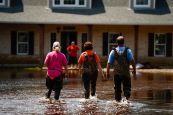
Severe weather events create significant challenges and often result in catastrophic loss for agricultural producers. Despite every attempt to mitigate risk, your operation may suffer losses. USDA offers several programs to help with recovery.
Risk Management
For producers who have risk protection through Federal Crop Insurance or the Noninsured Crop Disaster Assistance Program (NAP), we want to remind you to report crop damage to your crop insurance agent or the local Farm Service Agency (FSA) office.
If you have crop insurance, contact your agency within 72 hours of discovering damage and be sure to follow up in writing within 15 days. If you have NAP coverage, file a Notice of Loss (also called Form CCC-576) within 15 days of loss becoming apparent, except for hand-harvested crops, which should be reported within 72 hours.
Disaster Assistance
USDA also offers disaster assistance programs, which is especially important to livestock, fruit and vegetable, specialty and perennial crop producers who have fewer risk management options.
First, the Livestock Indemnity Program (LIP) and Emergency Assistance for Livestock, Honeybee and Farm-raised Fish Program (ELAP) reimburses producers for a portion of the value of livestock, poultry and other animals that died as a result of a qualifying natural disaster event or for loss of grazing acres, feed and forage. The Livestock Forage Disaster Program (LFP) provides assistance to producers of grazed forage crop acres that have suffered crop loss due to a qualifying drought. Livestock producers suffering the impacts of drought can also request Emergency Haying and Grazing on Conservation Reserve Program (CRP) acres.
Next, the Tree Assistance Program (TAP) provides cost share assistance to rehabilitate and replant tree, vines or shrubs loss experienced by orchards and nurseries. This complements NAP or crop insurance coverage, which cover the crop but not the plants or trees in all cases.
For LIP and ELAP, you will need to file a Notice of Loss for livestock and grazing or feed losses within 30 days and honeybee losses within 15 days. For TAP, you will need to file a program application within 90 days.
Documentation
It’s critical to keep accurate records to document all losses following a devastating weather event. Producers are advised to document all assets including livestock and crops by taking time and date-stamped video or pictures prior to and after the loss.
Other common documentation options include:
- Purchase records
- Production records
- Vaccination records
- Bank or other loan documents
- Third-party certification
Other Programs
The Emergency Conservation Program and Emergency Forest Restoration Program can assist landowners and forest stewards with financial and technical assistance to restore damaged farmland or forests.
Additionally, FSA offers a variety of loans available including emergency loans that are triggered by disaster declarations and operating loans that can assist producers with credit needs. You can use these loans to replace essential property, purchase inputs like livestock, equipment, feed and seed, or refinance farm-related debts, and other needs.
Meanwhile, USDA’s Natural Resources Conservation Service (NRCS) provides financial resources through its Environmental Quality Incentives Program to help with immediate needs and long-term support to help recover from natural disasters and conserve water resources. Assistance may also be available for emergency animal mortality disposal from natural disasters and other causes.
Additional Resources
Additional details – including payment calculations – can be found on our NAP, ELAP, LIP, and TAP fact sheets. On farmers.gov, the Disaster Assistance Discovery Tool, Disaster-at-a-Glance fact sheet, and Farm Loan Discovery Tool can help you determine program or loan options.
To file a Notice of Loss, contact the FSA Call Center at 1-877-508-8364 or email SM.FPAC.FSA.FLFSA.Disaster@usda.gov. Provide your information to the representative and what damage has occurred. Please note the call center will not be able to assist in providing any programmatic information. For more information, contact your local USDA Service Center.
|
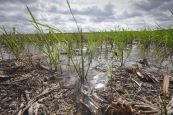
Farmers and ranchers know all too well that natural disasters can be a common, and likely a costly, variable to their operation. The Farm Service Agency (FSA) has emergency assistance programs to provide assistance when disasters strike, and for some of those programs, a disaster designation may be the eligibility trigger. When natural disaster occurs, there is a process for requesting a USDA Secretarial disaster designation for a county. You can play a vital role in this process.
If you have experienced a production loss as a result of a natural disaster, you may submit a request to your local FSA county office for your county to be evaluated for a Secretarial disaster designation. Once a request is received, the county office will collect disaster data and create a Loss Assessment Report. The County Emergency Board will review the Loss Assessment Report and determine if a recommendation is sent forward to the U.S. Secretary of Agriculture for the designation.
For more information on FSA disaster programs and disaster designations, contact your local USDA Service Centers or visit fsa.usda.gov/disaster.
|

FSA is cleaning up our producer record database and needs your help. Please report any changes of address, zip code, phone number, email address or an incorrect name or business name on file to our office. You should also report changes in your farm operation, like the addition of a farm by lease or purchase. You should also report any changes to your operation in which you reorganize to form a Trust, LLC or other legal entity.
FSA and NRCS program participants are required to promptly report changes in their farming operation to the County Committee in writing and to update their Farm Operating Plan on form CCC-902.
To update your records, contact your local USDA Service Centers.
|
The U.S. Department of Agriculture, Natural Resources Conservation Service (USDA NRCS) in Florida announced it has granted a waiver to extend the time for a sponsor to request Emergency Watershed Protection (EWP) assistance from 60 days to 120 days after Hurricane Ian. The deadline for a sponsor to request assistance for Hurricane Ian is January 27, 2023. A sample letter of request for EWP assistance is available for sponsors on the NRCS Florida website.
Through EWP, the NRCS provides assistance to local government sponsors for the cost of addressing watershed impairments or hazards such as debris removal and streambank stabilization.
Eligible sponsors include cities, counties, towns, or any federally recognized Native American Tribe or Tribal organization. Sponsors typically must submit a formal request (via mail or email) to the state conservationist for assistance within 60 days of the natural disaster occurrence or 60 days from the date when access to the sites become available. However, because of the extensive damage caused by Hurricane Ian, sponsors now have 120 days to apply. For more information, they should contact their local NRCS office.
“EWP provides immediate assistance to communities to mitigate potential hazards to life and property resulting from disasters and particularly the severe erosion and flooding that can occur following hurricanes,” said Juan C. Hernandez, State Conservationist for NRCS in Florida. “We can work with a local sponsor to help a damaged watershed so that lives and property are protected while preventing further devastation in the community.”
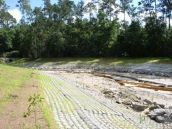
Photo (courtesy of NRCS): Ten Mile Creek streambank stabilization in Escambia County, Florida (2016) – completed with the aid of the USDA NRCS Emergency Watershed Protection program.
|

Producers and landowners in emergency declaration counties can apply for the Environmental Quality Incentive Program by November 15
Florida agricultural landowners and producers affected by damages caused by Hurricane Ian can apply for emergency assistance through the Environmental Quality Incentive Program, announced Juan C. Hernandez, State Conservationist for the U.S. Department of Agriculture (USDA) Natural Resources Conservation Service (NRCS) in Florida.
“Hurricane Ian caused an enormous amount of catastrophic damage to the state, and we are continuing to assess damages,” said Hernandez.
NRCS can provide payments, through conservation program contracts, for Environmental Quality Incentives Program (EQIP) conservation practices that address disaster related resource concerns on agricultural land. Interested landowners should apply by November 15, 2022.
NRCS is issuing EQIP early start waivers in emergency declaration counties, to allow commencement of key conservation practices prior to conservation program contract approval.
The 28 Florida counties identified for EQIP emergency assistance are: Brevard, Broward, Charlotte, Clay, Collier, Desoto, Flagler, Glades, Hardee, Hendry, Highlands, Hillsborough, Indian River, Lake, Lee, Manatee, Martin, Okeechobee, Orange, Osceola, Palm Beach, Polk, Putnam, Sarasota, Seminole, St. Johns, St. Lucie, and Volusia.
Interested agricultural producers and landowners can contact the NRCS State Office at (352) 338-9500 or email SM.NRCS.FL.DISASTERINFO@USDA.GOV to submit the following information to begin their EQIP application process:
- Location where assistance is requested (county, city, and major crossroads)
- Contact name and email address
- Phone number (state if mobile/cell; able to receive calls and/or text messages)
- Nature of need for assistance
Additional EQIP emergency assistance guidelines:
- An early start waiver is not a guarantee of conservation program payment.
- Waiver approval is contingent upon work not having been started on the conservation practice(s) before the date this waiver was approved.
- Producers are asked to file an EQIP application and a waiver before they start an EQIP conservation practice. Producers may submit application responses by email or phone.
- Conservation practices must meet NRCS standards and specifications for the producer or landowner to receive payment.
- EQIP conservation practices offered for financial assistance are listed below:
Practice Code Practice Name and Units
325 High Tunnel System (sf)
326 Clearing and Snagging (ac)
327 Conservation Cover (ac)
340 Cover Crop (ac)
342 Critical Area Planting (ac)
368 Emergency Animal Mortality Management (amu)
382 Fence (ft)
384 Woody Residue Treatment (ac)
484 Mulching (ac)
500 Obstruction Removal (no)
595 Pest Management Conservation System (ac)
More information on EQIP.
Photo: Aberdeen Angus and American Brahman cattle graze at a ranch in Okeechobee County, Florida.
|

The U.S. Department of Agriculture (USDA) launched a new online tool to help farmers and ranchers better navigate the farm loan application process. This uniform application process will help to ensure all farm loan applicants receive equal support and have a consistent customer experience with USDA’s Farm Service Agency (FSA) regardless of their individual circumstances.
USDA experiences a high rate of incomplete or withdrawn applications, particularly among underserved customers, due in part to a challenging and lengthy paper-based application process. The Loan Assistance Tool is available 24/7 and gives customers an online step-by-step guide that supplements the support they receive when working in person with a USDA employee, providing materials that may help an applicant prepare their loan application in one tool.
Farmers can access the Loan Assistance Tool by visiting farmers.gov/farm-loan-assistance-tool and clicking the ‘Get Started’ button. From here they can follow the prompts to complete the Eligibility Self-Assessment and start the farm loan journey. The tool is built to run on any modern browser like Chrome, Edge, Firefox, or the Safari browser, and is fully functional on mobile devices. It does not work in Internet Explorer.
The Loan Assistance Tool is the first of multiple farm loan process improvements that will be available to USDA customers on farmers.gov in the future. Other improvements and tools that are anticipated to launch in 2023 include:
- A streamlined and simplified direct loan application, reduced from 29 pages to 13 pages.
- An interactive online direct loan application that gives customers a paperless and electronic signature option, along with the ability to attach supporting documents such as tax returns.
- An online direct loan repayment feature that relieves borrowers from the necessity of calling, mailing, or visiting a local Service Center to pay a loan installment.
Background
USDA provides access to credit to approximately 115,000 producers who cannot obtain sufficient commercial credit through direct and guaranteed farm loans. With the funds and direction Congress provided in Section 22006 of the Inflation Reduction Act, USDA is taking action to immediately provide relief to qualifying distressed borrowers whose operations are at financial risk while working on making transformational changes to loan servicing so that borrowers are provided the flexibility and opportunities needed to address the inherent risks and unpredictability associated with agricultural operations.
|

If you have experienced delays in receiving Agriculture Risk Coverage (ARC) and Price Loss Coverage (PLC) payments, Loan Deficiency Payments (LDPs) and Market Gains on Marketing Assistance Loans (MALs), it may be because you have not filed form CCC-941, Adjusted Gross Income Certification.
If you don’t have a valid CCC-941 on file for the applicable crop year you will not receive payments. All farm operator/tenants/owners who have not filed a CCC-941 and have pending payments should IMMEDIATELY file the form with their recording county FSA office. Farm operators and tenants are encouraged to ensure that their landowners have filed the form.
FSA can accept the CCC-941 for 2018, 2019, 2020, 2021, and 2022. Unlike the past, you must have the CCC-941 certifying your AGI compliance before any payments can be issued.
Environmental Review Required Before Project Implementation
The National Environmental Policy Act (NEPA) requires Federal agencies to consider all potential environmental impacts for federally funded projects before the project is approved.
For all Farm Service Agency (FSA) programs, an environmental review must be completed before actions are approved, such as site preparation or ground disturbance. These programs include, but are not limited to, the Emergency Conservation Program (ECP), Farm Storage Facility Loan (FSFL) program and farm loans. If project implementation begins before FSA has completed an environmental review, the request will be denied. Although there are exceptions regarding the Stafford Act and emergencies, it’s important to wait until you receive written approval of your project proposal before starting any actions.
Applications cannot be approved until FSA has copies of all permits and plans. Contact your local FSA office early in your planning process to determine what level of environmental review is required for your program application so that it can be completed timely.
|
In order to claim a Farm Service Agency (FSA) payment on behalf of a deceased producer, all program conditions for the payment must have been met before the applicable producer’s date of death.
If a producer earned a FSA payment prior to his or her death, the following is the order of precedence for the representatives of the producer:
- administrator or executor of the estate
- the surviving spouse
- surviving sons and daughters, including adopted children
- surviving father and mother
- surviving brothers and sisters
- heirs of the deceased person who would be entitled to payment according to the State law
For FSA to release the payment, the legal representative of the deceased producer must file a form FSA-325 to claim the payment for themselves or an estate. The county office will verify that the application, contract, loan agreement, or other similar form requesting payment issuance, was signed by the applicable deadline by the deceased or a person legally authorized to act on their behalf at that time of application.
If the application, contract or loan agreement form was signed by someone other than the deceased participant, FSA will determine whether the person submitting the form has the legal authority to submit the form.
Payments will be issued to the respective representative’s name using the deceased program participant’s tax identification number. Payments made to representatives are subject to offset regulations for debts owed by the deceased.
FSA is not responsible for advising persons in obtaining legal advice on how to obtain program benefits that may be due to a participant who has died, disappeared or who has been declared incompetent.
Dec 05 - Last day to return voted ballots to the USDA Service Center
Dec 09 - Signup for Dairy Margin Coverage Program ends
Dec 31 - A Second Disaster Set-Aside for Farm Loans
| Farm Operating - Direct |
4.375% |
| Farm Operating - Microloan |
4.375% |
| Farm Ownership - Direct |
4.5% |
| Farm Ownership - Microloan |
4.5% |
| Farm Ownership - Direct, Joint Financing |
2.500% |
| Farm Ownership - Down Payment |
1.500% |
| Emergency Loan - Amount of Actual Loss |
3.750% |
|