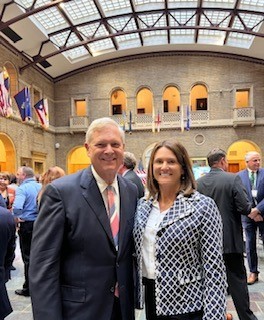
What an exciting October it has been for Maine agriculture! Earlier this month, we had the opportunity to meet with U.S. Secretary of Agriculture Thomas Vilsack during his visit to Maine, which was organized by Governor Mills. His visit started bright and early at the Gorham Middle School where he recognized National School Lunch week and the initiative to ensure all kids have access to fresh healthy meals. Secretary Vilsack praised Governor Mills for allocating $27 million to cover the cost of school meals in Maine from the supplemental budget. The free school lunch program makes Maine only the second state in the nation to make all meals free at public schools!! Gorham Middle School has their own garden where they grow vegetables used in the school lunch program and the school also partners with local farmers to provide additional fruits and vegetables. Secretary Vilsack took this opportunity to announce $50 million in American Rescue Plan funding that will directly help schools expand cooking from scratch, store locally grown produce, and provide the tools they need to serve healthy school meals. This funding exemplifies the USDA and the Biden-Harris Administration’s commitment to fostering healthy and equitable school meals. Our day ended with a closed round-table discussion with local producers and commodity representatives discussing the challenges they are facing and suggestions for improvements to available resources. We look forward to Secretary Vilsack’s next visit to Maine so we can give him a tour of the great work USDA is doing here in Maine to support our agricultural community.
Last week, USDA announced historic funding for delinquent and distressed farmers under the Inflation Reduction Act (IRA). Distressed borrowers with qualifying USDA farm loans have already received nearly $800 million in assistance, as part of the $3.1 billion in assistance for distressed farm loan borrowers provided through Section 22006 of the IRA. The IRA directed USDA to expedite assistance to distressed borrowers of direct or guaranteed loans administered by USDA’s Farm Service Agency (FSA) whose operations face financial risk. Through this assistance, USDA is focused on generating long-term stability and success. This first round of payments is focused on “stopping the bleeding” and helping to ensure distressed farm loan borrowers can stay in or re-enter the business of agriculture and continue feeding their communities. The October 18th announcement is just the first step in providing assistance. Additional resources and tools will be announced during subsequent phases. For further information, please visit https://www.farmers.gov/inflation-reduction-investments/assistance.
Please take a minute and review the upcoming deadlines outlined below. If you have any questions or would like further information, please contact your local FSA office which can be located here: offices.usda.gov.
Thank you,
|
 Maine State Executive Director, FSA
Agriculture Secretary Tom Vilsack announced that the U.S. Department of Agriculture (USDA) plans to provide up to $200 million in assistance for specialty crop producers who incur eligible on-farm food safety program expenses to obtain or renew a food safety certification in calendar years 2022 or 2023. USDA’s new Food Safety Certification for Specialty Crops (FSCSC) program will help to offset costs for specialty crop producers to comply with regulatory requirements and market-driven food safety certification requirements, which is part of USDA’s broader effort to transform the food system to create a more level playing field for small and medium producers and a more balanced, equitable economy for everyone working in food and agriculture.
Specialty crop operations can apply for assistance for eligible expenses related to a 2022 food safety certificate issued on or after June 21, 2022, beginning June 27, 2022. USDA is delivering FSCSC to provide critical assistance for specialty crop operations, with an emphasis on equity in program delivery while building on lessons learned from the COVID-19 pandemic and supply chain disruptions. Vilsack made the announcement from Hollis, N.H., where he toured a local, family-owned farm and highlighted USDA’s efforts to help reduce costs for farmers and support local economies by providing significant funding to cut regulatory costs and increase market opportunities for farmers in New Hampshire and across the nation.
Program Details
FSCSC will assist specialty crop operations that incurred eligible on-farm food safety certification and related expenses related to obtaining or renewing a food safety certification in calendar years 2022 and 2023. For each year, FSCSC covers a percentage of the specialty crop operation’s cost of obtaining or renewing their certification, as well as a portion of their related expenses.
To be eligible for FSCSC, the applicant must be a specialty crop operation; meet the definition of a small business or very small business; and have paid eligible expenses related to the 2022 (issued on or after June 21, 2022) or 2023 certification.
Specialty crop operations may receive assistance for the following costs:
- Developing a food safety plan for first-time food safety certification.
- Maintaining or updating an existing food safety plan.
- Food safety certification.
- Certification upload fees.
- Microbiological testing for products, soil amendments and water.
- Training.
FSCSC payments are calculated separately for each category of eligible costs. A higher payment rate has been set for socially disadvantaged, limited resource, beginning and veteran farmers and ranchers. Details about the payment rates and limitations can be found at farmers.gov/food-safety.
Applying for Assistance
The FSCSC application period for 2022 is June 27, 2022, through January 31, 2023, and the application period for 2023 will be announced at a later date. FSA will issue payments at the time of application approval for 2022 and after the application period ends for 2023. If calculated payments exceed the amount of available funding, payments will be prorated.
Interested specialty crop producers can apply by completing the FSA-888, Food Safety Certification for Specialty Crops Program (FSCSC) application. The application, along with other required documents, can be submitted to the FSA office at any USDA Service Center nationwide by mail, fax, hand delivery or via electronic means.
Producers can visit farmers.gov/food-safety for additional program details, eligibility information and forms needed to apply.
|

Free basic coverage available for new and underserved loan applicants
Producers who apply for Farm Service Agency (FSA) farm loans will be offered the opportunity to enroll in the Noninsured Crop Disaster Assistance Program (NAP). NAP is available to producers who grow noninsurable crops and is especially important to fruit, vegetable, and other specialty crop growers.
New, underserved and limited income specialty growers who apply for farm loans could qualify for basic loss coverage at no cost.
The basic disaster coverage protects at 55 percent of the market price for crop losses that exceed 50 percent of production. Covered “specialty” crops include vegetables, fruits, mushrooms, floriculture, ornamental nursery, aquaculture, turf grass, ginseng, honey, syrup, hay, forage, grazing and energy crops. FSA allows beginning, underserved or limited income producers to obtain NAP coverage up to 90 days after the normal application closing date when they also apply for FSA credit.
Producers can also protect value-added production, such as organic or direct market crops, at their fair market value in those markets. Targeted underserved groups eligible for free or discounted coverage include American Indians or Alaskan Natives, Asians, Blacks or African Americans, Native Hawaiians or other Pacific Islanders, Hispanics, and women.
FSA offers a variety of loan products, including farm ownership loans, operating loans and microloans that have a streamlined application process.
NAP coverage is not limited to FSA borrowers, beginning, limited resource, or underserved farmers. Any producer who grows eligible NAP crops can purchase coverage. To learn more, contact your local USDA Service Center or visit fsa.usda.gov/nap or fsa.usda.gov/farmloans.
|

USDA’s Farm Service Agency (FSA) has implemented pre-authorized debit (PAD) for Farm Loan Program (FLP) borrowers. PAD is a voluntary and alternative method for making weekly, bi-weekly, monthly, quarterly, semi-annual or annual payments on loans.
PAD payments are pre-authorized transactions that allow the National Financial and Accounting Operations Center (NFAOC) to electronically collect loan payments from a customer’s account at a financial institution.
PAD may be useful if you use nonfarm income from regular wages or salary to make payments on loans or adjustment offers or for payments from seasonal produce stands. PAD can only be established for future payments.
To request PAD, customers, along with their financial institution, must fill out form RD 3550-28. This form has no expiration date, but a separate form RD 3550-28 must be completed for each loan to which payments are to be applied. A fillable form can be accessed on the USDA Rural Development (RD) website at rd.usda.gov/publications/regulations-guidelines. Click forms and search for “Form 3550-28.”
If you have a “filter” on the account at your financial institution, you will need to provide the financial institution with the following information: Origination ID: 1220040804, Agency Name: USDA RD DCFO.
PAD is offered by FSA at no cost. Check with your financial institution to discuss any potential cost. Preauthorized debit has no expiration date, but you can cancel at any time by submitting a written request to your local FSA office. If a preauthorized debit agreement receives three payment rejections within a three-month period, the preauthorized debit agreement will be cancelled by FSA. The payment amount and due date of your loan is not affected by a cancellation of preauthorized debit. You are responsible to ensure your full payment is made by the due date.
For more information about PAD, contact your local USDA Service Center visit fsa.usda.gov.
|
The USDA Farm Service Agency’s (FSA) Direct Farm Ownership loans are a resource to help farmers and ranchers become owner-operators of family farms, improve and expand current operations, increase agricultural productivity, and assist with land tenure to save farmland for future generations.
There are three types of Direct Farm Ownership Loans: regular, down payment and joint financing. FSA also offers a Direct Farm Ownership Microloan option for smaller financial needs up to $50,000.
Direct Farm Ownership Loans can be used to construct, purchase or improve farm dwellings, service buildings or other facilities, and to make improvements essential to an operation.
Applicants must provide FSA with an estimate of the total cost of all planned development that completely describe the work, prior to loan approval and must show proof of sufficient funds to pay for the total cost of all planned development at or before loan closing. In some instances, applicants may be asked to provide certified plans, specifications or contract documents. The applicant cannot incur any debts for materials or labor or make any expenditures for development purposes prior to loan closing with the expectation of being reimbursed from FSA funds.
Construction and development work may be performed either by the contract method or the borrower method. Under the contract method, construction and development contractors perform work according to a written contract with the applicant or borrower. If applying for a direct loan to finance a construction project, the applicant must obtain a surety bond that guarantees both payment and performance in the amount of the construction contract from a construction contractor.
A surety bond is required when a contract exceeds $100,000. An authorized agency official determines that a surety bond appears advisable to protect the borrower against default of the contractor or a contract provides for partial payments in excess of the amount of 60 percent of the value of the work in place.
Under the borrower method, the applicant or borrower will perform the construction and development work. The borrower method may only be used when the authorized agency official determines, based on information from the applicant, that the applicant possesses or arranges to obtain the necessary skill and managerial ability to complete the work satisfactorily and that such work will not interfere with the applicant’s farming operation or work schedule.
|
Maine USDA State Office
967 Illinois Avenue
Bangor, Maine 04401
Phone: 207-990-9100
|
Farm Service Agency
Sherry Hamel, State Executive Director
Phone: 207-990-9140
Email: Sherry.Hamel@usda.gov
Website: www.fsa.usda.gov/me
|
Natural Resource Conservation Service
Matt Walker, State Conservationist
Phone: 207-990-9585
Email: Matt.Walker@usda.gov
Website: www.me.nrcs.usda.gov
|
USDA is an equal opportunity provider, employer and lender. To file a complaint of discrimination, write: USDA, Office of the Assistant Secretary for Civil Rights, Office of Adjudication, 1400 Independence Ave., SW, Washington, DC 20250-9410 or call (866) 632-9992 (Toll-free Customer Service), (800) 877-8339 (Local or Federal relay), (866) 377-8642 (Relay voice users).
|