|
Expanding Market Access: Financial Assistance through USDA's FSCSC Program
The USDA Farm Service Agency (FSA) and partners are hosting a webinar for stakeholders and producers that focuses on the new Food Safety Certification for Specialty Crops (FSCSC) program. FSCSC will provide up to $200 million in assistance for specialty crop producers who incur eligible on-farm food safety program expenses to obtain or renew a food safety certification in calendar years 2022 or 2023.
The webinar will be held on Thursday, Nov. 3, 2022, from 2:00 to 3:00 p.m. eastern and will be recorded. Please register in advance of the webinar at www.zoomgov.com/webinar/register/WN_v4FQsCFLROmC8ZvuZ73VrA.
Webinar topics include:
- FSCSC overview and eligibility requirements
- Overview of Food Safety Certification Requirements for Specialty Crops by USDA’s Agricultural Marketing Service and Toolkit Overview for GAP and Food Safety Plan Quality Management Systems by the National Association of State Departments of Agriculture
- Additional resources
The FSCSC application period for 2022 runs through January 31, 2023, and the application period for 2023 will be announced at a later date.
Producers can visit farmers.gov/food-safety for additional program details, eligibility information and forms needed to apply.
Payments Issuing to Producers of 2021 Crops Triggering Safety-Net Program Payments
Agricultural producers can now change election and enroll in the Agriculture Risk Coverage (ARC) and Price Loss Coverage programs for the 2023 crop year, two key safety net programs offered by the U.S. Department of Agriculture (USDA). Signup began Monday, and producers have until March 15, 2023, to enroll in these two programs. Additionally, USDA’s Farm Service Agency (FSA) has started issuing payments totaling more than $255 million to producers with 2021 crops that have triggered payments through ARC or PLC.
“It’s that time of year for produces to consider all of their risk management options, including safety-net coverage elections through Agriculture Risk Coverage and Price Loss Coverage,” said FSA Administrator Zach Ducheneaux. “We recognize that market prices have generally been very good, but if the ongoing COVID-19 pandemic, frequent catastrophic weather events and the Ukraine war have taught us anything, it’s that we must prepare for the unexpected. It’s through programs like ARC and PLC that FSA can provide producers the economic support and security they need to manage market volatility and disasters.”
2023 Elections and Enrollment
Producers can elect coverage and enroll in ARC-County (ARC-CO) or PLC, which provide crop-by-crop protection, or ARC-Individual (ARC-IC), which protects the entire farm. Although election changes for 2023 are optional, producers must enroll through a signed contract each year. Also, if a producer has a multi-year contract on the farm and makes an election change for 2023, they must sign a new contract.
If producers do not submit their election by the March 15, 2023 deadline, their election remains the same as their 2022 election for crops on the farm. Farm owners cannot enroll in either program unless they have a share interest in the farm.
Covered commodities include barley, canola, large and small chickpeas, corn, crambe, flaxseed, grain sorghum, lentils, mustard seed, oats, peanuts, dry peas, rapeseed, long grain rice, medium and short grain rice, safflower seed, seed cotton, sesame, soybeans, sunflower seed and wheat.
Web-Based Decision Tools
In partnership with USDA, the University of Illinois and Texas A&M University offer web-based decision tools to assist producers in making informed, educated decisions using crop data specific to their respective farming operations. Tools include:
-
Gardner-farmdoc Payment Calculator, a tool available through the University of Illinois allows producers to estimate payments for farms and counties for ARC-CO and PLC.
-
ARC and PLC Decision Tool, a tool available through Texas A&M that allows producers to obtain basic information regarding the decision and factors that should be taken into consideration such as future commodity prices and historic yields to estimate payments for 2022.
2021 Payments and Contracts
ARC and PLC payments for a given crop year are paid out the following fall to allow actual county yields and the Market Year Average prices to be finalized. This month, FSA processed payments to producers enrolled in 2021 ARC-CO, ARC-IC and PLC for covered commodities that triggered for the crop year.
For ARC-CO, producers can view the 2021 ARC-CO Benchmark Yields and Revenues online database, for payment rates applicable to their county and each covered commodity. For PLC, payments have triggered for rapeseed and peanuts.
For ARC-IC, producers should contact their local FSA office for additional information pertaining to 2021 payment information, which relies on producer-specific yields for the crop and farm to determine benchmark yields and actual year yields when calculating revenues.
By the Numbers
In 2021, producers signed nearly 1.8 million ARC or PLC contracts, and 251 million out of 273 million base acres were enrolled in the programs. For the 2022 crop year signed contracts surpassed 1.8 million, to be paid in the fall of 2023, if a payment triggers.
Since ARC and PLC were first authorized by the 2014 Farm Bill and reauthorized by the 2018 Farm Bill, these safety-net programs have paid out more than $34.9 billion to producers of covered commodities.
Crop Insurance Considerations
ARC and PLC are part of a broader safety net provided by USDA, which also includes crop insurance and marketing assistance loans.
Producers are reminded that ARC and PLC elections and enrollments can impact eligibility for some crop insurance products.
Producers on farms with a PLC election have the option of purchasing Supplemental Coverage Option (SCO) through their Approved Insurance Provider; however, producers on farms where ARC is the election are ineligible for SCO on their planted acres for that crop on that farm.
Unlike SCO, the Enhanced Coverage Option (ECO) is unaffected by an ARC election. Producers may add ECO regardless of the farm program election.
Upland cotton farmers who choose to enroll seed cotton base acres in ARC or PLC are ineligible for the stacked income protection plan (STAX) on their planted cotton acres for that farm.
More Information
For more information on ARC and PLC, visit the ARC and PLC webpage or contact your local USDA Service Center.
Dairy producers can now enroll for 2023 coverage through the Dairy Margin Coverage (DMC) Program, an important safety net program from the U.S. Department of Agriculture (USDA) that helps producers manage changes in milk and feed prices. Last year, USDA’s Farm Service Agency (FSA) took steps to improve coverage, especially for small- and mid-sized dairies, including offering a new Supplemental DMC program and updating its feed cost formula to better address retroactive, current and future feed costs. These changes continue to support producers through this year’s signup, which begins today and ends Dec. 9, 2022.
“Dairy producers are the backbone of many agricultural communities across rural America,” FSA Administrator Zach Ducheneaux said. “Dairy Margin Coverage provides critical assistance to our nation’s small- and mid-sized dairies, helping make sure they can manage the numerous and often unpredictable uncertainties that adversely impact market prices for milk. This year showed why enrolling in DMC makes good business sense. Early in the year, some economists predicted that DMC would not trigger any payments for the calendar year, but then fast forward to now, when we’re starting to see payments trigger and a return on investment.”
DMC is a voluntary risk management program that offers protection to dairy producers when the difference between the all-milk price and the average feed price (the margin) falls below a certain dollar amount selected by the producer.
So far in 2022, DMC payments to more than 17,000 dairy operations have triggered for August for more than $47.9 million. According to DMC margin projections, an indemnity payment is projected for September as well. At $0.15 per hundredweight for $9.50 coverage, risk coverage through DMC is a relatively inexpensive investment.
DMC offers different levels of coverage, even an option that is free to producers, aside from a $100 administrative fee. Limited resource, beginning, socially disadvantaged or a military veteran farmers or ranchers are exempt from paying the administrative fee, if requested. To determine the appropriate level of DMC coverage for a specific dairy operation, producers can use the online dairy decision tool.
Supplemental DMC
Last year, USDA introduced Supplemental DMC, which provided $42.8 million in payments to better help small- and mid-sized dairy operations that had increased production over the years but were not able to enroll the additional production. Supplemental DMC is also available for 2023.
Supplemental DMC coverage is applicable to calendar years 2021, 2022 and 2023. Eligible dairy operations with less than 5 million pounds of established production history may enroll supplemental pounds.
For producers who enrolled in Supplemental DMC in 2022, the supplemental coverage will automatically be added to the 2023 DMC contract that previously established a supplemental production history.
Producers who did not enroll in Supplemental DMC in 2022 can do so now. Producers should complete their Supplemental DMC enrollment before enrolling in 2023 DMC. To enroll, producers will need to provide their 2019 actual milk marketings, which FSA uses to determine established production history.
DMC Payments
Additionally, FSA will continue to calculate DMC payments using updated feed and premium hay costs, making the program more reflective of actual dairy producer expenses. These updated feed calculations use 100% premium alfalfa hay rather than 50%. The benefits of these feed cost adjustments were realized in the recent August 2022 margin payment as current high feed and premium hay costs were considered in payment calculations.
More Information
In addition to DMC, USDA offers other risk management tools for dairy producers, including the Dairy Revenue Protection (DRP) plan that protects against a decline in milk revenue (yield and price) and the Livestock Gross Margin (LGM) plan, which provides protection against the loss of the market value of livestock minus the feed costs. Both DRP and LGM livestock insurance policies are offered through the Risk Management Agency. Producers should contact their local crop insurance agent for more information.
For more information on DMC, visit the DMC webpage or contact your local USDA Service Center.
The U.S. Department of Agriculture (USDA) is offering virtual workshops – Nov. 15, and Dec. 13 – for agricultural producers and stakeholders to learn about the latest updates and improvements to the Whole-Farm Revenue Protection (WFRP) and the Micro Farm insurance options, two of the most comprehensive risk management options available. These insurance options are especially important to specialty crop, organic, urban, and direct market producers, and this is part of the USDA’s Risk Management Agency (RMA) efforts to increase participation in these options and crop insurance overall.
RMA will host these workshops for agricultural producers via Microsoft Teams events:
RSVP is not required. Attendees will have a chance to submit written questions during the event.
Learn more.
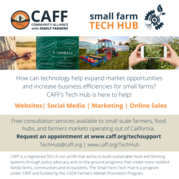
How can technology help expand market opportunities and increase business efficiencies for small farms?
Community Alliance with Family Farmers (CAFF) Tech Hub is here to Help!
Free Consultation services available to small scale farmers, food hubs and farmers markets operating out of California.
Request an appointment at www.caff.org/techsupport
For any questions email Techhub@caff.org or visit www.caff.org/techhub
|
The Farm Service Agency’s (FSA) Noninsured Crop Disaster Assistance Program (NAP) helps you manage risk through coverage for both crop losses and crop planting that was prevented due to natural disasters. The eligible or “noninsured” crops include agricultural commodities not covered by federal crop insurance.
You must be enrolled in the program and have purchased coverage for the eligible crop in the crop year in which the loss incurred to receive program benefits following a qualifying natural disaster.
NAP Buy-Up Coverage Option
NAP offers higher levels of coverage, from 50 to 65 percent of expected production in 5 percent increments, at 100 percent of the average market price. Buy-up levels of NAP coverage are available if the producer can show at least one year of previously successfully growing the crop for which coverage is being requested.
Producers of organics and crops marketed directly to consumers also may exercise the “buy-up” option to obtain NAP coverage of 100 percent of the average market price at the coverage levels of between 50 and 65 percent of expected production.
NAP basic coverage is available at 55 percent of the average market price for crop losses that exceed 50 percent of expected production.
Buy-up coverage is not available for crops intended for grazing.
NAP Service Fees
For all coverage levels, the NAP service fee is the lesser of $325 per crop or $825 per producer per county, not to exceed a total of $1,950 for a producer with farming interests in multiple counties.
NAP Enhancements for Qualified Military Veterans
Qualified veteran farmers or ranchers are eligible for a service fee waiver and premium reduction, if the NAP applicant meets certain eligibility criteria.
Beginning, limited resource and targeted underserved farmers or ranchers remain eligible for a waiver of NAP service fees and premium reduction when they file form CCC-860, “Socially Disadvantaged, Limited Resource and Beginning Farmer or Rancher Certification.”
For NAP application, eligibility and related program information, contact your local FSA office or visit fsa.usda.gov/nap.
Options Help More Beginning, Small and Urban Producers Gain Access to Credit
Producers can apply for a streamlined version of USDA guaranteed loans, which are tailored for smaller scale farms and urban producers EZ Guarantee Loans use a simplified application process to help beginning, small, underserved, and family farmers and ranchers apply for loans of up to $100,000 from USDA-approved lenders to purchase farmland or finance agricultural operations.
A new category of lenders will join traditional lenders, such as banks and credit unions, in offering USDA EZ Guarantee Loans. Microlenders, which include Community Development Financial Institutions and Rural Rehabilitation Corporations, will be able to offer their customers up to $50,000 of EZ Guaranteed Loans, helping to reach urban areas and underserved producers. Banks, credit unions and other traditional USDA-approved lenders, can offer customers up to $100,000 to help with agricultural operation costs.
EZ Guarantee Loans offer low interest rates and terms up to seven years for financing operating expenses and 40 years for financing the purchase of farm real estate. USDA-approved lenders can issue these loans with the Farm Service Agency (FSA) guaranteeing the loan up to 95 percent.
For more information about the available types of FSA farm loans, contact your local FSA county USDA Service Center or visit fsa.usda.gov/farmloans.
|
USDA is looking for exporters to apply for market development programs which provide funds to promote U.S. agricultural products overseas.
Programs like the Market Access Program (MAP), Foreign Market Development (FMD) program, Emerging Markets Program, Technical Assistance for Specialty Crops (TASC), and the Quality Samples Program (QSP) help U.S. producers, exporters, private companies, and trade organizations finance overseas marketing and promotional activities such as trade shows, market research, consumer promotions, technical assistance, trade servicing and educational seminars.
USDA programs also benefit small California producers and exporters through the Western United States Agricultural Trade Association (WUSATA), a MAP participant.
Each Spring, FAS announces market development programs on Grants.gov and details about these programs can be found here: https://www.fas.usda.gov/programs. Please reach out to Julie Scott at Julie.scott@usda.gov for more information.
The USDA Farm Service Agency (FSA) in California has partnered with the California Agriculture Mediation Program to provide free mediation services. Mediation can be an effective tool for farmers and ranchers who are experiencing challenges with their farm loans, creditors, neighbors, leases, or USDA agencies,.
Mediation is free to any producer for debt/credit issues, family farm transitions, leases, neighbor disputes, organic certification, adverse USDA decisions, and more. If your issue is not included in our authorized list of covered topics, we’ll work with you to find an affordable option.
Discussions and notes made during mediation cannot be shared unless everyone agrees to do so. Keeping information private helps create a safe space for difficult conversations. If you come to an agreement or plan, the parties may then decide to share it outside of the meeting.
Mediators are trained to help people talk to each other in a productive way. The mediator does not take a “side” in the conversation, but instead is there to support the conversation and move it forward to address the issue at hand. All of our mediators have agricultural backgrounds, so they understand the issues that are unique to the industry.
The mediator leads a discussion about reaching an agreement or plan. Should the parties reach an agreement, the mediator will draft a settlement document, which is a binding contract. But the parties, not the mediator, decide the outcome and course of action.
Statistically, 75 percent of mediations result in an agreement. Sometimes even if a final agreement is not reached, everyone gains a better understanding of the issue. Mediation can go hand-in-hand with other processes such as working with an estate planner or applying for a farm loan. Mediation can reopen lines of communication and help the participants continue productive conversations outside the meeting.
For more information, submit a request for mediation at www.calamp.org
Or contact:
Matt Strassberg (Director) at 916-330-4500 x101 or matts@emcenter.org
Mary Campbell (S. CA Coordinator) at 916-330-4500 x101 or maryc@emcenter.org
Jenna Muller (N. CA Coordinator) at 916-330-4500 x101 or jennam@emcenter.org
Farmers, are you searching for your future manager or supervisor? Whether you have a current employee who could use some additional training, or are seeking to hire a new team member, The Beginning Farm and Ranch Management Apprenticeship provides a structured pathway for aspiring farm managers to develop the knowledge and skills they need to be successful on your farm. The Center for Land-Based Learning covers all tuition for coursework and provides support for farmers and apprentices. To learn more about training an apprentice, visit https://landbasedlearning.org/apprentice-farmer-mentor
|







