In This Issue:

Farmers and ranchers know all too well that natural disasters can be a common, and likely a costly, variable to their operation. The Farm Service Agency (FSA) has emergency assistance programs to provide assistance when disasters strike, and for some of those programs, a disaster designation may be the eligibility trigger. When natural disaster occurs, there is a process for requesting a USDA Secretarial disaster designation for a county. You can play a vital role in this process.
If you have experienced a production loss as a result of a natural disaster, you may submit a request to your local FSA county office for your county to be evaluated for a Secretarial disaster designation. Once a request is received, the county office will collect disaster data and create a Loss Assessment Report. The County Emergency Board will review the Loss Assessment Report and determine if a recommendation is sent forward to the U.S. Secretary of Agriculture for the designation.
For more information on FSA disaster programs and disaster designations, contact your local County USDA Service Center or visit fsa.usda.gov/disaster.
|
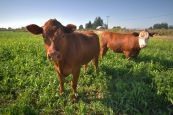
The Livestock Indemnity Program (LIP) provides assistance to you for livestock deaths in excess of normal mortality caused by adverse weather (including floods), disease and attacks by animals reintroduced into the wild by the federal government or protected by federal law.
For disease losses, FSA county committees can accept veterinarian certifications that livestock deaths were directly related to adverse weather and unpreventable through good animal husbandry and management.
You must file a notice within 30 calendar days of when the loss is first apparent. You then must provide the following supporting documentation to your local FSA office no later than 60 calendar days after the end of the calendar year in which the eligible loss condition occurred.
- Proof of death documentation
- Copy of grower’s contracts
- Proof of normal mortality documentation
USDA has established normal mortality rates for each type and weight range of eligible livestock, i.e. Adult Beef Cow = 1.5% and Non-Adult Beef Cattle (less than 400 pounds) = 3%. These established percentages reflect losses that are considered expected or typical under “normal” conditions. In addition to filing a notice of loss, you must also submit an application for payment by March 1, 2023.
For more information about LIP, contact your local County USDA Service Center at or visit fsa.usda.gov.
|
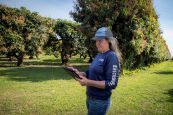
A hurricane has caused severe damage in several counties in Florida.
If you’ve suffered severe damage, you may be eligible for assistance under the Emergency Conservation Program (ECP) administered by the Farm Service Agency (FSA) in your county.
For land to be eligible, the natural disaster must create new conservation problems that, if untreated, would:
- be so costly to rehabilitate that Federal assistance is or will be needed to return the land to productive agricultural use
- is unusual and is not the type that would recur frequently in the same area
- affect the productive capacity of the farmland
- impair or endanger the land
If you qualify for ECP assistance, you may receive cost-share levels not to exceed 75 percent of the eligible cost of restoration measures. Eligible socially disadvantaged and beginning farmers and ranchers can receive up to 90 percent of the eligible cost of restoration. No one is eligible for more than $500,000 cost sharing per natural disaster occurrence.
If you’ve suffered a loss from a natural disaster may contact the local FSA County Office and request assistance.
To be eligible for assistance, practices must not be started until all of the following are met:
- an application for cost-share assistance has been filed
- the local FSA County Committee (COC) or its representative has conducted an onsite inspection of the damaged area
- the Agency responsible for technical assistance, such as the Natural Resource Conservation Service (NRCS), has made a needs determination, which may include cubic yards of earthmoving, etc., required for rehabilitation
For more information about ECP, contact your local County USDA Service Center or visit fsa.usda.gov.
|

The first 10 years of a farming or ranching operation are tough. USDA recognizes you need dedicated support to help make sense of all the information coming your way. Now each state has a Beginning Farmer and Rancher team headed up by a state coordinator. The coordinator helps producers who have operated a farm or ranch for less than 10 years navigate USDA and partner resources.
Each state has a dedicated Beginning Farmer and Rancher (BFR) team to help producers with less than 10 years’ experience learn about available programs and services. Cheryl Weflen is the Florida Coordinator. She is a Program Specialist with the Farm Service Agency. Cheryl is the team lead and will answer questions from farmers and ranchers. She can be reached at cherylweflen@usda.gov or 352-379-4544.
|
Options Help More Beginning, Small and Urban Producers Gain Access to Credit
Producers can apply for a streamlined version of USDA guaranteed loans, which are tailored for smaller scale farms and urban producers EZ Guarantee Loans use a simplified application process to help beginning, small, underserved, and family farmers and ranchers apply for loans of up to $100,000 from USDA-approved lenders to purchase farmland or finance agricultural operations.
A new category of lenders will join traditional lenders, such as banks and credit unions, in offering USDA EZ Guarantee Loans. Microlenders, which include Community Development Financial Institutions and Rural Rehabilitation Corporations, will be able to offer their customers up to $50,000 of EZ Guaranteed Loans, helping to reach urban areas and underserved producers. Banks, credit unions and other traditional USDA-approved lenders, can offer customers up to $100,000 to help with agricultural operation costs.
EZ Guarantee Loans offer low interest rates and terms up to seven years for financing operating expenses and 40 years for financing the purchase of farm real estate. USDA-approved lenders can issue these loans with the Farm Service Agency (FSA) guaranteeing the loan up to 95 percent.
For more information about the available types of FSA farm loans, contact your Local USDA Service Center or visit fsa.usda.gov/farmloans.

Producers with farmers.gov accounts can now access farm records and maps online, the latest self-service feature added to the U.S. Department of Agriculture (USDA) website. You can quickly and easily access your land information in real time by desktop computer, tablet or phone. Capabilities include:
- View, print and export detailed farm records such as cropland, base acres, yields, CRP acres, land ownership details, and much more;
- View, print and export farm/tract maps that can be provided to lenders, chemical or fertilizer providers, and FSA for reporting acreage and crop insurance agents; and
- Export common land unit (field) boundaries as ESRI shapefiles.
The ability to access these records on demand without a visit to the service center saves you time and money.
Farmers.gov now includes the most popular functionalities from FSAFarm+, the FSA portal for producers, while providing enhanced functionality and an improved user experience. A new enhancement expands the scope of accessibility to include farmers and ranchers who are members of an entity, as well as people with a power of attorney form (FSA-211) on file with FSA.
Managing USDA Business Online
Using farmers.gov, producers, entities and those acting on their behalf can also:
- View, upload, download, and e-sign conservation documents.
- Request financial assistance, including submitting a program application.
- View and submit conservation requests.
- View technical references and submit questions.
- Access information on current and past conservation practices, plans and contracts.
- Report practice completion and request practice certification.
- View farm loan and interest information (producers only).
Future plans include adding the ability to import and view other shapefiles, such as precision agriculture planting boundaries.
To access your information, you’ll will need a USDA eAuth account to login to farmers.gov. After obtaining an eAuth account, producers should visit farmers.gov and sign into the site’s authenticated portal via the Sign In/Sign Up link at the top right of the website. Google Chrome, Mozilla Firefox or Microsoft Edge are the recommended browsers to access the feature.
In addition to the self-service features available by logging into farmers.gov, the website also has ample information on USDA programs, including pandemic assistance, farm loans, disaster assistance, conservation programs and crop insurance. Recently, USDA updated the navigation and organization of the site as well as added some new webpages, including “Get Involved,” “Common Forms,” and “Translations.” Learn more about these changes.
|
The USDA Farm Service Agency’s (FSA) Direct Farm Ownership loans are a resource to help farmers and ranchers become owner-operators of family farms, improve and expand current operations, increase agricultural productivity, and assist with land tenure to save farmland for future generations.
There are three types of Direct Farm Ownership Loans: regular, down payment and joint financing. FSA also offers a Direct Farm Ownership Microloan option for smaller financial needs up to $50,000.
Direct Farm Ownership Loans can be used to construct, purchase or improve farm dwellings, service buildings or other facilities, and to make improvements essential to an operation.
Applicants must provide FSA with an estimate of the total cost of all planned development that completely describe the work, prior to loan approval and must show proof of sufficient funds to pay for the total cost of all planned development at or before loan closing. In some instances, applicants may be asked to provide certified plans, specifications or contract documents. The applicant cannot incur any debts for materials or labor or make any expenditures for development purposes prior to loan closing with the expectation of being reimbursed from FSA funds.
Construction and development work may be performed either by the contract method or the borrower method. Under the contract method, construction and development contractors perform work according to a written contract with the applicant or borrower. If applying for a direct loan to finance a construction project, the applicant must obtain a surety bond that guarantees both payment and performance in the amount of the construction contract from a construction contractor.
A surety bond is required when a contract exceeds $100,000. An authorized agency official determines that a surety bond appears advisable to protect the borrower against default of the contractor or a contract provides for partial payments in excess of the amount of 60 percent of the value of the work in place.
Under the borrower method, the applicant or borrower will perform the construction and development work. The borrower method may only be used when the authorized agency official determines, based on information from the applicant, that the applicant possesses or arranges to obtain the necessary skill and managerial ability to complete the work satisfactorily and that such work will not interfere with the applicant’s farming operation or work schedule.
Potential applicants should visit with FSA early in the initial project planning process to ensure environmental compliance.
For more eligibility requirements and information about FSA Loan programs, contact your local USDA Service Center or visit fsa.usda.gov.
Oct 31 - Organic and Transitional Education and Certification Program (OTECP)
Oct 31 - Organic Certification Cost Share Program (OCCSP)
Dec 31 - A Second Disaster Set-Aside for Farm Loans
Nov 07 - Ballots mailed to eligible voters
Dec 05 - Last day to return voted ballots to the USDA Service Center
| Farm Operating - Direct |
3.875% |
| Farm Operating - Microloan |
3.875% |
| Farm Ownership - Direct |
4.125% |
| Farm Ownership - Microloan |
4.125% |
| Farm Ownership - Direct, Joint Financing |
2.500% |
| Farm Ownership - Down Payment |
1.500% |
| Emergency Loan - Amount of Actual Loss |
3.750% |
|