Jerry Hurrle, Farm Loan Manager
Farm Service Agency continues to offer a variety of loan options for farmers that may be in need of financial assistance. One of our loan options is special loan program for youth to start an agricultural project. The youth loan program is available for qualified youth who are between 10 years old and 21 years of age to conduct modest projects in connection with their participation in 4-H, Future Farmers of America (FFA), or similar organizations. The project must produce adequate income to meet expenses and debt repayment with a maximum loan of $5,000. This is a great way for them to learn about operating a business, maintaining records, and hopefully make a profit. This may also be the start they need to grow into a future farm operation. To learn more about our youth loan program or our other loan options, please contact your local FSA office or visit our website at www.fsa.usda.gov.
Ryan Brunn, County Executive Director
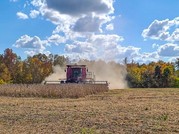
As September draws to a close and harvest begins to pick up we want to wish our farmers a safe and bountiful harvest season. There never seems to be enough hours in the day but please be careful and take care of yourself during this hectic time.
During harvest, it is a good time to remind you all that if you need some cash flow and do not typically market your crops at harvest, FSA offers Marketing Assistance Loans (MAL) for your stored grain. The collateral for the loan is the stored grain and interest rates are set the 1st of each month. The current interest rate for September is 4.125%. Please see the article below if you think this would assist your farm's financial planning.
|
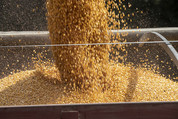
The 2018 Farm Bill extends loan authority through 2023 for Marketing Assistance Loans (MALs) and Loan Deficiency Payments (LDPs).
MALs and LDPs provide financing and marketing assistance for wheat, feed grains, soybeans, and other oilseeds, pulse crops, rice, peanuts, cotton, wool and honey. MALs provide you with interim financing after harvest to help you meet cash flow needs without having to sell your commodities when market prices are typically at harvest-time lows. A producer who is eligible to obtain a loan, but agrees to forgo the loan, may obtain an LDP if such a payment is available. Marketing loan provisions and LDPs are not available for sugar and extra-long staple cotton.
FSA is now accepting requests for 2022 MALs and LDPs for all eligible commodities after harvest. Requests for loans and LDPs shall be made on or before the final availability date for the respective commodities.
Commodity certificates are available to loan holders who have outstanding nonrecourse loans for wheat, upland cotton, rice, feed grains, pulse crops (dry peas, lentils, large and small chickpeas), peanuts, wool, soybeans and designated minor oilseeds. These certificates can be purchased at the posted county price (or adjusted world price or national posted price) for the quantity of commodity under loan, and must be immediately exchanged for the collateral, satisfying the loan. MALs redeemed with commodity certificates are not subject to Adjusted Gross Income provisions.
To be considered eligible for an LDP, you must have form CCC-633EZ, Page 1 on file at your local FSA Office before losing beneficial interest in the crop. Pages 2, 3 or 4 of the form must be submitted when payment is requested.
Marketing loan gains (MLGs) and loan deficiency payments (LDPs) are no longer subject to payment limitations, actively engaged in farming and cash-rent tenant rules.
Adjusted Gross Income (AGI) provisions state that if your total applicable three-year average AGI exceeds $900,000, then you’re not eligible to receive an MLG or LDP. You must have a valid CCC-941 on file to earn a market gain of LDP. The AGI does not apply to MALs redeemed with commodity certificate exchange.
For more information and additional eligibility requirements, contact your Benton/Mille Lacs County USDA Service Center at 320-968-5300 EXT 2 or visit fsa.usda.gov.
|

The term “sodbusting” is used to identify the conversion of land from native vegetation to commodity crop production after December 23, 1985. As part of the conservation provisions of the Food Security Act of 1985, if you’re proposing to produce agricultural commodities (crops that require annual tillage including one pass planting operations and sugar cane) on land that has been determined highly erodible and that has no crop history prior to December 23, 1985, that land must be farmed in accordance with a conservation plan or system that ensures no substantial increase in soil erosion.
Eligibility for many USDA programs requires compliance with a conservation plan or system on highly erodible land (HEL) used for the production of agricultural commodities. This includes Farm Service Agency (FSA) loan, disaster assistance, safety net, price support, and conservation programs; Natural Resources Conservation Service (NRCS) conservation programs; and Risk Management Agency (RMA) Federal crop insurance.
Before you clear or prepare areas not presently under production for crops that require annual tillage, you are required to file Form AD-1026 “Highly Erodible Land Conservation and Wetland Conservation Certification,” with FSA indicating the area to be brought into production. The notification will be referred to NRCS to determine if the field is considered highly erodible land. If the field is considered HEL, you are required to implement a conservation plan or system that limits the erosion to the tolerable soil loss (T) for the predominant HEL soil on those fields.
In addition, prior to removing trees or conducting any other land manipulations that may affect wetlands, remember to update form AD-1026, to ensure you remain in compliance with the wetland conservation provisions.
Prior to purchasing or renting new cropland acres, it is recommended that you check with your local USDA Service Center to ensure your activities will be in compliance with the highly erodible land and wetland conservation provisions.
For additional information on highly erodible land conservation and wetland conservation compliance, contact your local USDA Service Center.
|

If you received a payment under the Wildfires and Hurricanes Indemnity Program+ (WHIP+) or the Quality Loss Adjustment Program (QLA) for crop production and/or quality losses occurring in 2018, 2019, or 2020 crop years, you are required to meet linkage requirements by obtaining federal crop insurance or Non-Insured Crop Disaster Assistance Program (NAP) coverage at the 60/100 level, or higher, for both the 2022 and 2023 crop years.
When applying for WHIP+ or QLA, form FSA-895 (Crop Insurance and/or NAP Coverage Agreement) was submitted acknowledging the requirement to obtain federal crop insurance, if available, or NAP coverage if federal crop insurance is not available. The coverage requirement is applicable to the physical location county of the crop that received WHIP+ and/or QLA benefits.
Producers should not delay contacting their federal crop insurance agent or local county FSA Office to inquire about coverage options, as failure to obtain the applicable coverage by the sales/application closing date will result in the required refund of WHIP+ benefits received on the applicable crop, plus interest. You can determine if crops are eligible for federal crop insurance or NAP by visiting the RMA website.
For more information, contact your Benton/Mille Lacs County USDA Service Center at 320-968-5300 EXT 2 or visit fsa.usda.gov.
|
Farm loan borrowers who have pledged real estate as security for their Farm Service Agency (FSA) direct or guaranteed loans are responsible for maintaining loan collateral. Borrowers must obtain prior consent or approval from FSA or the guaranteed lender for any transaction that affects real estate security. These transactions include, but are not limited to:
- Leases of any kind
- Easements of any kind
- Subordinations
- Partial releases
- Sales
Failure to meet or follow the requirements in the loan agreement, promissory note, and other security instruments could lead to nonmonetary default which could jeopardize your current and future loans.
It is critical that borrowers keep an open line of communication with their FSA loan staff or guaranteed lender when it comes to changes in their operation. For more information on borrower responsibilities, read Your FSA Farm Loan Compass.
A video series from NRCS and farmers.gov, Conservation at Work, presents short and easy to understand videos about popular conservation practices. These videos feature producers explaining how an individual practice helps their land and why they are using it.
The videos shine the spotlight on farmers, ranchers, and forestland owners from across the U.S. who explain why they’ve implemented the conservation practices and how they work on their land. They also provide insight into how each practice is helping them protect and improve resources and save time and money.
We’ve got videos showcasing high tunnels, no-till, cover crops, prescribed grazing, and many more.
Check out the Conservation at Work video series at farmers.gov/conserve/conservationatwork.
|