FSA is investing in two outreach and education efforts for farmers and ranchers, including those who are new to agriculture or who have been historically underserved by programs.
First, FSA is announcing $10 million in the new Taxpayer Education and Asset Protection Initiative. Through this initiative, FSA has partnered with the University of Arkansas and the National Farm Income Tax Extension Committee to deliver tax education resources for farmers and ranchers, which includes engagement with agricultural educators, and tax professionals through partnerships with community groups and minority serving institutions across the country.
Second, FSA is investing $4.5 million in outreach for the Conservation Reserve Program Transition Incentives Program (CRP TIP), which increases access to land for new farmers and ranchers. FSA will award cooperative agreements to 15 to 20 partner and stakeholder organizations to conduct outreach and technical assistance and promote awareness and understanding among agricultural communities, particularly those who are military veterans, new to farming, or historically underserved.
|
USDA is announcing that Shared Capital Cooperative, Akiptan, Inc. and the Cherokee Nation Economic Development Trust Authority (CNEDTA), have been approved or conditionally approved as intermediary lenders through the Heirs’ Property Relending Program (HPRP). Once HPRP loans with these lenders close, these lenders will help agricultural producers and landowners resolve heirs’ land ownership and succession issues. Additionally, USDA encourages more intermediary lenders, including cooperatives, credit unions and nonprofit organizations to apply. More information is at farmers.gov/heirs/relending.
Heirs may apply directly to the intermediary lenders for loans to resolve land ownership and succession issues.
Farmers and ranchers working with USDA’s Farm Service Agency or Natural Resources Conservation Service can now sign and share documents online in just a few clicks. By using Box or OneSpan, producers can digitally complete business transactions without leaving their homes or agricultural operations. Both services are free, secure, and available for multiple FSA and NRCS programs.
Box is a secure, cloud-based site where FSA or NRCS documents can be managed and shared. Producers who choose to use Box can create a username and password to access their secure Box account, where documents can be downloaded, printed, manually signed, scanned, uploaded, and shared digitally with Service Center staff. This service is available to any FSA or NRCS customer with access to a mobile device or computer with printer connectivity.
OneSpan is a secure eSignature solution for FSA and NRCS customers. Like Box, no software downloads or eAuthentication is required for OneSpan. Instead, producers interested in eSignature through OneSpan can confirm their identity through two-factor authentication using a verification code sent to their mobile device or a personalized question and answer. Once identity is confirmed, documents can be reviewed and e-signed through OneSpan via the producer’s personal email address. Signed documents immediately become available to the appropriate Service Center staff.
Box and OneSpan are both optional services for customers interested in improved efficiency in signing and sharing documents with USDA, and they do not replace existing systems using eAuthentication for digital signature. Instead, these tools provide additional digital options for producers to use when conducting business with FSA or NRCS.
USDA Service Center staff are available to help producers get started with Box and OneSpan through a few simple steps. Please visit farmers.gov/service-locator to find your local office and let Service Center staff know you’re interested in signing and sharing documents through these new features. In most cases, one quick phone call will be all that is needed to initiate the process.
Visit farmers.gov/mydocs to learn more about Box and OneSpan, steps for getting started, and additional resources for conducting business with USDA online.
To learn more about program flexibilities and Service Center status during the coronavirus pandemic, visit farmers.gov/coronavirus.
At USDA, we are committed to helping farmers complete loan applications, environmental reviews, and other paperwork free of charge. One-on-one support is available at more than 2,300 USDA Service Centers nationwide. USDA’s Farm Service Agency and Natural Resources Conservation Service staff are usually co-located at these Service Centers and can help guide farmers to the best USDA assistance based on their unique goals, whether it is loans, conservation programs, or insurance.
Service Center staff can guide farmers through the process of preparing and submitting required paperwork on their own, with no need to hire a paid preparer. Language translation service is available in all USDA Service Centers, so one-on-one assistance with a Service Center employee can be translated in real time for farmers requiring it. And while some program and loan applications do have an administrative fee for filing, there is never a charge for preparation services provided by USDA staff.
Farmers who work with the USDA Service Center can:
- Establish their farm by registering for a farm number, which is required for USDA programs and assistance.
- Learn how to meet conservation compliance provisions.
- Verify eligibility for USDA programs.
- Discuss their business and conservation goals.
- Create a conservation plan.
- Fill out and file loan and program applications.
We are committed to delivering USDA programs and services to America’s farmers and ranchers while taking safety measures in response to COVID-19. We encourage you to check the status of your local USDA Service Center and make an appointment to discuss your business needs.
|
Agriculture Secretary Tom Vilsack announced that the U.S. Department of Agriculture (USDA) plans to provide up to $200 million in assistance for specialty crop producers who incur eligible on-farm food safety program expenses to obtain or renew a food safety certification in calendar years 2022 or 2023. USDA’s new Food Safety Certification for Specialty Crops (FSCSC) program will help to offset costs for specialty crop producers to comply with regulatory requirements and market-driven food safety certification requirements, which is part of USDA’s broader effort to transform the food system to create a more level playing field for small and medium producers and a more balanced, equitable economy for everyone working in food and agriculture.
Specialty crop operations can apply for assistance for eligible expenses related to a 2022 food safety certificate issued on or after June 21, 2022, beginning June 27, 2022. USDA is delivering FSCSC to provide critical assistance for specialty crop operations, with an emphasis on equity in program delivery while building on lessons learned from the COVID-19 pandemic and supply chain disruptions. Vilsack made the announcement from Hollis, N.H., where he toured a local, family-owned farm and highlighted USDA’s efforts to help reduce costs for farmers and support local economies by providing significant funding to cut regulatory costs and increase market opportunities for farmers in New Hampshire and across the nation.
Program Details
FSCSC will assist specialty crop operations that incurred eligible on-farm food safety certification and related expenses related to obtaining or renewing a food safety certification in calendar years 2022 and 2023. For each year, FSCSC covers a percentage of the specialty crop operation’s cost of obtaining or renewing their certification, as well as a portion of their related expenses.
To be eligible for FSCSC, the applicant must be a specialty crop operation; meet the definition of a small business or very small business; and have paid eligible expenses related to the 2022 (issued on or after June 21, 2022) or 2023 certification.
Specialty crop operations may receive assistance for the following costs:
- Developing a food safety plan for first-time food safety certification.
- Maintaining or updating an existing food safety plan.
- Food safety certification.
- Certification upload fees.
- Microbiological testing for products, soil amendments and water.
FSCSC payments are calculated separately for each category of eligible costs. A higher payment rate has been set for socially disadvantaged, limited resource, beginning and veteran farmers and ranchers. Details about the payment rates and limitations can be found at farmers.gov/food-safety.
Applying for Assistance
The FSCSC application period for 2022 is June 27, 2022, through January 31, 2023, and the application period for 2023 will be announced at a later date. FSA will issue payments at the time of application approval for 2022 and after the application period ends for 2023. If calculated payments exceed the amount of available funding, payments will be prorated.
Interested specialty crop producers can apply by completing the FSA-888, Food Safety Certification for Specialty Crops Program (FSCSC) application. The application, along with other required documents, can be submitted to the FSA office at any USDA Service Center nationwide by mail, fax, hand delivery or via electronic means.
Producers can visit farmers.gov/food-safety for additional program details, eligibility information and forms needed to apply.
Agricultural producers and handlers who are certified organic, along with producers and handlers who are transitioning to organic production, can now apply for the U.S. Department of Agriculture’s (USDA) Organic and Transitional Education Certification Program (OTECP) and Organic Certification Cost Share Program (OCCSP), which help producers and handlers cover the cost of organic certification, along with other related expenses. Applications for OTECP and OCCSP are both due October 31, 2022.
OTECP covers:
- Certification costs for organic producers and handlers (25% up to $250 per category).
- Eligible expenses for transitional producers, including fees for pre-certification inspections and development of an organic system plan (75% up to $750).
- Registration fees for educational events (75% up to $200).
- Soil testing (75% up to $100).
Meanwhile, OCCSP covers 50% or up to $500 per category of certification costs in 2022.
This cost share for certification is available for each of these categories: crops, wild crops, livestock, processing/handling and State organic program fees.
Producers can receive cost share through both OTECP and OCCSP. Both OTECP and OCCSP cover costs incurred from October 1, 2021, to September 30, 2022. Producers have until October 31, 2022 to file applications, and FSA will make payments as applications are received.
To apply, producers and handlers should contact the Farm Service Agency (FSA) at their local USDA Service Center. As part of completing the OCCSP applications, producers and handlers will need to provide documentation of their organic certification and eligible expenses. Organic producers and handlers may also apply for OCCSP through participating State agencies.
Additional details can be found on the OTECP and OCCSP webpages.

The Farm Service Agency’s (FSA) Farm Storage Facility Loan (FSFL) program provides low-interest financing to help you build or upgrade storage facilities and to purchase portable (new or used) structures, equipment and storage and handling trucks.
Eligible commodities include corn, grain sorghum, rice, soybeans, oats, peanuts, wheat, barley, minor oilseeds harvested as whole grain, pulse crops (lentils, chickpeas and dry peas), hay, honey, renewable biomass, fruits, nuts and vegetables for cold storage facilities, floriculture, hops, maple sap, rye, milk, cheese, butter, yogurt, meat and poultry (unprocessed), eggs, and aquaculture (excluding systems that maintain live animals through uptake and discharge of water). Qualified facilities include grain bins, hay barns and cold storage facilities for eligible commodities.
Loans up to $50,000 can be secured by a promissory note/security agreement, loans between $50,000 and $100,000 may require additional security, and loans exceeding $100,000 require additional security.
You do not need to demonstrate the lack of commercial credit availability to apply. The loans are designed to assist a diverse range of farming operations, including small and mid-sized businesses, new farmers, operations supplying local food and farmers markets, non-traditional farm products, and underserved producers.
For more information, contact your local County USDA Service Center or visit fsa.usda.gov/pricesupport.
|
Farmers and ranchers rely on crop insurance to protect themselves from disasters and unforeseen events, but not all crops are insurable through the USDA’s Risk Management Agency. The Farm Service Agency’s (FSA) Noninsured Crop Disaster Assistance Program (NAP) provides producers another option to obtain coverage against disaster for these crops. NAP provides financial assistance to producers of non-insured crops impacted by natural disasters that result in lower yields, crop losses, or prevents crop planting.
Commercially produced crops and agricultural commodities for which crop insurance is not available are generally eligible for NAP. Eligible crops include those grown specifically for food, fiber, livestock consumption, biofuel or biobased products, or be commodities such as value loss crops like Christmas trees and ornamental nursery, honey, maple sap, and many others. Contact your FSA office to see which crops are eligible in your state and county.
Eligible causes of loss include drought, freeze, hail, excessive moisture, excessive wind or hurricanes, earthquake, flood. These events must occur during the NAP policy coverage period, before or during harvest, and the disaster must directly affect the eligible crop. For guidance on causes of loss not listed, contact your local FSA county office.
Interested producers must apply for coverage using FSA form CCC-471, “Application for Coverage,” and pay the applicable service fee at the FSA office where their farm records are maintained. These must be filed by the application closing date. Closing dates vary by crop, so it is important to contact your local FSA office as soon as possible to ensure you don’t miss an application closing date.
At the time of application, each producer will be provided a copy of the NAP Basic Provisions, which describes how NAP works and all the requirements you must follow to maintain NAP coverage. NAP participants must provide accurate annual reports of their production in non-loss years to ensure their NAP coverage is beneficial to their individual operation.
Producers are required to pay service fees which vary depending on the number of crops and number of counties your operation is located in. The NAP service fee is the lesser of $325 per crop or $825 per producer per administrative county, not to exceed a total of $1,950 for a producer with farming interests in multiple counties. Premiums also apply when producers elect higher levels of coverage with a maximum premium of $15,750 per person or legal entity depending on the maximum payment limitation that may apply to the NAP covered producer. The service fee can be waived for beginning, qualifying veteran, and limited resource farmers and rancher., These farmers and ranchers can also receive a 50 percent reduction in the premium.
For more detailed information on NAP, download the NAP Fact Sheet. To get started with NAP, we recommend you contact your local USDA service center.
Farmers can use USDA farm ownership microloans to buy and improve property. These microloans are especially helpful to beginning or underserved farmers, U.S. veterans looking for a career in farming, and those who have small and mid-sized farming operations.
Microloans have helped farmers and ranchers with operating costs, such as feed, fertilizer, tools, fencing, equipment, and living expenses since 2013.
Microloans can also help with farmland and building purchases and soil and water conservation improvements. FSA designed the expanded program to simplify the application process, expand eligibility requirements and expedite smaller real estate loans to help farmers strengthen their operations. Microloans provide up to $50,000 to qualified producers and can be issued to the applicant directly from the USDA Farm Service Agency (FSA).
To learn more about the FSA microloan program, contact your local County USDA Service Center or visit fsa.usda.gov/microloans.
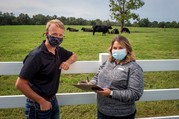
The Farm Loan team in Mississippi is already working on operating loans for spring 2022 and asks potential borrowers to submit their requests early so they can be timely processed. The farm loan team can help determine which loan programs are best for applicants.
FSA offers a wide range of low-interest loans that can meet the financial needs of any farm operation for just about any purpose. The traditional farm operating and farm ownership loans can help large and small farm operations take advantage of early purchasing discounts for spring inputs as well expenses throughout the year.
Microloans are a simplified loan program that will provide up to $50,000 for both Farm Ownership and Operating Microloans to eligible applicants. These loans, targeted for smaller and non-traditional operations, can be used for operating expenses, starting a new operation, purchasing equipment, and other needs associated with a farming operation. Loans to beginning farmers and members of underserved groups are a priority.
Other types of loans available include:
Marketing Assistance Loans allow producers to use eligible commodities as loan collateral and obtain a 9-month loan while the crop is in storage. These loans provide cash flow to the producer and allow them to market the crop when prices may be more advantageous.
Farm Storage Facility Loans can be used to build permanent structures used to store eligible commodities, for storage and handling trucks, or portable or permanent handling equipment. A variety of structures are eligible under this loan, including bunker silos, grain bins, hay storage structures, and refrigerated structures for vegetables and fruit. A producer may borrow up to $500,000 per loan.
|
|