In This Issue:
The new office will be located at the C. Clifton Young Federal Building & U.S. Courthouse, 300 Booth Street, Reno, NV 89509
NRCS’s move will be completed around October 2022 and NRCS’s State Office staff will be teleworking until the move is complete. FSA’s move will also be completed sometime before the end of the year. The FSA staff will be doing a combination of working from the new office and teleworking after August 15, 2022. Employees are available by email or you can call 775-857-8500 to schedule an in person appointment. A State Office directory on our websites can be found at nrcs.usda.gov and fsa.usda.gov
Severe weather events create significant challenges and often result in catastrophic loss for agricultural producers. Despite every attempt to mitigate risk, your operation may suffer losses. USDA offers several programs to help with recovery.
Risk Management
For producers who have risk protection through Federal Crop Insurance or the Noninsured Crop Disaster Assistance Program (NAP), we want to remind you to report crop damage to your crop insurance agent or the local Farm Service Agency (FSA) office.
If you have crop insurance, contact your agency within 72 hours of discovering damage and be sure to follow up in writing within 15 days. If you have NAP coverage, file a Notice of Loss (also called Form CCC-576) within 15 days of loss becoming apparent, except for hand-harvested crops, which should be reported within 72 hours.
Disaster Assistance
USDA also offers disaster assistance programs, which is especially important to livestock, fruit and vegetable, specialty and perennial crop producers who have fewer risk management options.
First, the Livestock Indemnity Program (LIP) and Emergency Assistance for Livestock, Honeybee and Farm-raised Fish Program (ELAP) reimburses producers for a portion of the value of livestock, poultry and other animals that died as a result of a qualifying natural disaster event or for loss of grazing acres, feed and forage. And, the Livestock Forage Disaster Program (LFP) provides assistance to producers of grazed forage crop acres that have suffered crop loss due to a qualifying drought. Livestock producers suffering the impacts of drought can also request Emergency Haying and Grazing on Conservation Reserve Program (CRP) acres.
Next, the Tree Assistance Program (TAP) provides cost share assistance to rehabilitate and replant tree, vines or shrubs loss experienced by orchards and nurseries. This complements NAP or crop insurance coverage, which cover the crop but not the plants or trees in all cases.
For LIP and ELAP, you will need to file a Notice of Loss for livestock and grazing or feed losses within 30 days and honeybee losses within 15 days. For TAP, you will need to file a program application within 90 days.
Documentation
It’s critical to keep accurate records to document all losses following this devastating cold weather event. Livestock producers are advised to document beginning livestock numbers by taking time and date-stamped video or pictures prior to after the loss.
Other common documentation options include:
- Purchase records
- Production records
- Vaccination records
- Bank or other loan documents
- Third-party certification
Other Programs
The Emergency Conservation Program and Emergency Forest Restoration Program can assist landowners and forest stewards with financial and technical assistance to restore damaged farmland or forests.
Additionally, FSA offers a variety of loans available including emergency loans that are triggered by disaster declarations and operating loans that can assist producers with credit needs. You can use these loans to replace essential property, purchase inputs like livestock, equipment, feed and seed, or refinance farm-related debts, and other needs.
Meanwhile, USDA’s Natural Resources Conservation Service (NRCS) provides financial resources through its Environmental Quality Incentives Program to help with immediate needs and long-term support to help recover from natural disasters and conserve water resources. Assistance may also be available for emergency animal mortality disposal from natural disasters and other causes.
Additional Resources
Additional details – including payment calculations – can be found on our NAP, ELAP, LIP, and TAP fact sheets. On farmers.gov, the Disaster Assistance Discovery Tool, Disaster-at-a-Glance fact sheet, and Farm Loan Discovery Tool can help you determine program or loan options.
While we never want to have to implement disaster programs, we are here to help. To file a Notice of Loss or to ask questions about available programs, contact your local USDA Service Center. All USDA Service Centers are open for business, including those that restrict in-person visits or require appointments because of the pandemic.
Livestock inventory records are necessary in the event of a natural disaster, so remember to keep them updated.
When disasters strike, the USDA Farm Service Agency (FSA) can help you if you’ve suffered excessive livestock death losses and grazing or feed losses due to eligible natural disasters.
To participate in livestock disaster assistance programs, you’ll be required to provide verifiable documentation of death losses resulting from an eligible adverse weather event and must submit a notice of loss to your local FSA office within 30 calendar days of when the loss of livestock is apparent. For grazing or feed losses, you must submit a notice of loss to your local FSA office within 30 calendar days of when the loss is apparent and should maintain documentation and receipts.
You should record all pertinent information regarding livestock inventory records including:
- Documentation of the number, kind, type, and weight range of livestock
- Beginning inventory supported by birth recordings or purchase receipts.
For more information on documentation requirements, contact your local County USDA Service Center or visit fsa.usda.gov.
The term “sodbusting” is used to identify the conversion of land from native vegetation to commodity crop production after December 23, 1985. As part of the conservation provisions of the Food Security Act of 1985, if you’re proposing to produce agricultural commodities (crops that require annual tillage including one pass planting operations and sugar cane) on land that has been determined highly erodible and that has no crop history prior to December 23, 1985, that land must be farmed in accordance with a conservation plan or system that ensures no substantial increase in soil erosion.
Eligibility for many USDA programs requires compliance with a conservation plan or system on highly erodible land (HEL) used for the production of agricultural commodities. This includes Farm Service Agency (FSA) loan, disaster assistance, safety net, price support, and conservation programs; Natural Resources Conservation Service (NRCS) conservation programs; and Risk Management Agency (RMA) Federal crop insurance.
Before you clear or prepare areas not presently under production for crops that require annual tillage, you are required to file Form AD-1026 “Highly Erodible Land Conservation and Wetland Conservation Certification,” with FSA indicating the area to be brought into production. The notification will be referred to NRCS to determine if the field is considered highly erodible land. If the field is considered HEL, you are required to implement a conservation plan or system that limits the erosion to the tolerable soil loss (T) for the predominant HEL soil on those fields.
In addition, prior to removing trees or conducting any other land manipulations that may affect wetlands, remember to update form AD-1026, to ensure you remain in compliance with the wetland conservation provisions.
Prior to purchasing or renting new cropland acres, it is recommended that you check with your local USDA Service Center to ensure your activities will be in compliance with the highly erodible land and wetland conservation provisions.
For additional information on highly erodible land conservation and wetland conservation compliance, contact your local USDA Service Center.
USDA’s National Agricultural Statistics Service (NASS) conducts hundreds of surveys every year and prepares reports covering virtually every aspect of U.S. agriculture.
If you receive a survey questionnaire, please respond quickly and online if possible.
The results of the surveys help determine the structure of USDA farm programs, such as soil rental rates for the Conservation Reserve Program and prices and yields used for the Agriculture Risk Coverage and Price Loss Coverage programs. This county-level data is critical for USDA farm payment determinations. Survey responses also help associations, businesses and policymakers advocate for their industry and help educate others on the importance of agriculture.
NASS safeguards the privacy of all respondents and publishes only aggregate data, ensuring that no individual operation or producer can be identified.
NASS data is available online at nass.usda.gov/Publications and through the searchable Quick Stats database. Watch a video on how NASS data is used at youtube.com/watch?v=m-4zjnh26io&feature=youtu.be.
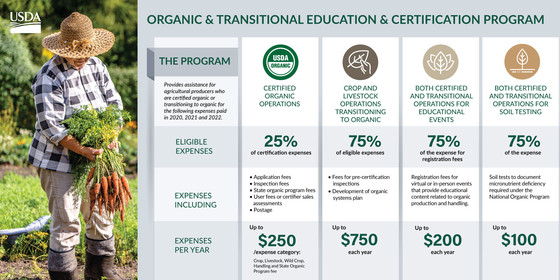
Agricultural producers and handlers who are certified organic, along with producers and handlers who are transitioning to organic production, can now apply for the U.S. Department of Agriculture’s (USDA) Organic and Transitional Education Certification Program (OTECP) and Organic Certification Cost Share Program (OCCSP), which help producers and handlers cover the cost of organic certification, along with other related expenses. Applications for OTECP and OCCSP are both due October 31, 2022.
OTECP covers:
- Certification costs for organic producers and handlers (25% up to $250 per category).
- Eligible expenses for transitional producers, including fees for pre-certification inspections and development of an organic system plan (75% up to $750).
- Registration fees for educational events (75% up to $200).
- Soil testing (75% up to $100).
Meanwhile, OCCSP covers 50% or up to $500 per category of certification costs in 2022.
This cost share for certification is available for each of these categories: crops, wild crops, livestock, processing/handling and State organic program fees.
Producers can receive cost share through both OTECP and OCCSP. Both OTECP and OCCSP cover costs incurred from October 1, 2021, to September 30, 2022. Producers have until October 31, 2022 to file applications, and FSA will make payments as applications are received.
To apply, producers and handlers should contact the Farm Service Agency (FSA) at their local USDA Service Center. As part of completing the OCCSP applications, producers and handlers will need to provide documentation of their organic certification and eligible expenses. Organic producers and handlers may also apply for OCCSP through participating State agencies.
Additional details can be found on the OTECP and OCCSP webpages.
Farmers can use USDA farm ownership microloans to buy and improve property. These microloans are especially helpful to beginning or underserved farmers, U.S. veterans looking for a career in farming, and those who have small and mid-sized farming operations.
Microloans have helped farmers and ranchers with operating costs, such as feed, fertilizer, tools, fencing, equipment, and living expenses since 2013.
Microloans can also help with farmland and building purchases and soil and water conservation improvements. FSA designed the expanded program to simplify the application process, expand eligibility requirements and expedite smaller real estate loans to help farmers strengthen their operations. Microloans provide up to $50,000 to qualified producers and can be issued to the applicant directly from the USDA Farm Service Agency (FSA).
To learn more about the FSA microloan program, contact your local County USDA Service Center or visit fsa.usda.gov/microloans.
FSA will hold three virtual listening sessions September 28 and 29
The U.S. Department of Agriculture (USDA) is gathering input to help shape a recently announced planned grant program focused on improving the resiliency of our food and agricultural supply chain by addressing labor shortages in agriculture, reducing irregular migration through increased use of legal pathways, and improving labor protections for farmworkers. USDA’s Farm Service Agency (FSA) will hold three virtual listening sessions on Sept. 28-29 for the new farm labor stabilization and protection pilot grant program, which the Biden-Harris administration announced earlier this year as part of the Los Angeles Declaration on Migration and Protection.
The grant program will use up to $65 million in American Rescue Plan Act funding to provide support for agricultural employers in implementing robust labor standards to promote a safe, healthy work environment for both U.S. workers and workers hired from northern Central American countries under the seasonal H-2A visa program.
More on the Grant Program
The program will aim to improve the resiliency of our food and agricultural supply chain and advance several major Administration priorities:
-
Driving U.S. economic recovery and safeguarding domestic food security by addressing current labor shortages in agriculture. Even before the onset of the COVID-19 pandemic, agricultural employers were struggling to secure a stable workforce. The pandemic has only exacerbated this problem, threatening our domestic capacity to produce a safe and robust food supply. This pilot program will help address this shortage by expanding the potential pool of workers.
-
Reducing irregular migration through the increased use of legal pathways. The Biden-Harris administration has taken numerous steps to address the elevated levels of irregular migration from Northern Central America. The H-2A visa program offers a lawful pathway for individuals from these countries to come to the United States to engage in temporary or seasonal agricultural work. An effective H-2A visa program is critical to the resiliency of the food and agricultural supply chain. This pilot program will aim to address challenges that both workers and employers face in utilizing the program.
-
Improving working conditions for farmworkers. Strong and safe working conditions are critical to the resiliency of the food and agricultural supply chain. Through this pilot program, USDA will support efforts to improve working conditions for both U.S. and H-2A workers and ensure that H-2A workers are not subjected to unfair recruitment practices.
Agricultural Employer Organizations
FSA will hold a listening session for agricultural employer organizations on Wednesday, Sept. 28 at 11 a.m. ET. FSA seeks input on:
- Challenges that employers face in securing a stable workforce.
- The set of incentives employers seek from USDA in order to improve their ability to hire workers from northern Central American countries under the seasonal H-2A visa program.
- The labor standards that will make meaningful progress towards ensuring a safer and fairer working environment for both domestic and H-2A farmworkers.
Labor Unions and Farmworker Advocacy Community
FSA will hold a listening session for labor unions on Wednesday, Sept. 28 at 2 p.m. ET, and one for the broader farmworker advocacy community on Thursday, Sept. 29 at 2 p.m. ET. From both groups, FSA seeks input on:
- Barriers or challenges faced by farmworkers, specifically those from northern Central American countries participating in the H-2A visa program.
- Recommendations to enhance farmworker protections and to increase farmworker awareness of resources and worker rights.
How to Attend
Register online at fsa.usda.gov/farmworkers. FSA will also consider comments received by 30 days after the date of publication in the Federal Register. Find more details in the Sept. 21 notice on the Federal Register or on fsa.usda.gov/farmworkers.
|