
|
|
Humboldt County USDA Service Center Updates - September 8, 2022
|
|
|
|
Farm Service Agency | Natural Resources Conservation Service | Risk Management Agency
|

Iowa farmers and private landowners interested in treating resource concerns on their lands have until Oct. 7 to be considered for priority funding for conservation programs administered through USDA’s Natural Resources Conservation Service (NRCS).
Four of the most popular USDA conservation programs are included in this signup period:
- Agricultural Conservation Easement Program-Wetland Reserve Easements (ACEP-WRE)
- Conservation Stewardship Program (CSP)
- Environmental Quality Incentives Program (EQIP)
- Regional Conservation Partnership Program (RCPP)
NRCS accepts program applications on a continuous basis but sets application cutoff dates as program funding allows. Interested producers and landowners should submit applications to their local NRCS office by the Oct. 7 application cutoff to ensure they are considered for 2023 funding.
ACEP-WRE (Wetland Easements) Through the ACEP-WRE, NRCS provides technical and financial assistance to private landowners and tribal entities for protecting and restoring wetlands through the purchase of a wetland conservation easement. NRCS will enroll eligible land through permanent or 30-year easements.
Private landowners and tribal entities can contact their local NRCS office to find out if they have eligible wetlands on their property, how to complete the application form, or for information about required ownership documents.
CSP Through CSP, NRCS helps agricultural producers build their operation while implementing conservation practices that help ensure its sustainability. The program provides many benefits including increased crop yields, decreased inputs, wildlife habitat improvements, and increased resilience to weather extremes. CSP is intended for working lands including cropland, pastureland, nonindustrial private forest land and agricultural land under the jurisdiction of a tribe.
EQIP
Through EQIP, NRCS provides conservation planning and financial assistance to implement conservation practices such as no-till, cover crops, terraces, grassed waterways, nutrient management, manure management facilities, and pasture management.
The Oct. 7 application signup cutoff includes EQIP initiatives, such as the National Water Quality Initiative (NWQI), Mississippi River Basin Health Watersheds Initiative (MRBI), Prairie Pothole Water Quality and Wildlife Program, Organic Initiative, High Tunnel Initiative, and On-Farm Energy Initiative.
RCPP Through RCPP, NRCS co-invests with partners to implement projects that demonstrate innovative solutions to conservation challenges and provide measurable improvements and outcomes tied to resource concerns.
For a complete list of Iowa RCPP project, visit: www.nrcs.usda.gov/wps/portal/nrcs/ia/programs/farmbill/rcpp/.
To apply for NRCS conservation programs, contact your local NRCS office. For more information about conservation planning and programs to help treat natural resource issues on your land, visit www.ia.nrcs.usda.gov
|
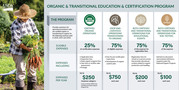
Agricultural producers and handlers who are certified organic, along with producers and handlers who are transitioning to organic production, can now apply for the U.S. Department of Agriculture’s (USDA) Organic and Transitional Education Certification Program (OTECP) and Organic Certification Cost Share Program (OCCSP), which help producers and handlers cover the cost of organic certification, along with other related expenses. Applications for OTECP and OCCSP are both due October 31, 2022.
OTECP covers:
- Certification costs for organic producers and handlers (25% up to $250 per category).
- Eligible expenses for transitional producers, including fees for pre-certification inspections and development of an organic system plan (75% up to $750).
- Registration fees for educational events (75% up to $200).
- Soil testing (75% up to $100).
Meanwhile, OCCSP covers 50% or up to $500 per category of certification costs in 2022.
This cost share for certification is available for each of these categories: crops, wild crops, livestock, processing/handling and State organic program fees.
Producers can receive cost share through both OTECP and OCCSP. Both OTECP and OCCSP cover costs incurred from October 1, 2021, to September 30, 2022. Producers have until October 31, 2022 to file applications, and FSA will make payments as applications are received.
To apply, producers and handlers should contact the Farm Service Agency (FSA) at their local USDA Service Center. As part of completing the OCCSP applications, producers and handlers will need to provide documentation of their organic certification and eligible expenses. Organic producers and handlers may also apply for OCCSP through participating State agencies.
Additional details can be found on the OTECP and OCCSP webpages.
|
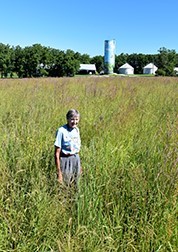
Like many widowed farmwives, Cathy Irvine of rural Dysart was overwhelmed with what to do with her farm after the death of her husband, David, in 2016. After considering what he would have wanted and their shared passion, Irvine donated 77 acres of her 460-acre farm to be restored to native prairie.
Irvine’s generosity and commitment to creating wildlife habitat contributed to her being named the 2022 Iowa Conservation Woman of the Year, as voted by USDA’s Natural Resources Conservation Service (NRCS) Federal Women’s Program Committee.
Read the full story
|
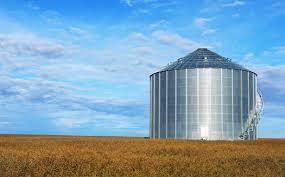
The Farm Service Agency’s (FSA) Farm Storage Facility Loan (FSFL) program provides low-interest financing to help you build or upgrade storage facilities and to purchase portable (new or used) structures, equipment and storage and handling trucks.
Eligible commodities include corn, grain sorghum, rice, soybeans, oats, peanuts, wheat, barley, minor oilseeds harvested as whole grain, pulse crops (lentils, chickpeas and dry peas), hay, honey, renewable biomass, fruits, nuts and vegetables for cold storage facilities, floriculture, hops, maple sap, rye, milk, cheese, butter, yogurt, meat and poultry (unprocessed), eggs, and aquaculture (excluding systems that maintain live animals through uptake and discharge of water). Qualified facilities include grain bins, hay barns and cold storage facilities for eligible commodities.
Loans up to $50,000 can be secured by a promissory note/security agreement, loans between $50,000 and $100,000 may require additional security, and loans exceeding $100,000 require additional security.
You do not need to demonstrate the lack of commercial credit availability to apply. The loans are designed to assist a diverse range of farming operations, including small and mid-sized businesses, new farmers, operations supplying local food and farmers markets, non-traditional farm products, and underserved producers.
For more information, contact your Humboldt County USDA Service Center at 515-332-2456 or visit fsa.usda.gov/pricesupport.
|
Accessing capital to begin, extend or support an agriculture operation can be especially challenging to new producers. Farm Service Agency’s “Beginning Farmer” direct and guaranteed loan programs provide an opportunity for qualified applicants to secure loans from funding set aside for producers who meet the following conditions:
- Has operated a farm for not more than 10 years
- Will materially and substantially participate in the operation of the farm
- Agrees to participate in a loan assessment, borrower training and financial management program sponsored by FSA
- Does not own a farm in excess of 30 percent of the county’s average size farm.
For more information contact, contact your Humboldt County USDA Service Center at 515-332-2456 or visit fsa.usda.gov.
|
|
|
Humboldt USDA Service Center
1301 6th Avenue North
Suite 3
Humboldt, IA 50558
Phone: 515-332-2456
Fax: 855-211-4008
|
County Executive Director, FSA
DAVID WAECHTER, CED
david.waechter@usda.gov
|
District Conservationist, NRCS
KELSI SIEREN, DC
kelsi.sieren@usda.gov
|
|
Farm Loan Manager, FSA
SAMANTHA RIES 712-335-3596
samantha.ries@usda.gov
|
Humboldt County Committee, FSA
Joni Harvey
Dave Torkelson
Mark Olson
|
|
Program Technicians, FSA
RUTH ENGELMANN
MEGAN RUBERG
COURTNEY CLARK
|
Next COC Meeting: September 20, 2022 (date subject to change, please call ahead to verify)
|
|
|
|
|
|







