|
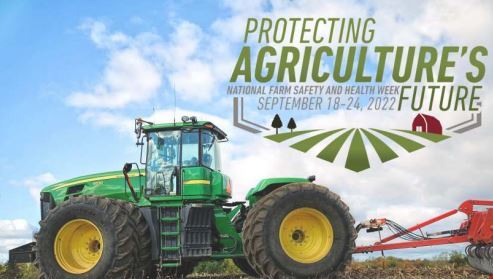
This year’s theme is ‘Protecting Agriculture's Future’. The National Education Center for Agricultural Safety will be hosting daily webinars.
Daily Topics of Focus:
- Monday, September 19 - Tractor Safety & Rural Roadway Safety
- Tuesday, September 20 - Overall Farmer Health
- Wednesday, September 21 - Safety & Health for Youth in Agriculture
- Thursday, September 22 - Confined Spaces
- Friday, September 23 - Safety & Health for Women in Agriculture
To register, visit their website National Farm Safety and Health Week » National Education Center for Agricultural Safety (necasag.org).
As you prepare for your 2022 harvest, we ask that you remain cognizant of your surroundings and of the many hazards on the farm.
- Flowing grain in a storage bin or gravity-flow wagon is like quicksand — it can kill quickly. It takes less than five seconds for a person caught in flowing grain to be trapped.
- The mechanical operation of grain handling equipment presents a real danger. Augers, power take offs, and other moving parts can grab people or clothing.
- Pinch points and missing shields are dangerous enough for adults; not to mention children. Keep children at a safe distance from operating farm equipment.
- Always use extra caution when backing or maneuvering farm machinery. Ensure everyone is visibly clear and accounted for before machinery is engaged.
FSA wants all farmers to have a productive crop year and that begins with putting safety first.
Marketing Assistance Loans (MALs) and Loan Deficiency Payments (LDPs) provide financing and marketing assistance for wheat, feed grains, soybeans, and other oilseeds, pulse crops, rice, peanuts, cotton, wool and honey. MALs provide you with interim financing after harvest to help you meet cash flow needs without having to sell your commodities when market prices are typically at harvest-time lows. A producer who is eligible to obtain a loan, but agrees to forgo the loan, may obtain an LDP if such a payment is available. Marketing loan provisions and LDPs are not available for sugar and extra-long staple cotton.
FSA is now accepting requests for 2022 MALs and LDPs for all eligible commodities after harvest. Requests for loans and LDPs shall be made on or before the final availability date for the respective commodities.
Commodity certificates are available to loan holders who have outstanding nonrecourse loans for wheat, upland cotton, rice, feed grains, pulse crops (dry peas, lentils, large and small chickpeas), peanuts, wool, soybeans and designated minor oilseeds. These certificates can be purchased at the posted county price (or adjusted world price or national posted price) for the quantity of commodity under loan, and must be immediately exchanged for the collateral, satisfying the loan. MALs redeemed with commodity certificates are not subject to Adjusted Gross Income provisions.
To be considered eligible for an LDP, you must have form CCC-633EZ, Page 1 on file at your local FSA Office before losing beneficial interest in the crop. Pages 2, 3 or 4 of the form must be submitted when payment is requested.
Marketing loan gains (MLGs) and loan deficiency payments (LDPs) are no longer subject to payment limitations, actively engaged in farming and cash-rent tenant rules.
Adjusted Gross Income (AGI) provisions state that if your total applicable three-year average AGI exceeds $900,000, then you’re not eligible to receive an MLG or LDP. You must have a valid CCC-941 on file to earn a market gain of LDP. The AGI does not apply to MALs redeemed with commodity certificate exchange.
For more information and additional eligibility requirements, contact your local USDA Service Center or visit fsa.usda.gov.
Typically, Marketing Assistance Loans (MALs) mature on demand, but no later than the last day of the 9th calendar month after the month the MAL is disbursed. However, with the passage of the Consolidated Appropriations Act of 2021, agricultural producers now have additional time to repay MALs.
The Consolidated Appropriations Act of 2021 provides an extension of the MAL maturity to 12 months. This extension is applicable to nonrecourse loans for all commodities except seed cotton and sugar. Eligible open loans must be in good standing with a maturity date on or after July 31, 2021. New crop year loans (2021) requested by September 30, 2021, will also be eligible for the twelve-month maturity.
All current, active loans will automatically be extended the additional three months. Producers who prefer a nine-month loan maturity will need to notify their local FSA county office. Loans that are requested after September 30, 2021, will have a nine-month maturity.
MALs have a maximum loan maturity term of 12 months, therefore loans that had the maturity extended through the Coronavirus Aid, Relief, and Economic Stability Act of 2020 (CARES Act) are not eligible for an additional extension.
Eligible commodities include barley, chickpeas (small and large), corn, cotton (upland), dry peas, grain sorghum, honey, lentils, mohair, oats, peanuts, rice (long and medium grain), soybeans, unshorn pelts, wheat, wool (graded and nongraded); and other oilseeds, including canola, crambe, flaxseed, mustard seed, rapeseed, safflower, sunflower seed, and sesame seed. Seed cotton and sugar are not eligible.
For more information on MALs, contact your local USDA Service Center or visit www.fsa.usda.gov.
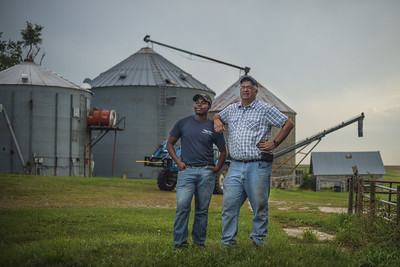
Bins are ideally designed to hold a level volume of grain. When bins are overfilled and grain is heaped up, airflow is hindered and the chance of spoilage increases.
If you take out marketing assistance loans and use the farm-stored grain as collateral, remember that you are responsible for maintaining the quality of the grain through the term of the loan.
|
If loan grain has been disposed of through feeding, selling or any other form of disposal without prior written authorization from the county office staff, it is considered unauthorized disposition. The financial penalties for unauthorized dispositions are severe and your name will be placed on a loan violation list for a two-year period. Always call before you haul any grain under loan.
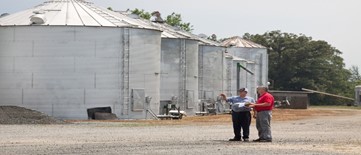
Farm Storage Facility Loans (FSFLs) provide low-interest financing for producers to store, handle and/or transport eligible commodities they produce.
Funds can be used to:
- Acquire, construct or upgrade new or used, portable or permanently affixed, on-farm storage and handling facilities
- Acquire new or used storage and handling trucks; and
- Acquire portable or permanently affixed storage and handling equipment.
ELIGIBLE COMMODITIES
The following commodities are eligible:
- Corn, grain sorghum, rice, soybeans, oats, peanuts, wheat, barley or minor oilseeds
harvested as whole grain
- Corn, grain sorghum, oats, wheat or barley harvested as other-than-whole grain
- Other grains (triticale, speltz and buckwheat)
- Fruits (includes nuts) and vegetables - cold storage facilities
- Hay
- Honey
- Floriculture
- Maple sap and syrup
- Milk, cheese, butter and yogurt
- Eggs
- Meat/poultry(unprocessed)
- Aquaculture
Other eligible commodities can be found by viewing the Farm Storage Facility Loan Fact Sheet.
ELIGIBLE FACILITIES, EQUIPMENT AND UPGRADES
The following types of new/used facilities and upgrades are eligible and must have a useful life for at least the term of the loan:
- Conventional cribs or bins;
- Oxygen-limiting structures and remanufactured oxygen-limiting structures;
- Flat-type storage structures;
- Electrical equipment and handling equipment, excluding the installation of electrical service to the electrical meter;
- Safety equipment, such as interior and exterior ladders and lighting;
- Equipment to improve, maintain or monitor the quality of stored grain;
- Concrete foundations, aprons, pits and pads, including site preparation, off-farm labor and material, essential to the proper operation of the grain storage and handling equipment;
- Renovation of existing farm storage facilities, under certain circumstances, if the renovation is for maintaining or replacing items;
- Concrete foundations, aprons, pits and pads, including site preparation, off-farm labor and material, essential to the proper operation of the grain storage and handling equipment;
- Renovation of existing farm storage facilities, under certain circumstances, if the renovation is for maintaining or replacing items;
- Grain handling and grain drying equipment determined by the Commodity Credit Corporation to be needed and essential to the proper operation of a grain storage system (with or without a loan for the storage facility);
- Structures that are bunker-type, horizontal or open silo structures with at least two concrete walls and a concrete floor;
- Structures suitable for storing hay built according to acceptable design guidelines;
- Structures suitable for storing renewable biomass;
- Bulk tanks for storing milk or maple sap;
- Cold storage buildings, including prefabricated buildings that are suitable for eligible Also may include cooling, circulating and monitoring equipment and electrical equipment, including labor and materials for installation of lights, motors and wiring integral to the proper operation of a cold storage facility; and
- Storage and handling trucks, including refrigerated trucks.
Other examples of equipment can be found by viewing the Farm Storage Facility Loan Fact Sheet.
WHO IS ELIGIBLE?
An eligible borrower is any person who is a landowner, landlord, leaseholder, tenant or sharecropper. Eligible borrowers must be able to show repayment ability and meet other requirements to qualify for a loan.
LOAN FUNDS
A producer may borrow up to $500,000 per loan, with a minimum down payment of 15 percent. Loan terms are up to 12 years, depending on the amount of the loan. Producers must demonstrate storage needs based on three years of production history. FSA also provides a microloan option that, while available to all eligible farmers, also should be of particular interest to new or small producers where there is a need for financing options for loans up to $50,000 at a lower down payment with reduced documentation.
MICROLOAN OPTION
Producers who select the microloan option can borrow up to $50,000, with the minimum down payment reduced to 5 percent and shorter loan terms. Producers can self-certify the storage needs of the eligible commodity and are not required to demonstrate storage needs based on production history.
ENVIRONMENTAL EVALUATION REQUIREMENTS
These loans must be approved by the local FSA state or county committee before any site preparation and/or construction can be started.
All loan requests are subject to an environmental evaluation. Accepting delivery of equipment, starting any site preparation or construction before loan approval may impede the successful completion of an environmental evaluation and may adversely affect loan eligibility.
Additional information on the Environmental Evaluation Requirements can be found in the below article.
FOR MORE INFORMATION
Contact your local USDA Service Center or visit fsa.usda.gov.
|
The National Environmental Policy Act (NEPA) requires Federal agencies to consider all potential environmental impacts for federally funded projects before the project is approved.
For all Farm Service Agency (FSA) programs, an environmental review must be completed before actions are approved, such as site preparation or ground disturbance. These programs include, but are not limited to, the Emergency Conservation Program (ECP), Farm Storage Facility Loan (FSFL) program and farm loans. If project implementation begins before FSA has completed an environmental review, the request will be denied. Although there are exceptions regarding the Stafford Act and emergencies, it’s important to wait until you receive written approval of your project proposal before starting any actions.
Applications cannot be approved until FSA has copies of all permits and plans. Contact your local FSA office early in your planning process to determine what level of environmental review is required for your program application so that it can be completed timely.
Winter months in Indiana can be long and cold, and for several years, farmers have faced propane storage shortages. FSA’s Farm Storage Facility Loan (FSFL) program provides funding for on-farm liquified petroleum tanks.
FSFL low-interest financing can be used to build or upgrade storage facilities and to purchase portable (new or used) structures, equipment, storage and handling trucks. Liquified petroleum tanks are covered for eligible commodities for the use of fuel for grain dryer equipment.
Loans up to $50,000 can be secured by a promissory note/security agreement, while loans exceeding $100,000 require additional security.
You do not need to demonstrate the lack of commercial credit availability to apply. The loans are designed to assist a diverse range of farming operations, including conventional operations, small and mid-sized businesses, new farmers, operations supplying local food and farmers markets, non-traditional farm products, and underserved producers.
To learn more about FSFLs and how these loans can help with your on-site propane tank storage needs, contact your local USDA Service Center or visit fsa.usda.gov.
To assist Farm Storage Facility Loan (FSFL) borrowers experiencing financial hardship from the pandemic and other challenges in production agriculture, USDA’s Farm Service Agency (FSA) is offering a one-time annual installment payment deferral option. No fees or prepayment penalties apply for borrowers who choose this FSFL loan flexibility option.
Eligible borrowers can request a one-time only annual installment payment deferral for loans having terms of three, five, seven or ten years. The installment deferral option is not available for 12-year term loans.
The FSFL installment payments will remain the same, except for the last year. The original loan interest rate and annual payment due date will remain the same. However, because the installment payment deferral is a one-year loan term extension, the final payment will be higher due to additional accrued interest.
Borrowers interested in exercising the one-time annual installment deferral option should contact FSA to make the request and to obtain, complete and sign required forms.
FSFLs provide low-interest financing for producers to store, handle and transport eligible commodities.
More Information
In addition to offering flexibilities for FSFLs, FSA has also made other flexibilities to help producers impacted by the pandemic, including relaxing the loan-making process for farm operating and ownership loans and implementing the Disaster Set-Aside provision that enables an upcoming installment on a direct loan to be set aside for the year. More information on these flexibilities can be found at farmers.gov/coronavirus. For more information, contact your local USDA Service Center. To locate your local FSA office, visit farmers.gov/service-center-locator.
Commodity Loans
(less than one year disbursed): 4.125%
Farm Storage Facility Loans
3-year loan: 3.125%
5-, 7-, or 12-year loans: 2.875%
10-year loans: 2.750%
September 15 – Final Acreage Reporting Date for Cucumbers (Planted 6/1-8/15) Knox County
September 30 – Final Acreage Reporting Date for Value Loss & Controlled Environment Crops for the 2023 Crop Year)
September 30 – NAP Sales Closing Date for Garlic, Wheat, Barley, Rye and Mint for the 2023 Crop Year
September 30 – Final Date to Submit Receipts for 2022 Conservation Reserve Program Mid-Contract Management
October 10 – Offices Closed in Observance of Columbus Day
October 31 –Signup Deadline for Organic Certification Cost Share Program and the Organic and Transitional Education and Certification Program
Ongoing - Signup for Continuous CRP
Ongoing – Submit an Application for a Farm Storage Facility Loan
Continuous - Submit an Application for a FSA Farm Loan
Continuous - Signup for Local County Office FSA Text Alerts
Continuous – Sign up for GovDelivery Newsletters, Bulletins and Indiana Press Releases (Subscribe to USDA Emails for Farmers | Farmers.gov)
|