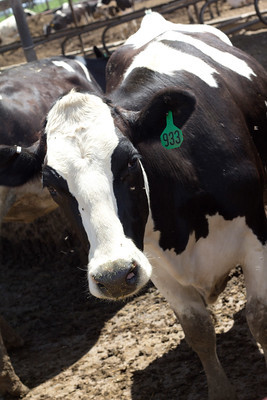
Dairy producers have until Sept. 1, 2022, to pay premiums for the Dairy Margin Coverage (DMC) Program. With monthly DMC program triggers well above the $9.50 per hundredweight (cwt) coverage level, there have been no indemnity payments distributed through the USDA’s Farm Service Agency (FSA) through June 2022. In prior years, producers were able to deduct annual DMC premiums from indemnity payments, but that’s not the case this year.
Approximately 75% of calendar year 2022 DMC and Supplemental DMC premiums have not been paid as the payment deadline of Sept. 1 approaches.
Failure to pay the DMC premium by the deadline may affect a dairy operation’s ability to participate in the DMC program in future years. Contact your local FSA office for more information.
For more information visit the FSA dairy programs webpage or the online dairy decision tool.
|
 A message from FSA Administrator Zach Ducheneaux
As a former rancher myself, I know the tremendous investments—in time, sweat, and thought—that producers make even before their calves hit the ground. My experiences lead me to firmly believe that, here at the Farm Service Agency (FSA), we must find flexibilities where possible to help our farmers and ranchers best meet the challenges of the day.
In recent meetings with Senator John Hoeven, FSA North Dakota State Executive Director Marcy Svenningsen, and livestock producers in North Dakota impacted by catastrophic 2021 winter storms, it became apparent that our Livestock Indemnity Program (LIP) payment rates were not reflective of the true market value for non-adult beef, beefalo, bison, and dairy animals. It was time for us to pivot.
LIP provides benefits to livestock owners and some contract growers for livestock deaths exceeding normal mortality from eligible adverse weather events, certain predation losses and reduced sales prices due to injury from an eligible loss.
Indemnity payments are made at a rate of 75 percent of the market value of the livestock on the day before the date of death. I don’t mind saying that, under our previous payment rates, cutting a LIP check to a rancher for $150 for a calf in today’s market came nowhere near covering the year-long investment in carrying the cow through pregnancy and carrying the calf from birth to sale.
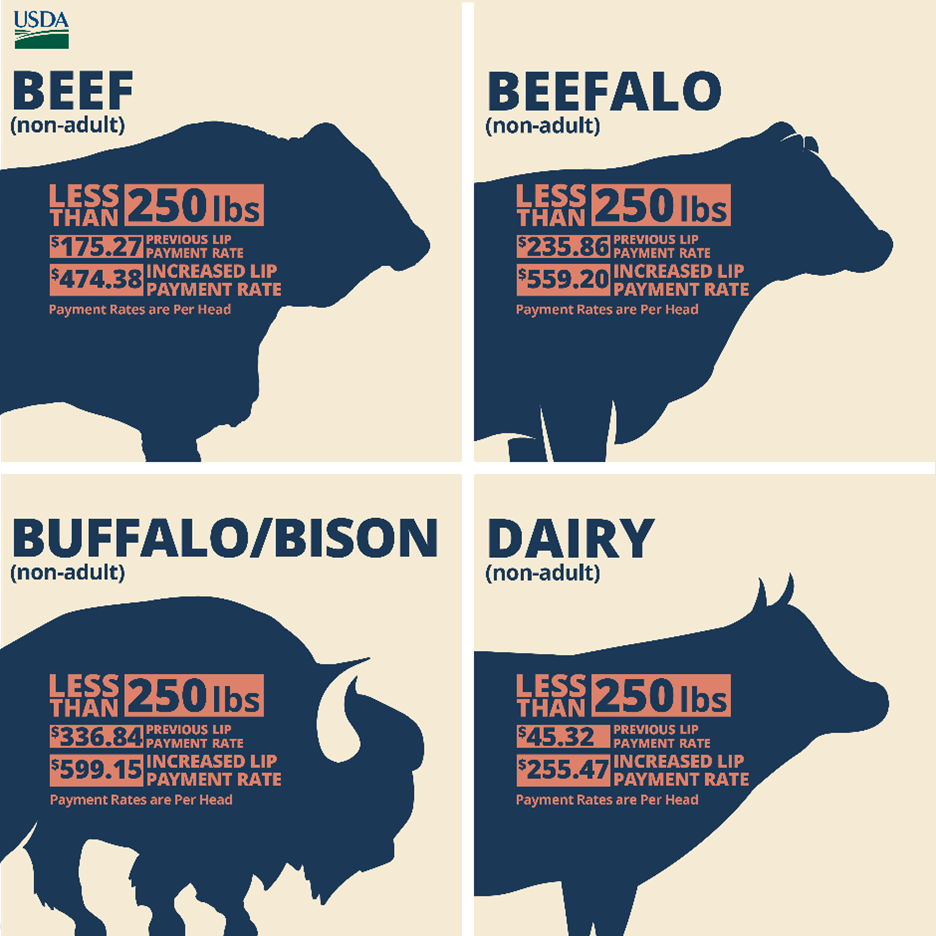
To better capture ranchers’ investments in their animals, we recently announced increased LIP payment rates for beef, beefalo, bison, and dairy animals less than 250 pounds. These now-updated payment rates are reflective of the substantial increased cost of these non-adult livestock in 2022:
The updated LIP payment rates are effective immediately and will be applied retroactively starting January 1, 2022, for all eligible causes of loss including excessive heat, tornado, winter storms, and other qualifying natural disasters. Producers who have already received LIP payments for 2022 will receive an additional payment, if applicable, commensurate with these updated rates. For details on eligibility and payment rates, you can review our LIP fact sheet.
Other Program Improvements
These LIP policy changes complement enhancements we recently made to our Emergency Assistance for Livestock, Honey Bees and Farm-Raised Fish Program (ELAP) – changes that also were derived from the direct input and feedback of producers and the livestock groups.
In addition to paying above normal costs for hauling water to drought-stricken livestock, we also added compensation for hauling feed to livestock and livestock to forage or other grazing acres. And, in 2021, we added fish raised for food as an ELAP-eligible commodity because producers and industry leaders expressed the need.
By continually evaluating how we can deliver our programs in a manner that is meaningful to the farmers and ranchers we serve, we demonstrate our ongoing commitment to stakeholder engagement and our dedication to improving programs for livestock producers first signaled by Agriculture Secretary Tom Vilsack during a Senate Agriculture Committee hearing earlier this year.
It has been said actions speak louder than words, but when it comes to FSA programs that directly affect producers’ livelihoods and way of life and ultimately impact food security for all Americans, I believe the two are not mutually exclusive. Rest assured that when producers and producer groups speak, FSA and I, to the extent possible, will do whatever is within our power to turn those words into actions.
FSA is investing in two outreach and education efforts for farmers and ranchers, including those who are new to agriculture or who have been historically underserved by programs.
First, FSA is announcing $10 million in the new Taxpayer Education and Asset Protection Initiative. Through this initiative, FSA has partnered with the University of Arkansas and the National Farm Income Tax Extension Committee to deliver tax education resources for farmers and ranchers, which includes engagement with agricultural educators, and tax professionals through partnerships with community groups and minority serving institutions across the country.
Second, FSA is investing $4.5 million in outreach for the Conservation Reserve Program Transition Incentives Program (CRP TIP), which increases access to land for new farmers and ranchers. FSA will award cooperative agreements to 15 to 20 partner and stakeholder organizations to conduct outreach and technical assistance and promote awareness and understanding among agricultural communities, particularly those who are military veterans, new to farming, or historically underserved.
Learn more and register for a free webinar on tax preparation at www.usda.gov.

The U.S. Department of Agriculture (USDA) has processed more than 255,000 applications for the new Emergency Relief Program (ERP). USDA has made approximately $6.1 billion, to date, in payments to commodity and specialty crop producers to help offset eligible losses from qualifying 2020 and 2021 natural disasters. By breaking-down agency barriers, using existing data across USDA and pre-filled applications, USDA’s Farm Service Agency (FSA) in cooperation with the Risk Management Agency (RMA) has been able to expediently provide economic relief and save producers and staff over a million hours of time.
The design of ERP Phase One allowed for an expedited process that saved time for staff and producers. FSA was able to begin disbursing payments to producers within days of rolling out the program when under the predecessor program lengthy applications and processing were required before making payments. FSA county offices can process almost nine ERP applications in the time it took to process one application for the Wildfire and Hurricane Indemnity Program — Plus (WHIP+), the predecessor program for ad hoc disaster assistance. This equates to 88% less time to process applications and a reduction of more than one million staff hours for implementation of ERP compared with WHIP+. While not specifically tracked, we expect the savings for producers to be at least as significant as they previously would have had a significant burden to collect records and often sit across from the local staff as the data is entered.
These process improvements also enhanced the customer experience for farmers by reducing the number of producer trips to FSA county offices and allowing producers to spend less time completing forms so they could focus more on their agricultural operations. In addition, the ERP program design greatly diminished the risk potential for errors and leveraged the existing RMA and Federal Crop Insurance loss adjustment and verification processes. With more applications approved, more dollars distributed, and more dollars paid per application in a shorter timeframe, the streamlined application process developed to deliver ERP has significantly outperformed the previous implementation of WHIP+. FSA also has paid more than $1 billion to historically underserved producers.
Emergency Relief Payments to Date
The efforts to streamline, improve responsiveness and work across traditional agency-borders goes beyond just the recent ERP process. FSA mailed pre-filled ERP applications to producers of commodities covered by federal crop insurance in late May and has since paid producers with eligible losses more than $6 billion. Pre-filled ERP applications were mailed to producers with Noninsured Crop Disaster Assistance Program (NAP) coverage last week, and so far, FSA has already issued $35.9 million in payments to producers with eligible losses. NAP-related ERP payments also were not factored and are being made, in full, from the start to speed and target assistance to the small and underserved producers that commonly rely on NAP coverage. Also, earlier this year, staff processed more than 100,000 payments through the Emergency Livestock Relief Program (ELRP) and paid eligible producers more than $601.3 million for 2021 grazing losses within days of the program announcement.
ERP Data Now Available Online
A new public-facing dashboard on the ERP webpage has information on ERP payments that can be sorted by crop type – specialty or non-specialty, specific commodities and state. FSA will update the dashboard on Monday each week.
More Information
ERP and the previously announced ELRP are funded by the Extending Government Funding and Delivering Emergency Assistance Act, which President Biden signed into law in 2021. The law provided $10 billion to help agricultural producers impacted by wildfires, droughts, hurricanes, winter storms and other eligible disaster events experienced during calendar years 2020 and 2021.
For more information on ERP and ELRP eligibility, program provisions for historically underserved producers as well as Frequently Asked Questions, producers can visit FSA’s Emergency Relief webpage.
Additional USDA disaster assistance information can be found on farmers.gov, including the Disaster Assistance Discovery Tool, Disaster-at-a-Glance fact sheet and Farm Loan Discovery Tool. For FSA and Natural Resources Conservation Service programs, producers should contact their local USDA Service Center. For assistance with a crop insurance claim, producers and landowners should contact their crop insurance agent.
|

USDA is announcing that Shared Capital Cooperative, Akiptan, Inc. and the Cherokee Nation Economic Development Trust Authority (CNEDTA), have been approved or conditionally approved as intermediary lenders through the Heirs’ Property Relending Program (HPRP). Once HPRP loans with these lenders close, these lenders will help agricultural producers and landowners resolve heirs’ land ownership and succession issues. Additionally, USDA encourages more intermediary lenders, including cooperatives, credit unions and nonprofit organizations to apply. More information is at farmers.gov/heirs/relending.
Heirs may apply directly to the intermediary lenders for loans to resolve land ownership and succession issues.
|
|







