All of us at the Farm Service Agency (FSA), here in Kentucky, strive daily to equitably serve all farmers, ranchers, and agricultural partners throughout the state by delivering effective and efficient agricultural programs. And now, following the devastating flooding in Eastern Kentucky, we are standing by to assist those impacted by this historic flooding event that began on July 26, 2022. We are here to help. Our offices are open with staff ready to discuss disaster assistance and provide technical support. Please reach out to your local USDA service center to learn more about how we can assist your agricultural operation. Be sure to call ahead to check local COVID policy guidelines.
A good resource to discover some of the ways we can assist you is to visit USDA Disaster Assistance Programs. This page lists a variety of USDA FSA programs to help farmers, ranchers, communities, and businesses during disasters. On this page, you’ll also find additional resources such as the USDA Disaster Resource Center which lists other preparedness and assistance resources including DisasterAssistance.gov.
You can also visit farmers.gov for additional USDA programs that can help agricultural producers recover. Here, you'll find the Disaster Assistance Discovery Tool, the Farm Loan Discovery Tool and the Disaster Assistance-at-a-Glance fact sheet that will help producers and landowners determine program or loan options to help with the recovery of losses and rebuilding.
We included a USDA Farm Production and Conservation (FPAC) article in this newsletter that summarizes a variety of USDA programs offered through the Farm Service Agency, Natural Resources Conservation Service and Risk Management Agency that can help Kentucky farmers and ranchers with this disastrous flooding event.
Federal and State agencies are working together to get information on assistance to Kentucky farmers and ranchers affected by this flood. The Kentucky Department of Agriculture has put together a resource page listing federal and state disaster programs that assist Kentucky farmers and ranchers. You can find other Kentucky flood resources on the KY.gov website and the UK College of Agriculture - Kentucky Flood Resources page.
Most importantly, our hearts and thoughts go out to the families who’ve lost loved ones and suffered other losses and damages due to this flood. There are resources to help impacted persons with emotional support. The new Suicide and Crisis Lifeline is a national network of local crisis centers that provides free and confidential emotional support to anyone experiencing emotional distress. It is available 24 hours a day, 7 days a week and may be reached by calling or texting 988 or chatting at https://988lifeline.org/chat/.
Another source of emotional support is Raising Hope, a local outreach campaign to support healthy lives on Kentucky farms, helping farmers and their families across Kentucky during disaster events.
You can visit farmers.gov/subscribe to signup to receive email and text alerts to be reminded of program deadlines and updates. From there you can choose from a wide number of topics including disaster assistance, conservation programs, crop insurance, farm loans, and more. For more information visit farmers.gov/working-with-us/stay-connected or for subscription assistance, contact your local USDA Service Center.
Please don't hesitate to reach out to you local local USDA Service Center for assistance.
Dean Schamore
State Executive Director for FSA
Kentucky State Office
|
Kentucky agricultural operations have been significantly impacted by the recent floods in the eastern part of the state. The U.S. Department of Agriculture (USDA) has technical and financial assistance available to help farmers and livestock producers recover. Impacted producers should contact their local USDA Service Center to report losses and learn more about program options available to assist in their recovery from crop, land, infrastructure and livestock losses and damages.
“USDA stands ready to assist in the recovery from this catastrophic flood event by helping farmers, landowners and communities clean up and restore farmland, forests and watersheds,” said Robert Bonnie, Under Secretary for Farm Production and Conservation (FPAC). “I assure you that USDA employees are working diligently to deliver FPAC’s extensive portfolio of disaster assistance programs and services.”
USDA Disaster Assistance
Producers who experience livestock deaths may be eligible for the Livestock Indemnity Program (LIP). To participate in LIP, producers will be required to provide verifiable documentation of death losses resulting from an eligible adverse weather event and must submit a notice of loss to their local FSA office within 30 calendar days of when the loss of livestock is apparent.
Meanwhile, the Emergency Assistance for Livestock, Honeybees, and Farm-Raised Fish Program provides eligible producers with compensation for feed and grazing losses. For ELAP, producers will need to file a notice of loss within 30 days and honeybee losses within 15 days.
Additionally, eligible orchardists and nursery tree growers may be eligible for cost-share assistance through the Tree Assistance Program to replant or rehabilitate eligible trees, bushes or vines lost. This complements Noninsured Crop Disaster Assistance Program or crop insurance coverage, which covers the crop but not the plants or trees in all cases. For TAP, a program application must be filed within 90 days.
“Once you are able to safely evaluate the impact on your operation, be sure to contact your local FSA office to timely report all crop, livestock and farm infrastructure damages and losses,” said Dean Schamore, State Executive Director for the Farm Service Agency (FSA) in Kentucky. “To expedite FSA disaster assistance, you will likely need to provide documents, such as farm records, herd inventory, receipts and pictures of damages or losses.”
FSA also offers a variety of direct and guaranteed farm loans, including operating and emergency farm loans, to producers unable to secure commercial financing. Producers in counties with a primary or contiguous disaster designation may be eligible for low-interest emergency loans to help them recover from production and physical losses. Loans can help producers replace essential property, purchase inputs like livestock, equipment, feed and seed, cover family living expenses or refinance farm-related debts and other needs. Additionally, FSA has a variety of loan servicing options available for borrowers who are unable to make scheduled payments on their farm loan debt to FSA because of reasons beyond their control.
Risk Management
Producers who have risk protection through Federal Crop Insurance or FSA’s NAP should report crop damage to their crop insurance agent or FSA office. If they have crop insurance, producers should report crop damage to their agent within 72 hours of damage discovery and follow up in writing within 15 days. For NAP covered crops, a Notice of Loss (CCC-576) must be filed within 15 days of the loss becoming apparent, except for hand-harvested crops, which should be reported within 72 hours.
“Crop insurance and other USDA risk management options are there to help producers manage risk because we never know what nature has in store for the future,” said Roddric Bell, Director of RMA’s Regional Office that covers Kentucky. “The Approved Insurance Providers, loss adjusters and agents are experienced and well trained in handling these types of events.”
Conservation
The Emergency Conservation Program (ECP) and Emergency Forest Restoration Program (EFRP) can assist landowners and forest stewards with financial and technical assistance to restore fencing, damaged farmland or forests.
USDA’s Natural Resources Conservation Service (NRCS) administers the Emergency Watershed Protection (EWP) program, which provides assistance to local government sponsors with the cost of addressing watershed impairments or hazards such as debris removal and streambank stabilization. The EWP Program is a recovery effort aimed at relieving imminent hazards to life and property caused by floods, fires, windstorms and other natural disasters. All projects must have a project sponsor. NRCS may bear up to 75% of the eligible construction cost of emergency measures (90% within limited-resource areas as identified by the U.S. Census data). The remaining costs must come from local sources and can be in the form of cash or in-kind services.
EWP is designed for installation of recovery measures to safeguard life and property as a result of a natural disaster. Threats that the EWP Program addresses are termed watershed impairments. These include, but are not limited to:
- Debris-clogged waterways.
- Unstable streambanks.
- Severe erosion jeopardizing public infrastructure.
- Wind-borne debris removal.
- Damaged upland sites stripped of protective vegetation by fire or drought.
Eligible sponsors include cities, counties, towns, or any federally recognized Native American tribe or tribal organization. Sponsors must submit a formal request (by mail or email) to the state conservationist for assistance within 60 days of the natural disaster occurrence or 60 days from the date when access to the sites become available. For more information, potential sponsors should contact their local NRCS office.
“NRCS can be a very valuable partner to help communities with their recovery efforts,” said Greg Stone, State Conservationist for the NRCS in Kentucky. “Our staff will work with communities to make assessments of the damages and develop approaches that focus on effective recovery of the land.”
More Information
On farmers.gov, the Disaster Assistance Discovery Tool, Disaster Assistance-at-a-Glance fact sheet, and Farm Loan Discovery Tool can help producers and landowners determine program or loan options. For assistance with a crop insurance claim, producers and landowners should contact their crop insurance agent. For FSA and NRCS programs, they should contact their local USDA Service Center.
Ask USDA is now available as a tool for FSA customers to ask questions about FSA programs and services.
Ask USDA, available at ask.usda.gov is similar to AskFSA, which was decommissioned Sept. 21, but it also provides information for all USDA programs. Ask USDA allows USDA customers to search for and read answers about FSA programs and services in the same location as they read about other USDA programs and services.
Customers are able to submit questions through email, chat, and phone if they need more information. This improved customer service approach provides a one-stop shopping experience that covers all of USDA’s many programs.
Farm Service Agency (FSA) borrowers with farms located in designated primary or contiguous disaster areas who are unable to make their scheduled FSA loan payments should consider the Disaster Set-Aside (DSA) program.
DSA is available to producers who suffered losses as a result of a natural disaster and relieves immediate and temporary financial stress. FSA is authorized to consider setting aside the portion of a payment/s needed for the operation to continue on a viable scale.
Borrowers must have at least two years left on the term of their loan in order to qualify.
Borrowers have eight months from the date of the disaster designation to submit a complete application. The application must include a written request for DSA signed by all parties liable for the debt along with production records and financial history for the operating year in which the disaster occurred. FSA may request additional information from the borrower in order to determine eligibility.
All farm loans must be current or less than 90 days past due at the time the DSA application is complete. Borrowers may not set aside more than one installment on each loan.
The amount set-aside, including interest accrued on the principal portion of the set-aside, is due on or before the final due date of the loan.
For more information contact your local USDA Service Center.

The U.S. Department of Agriculture (USDA) is accepting offers for more than 3.1 million acres from agricultural producers and private landowners through this year’s Conservation Reserve Program (CRP) Grassland Signup, the highest in history. The signup’s results include nearly 2,000 acres in Kentucky. This program allows producers and landowners to continue grazing and haying practices while protecting grasslands and promoting plant and animal biodiversity and conservation, and it’s part of the Biden-Harris administration’s broader effort to address climate change and to conserve natural resources.
Nationwide, this year’s Grassland CRP signup surpassed last year’s 2.5 million acres by 22%. So far this year, producers have enrolled 2 million acres through the General Signup and more than 464,000 acres have been submitted through the Continuous CRP Signup. This means about 5.6 million acres are entering CRP in 2023, surpassing the 3.9 million acres expiring this year.
Other highlights include:
- Top states included Colorado (642,000 acres), South Dakota (nearly 425,000 acres) and Nebraska (nearly 422,000 acres).
- States with the highest increase in acres compared with last year include Arizona (141% increase), California (129% increase), and Utah (122% increase).
Because Grassland CRP supports not only grazing operations but also biodiversity and conserving environmentally sensitive land such as that prone to wind erosion, USDA’s Farm Service Agency (FSA) created two National Priority Zones in 2021: the Greater Yellowstone Migration Corridor and Dust Bowl Zone. For this year’s signup, FSA expanded the Greater Yellowstone Wildlife Migration Corridor Priority Zone to include seven additional counties across Montana, Wyoming, and Utah, to help protect the big-game animal migration corridor associated with Wyoming elk, mule deer and antelope. FSA accepted offers on more than 1.4 million acres in these two zones.
Grasslands enrolled in CRP help sequester carbon in vegetation and soil, while enhancing resilience to drought and wildfire. Meanwhile, producers can still conduct common grazing practices, such as haying, mowing, or harvesting seed from the enrolled land, which supports ag production.
Broadening Reach of Program
As part of the Agency’s Justice40 efforts, producers and landowners who are historically underserved, including beginning farmers and military veterans, will receive 10 additional ranking points to enhance their offers. From more than 5,000 underserved producers, USDA accepted offers of more than 1.9 million acres, about 87% of those who submitted applications.
Additionally, USDA is working to broaden the scope and reach of Grassland CRP by leveraging the Conservation Reserve Enhancement Program (CREP) to engage historically underserved communities. CREP is a partnership program that enables states, Tribal governments, and non-profit entities to partner with FSA to implement CRP practices and address high priority conservation and environmental objectives. Interested entities are encouraged to contact FSA.
Producers can still make an offer to participate in CRP through the Continuous CRP Signup, which is ongoing, by contacting the FSA at their local USDA Service Center.
|
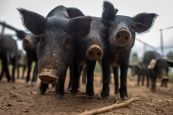
The U.S. Department of Agriculture (USDA) is increasing the amount of funding available for the Spot Market Hog Pandemic Program (SMHPP) and expects to issue approximately $62.8 million in pandemic assistance payments to hog producers starting this week. SMHPP assists eligible producers who sold hogs through a spot market sale from April 16, 2020, through Sept. 1, 2020. USDA’s Farm Service Agency (FSA) accepted SMHPP applications through April 29, 2022.
SMHPP Payments
SMHPP payments will be calculated by multiplying the number of head of eligible hogs, not to exceed 10,000 head, by the payment rate of $54 per head.
FSA originally planned to apply a payment factor if calculated payments exceeded the allocated $50 million in pandemic assistance funds for SMHPP. Payments are not expected to be factored due to Agriculture Secretary Tom Vilsack’s decision to increase funding enabling producers to receive 100% of the calculated SMHPP payment.
There is no per person or legal entity payment limitation on SMHPP payments.
SMHPP Background
USDA offered SMHPP in response to a reduction in packer production due to the COVID-19 pandemic, which resulted in fewer negotiated hogs being procured and subsequent lower market prices. The program is part of USDA’s broader Pandemic Assistance for Producers initiative and addresses gaps in previous assistance for hog producers.
|
A message from FSA Administrator Zach Ducheneaux
As a former rancher myself, I know the tremendous investments—in time, sweat, and thought—that producers make even before their calves hit the ground. My experiences lead me to firmly believe that, here at the Farm Service Agency (FSA), we must find flexibilities where possible to help our farmers and ranchers best meet the challenges of the day.
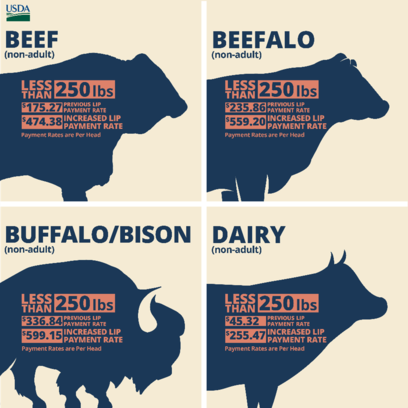
In recent meetings with Senator John Hoeven, FSA North Dakota State Executive Director Marcy Svenningsen, and livestock producers in North Dakota impacted by catastrophic 2021 winter storms, it became apparent that our Livestock Indemnity Program (LIP) payment rates were not reflective of the true market value for non-adult beef, beefalo, bison, and dairy animals. It was time for us to pivot.
LIP provides benefits to livestock owners and some contract growers for livestock deaths exceeding normal mortality from eligible adverse weather events, certain predation losses and reduced sales prices due to injury from an eligible loss.
Indemnity payments are made at a rate of 75 percent of the market value of the livestock on the day before the date of death. I don’t mind saying that, under our previous payment rates, cutting a LIP check to a rancher for $150 for a calf in today’s market came nowhere near covering the year-long investment in carrying the cow through pregnancy and carrying the calf from birth to sale.
To better capture ranchers’ investments in their animals, we recently announced increased LIP payment rates for beef, beefalo, bison, and dairy animals less than 250 pounds. These now-updated payment rates are reflective of the substantial increased cost of these non-adult livestock in 2022:
The updated LIP payment rates are effective immediately and will be applied retroactively starting January 1, 2022, for all eligible causes of loss including excessive heat, tornado, winter storms, and other qualifying natural disasters. Producers who have already received LIP payments for 2022 will receive an additional payment, if applicable, commensurate with these updated rates. For details on eligibility and payment rates, you can review our LIP fact sheet.
Other Program Improvements
These LIP policy changes complement enhancements we recently made to our Emergency Assistance for Livestock, Honey Bees and Farm-Raised Fish Program (ELAP) – changes that also were derived from the direct input and feedback of producers and the livestock groups.
In addition to paying above normal costs for hauling water to drought-stricken livestock, we also added compensation for hauling feed to livestock and livestock to forage or other grazing acres. And, in 2021, we added fish raised for food as an ELAP-eligible commodity because producers and industry leaders expressed the need.
By continually evaluating how we can deliver our programs in a manner that is meaningful to the farmers and ranchers we serve, we demonstrate our ongoing commitment to stakeholder engagement and our dedication to improving programs for livestock producers first signaled by Agriculture Secretary Tom Vilsack during a Senate Agriculture Committee hearing earlier this year.
It has been said actions speak louder than words, but when it comes to FSA programs that directly affect producers’ livelihoods and way of life and ultimately impact food security for all Americans, I believe the two are not mutually exclusive. Rest assured that when producers and producer groups speak, FSA and I, to the extent possible, will do whatever is within our power to turn those words into actions.
| Farm Loan Programs |
| 90-Day Treasury Bill |
1.375% |
| Farm Operating Loans - Direct |
4.000% |
| Farm Ownership Loans - Direct |
4.250% |
| Limited Resource Loans |
5.000% |
| Farm Ownership Loans - Direct FO Down Payment |
1.500% |
| Emergency Loans |
3.750% |
Farm Programs
Farm Storage Facility Loans
|
| 3 Year |
3.125% |
| 5 Year |
3.125% |
| 7 Year |
3.125% |
| 10 Year |
3.000% |
| 12 Year |
3.125% |
| Commodity Loans |
4.000% |
| CCC Borrowing Rate |
3.000% |
|