FSA is now accepting nominations for county committee members. Elections will occur in certain Local Administrative Areas (LAA) for members. LAAs are elective areas for FSA committees in a single county or multi-county jurisdiction. This may include LAAs that are focused on an urban or suburban area.
County committee members make important decisions about how Federal farm programs are administered locally. All nomination forms for the 2022 election must be postmarked or received in the local FSA office by Aug. 1, 2022.
Agricultural producers who participate or cooperate in a USDA program and reside in the LAA that is up for election this year, may be nominated for candidacy for the county committee. A cooperating producer is someone who has provided information about their farming or ranching operation to FSA, even if they have not applied or received program benefits. Individuals may nominate themselves or others and qualifying organizations may also nominate candidates. USDA encourages minority producers, women, and beginning farmers or ranchers to nominate, vote and hold office.
Nationwide, more than 7,700 dedicated members of the agricultural community serve on FSA county committees. The committees are made up of three to 11 members who serve three-year terms. Producers serving on FSA county committees play a critical role in the day-to-day operations of the agency. Committee members are vital to how FSA carries out disaster programs, as well as conservation, commodity and price support programs, county office employment and other agricultural issues.
New Urban COCs in Detroit and Grand Rapids
Elections for the new Detroit and Grand Rapids Urban County Office Committees are planned to take place later this year. Stay tuned for more information.
More Information
Producers should contact their local FSA office today to register and find out how to get involved in their county’s election, including if their LAA is up for election this year. To be considered, a producer must be registered and sign an FSA-669A nomination form. The form and other information about FSA county committee elections are available at fsa.usda.gov/elections.
Election ballots will be mailed to eligible voters beginning Nov. 7, 2022. Producers can find their local USDA Service Center at farmers.gov/service-locator.
|
Agricultural producers and handlers who are certified organic, along with producers and handlers who are transitioning to organic production, can now apply for the U.S. Department of Agriculture’s (USDA) Organic and Transitional Education Certification Program (OTECP) and Organic Certification Cost Share Program (OCCSP), which help producers and handlers cover the cost of organic certification, along with other related expenses. Applications for OTECP and OCCSP are both due October 31, 2022.
OTECP covers:
- Certification costs for organic producers and handlers (25% up to $250 per category).
- Eligible expenses for transitional producers, including fees for pre-certification inspections and development of an organic system plan (75% up to $750).
- Registration fees for educational events (75% up to $200).
- Soil testing (75% up to $100).
Meanwhile, OCCSP covers 50% or up to $500 per category of certification costs in 2022.
This cost share for certification is available for each of these categories: crops, wild crops, livestock, processing/handling and State organic program fees.
Producers can receive cost share through both OTECP and OCCSP. Both OTECP and OCCSP cover costs incurred from October 1, 2021, to September 30, 2022. Producers have until October 31, 2022 to file applications, and FSA will make payments as applications are received.
To apply, producers and handlers should contact the Farm Service Agency (FSA) at their local USDA Service Center. As part of completing the OCCSP applications, producers and handlers will need to provide documentation of their organic certification and eligible expenses. Organic producers and handlers may also apply for OCCSP through participating State agencies.
Additional details can be found on the OTECP and OCCSP webpages.
|
Farm Service Agency (FSA) is committed to providing our farm loan borrowers the tools necessary to be successful. FSA staff will provide guidance and counsel from the loan application process through the borrower’s graduation to commercial credit. While it is FSA’s commitment to advise borrowers as they identify goals and evaluate progress, it is crucial for borrowers to communicate with their farm loan staff when changes occur. It is the borrower’s responsibility to alert FSA to any of the following:
- Any proposed or significant changes in the farming operation
- Any significant changes to family income or expenses
- The development of problem situations
- Any losses or proposed significant changes in security
If a farm loan borrower can’t make payments to suppliers, other creditors, or FSA on time, contact your farm loan staff immediately to discuss loan servicing options.
For more information on FSA farm loan programs, contact your Gratiot County USDA Service Center at 989-875-3900 or visit fsa.usda.gov.
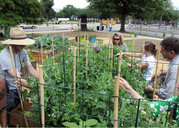
Agriculture Secretary Tom Vilsack recently planted a tree to announce the reopening of the USDA’s People’s Garden Initiative. People’s Gardens across the country will grow fresh, healthy food and support resilient, local food systems; teach people how to garden using conservation practices; nurture habitat for pollinators and wildlife and create greenspace for neighbors. The garden at USDA headquarters in Washington, D.C. will be joined by 17 flagship gardens located in urban communities nationwide.
The Washington, D.C. People’s Garden is growing plants in a variety of ways, from small containers to wheelchair accessible raised beds. Active beehives are on the rooftop of the USDA Whitten Building. In early spring, cool weather crops like peas, kale, collards, radishes, cilantro, parsley, carrots, lettuces, beets, chard and spinach are planted, followed by warm weather crops like beans, tomatoes, peppers, eggplant, squash, and pumpkins in late spring and early summer. Conservation practices like cover crops and pollinator plantings are being used to conserve natural resources. Meanwhile, USDA has plans to launch flagship gardens in urban communities. Those cities include:
- Albuquerque, N.M.
- Atlanta, Ga.
- Chicago, Ill.
- Cleveland, Ohio
- Dallas, Texas
- Detroit, Mich.
- Grand Rapids, Mich.
- Los Angeles, Calif.
- Minneapolis, Minn.
- New Orleans, La.
- New York, N.Y.
- Oakland, Calif.
- Philadelphia, Pa.
- Phoenix, Ariz.
- Portland, Ore.
- Richmond, Va.
- St. Louis, Mo.
USDA plans to expand the initiative to other communities later this year. School gardens, community gardens, urban farms, and small-scale agriculture projects in rural and urban areas can be recognized as a “People’s Garden” if they:
- Benefit the community by providing food, green space, wildlife habitat, education space.
- Are a collaborative effort. This can include groups working together with USDA agencies, food banks, Girl Scouts, Master Gardeners, conservation districts, etc.
- Incorporate conservation management practices, such as using native plant species, rain barrels, integrated pest management, xeriscaping.
- Educate the public about sustainable gardening practices and the importance of local, diverse, and resilient food systems providing healthy food for the community.
USDA originally launched the People’s Garden Initiative in 2009. It’s named for the “People’s Department,” former President Abraham Lincoln’s nickname for USDA, which was established during his presidency in 1862. To watch these gardens grow, visit our People’s Garden Webpage or follow the hashtag #PeoplesGarden on USDA’s social media channels.
|
|