In This Issue:
The new office will be located at the C. Clifton Young Federal Building & U.S. Courthouse, 300 Booth Street, Reno, NV 89509
NRCS’s move will be completed around October 2022 and NRCS’s State Office staff will be teleworking until the move is complete. FSA’s move will also be completed sometime before the end of the year. The FSA staff will be doing a combination of working from the new office and teleworking after August 15, 2022. Employees are available by email or you can call 775-857-8500 to schedule an in person appointment. A State Office directory on our websites can be found at nrcs.usda.gov and fsa.usda.gov
If you’ve suffered above normal expenses for hauling feed or water to livestock or hauling livestock to forage/grazing acres due to the impacts of drought, you may be eligible for financial assistance through the Emergency Assistance for Livestock, Honey Bees, and Farm-Raised Fish Program (ELAP).
For eligible producers in qualifying counties, ELAP provides financial assistance for:
- the transportation of water to livestock;
- the above normal cost of mileage for transporting feed to livestock,
- the above normal cost of transporting livestock to forage/grazing acres.*
*Hauling livestock one-way, one haul per animal reimbursement and no payment for “empty miles.”
Eligible livestock include cattle, buffalo, goats and sheep, among others, that are maintained for commercial use and located in a county where the qualifying drought conditions occur. A county must have had D2 severe drought intensity on the U.S. Drought Monitor for eight consecutive weeks during the normal grazing period, or D3 or D4 drought intensity at any time during the normal grazing period. Producers must have risk in both eligible livestock and eligible grazing land in an eligible county to qualify for ELAP assistance.
WATER TRANSPORTATION
For ELAP water transportation assistance, a producer must be transporting water to eligible livestock on eligible grazing land where the producer had adequate livestock watering systems or facilities in place before the drought occurred and where they do not normally require the transportation of water. Payments are for costs associated with personal labor, equipment, hired labor, equipment, and/or contracted water transportation fees. Cost of the water itself is not covered. The ELAP payment formula uses a national average price per gallon.
ABOVE NORMAL COSTS OF TRANSPORTING FEED
ELAP provides financial assistance to livestock producers who incur above normal expenses for transporting feed to livestock during drought. The payment formula excludes the first 25 miles and any mileage over 1,000 miles. The reimbursement rate is 60% of the costs above what would normally have been incurred during the same time period in a normal (non-drought) year. ABOVE NORMAL COSTS OF TRANSPORTING LIVESTOCK TO FORAGE/GRAZING ACRES
ELAP provides financial assistance to livestock producers who are hauling livestock to a new location for feed resources due to insufficient feed and/or grazing in drought-impacted areas. Assistance for Livestock transportation is retroactive to 2021 and available for 2022 and subsequent years. Please contact your county FSA office for additional details.
For calendar year 2022 forward, producers must submit a notice of loss to your local FSA office within 30 calendar days of when the loss is apparent; producers should contact their county FSA office as soon as the loss of water resources or feed resources are known. For ELAP eligibility, documentation of expenses is critical. Producers should maintain records and receipts associated with the costs of transporting water to eligible livestock, the costs of transporting feed to eligible livestock, and the costs of transporting eligible livestock to forage/grazing acres.
ELAP also offers assistance to producers impacted by wildfire. Contact your county FSA office for more information on ELAP resources for wildfire losses. In addition, beekeepers also can benefit from ELAP provisions and should contact their county FSA office within 15 calendar days of when a loss occurs or from when the loss is apparent.
For more information regarding ELAP, contact your local County USDA Service Center or visit fsa.usda.gov/disaster.
The U.S. Department of Agriculture (USDA) is updating its farm loan programs to better support current borrowers, including historically underserved producers. These improvements are part of USDA’s commitment to increase equity in all programs, including farm loans that provide important access to capital for covering operating expenses and purchasing land and equipment.
The 2018 Farm Bill authorized FSA to provide equitable relief to certain direct loan borrowers, who are non-compliant with program requirements due to good faith reliance on a material action of, advice of, or non-action from an FSA official. Previously, borrowers may have been required to immediately repay the loan or convert it to a non-program loan with higher interest rates, less favorable terms, and limited loan servicing.
Now, FSA has additional flexibilities to assist borrowers in such situations. If the agency provided incorrect guidance to an existing direct loan borrower, the agency may provide equitable relief to that borrower. FSA may assist the borrower by allowing the borrower to keep their loans at current rates or other terms received in association with the loan which was determined to be noncompliant or the borrower may receive other equitable relief for the loan as the Agency determines to be appropriate.
USDA encourages producers to reach out to their local loan officials to ensure they fully understand the wide range of loan and servicing options available that can assist them in starting, expanding or maintaining their operation.
Additional Updates
Equitable relief is one of several changes authorized by the 2018 Farm Bill that USDA has made to the direct and guaranteed loan programs. Other changes that were previously implemented include:
- Modifying the existing three-year farming experience requirement for Direct Farm Ownership loans to include additional items as acceptable experience.
- Allowing socially disadvantaged and beginning farmer applicants to receive a guarantee equal to 95%, rather than the otherwise applicable 90% guarantee.
- Expanding the definition of and providing additional benefits to veteran farmers.
- Allowing borrowers who received restructuring with a write down to maintain eligibility for an Emergency loan.
- Expanding the scope of eligible issues and persons covered under the agricultural Certified Mediation Program.
Additional information on these changes is available in the March 8, 2022 rule on the Federal Register.
More Background
FSA has taken other recent steps to increase equity in its programs. Last summer, USDA announced it was providing $67 million in competitive loans through its new Heirs’ Property Relending Program to help agricultural producers and landowners resolve heirs’ land ownership and succession issues. FSA also invested $4.7 million to establish partnerships with organizations to provide outreach and technical assistance to historically underserved farmers and ranchers, which contributed to a fourfold increase in participation by historically underserved producers in the Coronavirus Food Assistance Program 2 (CFAP 2), a key pandemic assistance program, since April 2021.
The USDA Farm Service Agency’s (FSA) Direct Farm Ownership loans are a resource to help farmers and ranchers become owner-operators of family farms, improve and expand current operations, increase agricultural productivity, and assist with land tenure to save farmland for future generations.
There are three types of Direct Farm Ownership Loans: regular, down payment and joint financing. FSA also offers a Direct Farm Ownership Microloan option for smaller financial needs up to $50,000.
Direct Farm Ownership Loans can be used to construct, purchase or improve farm dwellings, service buildings or other facilities, and to make improvements essential to an operation.
Applicants must provide FSA with an estimate of the total cost of all planned development that completely describe the work, prior to loan approval and must show proof of sufficient funds to pay for the total cost of all planned development at or before loan closing. In some instances, applicants may be asked to provide certified plans, specifications or contract documents. The applicant cannot incur any debts for materials or labor or make any expenditures for development purposes prior to loan closing with the expectation of being reimbursed from FSA funds.
Construction and development work may be performed either by the contract method or the borrower method. Under the contract method, construction and development contractors perform work according to a written contract with the applicant or borrower. If applying for a direct loan to finance a construction project, the applicant must obtain a surety bond that guarantees both payment and performance in the amount of the construction contract from a construction contractor.
A surety bond is required when a contract exceeds $100,000. An authorized agency official determines that a surety bond appears advisable to protect the borrower against default of the contractor or a contract provides for partial payments in excess of the amount of 60 percent of the value of the work in place.
Under the borrower method, the applicant or borrower will perform the construction and development work. The borrower method may only be used when the authorized agency official determines, based on information from the applicant, that the applicant possesses or arranges to obtain the necessary skill and managerial ability to complete the work satisfactorily and that such work will not interfere with the applicant’s farming operation or work schedule.
Potential applicants should visit with FSA early in the initial project planning process to ensure environmental compliance.
Check out the newest Conservation at Work Videos shot right here in Nevada! In two minutes or less, learn about the benefits of conservation practices directly from the farmers, ranchers, and forestland owners applying them. Learn from Nevada producers about Irrigation Land Leveling and Spring Development. Find the Conservation at Work video library with about 50 videos about our conservation practices HERE.
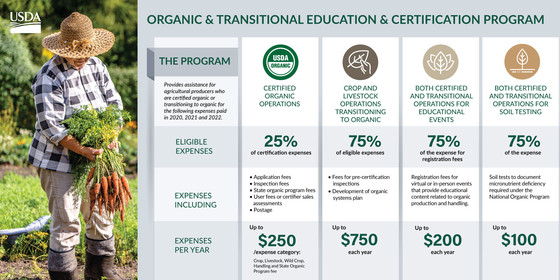
Agricultural producers and handlers who are certified organic, along with producers and handlers who are transitioning to organic production, can now apply for the U.S. Department of Agriculture’s (USDA) Organic and Transitional Education Certification Program (OTECP) and Organic Certification Cost Share Program (OCCSP), which help producers and handlers cover the cost of organic certification, along with other related expenses. Applications for OTECP and OCCSP are both due October 31, 2022.
OTECP covers:
- Certification costs for organic producers and handlers (25% up to $250 per category).
- Eligible expenses for transitional producers, including fees for pre-certification inspections and development of an organic system plan (75% up to $750).
- Registration fees for educational events (75% up to $200).
- Soil testing (75% up to $100).
Meanwhile, OCCSP covers 50% or up to $500 per category of certification costs in 2022.
This cost share for certification is available for each of these categories: crops, wild crops, livestock, processing/handling and State organic program fees.
Producers can receive cost share through both OTECP and OCCSP. Both OTECP and OCCSP cover costs incurred from October 1, 2021, to September 30, 2022. Producers have until October 31, 2022 to file applications, and FSA will make payments as applications are received.
To apply, producers and handlers should contact the Farm Service Agency (FSA) at their local USDA Service Center. As part of completing the OCCSP applications, producers and handlers will need to provide documentation of their organic certification and eligible expenses. Organic producers and handlers may also apply for OCCSP through participating State agencies.
Additional details can be found on the OTECP and OCCSP webpages.
Cash Rents Survey:
Data Collection: February through June 21.
Partnership w/ USDA – Farm Service Agency (FSA).
Data on rental rates on Irrigated Cropland, Non-Irrigated Cropland and Pasture by County.
More Info here: https://www.nass.usda.gov/Surveys/Guide_to_NASS_Surveys/Cash_Rents_by_County/index.php
- Publication Releases:
- August 5, 2022 for State level data (3 pm ET)
- August 26 for County level data (3 pm ET)
Upcoming Releases:
End of each month- Monthly Hay Prices, Included in ‘Agricultural Prices’ release
Weekly Crop Progress & Condition (April through November). Monthly, other months. (first of week)
July 21 – Milk Production (3 pm ET)
July 21 – Livestock Slaughter (3 pm ET)
July 22 – Cattle (3 pm ET)
July 29 – Farm Production Expenditures (Combined w/ ‘West’ Region (Arizona, California, Colorado, Idaho, Montana, New Mexico, Oregon, Utah, Washington, and Wyoming) (3 pm ET))
Resources:
- Nevada NASS Website:
- USDA NASS:
- USDA NASS Census:
- NASS YouTube Channel:
USDA’s Farm Service Agency (FSA) has implemented pre-authorized debit (PAD) for Farm Loan Program (FLP) borrowers. PAD is a voluntary and alternative method for making weekly, bi-weekly, monthly, quarterly, semi-annual or annual payments on loans.
PAD payments are pre-authorized transactions that allow the National Financial and Accounting Operations Center (NFAOC) to electronically collect loan payments from a customer’s account at a financial institution.
PAD may be useful if you use nonfarm income from regular wages or salary to make payments on loans or adjustment offers or for payments from seasonal produce stands. PAD can only be established for future payments.
To request PAD, customers, along with their financial institution, must fill out form RD 3550-28. This form has no expiration date, but a separate form RD 3550-28 must be completed for each loan to which payments are to be applied. A fillable form can be accessed on the USDA Rural Development (RD) website at rd.usda.gov/publications/regulations-guidelines. Click forms and search for “Form 3550-28.”
If you have a “filter” on the account at your financial institution, you will need to provide the financial institution with the following information: Origination ID: 1220040804, Agency Name: USDA RD DCFO.
PAD is offered by FSA at no cost. Check with your financial institution to discuss any potential cost. Preauthorized debit has no expiration date, but you can cancel at any time by submitting a written request to your local FSA office. If a preauthorized debit agreement receives three payment rejections within a three-month period, the preauthorized debit agreement will be cancelled by FSA. The payment amount and due date of your loan is not affected by a cancellation of preauthorized debit. You are responsible to ensure your full payment is made by the due date.
For more information about PAD, contact your local County USDA Service Center or visit fsa.usda.gov.
Agriculture Secretary Tom Vilsack announced that to date, agricultural producers have already received more than $4 billion through the Emergency Relief Program (ERP), representing approximately 67% of the more than $6 billion projected to be paid through this first phase of the program. The U.S. Department of Agriculture (USDA) mailed out pre-filled applications in late May to producers with crop insurance who suffered losses due to natural disasters in 2020 and 2021. Commodity and specialty crop producers have until July 22 to complete applications.
USDA is implementing ERP and ELRP in two phases, with the first phase utilizing existing claim data to provide relief expediently, and the second phase focusing on ensuring producers not covered by other programs receive assistance. For phase one, USDA used crop insurance and Noninsured Crop Disaster Assistance Program (NAP) claim data.
Both ERP and the previously announced Emergency Livestock Relief Program (ELRP) are funded by the Extending Government Funding and Delivering Emergency Assistance Act, which President Biden signed into law in 2021. The law provided $10 billion to help agricultural producers impacted by wildfires, droughts, hurricanes, winter storms and other eligible disasters experienced during calendar years 2020 and 2021, of which $750 million is committed to livestock producers who experienced losses to drought or wildfire in calendar year 2021. Eligible livestock producers received ELRP payments totaling more than $590 million since the program was rolled out in late March.
Pre-Filled Applications
Eligible producers with eligible crop insurance claims have received pre-filled applications, which included eligibility requirements and payment calculations. Producers received a separate application form for each program year in which they experienced an eligible loss.
Producers should check with the Farm Service Agency (FSA) at their local USDA Service Center to confirm eligibility and to ensure that all required farm program participation, adjusted gross income and conservation compliance forms are on file. Producers who have previously participated in FSA programs likely have these required forms already on file.
ERP provisions allow for a higher payment percentage for historically underserved producers, including beginning, limited resource, socially disadvantaged and military veteran producers. To qualify for the higher payment rate, individuals must have a Form CCC-860, Socially Disadvantaged, Limited Resource, Beginning and Veteran Farmer or Rancher Certification on file.
To receive a payment, producers must complete and submit their forms by the July 22 deadline. Once the completed ERP application for payment is submitted to and signed by the FSA, producers enrolled in direct deposit should look for their payment within three business days.
Additional Assistance through Phase One
FSA will be sending pre-filled applications for about 9,000 eligible producers with NAP coverage in mid-July.
The Federal crop insurance data used to populate ERP phase one pre-filled applications included claim data on file with USDA’s Risk Management Agency (RMA) as of May 2, 2022. At that time, claim data for the Supplemental Coverage Option (SCO), Enhanced Coverage Option (ECO), Stacked Income Protection Plan (STAX), Margin Protection Plan (MP) or Area Risk Protection Insurance (ARPI) were not complete, so crop/units including these coverage options were not included in the pre-filled ERP application form. In late summer 2022, updated claim information will be used to generate a second pre-filled application for those crop/units with eligible losses on file with RMA not included in the first mailing.
More Information
ERP covers losses to crops, trees, bushes and vines due to a qualifying natural disaster event in calendar years 2020 and 2021. Eligible crops include all crops for which crop insurance or NAP coverage was available, except for crops intended for grazing. Qualifying natural disaster events include wildfires, hurricanes, floods, derechos, excessive heat, winter storms, freeze (including a polar vortex), smoke exposure, excessive moisture, qualifying drought and related conditions.
All producers who receive ERP phase one payments are statutorily required to purchase crop insurance or NAP coverage where crop insurance is not available for the next two available crop years.
Producers should contact their local Service Center if they have questions. Additionally, other resources include:
The second phase of both ERP and ELRP will be aimed at filling gaps and providing assistance to producers who did not participate in or receive payments through the existing programs that are being leveraged for phase one implementation. Through proactive communication and outreach, USDA will keep producers and stakeholders informed as program details are made available.
This is likely no surprise to you, but drought persists across the western U.S. and is intensifying in some areas. No geographic area is immune to the potential of drought at any given time. The U.S. Drought Monitor provides a weekly drought assessment, and it plays an important role in USDA programs that help farmers and ranchers recover from drought.
Fact #1 - Numerous agencies use the Drought Monitor to inform drought-related decisions.
The map identifies areas of drought and labels them by intensity on a weekly basis. It categorizes the entire country as being in one of six levels of drought. The first two, None and Abnormally Dry (D0), are not considered to be drought. The next four describe increasing levels of drought: Moderate (D1), Severe (D2), Extreme (D3) and Exceptional (D4).
While many entities consult the Drought Monitor for drought information, drought declarations are made by federal, state and local agencies that may or may not use the Drought Monitor to inform their decisions. Some of the ways USDA uses it to determine a producer’s eligibility for certain drought assistance programs, like the Livestock Forage Disaster Program and Emergency Haying or Grazing on Conservation Reserve Program acres and to “fast-track” Secretarial drought disaster designations.
Fact #2 - U.S. Drought Monitor is made with more than precipitation data.
When you think about drought, you probably think about water, or the lack of it. Precipitation plays a major role in the creation of the Drought Monitor, but the map’s author considers numerous indicators, including drought impacts and local insight from over 450 expert observers around the country. Authors use several dozen indicators to assess drought, including precipitation, streamflow, reservoir levels, temperature and evaporative demand, soil moisture and vegetation health. Because the drought monitor depicts both short and long‐term drought conditions, the authors must look at data for multiple timeframes. The final map produced each week represents a summary of the story being told by all the pieces of data. To help tell that story, authors don’t just look at data. They converse over the course of the map-making week with experts across the country and draw information about drought impacts from media reports and private citizens.
Fact #3 - A real person, using real data, updates the map.
Each week’s map author, not a computer, processes and analyzes data to update the drought monitor. The map authors are trained climatologists or meteorologists from the National Drought Mitigation Center at the University of Nebraska-Lincoln (the academic partner and website host of the Drought Monitor), the National Oceanic and Atmospheric Administration and USDA. The author’s job is to do what a computer can’t – use their expertise to reconcile the sometimes-conflicting stories told by each stream of data into a single assessment.
Fact #4 - The Drought Monitor provides a current snapshot, not a forecast.
The Drought Monitor is a “snapshot” of conditions observed during the most recent week and builds off the previous week’s map. The map is released on Thursdays and depicts conditions based on data for the week that ended the preceding Tuesday. Rain that falls on the Wednesday just before the USDM’s release won’t be reflected until the next map is published. This provides a consistent, week‐to‐week product and gives the author a window to assess the data and come up with a final map.
Fact #5 – Your input can be part of the drought-monitoring process.
State climatologists and other trained observers in the drought monitoring network relay on-the-ground information from numerous sources to the US Drought monitor author each week. That can include information that you contribute.
The Drought Monitor serves as a trigger for multiple forms of federal disaster relief for agricultural producers, and sometimes producers contact the author to suggest that drought conditions in their area are worse than what the latest drought monitor shows. When the author gets a call like that, it prompts them to look closely at all available data for that area, to see whether measurements of precipitation, temperature, soil moisture and other indicators corroborate producer-submitted reports. This is the process that authors follow whether they receive one report or one hundred reports, although reports from more points may help state officials and others know where to look for impacts.
There are multiple ways to contribute your observations:
-
Talk to your state climatologist - Find the current list at the American Association of State Climatologists website.
-
Email - Emails sent to droughtmonitor@unl.edu inform the USDM authors.
-
Become a CoCoRaHS observer - Submit drought reports along with daily precipitation observations to the Community Collaborative Rain, Hail & Snow Network.
-
Submit Condition Monitoring Observer Reports (CMOR) - go.unl.edu/CMOR.
For more information, read our Ask the Expert blog with a NDMC climatologist or visit farmers.gov/protection-recovery.
The first 10 years of a farming or ranching operation are tough. USDA recognizes you need dedicated support to help make sense of all the information coming your way. Now each state has a Beginning Farmer and Rancher team headed up by a state coordinator. The coordinator helps producers who have operated a farm or ranch for less than 10 years navigate USDA and partner resources.
To find your State coordinator, visit farmers.gov/newfarmers/coordinators/. For more beginning farmer and rancher information, visit farmers.gov/newfarmers.
|