|
July 15, 2022: Acreage Reporting Deadline for Barley, Corn, Dry Beans, Forage Seeding, Grain Sorghum, Green Peas, Hemp, Mint, Oats, Onions, Popcorn, Potatoes, Soybeans, Sweet Corn, Whole Farm Revenue, and all other spring planted crops.
July 22, 2022: Deadline for Emergency Relief Program (ERP) Phase I applications for insured producers.
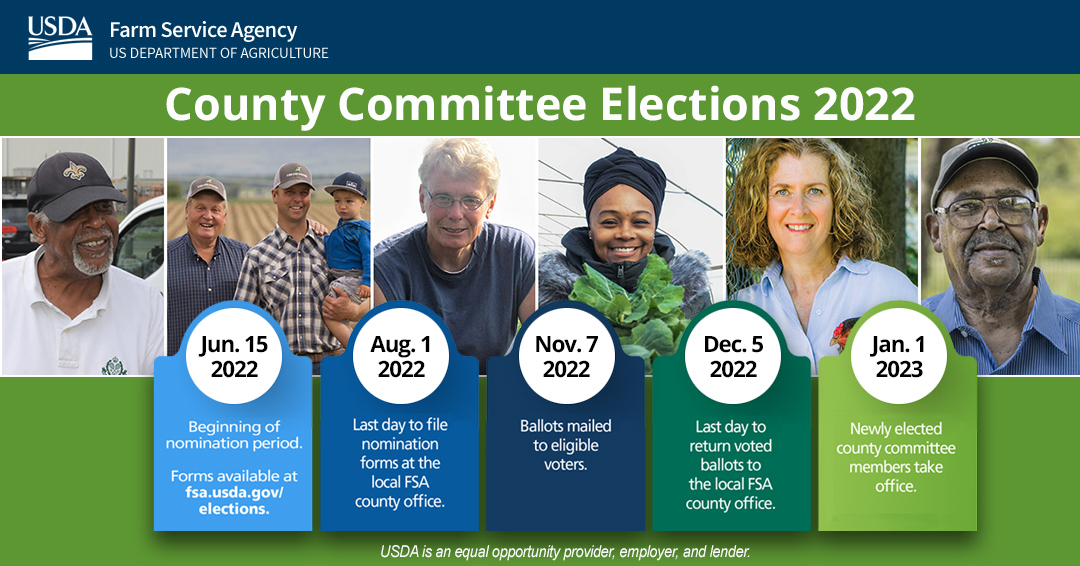
August 1, 2022: Last day to file nomination forms at the local USDA Service Center for County Committee Elections
August 5, 2022: Deadline to enroll expiring CRP acreage into the Continuous signup (including CLEAR30, HELI, SAFE, and CREP)
August 15, 2022: Acreage Reporting Deadline for Cabbage, Cucumbers, Processing Beans
Agriculture Secretary Tom Vilsack announced that to date, agricultural producers have already received more than $4 billion through the Emergency Relief Program (ERP), representing approximately 67% of the more than $6 billion projected to be paid through this first phase of the program. The U.S. Department of Agriculture (USDA) mailed out pre-filled applications in late May to producers with crop insurance who suffered losses due to natural disasters in 2020 and 2021. Commodity and specialty crop producers have until July 22 to complete applications.
USDA is implementing ERP and ELRP in two phases, with the first phase utilizing existing claim data to provide relief expediently, and the second phase focusing on ensuring producers not covered by other programs receive assistance. For phase one, USDA used crop insurance and Noninsured Crop Disaster Assistance Program (NAP) claim data.
Both ERP and the previously announced Emergency Livestock Relief Program (ELRP) are funded by the Extending Government Funding and Delivering Emergency Assistance Act, which President Biden signed into law in 2021. The law provided $10 billion to help agricultural producers impacted by wildfires, droughts, hurricanes, winter storms and other eligible disasters experienced during calendar years 2020 and 2021, of which $750 million is committed to livestock producers who experienced losses to drought or wildfire in calendar year 2021. Eligible livestock producers received ELRP payments totaling more than $590 million since the program was rolled out in late March.
Pre-Filled Applications
Eligible producers with eligible crop insurance claims have received pre-filled applications, which included eligibility requirements and payment calculations. Producers received a separate application form for each program year in which they experienced an eligible loss.
Producers should check with the Farm Service Agency (FSA) at their local USDA Service Center to confirm eligibility and to ensure that all required farm program participation, adjusted gross income and conservation compliance forms are on file. Producers who have previously participated in FSA programs likely have these required forms already on file.
ERP provisions allow for a higher payment percentage for historically underserved producers, including beginning, limited resource, socially disadvantaged and military veteran producers. To qualify for the higher payment rate, individuals must have a Form CCC-860, Socially Disadvantaged, Limited Resource, Beginning and Veteran Farmer or Rancher Certification on file.
To receive a payment, producers must complete and submit their forms by the July 22 deadline. Once the completed ERP application for payment is submitted to and signed by the FSA, producers enrolled in direct deposit should look for their payment within three business days.
Additional Assistance through Phase One
FSA will be sending pre-filled applications for about 9,000 eligible producers with NAP coverage in mid-July.
The Federal crop insurance data used to populate ERP phase one pre-filled applications included claim data on file with USDA's Risk Management Agency (RMA) as of May 2, 2022. At that time, claim data for the Supplemental Coverage Option (SCO), Enhanced Coverage Option (ECO), Stacked Income Protection Plan (STAX), Margin Protection Plan (MP) or Area Risk Protection Insurance (ARPI) were not complete, so crop/units including these coverage options were not included in the pre-filled ERP application form. In late summer 2022, updated claim information will be used to generate a second pre-filled application for those crop/units with eligible losses on file with RMA not included in the first mailing.
More Information
ERP covers losses to crops, trees, bushes and vines due to a qualifying natural disaster event in calendar years 2020 and 2021. Eligible crops include all crops for which crop insurance or NAP coverage was available, except for crops intended for grazing. Qualifying natural disaster events include wildfires, hurricanes, floods, derechos, excessive heat, winter storms, freeze (including a polar vortex), smoke exposure, excessive moisture, qualifying drought and related conditions.
All producers who receive ERP phase one payments are statutorily required to purchase crop insurance or NAP coverage where crop insurance is not available for the next two available crop years.
Producers should contact their local Service Center if they have questions. Additionally, other resources include:
Current loan rates as of July 1, 2022.
Farm Loan Interest Rates:
| Farm Operating - Direct |
3.875% |
| Farm Operating - Microloan |
3.875% |
| Farm Ownership - Direct |
4.125% |
| Farm Ownership - Microloan |
4.125% |
| Farm Ownership - Direct, Joint Financing |
2.500% |
| Farm Ownership - Down Payment |
1.500% |
| Emergency - Amount of Actual Loss |
3.750% |
Farm Storage Facility Loans (FSFL):
| 3-year FSFL |
3.000% |
| 5-year FSFL |
3.000% |
| 7-year FSFL |
3.125% |
| 10-year FSFL |
3.000% |
| 12-year FSFL |
3.125% |
Please visit the Farm Loan Program webpage for more information.
Agricultural producers who have not yet completed their crop acreage reports after spring planting should make an appointment with your local Farm Service Agency (FSA) before the applicable deadline.
An acreage report documents a crop grown on a farm or ranch and its intended uses. Filing an accurate and timely acreage report for all crops and land uses, including failed acreage and prevented planted acreage, can prevent the loss of benefits.
How to File a Report
To file a crop acreage report, producers need to provide:
- Crop and crop type or variety.
- Intended use of the crop.
- Number of acres of the crop.
- Map with approximate boundaries for the crop.
- Planting date(s).
- Planting pattern, when applicable.
- Producer shares.
- Irrigation practice(s).
- Acreage prevented from planting, when applicable.
- Other information as required.
Acreage Reporting Details
The following exceptions apply to acreage reporting dates:
- If the crop has not been planted by the acreage reporting date, then the acreage must be reported no later than 15 calendar days after planting is completed.
- If a producer acquires additional acreage after the acreage reporting date, then the acreage must be reported no later than 30 calendar days after purchase or acquiring the lease. Appropriate documentation must be provided to the county office.
- If crops are covered by the Noninsured Crop Disaster Assistance Program, acreage reports should be submitted by the applicable state, county, or crop-specific reporting deadline or 15 calendar days before grazing or harvesting of the crop begins.
Producers should also report crop acreage they intended to plant, but due to natural disaster, were unable to because of a natural disaster.
Prevented planting acreage must be reported on form CCC-576, Notice of Loss, no later than 15 calendar days after the final planting date as established by FSA and USDA's Risk Management Agency.
FSA offers continuous certification for perennial forage. This means after perennial forage is reported once and the producer elects continuous certification, the certification remains in effect until a change is made. Check with FSA at the local USDA Service Center for more information on continuous certification.
New Option to View, Print and Label Maps on Farmers.gov
Producers with an eAuth account linked to their USDA customer record can now access their FSA farm records, maps and common land units by logging into farmers.gov. A new feature will allow producers to export field boundaries as shapefiles and import and view other shapefiles, such as precision agriculture boundaries. This will allow producers to view, print and label their own maps for acreage reporting purposes.
Producers who have authority to act on behalf of another customer as a grantee via form FSA-211 Power of Attorney, Business Partner Signature Authority, along with other signature types, or as a member of a business can now access information in the farmers.gov portal.
Producers can learn how to use the farmers.gov Farm Records Mapping functionality with this fact sheet and these video tutorials.
More Information
For questions, please contact your local USDA Service Center.
The University of Wisconsin Division of Extension has released the Fox Demo Farms Impact Evaluation Report, which describes the role of the Fox Demo Farms in prompting farmers associated with the project, as well as farmers who are not directly associated with the project, to adopt conservation practices within the Lower Fox River watershed. Fox Demo Farms are a Great Lakes Restoration Initiative (GLRI) project funded through United States Department of Agriculture Natural Resources Conservation Service.
The report looks comprehensively at farmers' experiences with conservation practices and compiles recommendations from farmers and stakeholders to inform future priorities. The evaluation project was designed to better understand the project's impacts on the watershed and highlights transferable findings that can be used in other watersheds throughout the Great Lakes Basin.
Fox Demo Farms began in 2014 and was the first project of its kind in the Great Lakes Basin. The Fox Demo Farms’ objectives are to:
- Establish demonstration farms within the Lower Fox River Basin to test new and standard conservation systems in reducing phosphorus and sediment.
- Establish an efficient mechanism to share this technology and information with farmers, agribusiness, conservation agencies, and the public.
- Create opportunities for others to test their research and program ideas.
- Share information and lessons learned throughout the Great Lakes basin.
Click here to read the full report.
To learn more about the Lower Fox Demonstration Farms, visit the Fox Demo Farms website.
The USDA Farm Service Agency’s (FSA) Direct Farm Ownership loans can help farmers and ranchers become owner-operators of family farms, improve and expand current operations, increase agricultural productivity, and assist with land tenure to save farmland for future generations.
There are three types of Direct Farm Ownership Loans: regular, down payment and joint financing. FSA also offers a Direct Farm Ownership Microloan option for smaller financial needs up to $50,000.
Joint financing allows FSA to provide more farmers and ranchers with access to capital. FSA lends up to 50 percent of the total amount financed. A commercial lender, a State program or the seller of the property being purchased, provides the balance of loan funds, with or without an FSA guarantee. The maximum loan amount for a joint financing loan is $600,000, and the repayment period for the loan is up to 40 years.
The operation must be an eligible farm enterprise. Farm Ownership loan funds cannot be used to finance nonfarm enterprises and all applicants must be able to meet general eligibility requirements. Loan applicants are also required to have participated in the business operations of a farm or ranch for at least three years out of the 10 years prior to the date the application is submitted. The applicant must show documentation that their participation in the business operation of the farm or ranch was not solely as a laborer.
For more information about farm loans, contact your local USDA Service Center or visit fsa.usda.gov.
USDA Farm Service Agency (FSA) reminds you to report prevented planted and failed acres in order to establish or retain FSA program eligibility for some programs.
You should report crop acreage you intended to plant, but due to natural disaster, were prevented from planting. Prevented planting acreage must be reported on form CCC-576, Notice of Loss, no later than 15 calendar days after the final planting date as established by FSA and the Risk Management Agency (RMA).
If you're unable to report the prevented planting acreage within the 15 calendar days following the final planting date, a late-filed report can be submitted. Late-filed reports will only be accepted if FSA conducts a farm visit to assess the eligible disaster condition that prevented the crop from being planted. A measurement service fee will be charged.
Additionally, if you have failed acres, you should also use form CCC-576, Notice of Loss, to report failed acres.
For hand-harvested crops and certain perishables, you must notify FSA of damage or loss through the administrative county office within 72 hours of the date of damage or loss first becomes apparent. This notification can be provided by filing a CCC-576, email, fax or phone. If you notify the County Office by any method other than by filing the CCC-576, you are still required to file a CCC-576, Notice of Loss, within the required 15 calendar days.
For losses on crops covered by the Noninsured Crop Disaster Assistance Program (NAP), you must file a Notice of Loss within 15 days of the occurrence of the disaster or when losses become apparent. You must timely file a Notice of Loss for failed acres on all crops including grasses.
To file a Notice of Loss, contact your local USDA Service Center or visit www.fsa.usda.gov.
|