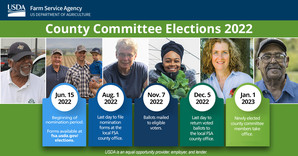
The U.S. Department of Agriculture (USDA) Farm Service Agency (FSA) county committees are a critical component of the day-to-day operations of FSA and allow grassroots input and local administration of federal farm programs.
Committees are comprised of locally elected agricultural producers responsible for the fair and equitable administration of FSA farm programs in their counties. Committee members are accountable to the Secretary of Agriculture. If elected, members become part of a local decision making and farm program delivery process.
A county committee is composed of three to 11 elected members from local administrative areas (LAA). Each member serves a three-year term. To be eligible for nomination and hold office as a committee member or alternate, a person must fulfill each of the following requirements: (1) be a producer with an interest in farming or ranching operations, (2) participate or cooperate in any FSA program provided for by law, (3) be a U.S. citizen, (4) be of legal voting age, (5) meet the basic eligibility requirements, and (6) reside in the county or multi-county jurisdiction in which they will be serving. A cooperating producer is someone who has provided information about their farming or ranching operation(s) but may not have applied or received FSA program benefits.
All nomination forms for the 2022 election must be postmarked or received in the local USDA Service Center by Aug. 1, 2022. For more information on FSA county committee elections and appointments, refer to the FSA fact sheet: Eligibility to Vote and Hold Office as a COC Member available online at: fsa.usda.gov/elections.
|

Accessing capital to begin, extend or support an agriculture operation can be especially challenging to new producers. Farm Service Agency’s “Beginning Farmer” direct and guaranteed loan programs provide an opportunity for qualified applicants to secure loans from funding set aside for producers who meet the following conditions:
- Has operated a farm for not more than 10 years
- Will materially and substantially participate in the operation of the farm
- Agrees to participate in a loan assessment, borrower training and financial management program sponsored by FSA
- Does not own a farm in excess of 30 percent of the county’s average size farm.
For more information contact, contact your local Parish USDA Service Center or visit fsa.usda.gov.
|
Agricultural producers and handlers who are certified organic, along with producers and handlers who are transitioning to organic production, can now apply for the U.S. Department of Agriculture’s (USDA) Organic and Transitional Education Certification Program (OTECP) and Organic Certification Cost Share Program (OCCSP), which help producers and handlers cover the cost of organic certification, along with other related expenses. Applications for OTECP and OCCSP are both due October 31, 2022.
OTECP covers:
- Certification costs for organic producers and handlers (25% up to $250 per category).
- Eligible expenses for transitional producers, including fees for pre-certification inspections and development of an organic system plan (75% up to $750).
- Registration fees for educational events (75% up to $200).
- Soil testing (75% up to $100).
Meanwhile, OCCSP covers 50% or up to $500 per category of certification costs in 2022.
This cost share for certification is available for each of these categories: crops, wild crops, livestock, processing/handling and State organic program fees.
Producers can receive cost share through both OTECP and OCCSP. Both OTECP and OCCSP cover costs incurred from October 1, 2021, to September 30, 2022. Producers have until October 31, 2022 to file applications, and FSA will make payments as applications are received.
To apply, producers and handlers should contact the Farm Service Agency (FSA) at their local USDA Service Center. As part of completing the OCCSP applications, producers and handlers will need to provide documentation of their organic certification and eligible expenses. Organic producers and handlers may also apply for OCCSP through participating State agencies.
Additional details can be found on the OTECP and OCCSP webpages.
USDA Reminds Louisiana Producers to File Crop Acreage Reports
Agricultural producers in Louisiana who have not yet completed their crop acreage reports after planting should make an appointment with their U.S. Department of Agriculture (USDA) Farm Service Agency (FSA) service center before the applicable deadline.
An acreage report documents a crop grown on a farm or ranch and its intended uses. Filing an accurate and timely acreage report for all crops and land uses, including failed acreage and prevented planted acreage, can prevent the loss of benefits.
How to File a Report
Acreage reporting dates vary by crop and by county. Contact your local FSA office for a list of acreage reporting deadlines by crop.
To file a crop acreage report, producers need to provide:
- Crop and crop type or variety.
- Intended use of the crop.
- Number of acres of the crop.
- Map with approximate boundaries for the crop.
- Planting date(s).
- Planting pattern, when applicable.
- Producer shares.
- Irrigation practice(s).
- Acreage prevented from planting, when applicable.
- Other information as required.
Acreage Reporting Details
The following exceptions apply to acreage reporting dates:
- If the crop has not been planted by the acreage reporting date, then the acreage must be reported no later than 15 calendar days after planting is completed.
- If a producer acquires additional acreage after the acreage reporting date, then the acreage must be reported no later than 30 calendar days after purchase or acquiring the lease. Appropriate documentation must be provided to the county office.
- If crops are covered by the Noninsured Crop Disaster Assistance Program, acreage reports should be submitted by the applicable state, county, or crop-specific reporting deadline or 15 calendar days before grazing or harvesting of the crop begins.
Producers should also report crop acreage they intended to plant, but due to natural disaster, were unable to because of a natural disaster.
Prevented planting acreage must be reported on form CCC-576, Notice of Loss, no later than 15 calendar days after the final planting date as established by FSA and USDA’s Risk Management Agency.
FSA offers continuous certification for perennial forage. This means after perennial forage is reported once and the producer elects continuous certification, the certification remains in effect until a change is made. Check with FSA at the local USDA Service Center for more information on continuous certification.
New Option to View, Print and Label Maps on Farmers.gov
Producers with an eAuth account linked to their USDA customer record can now access their FSA farm records, maps and common land units by logging into farmers.gov. A new feature will allow producers to export field boundaries as shapefiles and import and view other shapefiles, such as precision agriculture boundaries. This will allow producers to view, print and label their own maps for acreage reporting purposes.
Producers who have authority to act on behalf of another customer as a grantee via form FSA-211 Power of Attorney, Business Partner Signature Authority, along with other signature types, or as a member of a business can now access information in the farmers.gov portal.
Producers can learn how to use the farmers.gov Farm Records Mapping functionality with this fact sheet and these video tutorials.
More Information
Producers can make an appointment to report acres by contacting their local USDA Service Center.
Agriculture Secretary Tom Vilsack announced that to date, agricultural producers have already received more than $4 billion through the Emergency Relief Program (ERP), representing approximately 67% of the more than $6 billion projected to be paid through this first phase of the program. The U.S. Department of Agriculture (USDA) mailed out pre-filled applications in late May to producers with crop insurance who suffered losses due to natural disasters in 2020 and 2021. Commodity and specialty crop producers have until July 22 to complete applications.
USDA is implementing ERP and ELRP in two phases, with the first phase utilizing existing claim data to provide relief expediently, and the second phase focusing on ensuring producers not covered by other programs receive assistance. For phase one, USDA used crop insurance and Noninsured Crop Disaster Assistance Program (NAP) claim data.
Both ERP and the previously announced Emergency Livestock Relief Program (ELRP) are funded by the Extending Government Funding and Delivering Emergency Assistance Act, which President Biden signed into law in 2021. The law provided $10 billion to help agricultural producers impacted by wildfires, droughts, hurricanes, winter storms and other eligible disasters experienced during calendar years 2020 and 2021, of which $750 million is committed to livestock producers who experienced losses to drought or wildfire in calendar year 2021. Eligible livestock producers received ELRP payments totaling more than $590 million since the program was rolled out in late March.
Pre-Filled Applications
Eligible producers with eligible crop insurance claims have received pre-filled applications, which included eligibility requirements and payment calculations. Producers received a separate application form for each program year in which they experienced an eligible loss.
Producers should check with the Farm Service Agency (FSA) at their local USDA Service Center to confirm eligibility and to ensure that all required farm program participation, adjusted gross income and conservation compliance forms are on file. Producers who have previously participated in FSA programs likely have these required forms already on file.
ERP provisions allow for a higher payment percentage for historically underserved producers, including beginning, limited resource, socially disadvantaged and military veteran producers. To qualify for the higher payment rate, individuals must have a Form CCC-860, Socially Disadvantaged, Limited Resource, Beginning and Veteran Farmer or Rancher Certification on file.
To receive a payment, producers must complete and submit their forms by the July 22 deadline. Once the completed ERP application for payment is submitted to and signed by the FSA, producers enrolled in direct deposit should look for their payment within three business days.
Additional Assistance through Phase One
FSA will be sending pre-filled applications for about 9,000 eligible producers with NAP coverage in mid-July.
The Federal crop insurance data used to populate ERP phase one pre-filled applications included claim data on file with USDA’s Risk Management Agency (RMA) as of May 2, 2022. At that time, claim data for the Supplemental Coverage Option (SCO), Enhanced Coverage Option (ECO), Stacked Income Protection Plan (STAX), Margin Protection Plan (MP) or Area Risk Protection Insurance (ARPI) were not complete, so crop/units including these coverage options were not included in the pre-filled ERP application form. In late summer 2022, updated claim information will be used to generate a second pre-filled application for those crop/units with eligible losses on file with RMA not included in the first mailing.
More Information
ERP covers losses to crops, trees, bushes and vines due to a qualifying natural disaster event in calendar years 2020 and 2021. Eligible crops include all crops for which crop insurance or NAP coverage was available, except for crops intended for grazing. Qualifying natural disaster events include wildfires, hurricanes, floods, derechos, excessive heat, winter storms, freeze (including a polar vortex), smoke exposure, excessive moisture, qualifying drought and related conditions.
All producers who receive ERP phase one payments are statutorily required to purchase crop insurance or NAP coverage where crop insurance is not available for the next two available crop years.
Producers should contact their local Service Center if they have questions. Additionally, other resources include:
The second phase of both ERP and ELRP will be aimed at filling gaps and providing assistance to producers who did not participate in or receive payments through the existing programs that are being leveraged for phase one implementation. Through proactive communication and outreach, USDA will keep producers and stakeholders informed as program details are made available.

The Farm Service Agency (FSA) is accepting offers for specific conservation practices under the Conservation Reserve Program (CRP) Continuous Signup.
In exchange for a yearly rental payment, farmers enrolled in the program agree to remove environmentally sensitive land from agricultural production and to plant species that will improve environmental health and quality. The program’s long-term goal is to re-establish valuable land cover to improve water quality, prevent soil erosion, and reduce loss of wildlife habitat. Contracts for land enrolled in CRP are 10-15 years in length.
Under continuous CRP signup, environmentally sensitive land devoted to certain conservation practices can be enrolled in CRP at any time. Offers for continuous enrollment are not subject to competitive bidding during specific periods. Instead they are automatically accepted provided the land and producer meet certain eligibility requirements and the enrollment levels do not exceed the statutory cap.
For more information, including a list of acceptable practices, contact your local Parish USDA Service Center or visit fsa.usda.gov/crp.
|
The U.S. Department of Agriculture (USDA) is updating its farm loan programs to better support current borrowers, including historically underserved producers. These improvements are part of USDA’s commitment to increase equity in all programs, including farm loans that provide important access to capital for covering operating expenses and purchasing land and equipment.
The 2018 Farm Bill authorized FSA to provide equitable relief to certain direct loan borrowers, who are non-compliant with program requirements due to good faith reliance on a material action of, advice of, or non-action from an FSA official. Previously, borrowers may have been required to immediately repay the loan or convert it to a non-program loan with higher interest rates, less favorable terms, and limited loan servicing.
Now, FSA has additional flexibilities to assist borrowers in such situations. If the agency provided incorrect guidance to an existing direct loan borrower, the agency may provide equitable relief to that borrower. FSA may assist the borrower by allowing the borrower to keep their loans at current rates or other terms received in association with the loan which was determined to be noncompliant or the borrower may receive other equitable relief for the loan as the Agency determines to be appropriate.
USDA encourages producers to reach out to their local loan officials to ensure they fully understand the wide range of loan and servicing options available that can assist them in starting, expanding or maintaining their operation.
Additional Updates
Equitable relief is one of several changes authorized by the 2018 Farm Bill that USDA has made to the direct and guaranteed loan programs. Other changes that were previously implemented include:
- Modifying the existing three-year farming experience requirement for Direct Farm Ownership loans to include additional items as acceptable experience.
- Allowing socially disadvantaged and beginning farmer applicants to receive a guarantee equal to 95%, rather than the otherwise applicable 90% guarantee.
- Expanding the definition of and providing additional benefits to veteran farmers.
- Allowing borrowers who received restructuring with a write down to maintain eligibility for an Emergency loan.
- Expanding the scope of eligible issues and persons covered under the agricultural Certified Mediation Program.
Additional information on these changes is available in the March 8, 2022 rule on the Federal Register.
More Background
FSA has taken other recent steps to increase equity in its programs. Last summer, USDA announced it was providing $67 million in competitive loans through its new Heirs’ Property Relending Program to help agricultural producers and landowners resolve heirs’ land ownership and succession issues. FSA also invested $4.7 million to establish partnerships with organizations to provide outreach and technical assistance to historically underserved farmers and ranchers, which contributed to a fourfold increase in participation by historically underserved producers in the Coronavirus Food Assistance Program 2 (CFAP 2), a key pandemic assistance program, since April 2021.
Additionally, in January 2021, Secretary Vilsack announced a temporary suspension of past-due debt collection and foreclosures for distressed direct loan borrowers due to the economic hardship imposed by the COVID-19 pandemic.
Producers can explore available loan options using the Farm Loan Discover Tool on farmers.gov (also available in Spanish) or by contacting their local USDA Service Center. Service Center staff continue to work with agricultural producers via phone, email, and other digital tools. Due to the pandemic, some USDA Service Centers are open to limited visitors. Producers can contact their local Service Center to set up an in-person or phone appointment to discuss loan options.
|

Producers in certain Louisiana Parishes are eligible to apply for 2022 Livestock Forage Disaster Program (LFP) benefits on Annual Ryegrass, Full Season Improved Mixed, Full Season Improved Pasture, Long Season Small Grains, Native Pasture.
LFP provides compensation if you suffer grazing losses for covered livestock due to drought on privately owned or cash leased land or fire on federally managed land.
County committees can only accept LFP applications after notification is received by the National Office of qualifying drought or if a federal agency prohibits producers from grazing normal permitted livestock on federally managed lands due to qualifying fire. You must complete a CCC-853 and the required supporting documentation no later than January 30, 2023, for 2022 losses.
For additional information about LFP, including eligible livestock and fire criteria, contact the local Parish USDA Service Center or visit fsa.usda.gov.
|
In this Ask the Expert, Jack Carlile, Farm Loan Manager for the USDA Farm Service Agency (FSA), answers questions about farm operating loans and when producers should apply in order to secure funds for the current crop year.
As the Farm Loan Manager for the Cherokee County Service Center, Jack is responsible for managing the loan making and loan servicing activities for five counties in northeast Oklahoma. His office provides services for over 650 farm loan customers. Jack was raised on a cross bred cow/calf operation that his grandparents started. Over the years, each generation has added to the operation by purchasing additional pasture. The operation also grows and bales their own hay. Jack’s agriculture background and degree in agriculture economics from Oklahoma State University help him better understand the financing needs of his producers.
Who can apply for FSA Farm Loans?
Anyone can apply for FSA’s loan programs. Applications will be considered on basic eligibility requirements. To apply for a loan, you must meet the following general eligibility requirements including:
- Be a U.S. citizen or qualified alien.
- Operator of a family farm or ranch.
- Have a satisfactory credit history.
- Unable to obtain credit elsewhere at reasonable rates and terms to meet actual needs.
- Not be delinquent on any federal debts.
What can I purchase with operating loans?
Farm Operating Loans are traditionally used for purchasing capital items such as farm machinery, equipment, or livestock. Loan funds can also be used to help pay typical operating expenses for farming and ranching operations. For example, a rancher may use an operating loan to purchase forage for his cattle to feed them through the winter or a row crop producer may use an operating loan for paying for inputs like seed or fertilizer.
What is the maximum loan amount and terms?
The maximum loan amount for a Direct Farm Operating Loan is $400,000. Direct loans are made and serviced by FSA.
Producers can also apply for Guaranteed Operating Loans that are made by your commercial lender, and guaranteed against loss by FSA. The maximum loan amount for a Guaranteed Farm Operating Loan is $1,825,000. Loan terms for operating loans range from one to seven years.
How do I apply?
If you’re interested in applying for a farm loan, you can pick up an application by visiting your local FSA office. Visit farmers.gov to find the USDA Service Center nearest you.
When applying for a loan, you will need a business plan, which must include:
- Your mission, vision, and goals for your farm or ranch.
- Your current assets and liabilities.
- Marketing Plan (what your operation will produce and where you will market and sell your products.)
- Whether the amount of income your operation generates will be enough to pay your business and family living expenses.
When should I apply for an operating loan?
I would recommend beginning the application process a few months in advance of needing the funds to allow time for the request to be processed, and for any necessary security checks and searches to be completed. That allows time for the funds to be available for your use when most needed.
Where can I find more information?
To learn more about FSA loans visit farmers.gov/loans or fsa.usda.gov/farmloans. Fact sheets and application packages are also available at your USDA Service Center. To learn more about other types of FSA loans or to find the right loan for your operation, use the Farm Loan Discovery Tool by visiting farmers.gov/loans/farm-loan-discovery-tool.
When changes in farm ownership or operation take place, a farm reconstitution is necessary. The reconstitution — or recon — is the process of combining or dividing farms or tracts of land based on the farming operation.
To be effective for the current Fiscal Year (FY), farm combinations and farm divisions must be requested by August 1 of the FY for farms subject to the Agriculture Risk Coverage (ARC) and Price Loss Coverage (PLC) program. A reconstitution is considered to be requested when all of the required signatures are on FSA-155 and all other applicable documentation, such as proof of ownership, is submitted.
Total Conservation Reserve Program (CRP) and non-ARC/PLC farms may be reconstituted at any time.
The following are the different methods used when doing a farm recon:
-
Estate Method — the division of bases, allotments and quotas for a parent farm among heirs in settling an estate
-
Designation of Landowner Method — may be used when (1) part of a farm is sold or ownership is transferred; (2) an entire farm is sold to two or more persons; (3) farm ownership is transferred to two or more persons; (4) part of a tract is sold or ownership is transferred; (5) a tract is sold to two or more persons; or (6) tract ownership is transferred to two or more persons. In order to use this method, the land sold must have been owned for at least three years, or a waiver granted, and the buyer and seller must sign a Memorandum of Understanding
-
DCP Cropland Method — the division of bases in the same proportion that the DCP cropland for each resulting tract relates to the DCP cropland on the parent tract
-
Default Method — the division of bases for a parent farm with each tract maintaining the bases attributed to the tract level when the reconstitution is initiated in the system.
For questions on your farm reconstitution, contact your [NAME] County USDA Service Center at [XXX-XXX-XXXX].
Three-year loan terms: 3.000%
Five-year loan terms: 3.000%
Seven-year loan terms: 3.125 %
Ten-year loan terms: 3.000%
Twelve-year loan terms: 3.125 %
July 15- Acreage reporting deadline for most spring seeded crops.
Aug. 1– Deadline to request Farm reconstitutions
Aug. 1 - Last day to file County Committee nomination forms at your local USDA
Service Center
Aug. 5 – Producers may apply for CLEAR30 through August 5, 2022
Sept. 30- Last day to certify 2023 Crawfish
Oct. 31- Deadline to apply for Organic Certification Cost Share Program (OCCSP)
Oct. 31- Deadline to apply for Organic and Transitional Education and Certification
Program (OTECP)
Nov. 15 - Last day to certify Ryegrass
Dec. 15 - Last day to certify Fall seeded small grains
FSA now offers SMS texting; receive text message alerts on your cell phone regarding important deadlines, reporting requirements and updates. Call your local Service Center to schedule an appointment. You can find contact information at farmers.gov/service-locator.
|







